2021 RAM PROMASTER wheel torque
[x] Cancel search: wheel torquePage 7 of 288

5
SERVICING AND MAINTENANCE
SCHEDULED SERVICING .................................. 211Maintenance Plan......................................212
ENGINE COMPARTMENT .................................. 215
3.6L Engine ...............................................215Checking Oil Level......................................216
Adding Washer Fluid..................................217Maintenance-Free Battery .......................217
Pressure Washing ......................................217
VEHICLE MAINTENANCE ................................... 218
Engine Oil ...................................................218
Engine Oil Filter ..........................................219Engine Air Cleaner Filter ...........................219
Air Conditioner Maintenance ...................219Body Lubrication ........................................221
Windshield Wiper Blades .........................221
Exhaust System ........................................221
Cooling System ..........................................223Brake System ............................................226
Automatic Transmission ............................226
FUSES .........................................................228
BULB REPLACEMENT ................................235
TIRES .................................................................. 240
Tire Safety Information .............................240Tires — General Information .....................248Tire Types ...................................................252
Spare Tires — If Equipped .........................253
Wheel And Wheel Trim Care ....................255
Snow Traction Devices .............................257Tire Rotation Recommendations ..............258 DEPARTMENT OF TRANSPORTATION
UNIFORM TIRE QUALITY GRADES .................. 259
Treadwear .................................................. 259
Traction Grades ......................................... 259
Temperature Grades ................................. 259
STORING THE VEHICLE .....................................260
BODYWORK ........................................................ 260
Protection From Atmospheric Agents....... 260
Body And Underbody Maintenance .......... 260Preserving The Bodywork .......................... 261
INTERIORS ......................................................... 261
Seats And Fabric Parts .............................. 261
Plastic And Coated Parts ........................... 262
Leather Surfaces ....................................... 263Glass Surfaces .......................................... 263Cleaning The Instrument Panel
Cupholders ................................................. 263
TECHNICAL SPECIFICATIONS
VEHICLE IDENTIFICATION NUMBER.................264
BRAKE SYSTEM .................................................. 264
WHEEL AND TIRE TORQUE SPECIFICATIONS .... 264
Torque Specifications ................................ 264
FUEL REQUIREMENTS .......................................265
3.6L Engine ................................................ 265
Reformulated Gasoline ............................ 266
Materials Added To Fuel ........................... 266
Gasoline/Oxygenate Blends ..................... 266Do Not Use E-85 In Non-Flex Fuel
Vehicles ...................................................... 266
CNG And LP Fuel System Modifications ..... 267
MMT In Gasoline........................................ 267
Fuel System Cautions................................ 267
FLUID CAPACITIES ............................................. 268
ENGINE FLUIDS AND LUBRICANTS ................. 268
CHASSIS FLUIDS AND LUBRICANTS ............... 270
CUSTOMER ASSISTANCE
SUGGESTIONS FOR OBTAINING SERVICE
FOR YOUR VEHICLE .......................................... 271 Prepare For The Appointment .................. 271Prepare A List............................................. 271
Be Reasonable With Requests ................. 271
IF YOU NEED ASSISTANCE .............................. 271
FCA US LLC Customer Center ................... 272
FCA Canada Inc. Customer Center ........... 272
Mexico ........................................................ 272
Puerto Rico And US Virgin Islands ............ 272
Customer Assistance For The Hearing Or
Speech Impaired (TDD/TTY) ..................... 272 Service Contract ....................................... 272
WARRANTY INFORMATION .............................. 273
MOPAR PARTS .................................................. 273
REPORTING SAFETY DEFECTS ........................ 273 In The 50 United States And
Washington, D.C. ....................................... 273 In Canada ................................................... 273
PUBLICATION ORDER FORMS ........................ 274
General Information.......................................... 274
21_VF_OM_EN_USC_t.book Page 5
Page 154 of 288

152SAFETY
ESC Partial Off
This mode is entered by momentarily pushing
the ESC OFF button.
When in the “Partial Off” mode, the TCS portion
of ESC, except for the “limited slip” feature
described in the TCS section, has been disabled
and the ESC OFF Indicator Light will be
illuminated. When in the “Partial Off” mode,
ESC will operate without engine torque
management. This mode is intended to be used
if the vehicle is in deep snow, sand or gravel
conditions and more wheel spin than ESC would
normally allow is required to gain traction.
To turn ESC on again, momentarily push the
ESC OFF button. This will restore the normal
“ESC On” mode of operation. NOTE:
To improve the vehicle's traction when driving
with snow chains, or starting off in deep snow,
sand or gravel, it may be desirable to switch to
the “Partial Off” mode by pushing the ESC OFF
button. Once the situation requiring ESC to be
switched to the “Partial Off” mode is overcome,
turn ESC back on by momentarily pushing the
ESC OFF button. This may be done while the
vehicle is in motion.ESC Activation/Malfunction Indicator Light
And ESC OFF Indicator Light
The ESC Activation/Malfunction
Indicator Light in the instrument
cluster will come on when the ignition
is turned to the ON mode. It should go
out with the engine running. If the ESC
Activation/Malfunction Indicator Light comes
on continuously with the engine running, a
malfunction has been detected in the ESC
system. If this light remains on after several
ignition cycles, and the vehicle has been driven
several miles (kilometers) at speeds greater
than 30 mph (48 km/h), see an authorized
dealer as soon as possible to have the problem
diagnosed and corrected.
The ESC Activation/Malfunction Indicator Light
starts to flash as soon as the tires lose traction
and the ESC system becomes active. The ESC
Activation/Malfunction Indicator Light also
flashes when TCS is active. If the ESC
Activation/Malfunction Indicator Light begins to
flash during acceleration, ease up on the
accelerator and apply as little throttle as
possible. Be sure to adapt your speed and
driving to the prevailing road conditions.
WARNING!
When in “Partial Off” mode, the TCS func -
tionality of ESC, (except for the limited slip
feature described in the TCS section), has
been disabled and the ESC OFF Indicator
Light will be illuminated. When in “Partial
Off” mode, the engine power reduction
feature of TCS is disabled, and the
enhanced vehicle stability offered by the
ESC system is reduced.
Trailer Sway Control (TSC) is disabled when
the ESC system is in the “Partial Off” mode.
21_VF_OM_EN_USC_t.book Page 152
Page 156 of 288

154SAFETY
Towing With HSA
HSA will also provide assistance to mitigate roll
back while towing a trailer.
Traction Control System (TCS)
TCS monitors the amount of wheel spin of each
of the driven wheels. If wheel spin is detected,
brake pressure is applied to the slipping
wheel(s) and engine power is reduced, to
provide enhanced acceleration and stability. A
feature of the TCS, Brake Limited Differential
(BLD), functions similarly to a limited slip
differential and controls the wheel spin across a
driven axle. If one wheel on a driven axle is
spinning faster than the other, the system will
apply the brake of the spinning wheel. This will
allow more engine torque to be applied to the
wheel that is not spinning. This feature remains
active even if the ESC is in the “Partial Off”
mode.
The ESC Activation/Malfunction Indicator Light
(in the instrument cluster) will start to flash as
soon as the tires lose traction and the wheels
begin to spin. This indicates that the TCS is
active. If the indicator light flashes during
acceleration, ease up on the accelerator and
apply as little throttle as possible. Be sure to
adapt your speed and driving to the prevailing
road conditions, and do not switch off the ESC
or TCS.
Trailer Sway Control (TSC) — If Equipped
TSC uses sensors in the vehicle to recognize an
excessively swaying trailer and will take the
appropriate actions to attempt to stop the sway.
The system may reduce engine power and apply
the brake of the appropriate wheel(s) to
counteract the sway of the trailer.
WARNING!
If you use a trailer brake controller with your
trailer, the trailer brakes may be activated
and deactivated with the brake switch. If
so, there may not be enough brake pres -
sure to hold both the vehicle and the trailer
on a hill when the brake pedal is released.
In order to avoid rolling down an incline
while resuming acceleration, manually acti -
vate the trailer brake or apply more vehicle
brake pressure prior to releasing the brake
pedal.
HSA is not a parking brake. Always apply
the parking brake fully when exiting your
vehicle. Also, be certain to place the trans -
mission in PARK.
Failure to follow these warnings can result
in a collision or serious personal injury.
WARNING!
The TCS cannot prevent the natural laws of
physics from acting on the vehicle, nor can
it increase the traction afforded.
The TCS cannot prevent collisions,
including those resulting from excessive
speed in turns, or hydroplaning.
The capabilities of a TCS-equipped vehicle
must never be exploited in a reckless or
dangerous manner, which could jeopardize
the user's safety or the safety of others.
21_VF_OM_EN_USC_t.book Page 154
Page 266 of 288
264
TECHNICAL SPECIFICATIONS
VEHICLE IDENTIFICATION NUMBER
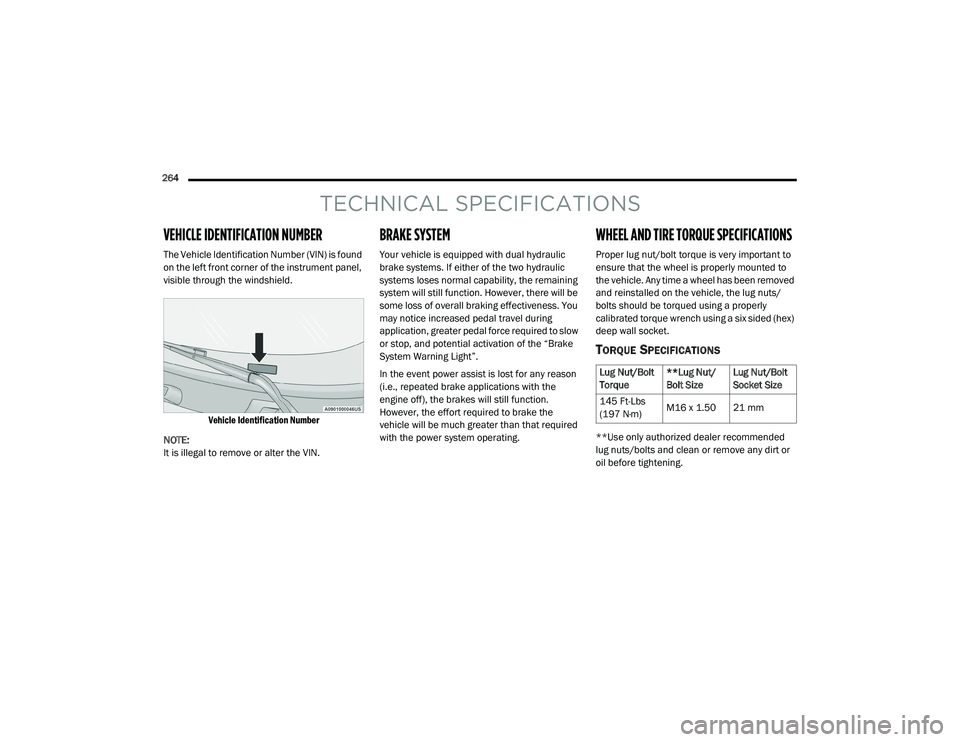
The Vehicle Identification Number (VIN) is found
on the left front corner of the instrument panel,
visible through the windshield.
Vehicle Identification Number
NOTE:
It is illegal to remove or alter the VIN.
BRAKE SYSTEM
Your vehicle is equipped with dual hydraulic
brake systems. If either of the two hydraulic
systems loses normal capability, the remaining
system will still function. However, there will be
some loss of overall braking effectiveness. You
may notice increased pedal travel during
application, greater pedal force required to slow
or stop, and potential activation of the “Brake
System Warning Light”.
In the event power assist is lost for any reason
(i.e., repeated brake applications with the
engine off), the brakes will still function.
However, the effort required to brake the
vehicle will be much greater than that required
with the power system operating.
WHEEL AND TIRE TORQUE SPECIFICATIONS
Proper lug nut/bolt torque is very important to
ensure that the wheel is properly mounted to
the vehicle. Any time a wheel has been removed
and reinstalled on the vehicle, the lug nuts/
bolts should be torqued using a properly
calibrated torque wrench using a six sided (hex)
deep wall socket.
TORQUE SPECIFICATIONS
**Use only authorized dealer recommended
lug nuts/bolts and clean or remove any dirt or
oil before tightening.
Lug Nut/Bolt
Torque **Lug Nut/
Bolt SizeLug Nut/Bolt
Socket Size
145 Ft-Lbs
(197 N·m) M16 x 1.50 21 mm
21_VF_OM_EN_USC_t.book Page 264
Page 267 of 288

TECHNICAL SPECIFICATIONS265
Inspect the wheel mounting surface prior to
mounting the tire and remove any corrosion or
loose particles.
Wheel Mounting Surface
Tighten the lug nuts/bolts in a star pattern until
each nut/bolt has been tightened twice. Ensure
that the socket is fully engaged on the lug nut/
bolt (do not insert it halfway).
Torque Patterns
After 25 miles (40 km), check the lug nut/bolt torque to be sure that all the lug nuts/bolts are
properly seated against the wheel.FUEL REQUIREMENTS
While operating on gasoline with the required
octane number, hearing a light knocking sound
from the engine is not a cause for concern.
However, if the engine is heard making a heavy
knocking sound, see a dealer immediately. Use
of gasoline with a lower than recommended
octane number can cause engine failure and
may void or not be covered by the New Vehicle
Limited Warranty.
Poor quality gasoline can cause problems such
as hard starting, stalling, and hesitations. If you
experience these symptoms, try another brand
of gasoline before considering service for the
vehicle.
3.6L ENGINE
This engine is designed to meet all
emissions regulations and provide
optimum fuel economy and
performance when using high quality
unleaded “Regular” gasoline having a posted
octane number of 87 as specified by the (R+M)/
2 method. The use of higher octane “Premium”
gasoline is not required, as it will not provide
any benefit over “Regular” gasoline in these
engines.
WARNING!
To avoid the risk of forcing the vehicle off the
jack, do not tighten the lug nuts/bolts fully
until the vehicle has been lowered. Failure to
follow this warning may result in personal
injury.
9
21_VF_OM_EN_USC_t.book Page 265
Page 283 of 288

281
Storing Your Vehicle
...................................... 260Supplemental Restraint System – Air Bag..... 174Sway Control, Trailer...................................... 154Synthetic Engine Oil....................................... 218
T
Telescoping Steering Column.......................... 15Tire And Loading Information Placard........... 245Tire Markings................................................. 240Tire Safety Information.................................. 240Tire Service Kit.................. 197, 198, 200, 202Tires................................... 188, 248, 253, 259Aging (Life Of Tires)................................... 251Air Pressure............................................... 248Chains....................................................... 257Changing................................................... 190Compact Spare......................................... 253General Information........................ 248, 253High Speed................................................ 249Inflation Pressure...................................... 249Jacking...................................................... 190Life Of Tires............................................... 251Load Capacity............................................ 245Pressure Monitoring System (TPMS)............................... 51, 161Quality Grading.......................................... 259Radial........................................................ 250Replacement............................................. 251Rotation.................................................... 258
Safety.............................................. 240, 248Sizes......................................................... 241Snow Tires................................................ 253Spare Tires...................................... 253, 255Spinning................................................... 250Trailer Towing.............................................. 82Tread Wear Indicators.............................. 251Wheel Nut Torque..................................... 264To Open Hood.................................................. 40Tongue Weight/Trailer Weight......................... 81Torque Converter Clutch.................................. 66Towing....................................................78, 209Disabled Vehicle....................................... 209Guide........................................................... 81Recreational................................................ 85Weight......................................................... 81Towing Behind A Motorhome........................... 85Traction............................................................ 86Traction Control............................................ 154Trailer Sway Control (TSC)............................. 154Trailer Towing.................................................. 78Hitches........................................................ 80Minimum Requirements.............................. 81Tips.............................................................. 84Trailer And Tongue Weight........................... 81Wiring.......................................................... 83Trailer Towing Guide........................................ 81Trailer Weight................................................... 81
TransmissionAutomatic.......................................... 60, 226Fluid.......................................................... 270Maintenance............................................ 226Transporting Pets.......................................... 187Tread Wear Indicators................................... 251Turn Signals.....................................................54
U
UconnectPhone Call Features
................................. 118Things You Should Know About YourUconnect Phone................................... 121Uconnect Phone..........................113, 114, 116Answer Or Ignore An Incoming Call — Call Currently In Progress..................... 120Answer Or Ignore An Incoming Call —No Call Currently In Progress................ 119Bluetooth Communication Link................ 124Call Continuation...................................... 121Call Controls............................................. 119Call Termination....................................... 121Cancel Command..................................... 114Connecting To A Particular Mobile Phone Or Audio Device After Pairing................ 116Help Command......................................... 114Join Calls.................................................. 12111
21_VF_OM_EN_USC_t.book Page 281