2021 RAM PROMASTER warning
[x] Cancel search: warningPage 261 of 288

SERVICING AND MAINTENANCE259
DEPARTMENT OF TRANSPORTATION
UNIFORM TIRE QUALITY GRADES
The following tire grading categories
were established by the National
Highway Traffic Safety Administration.
The specific grade rating assigned by the
tire's manufacturer in each category is
shown on the sidewall of the tires on
your vehicle.
All passenger vehicle tires must conform
to Federal safety requirements in
addition to these grades.
TREADWEAR
The Treadwear grade is a comparative
rating, based on the wear rate of the tire
when tested under controlled conditions on
a specified government test course. For
example, a tire graded 150 would wear one
and one-half times as well on the
government course as a tire graded 100.
The relative performance of tires depends
upon the actual conditions of their use,
however, and may depart significantly from the norm due to variations in driving habits,
service practices, and differences in road
characteristics and climate.
TRACTION GRADES
The Traction grades, from highest to
lowest, are AA, A, B, and C. These grades
represent the tire's ability to stop on wet
pavement, as measured under
controlled conditions on specified
government test surfaces of asphalt and
concrete. A tire marked C may have poor
traction performance.
TEMPERATURE GRADES
The Temperature grades are A (the
highest), B, and C, representing the tire's
resistance to the generation of heat and
its ability to dissipate heat, when tested
under controlled conditions on a
specified indoor laboratory test wheel.
Sustained high temperature can cause
the material of the tire to degenerate
and reduce tire life, and excessive
temperature can lead to sudden tire
failure. The grade C corresponds to a
level of performance, which all
passenger vehicle tires must meet
under the Federal Motor Vehicle Safety
Standard No. 109. Grades B and A
represent higher levels of performance
on the laboratory test wheel, than the
minimum required by law.
WARNING!
The traction grade assigned to this tire is
based on straight-ahead braking traction
tests, and does not include acceleration,
cornering, hydroplaning, or peak traction
characteristics.
WARNING!
The temperature grade for this tire is
established for a tire that is properly inflated
and not overloaded. Excessive speed,
underinflation, or excessive loading, either
separately or in combination, can cause heat
buildup and possible tire failure.
8
21_VF_OM_EN_USC_t.book Page 259
Page 263 of 288

SERVICING AND MAINTENANCE261
(Continued)
PRESERVING THE BODYWORK
Washing
Wash your vehicle regularly. Always wash
your vehicle in the shade using Mopar Car
Wash, or a mild car wash soap, and rinse the
panels completely with water.
If insects, tar, or other similar deposits have
accumulated on your vehicle, use Mopar
Super Kleen Bug and Tar Remover to
remove.
Use a high quality cleaner wax, such as
Mopar Cleaner Wax to remove road film,
stains and to protect your paint finish. Use
precautions to not scratch the paint.
Avoid using abrasive compounds and power
buffing that may diminish the gloss or thin
out the paint finish.
Special Care
If you drive on salted or dusty roads or if you
drive near the ocean, hose off the undercar -
riage at least once a month.
It is important that the drain holes in the
lower edges of the doors, rocker panels, and
trunk be kept clear and open.
If you detect any stone chips or scratches in
the paint, touch them up immediately.
If your vehicle is damaged due to a collision
or similar cause that destroys the paint and
protective coating, have your vehicle repaired
as soon as possible.
If you carry special cargo such as chemicals,
fertilizers, de-icer salt, etc., be sure that such
materials are well packaged and sealed.
If a lot of driving is done on gravel roads,
consider mud or stone shields behind each
wheel.
Use Mopar Touch Up Paint on scratches as
soon as possible. An authorized dealer has
touch up paint to match the color of your
vehicle.
INTERIORS
SEATS AND FABRIC PARTS
Use Mopar Total Clean to clean fabric
upholstery and carpeting.
CAUTION!
Do not use abrasive or strong cleaning
materials such as steel wool or scouring
powder that will scratch metal and painted
surfaces.
Use of power washers exceeding 1,200 psi
(8,274 kPa) can result in damage or
removal of paint and decals.
CAUTION! (Continued)
WARNING!
Do not use volatile solvents for cleaning
purposes. Many are potentially flammable,
and if used in closed areas they may cause
respiratory harm.
8
21_VF_OM_EN_USC_t.book Page 261
Page 264 of 288

262SERVICING AND MAINTENANCE
Stain Repel Fabric Cleaning Procedure — If
Equipped
Stain Repel seats may be cleaned in the
following manner:
Remove as much of the stain as possible by
blotting with a clean, dry towel.
Blot any remaining stain with a clean, damp
towel.
For tough stains, apply Mopar Total Clean, or
a mild soap solution to a clean, damp cloth
and remove stain. Use a fresh, damp towel to
remove soap residue.
For grease stains, apply Mopar Multi-Purpose
Cleaner to a clean, damp cloth and remove
stain. Use a fresh, damp towel to remove
soap residue.
Do not use any harsh solvents or any other
form of protectants on Stain Repel products.
Seat Belt Maintenance
Do not bleach, dye or clean the belts with
chemical solvents or abrasive cleaners. This will
weaken the fabric.
If the belts need cleaning, use a mild soap
solution or lukewarm water. Do not remove the
belts from the vehicle to wash them. Dry with a
soft cloth.
Sun damage can also weaken the fabric.
Replace the belts if they appear frayed or worn
or if the buckles do not work properly.
PLASTIC AND COATED PARTS
Use Mopar Total Clean to clean vinyl upholstery.
Cleaning Plastic Instrument Cluster
Lenses
The lenses in front of the instruments in this
vehicle are molded in clear plastic. When
cleaning the lenses, care must be taken to
avoid scratching the plastic.
Clean with a wet soft cloth. A mild soap solution
may be used, but do not use high alcohol
content or abrasive cleaners. If soap is used,
wipe clean with a clean damp cloth. Dry with a
soft cloth.
WARNING!
A frayed or torn belt could rip apart in a
collision and leave you with no protection.
Inspect the belt system periodically, checking
for cuts, frays, or loose parts. Damaged parts
must be replaced immediately. Do not
disassemble or modify the system. Seat belt
assemblies must be replaced after a collision
if they have been damaged (i.e., bent
retractor, torn webbing, etc.).
CAUTION!
Direct contact of air fresheners, insect
repellents, suntan lotions, or hand sani -
tizers to the plastic, painted, or decorated
surfaces of the interior may cause perma -
nent damage. Wipe away immediately.
Damage caused by these type of products
may not be covered by your New Vehicle
Limited Warranty.
21_VF_OM_EN_USC_t.book Page 262
Page 266 of 288
264
TECHNICAL SPECIFICATIONS
VEHICLE IDENTIFICATION NUMBER
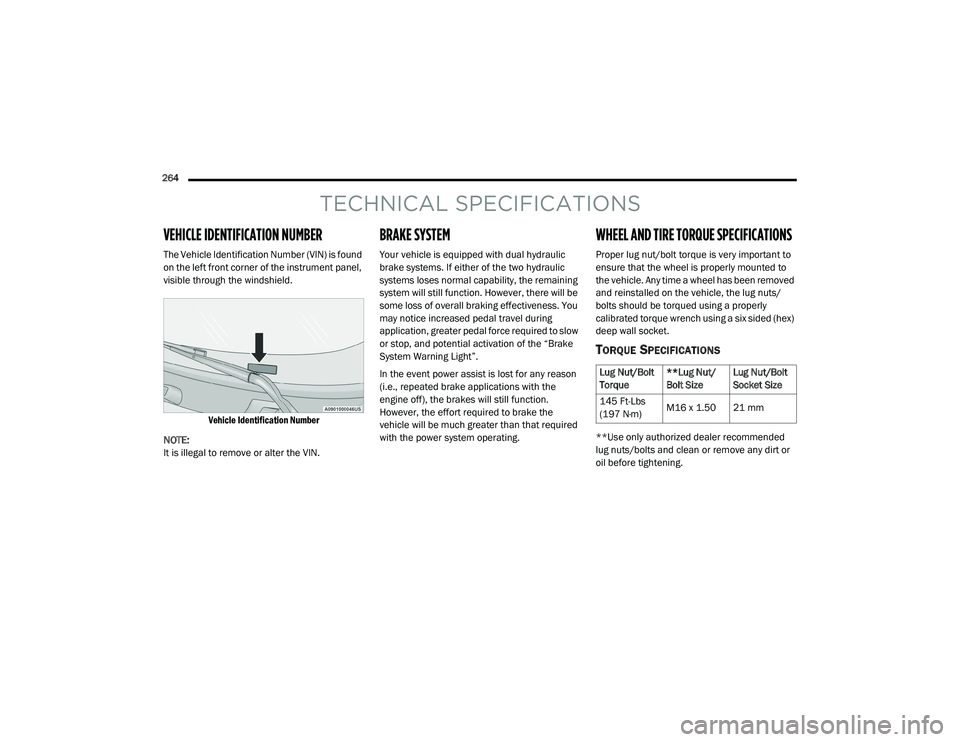
The Vehicle Identification Number (VIN) is found
on the left front corner of the instrument panel,
visible through the windshield.
Vehicle Identification Number
NOTE:
It is illegal to remove or alter the VIN.
BRAKE SYSTEM
Your vehicle is equipped with dual hydraulic
brake systems. If either of the two hydraulic
systems loses normal capability, the remaining
system will still function. However, there will be
some loss of overall braking effectiveness. You
may notice increased pedal travel during
application, greater pedal force required to slow
or stop, and potential activation of the “Brake
System Warning Light”.
In the event power assist is lost for any reason
(i.e., repeated brake applications with the
engine off), the brakes will still function.
However, the effort required to brake the
vehicle will be much greater than that required
with the power system operating.
WHEEL AND TIRE TORQUE SPECIFICATIONS
Proper lug nut/bolt torque is very important to
ensure that the wheel is properly mounted to
the vehicle. Any time a wheel has been removed
and reinstalled on the vehicle, the lug nuts/
bolts should be torqued using a properly
calibrated torque wrench using a six sided (hex)
deep wall socket.
TORQUE SPECIFICATIONS
**Use only authorized dealer recommended
lug nuts/bolts and clean or remove any dirt or
oil before tightening.
Lug Nut/Bolt
Torque **Lug Nut/
Bolt SizeLug Nut/Bolt
Socket Size
145 Ft-Lbs
(197 N·m) M16 x 1.50 21 mm
21_VF_OM_EN_USC_t.book Page 264
Page 267 of 288

TECHNICAL SPECIFICATIONS265
Inspect the wheel mounting surface prior to
mounting the tire and remove any corrosion or
loose particles.
Wheel Mounting Surface
Tighten the lug nuts/bolts in a star pattern until
each nut/bolt has been tightened twice. Ensure
that the socket is fully engaged on the lug nut/
bolt (do not insert it halfway).
Torque Patterns
After 25 miles (40 km), check the lug nut/bolt torque to be sure that all the lug nuts/bolts are
properly seated against the wheel.FUEL REQUIREMENTS
While operating on gasoline with the required
octane number, hearing a light knocking sound
from the engine is not a cause for concern.
However, if the engine is heard making a heavy
knocking sound, see a dealer immediately. Use
of gasoline with a lower than recommended
octane number can cause engine failure and
may void or not be covered by the New Vehicle
Limited Warranty.
Poor quality gasoline can cause problems such
as hard starting, stalling, and hesitations. If you
experience these symptoms, try another brand
of gasoline before considering service for the
vehicle.
3.6L ENGINE
This engine is designed to meet all
emissions regulations and provide
optimum fuel economy and
performance when using high quality
unleaded “Regular” gasoline having a posted
octane number of 87 as specified by the (R+M)/
2 method. The use of higher octane “Premium”
gasoline is not required, as it will not provide
any benefit over “Regular” gasoline in these
engines.
WARNING!
To avoid the risk of forcing the vehicle off the
jack, do not tighten the lug nuts/bolts fully
until the vehicle has been lowered. Failure to
follow this warning may result in personal
injury.
9
21_VF_OM_EN_USC_t.book Page 265
Page 275 of 288

CUSTOMER ASSISTANCE273
WARRANTY INFORMATION
See the Warranty Information for the terms and
provisions of FCA US LLC warranties applicable
to this vehicle and market. Refer to
www.mopar.com/om for further information.
MOPAR PARTS
Mopar original equipment parts and
accessories and factory filled fluids are
available from an authorized dealer. They are
recommended for your vehicle to keep it
operating at its best and maintain its original
condition.
REPORTING SAFETY DEFECTS
IN THE 50 UNITED STATES AND
W
ASHINGTON, D.C.
If you believe that your vehicle has a
defect that could cause a crash or cause
injury or death, you should immediately
inform the National Highway Traffic
Safety Administration (NHTSA) in
addition to notifying FCA US LLC.
If NHTSA receives similar complaints, it
may open an investigation, and if it finds
that a safety defect exists in a group of
vehicles, it may order a recall and
remedy campaign. However, NHTSA
cannot become involved in individual
problems between you, an authorized
dealer, or FCA US LLC. To contact NHTSA, you may call the
Vehicle Safety Hotline toll free at
1-888-327-4236 (TTY:
1-800-424-9153); or go to
http://www.safercar.gov; or write to:
Administrator, NHTSA, 1200 New Jersey
Avenue, SE., West Building,
Washington, D.C. 20590. You can also
obtain other information about motor
vehicle safety from
http://www.safercar.gov.
IN CANADA
If you believe that your vehicle has a
safety defect, you should contact the
Customer Service Department
immediately. Canadian customers who
wish to report a safety defect to the
Canadian government should contact
Transport Canada, Motor Vehicle Defect
Investigations and Recalls at
1-800-333-0510 or go to
wwwapps.tc.gc.ca/Saf-Sec-Sur/7/
PCDB-BDPP.
WARNING!
Engine exhaust (internal combustion engines
only), some of its constituents, and certain
vehicle components contain, or emit,
chemicals known to the State of California to
cause cancer and birth defects, or other
reproductive harm. In addition, certain fluids
contained in vehicles and certain products of
component wear contain, or emit, chemicals
known to the State of California to cause
cancer and birth defects, or other
reproductive harm.
10
21_VF_OM_EN_USC_t.book Page 273
Page 277 of 288

275
INDEX
A
Adding Engine Coolant (Antifreeze)............... 224Adding Washing Fluid.................................... 217Additives, Fuel............................................... 266Advance Phone Connectivity......................... 121Air Bag........................................................... 174Air Bag Operation...................................... 175Air Bag Warning Light................................ 173Enhanced Accident Response...................210Event Data Recorder (EDR)....................... 210If Deployment Occurs................................ 178Maintaining Your Air Bag System.............. 179Maintenance............................................. 179Side Air Bags............................................. 175Transporting Pets...................................... 187Air Bag Light..................................48, 173, 187Air Cleaner, Engine
(Engine Air Cleaner Filter).............................. 219Air Conditioner Maintenance......................... 219Air Conditioner Refrigerant.................. 219, 220Air Conditioner System.................................. 219Air Conditioning Filter............................. 35, 220Air Conditioning, Operating Tips................ 34, 35Air Filter......................................................... 219Air PressureTires.......................................................... 249
AlarmSecurity Alarm...................................... 13, 50Alarm SystemSecurity Alarm............................................. 13Alterations/ModificationsVehicle........................................................... 7Antifreeze (Engine Coolant)................. 223, 268Disposal................................................... 225Anti-Lock Brake System (ABS)...................... 149Anti-Lock Warning Light................................... 53Assist, Hill Start............................................. 153Audio Settings............................................... 107Audio Systems (Radio)..................................... 88Auto Down Power Windows............................. 39Auto Up Power Windows.................................. 39Automatic Door Locks...................................... 15Automatic Transmission.........................60, 227Adding Fluid.............................................. 227Fluid And Filter Change............................ 227Fluid Change............................................ 227Fluid Level Check............................ 226, 227Fluid Type........................................ 226, 270Special Additives...................................... 227AUX Cord.......................................................... 37Auxiliary Driving Systems.............................. 155
B
Battery................................................... 48, 217Charging System Light.................................48Keyless Key Fob Replacement....................11Belts, Seat.................................................... 187Blind Spot Monitoring................................... 155BluetoothConnecting To A Particular Mobile PhoneOr Audio Device After Pairing
................ 116Body Builders Guide........................................... 7Body Mechanism Lubrication........................ 221B-Pillar Location............................................ 245Brake Assist System..................................... 150Brake Control System, Electronic.................. 150Brake Fluid........................................... 226, 270Brake System....................................... 226, 264Anti-Lock (ABS)......................................... 149Fluid Check............................................... 226Master Cylinder........................................ 226Parking........................................................59Warning Light...............................................49Brake, Parking.................................................59Brake/Transmission Interlock..........................60Bulb Replacement........................................ 235Bulbs, Light.......................................... 188, 23511
21_VF_OM_EN_USC_t.book Page 275
Page 278 of 288

276 C
Camera, Rear
.................................................. 73Capacities, Fluid............................................ 268Caps, Filler Fuel............................................................. 75Oil (Engine)................................................ 215Power Steering............................................ 67Radiator (Coolant Pressure)...................... 224Car Washes................................................... 261Carbon Monoxide Warning............................ 189Cargo Area Cover............................................. 41Cargo Compartment........................................ 41Cargo Light...................................................... 28Certification Label........................................... 76Change Oil Indicator........................................ 45Changing A Flat Tire....................................... 190Chart, Tire Sizing............................................ 241Check Engine Light
(Malfunction Indicator Light)........................... 56Checking Your Vehicle For Safety.................. 186Checks, Safety............................................... 186Child Restraint............................................... 181Child RestraintsBooster Seats............................................ 184Child Seat Installation............................... 186Infant And Child Restraints....................... 183Older Children And Child Restraints..........183Clean Air Gasoline......................................... 266CleaningWheels...................................................... 255
Climate Control................................................ 31Manual........................................................ 31Rear............................................................. 34Cold Weather Operation.................................. 57Compact Spare Tire...................................... 253Contract, Service.......................................... 272Cooling Pressure Cap (Radiator Cap)............ 224Cooling System............................................. 223Adding Coolant (Antifreeze)...................... 224Coolant Level................................... 223, 225Cooling Capacity....................................... 268Disposal Of Used Coolant......................... 225Drain, Flush, And Refill............................. 223Inspection................................................. 225Points To Remember................................ 225Pressure Cap............................................ 224Radiator Cap............................................ 224Selection Of Coolant (Antifreeze)..... 223, 268Corrosion Protection..................................... 260Cruise Control (Speed Control)........................ 67Cruise Light...................................................... 54Cupholders................................................... 263Customer Assistance.................................... 271Customer Programmable Features.................. 89Cybersecurity................................................... 88
D
Dealer Service.............................................. 218Defroster, Windshield................................... 187Deleting A Phone.......................................... 117
Diagnostic System, Onboard............................55Dimmer Control Switch....................................29Dimmer SwitchHeadlight.....................................................26DipsticksAutomatic Transmission........................... 227Oil (Engine)............................................... 216Power Steering............................................67Disable Vehicle Towing................................. 209Disconnecting............................................... 117DisposalAntifreeze (Engine Coolant)...................... 225Disturb.......................................................... 120Door Ajar..........................................................49Door Ajar Light.................................................49Door Locks.......................................................14Automatic....................................................15Doors...............................................................14Driver’s Seat Back Tilt......................................15DrivingThrough Flowing, Rising, Or Shallow Standing Water
..........................86
E
Electric Brake Control System....................... 150Electric Remote Mirrors...................................24Electrical Power Outlets...................................37Electronic Speed Control (Cruise Control)........67Electronic Stability Control (ESC)................... 150Electronic Throttle Control Warning Light.........49
21_VF_OM_EN_USC_t.book Page 276