2021 NISSAN LEAF window
[x] Cancel search: windowPage 472 of 602
• Drive at a constant speed. Maintain cruis-ing speeds with a constant accelerator
position or by using cruise control when
appropriate.
• Accelerate slowly and smoothly. Gently press and release the accelerator pedal
for acceleration and deceleration.
• Drive at moderate speeds on the highway.
• Avoid frequent stopping and braking. Maintain a safe distance behind other
vehicles.
• Turn off the air conditioner/heater when it is not necessary.
• Select a moderate temperature setting for heating or cooling to help reduce
power consumption.
• Use the air conditioner/heater and close windows to reduce drag when cruising at
a highway speed. • Release the accelerator pedal to slow
down and do not apply the brakes when
traffic and road conditions allow.– This vehicle is equipped with a regen- erative brake system. The primary pur-
pose of the regenerative brake system
is to provide some power to recharge
the Li-ion battery and extend driving
range. A secondary benefit is “engine
braking” that operates based on Li-ion
battery conditions. In the D (Drive) posi-
tion, when the accelerator pedal is re-
leased, the regenerative brake system
provides some deceleration and some
power to the Li-ion battery. The ECO Drive Report appears for approxi-
mately 30 seconds af ter placing the power
switch in the OFF position, driving the ve-
hicle for more than 0.3 miles (500 m), and
pressing the
button on the steering
wheel.
ECO DRIVE REPORT
Starting and driving5-153
Page 489 of 602

TIRE EQUIPMENT
SUMMER tires have a tread designed to
provide superior performance on dry
pavement. However, the performance of
these tires will be substantially reduced in
snowy and icy conditions. If you operate
your vehicle on snowy or icy roads, NISSAN
recommends the use of MUD & SNOW or
ALL SEASON tires on all four wheels. It is
recommended that you visit a NISSAN cer-
tified LEAF dealer for the tire type, size,
speed rating and availability information.
For additional traction on icy roads, stud-
ded tires may be used. However, some U.S.
states and Canadian provinces prohibit
their use. Check local, state and provincial
laws before installing studded tires.
Skid and traction capabilities of studded
snow tires, on wet or dry surfaces, may
be poorer than that of non-studded
snow tires.
Tire chains may be used. For additional in-
formation, see “Tire chains” (P. 8-33).
SPECIAL WINTER EQUIPMENT
It is recommended that the following items
be carried in the vehicle during winter:
• A scraper and stiff-bristled brush to re-move ice and snow from the windows
and wiper blades.
• A shovel to dig the vehicle out of snow-drif ts.
• Extra windshield-washer fluid to refill the reservoir tank.
DRIVING ON SNOW OR ICE
WARNING
• Wet ice (32°F, 0°C and freezing rain),
very cold snow or ice can be slick and
very hard to drive on. The vehicle will
have much less traction or “grip” un-
der these conditions. Try to avoid
driving on wet ice until the road is
salted or sanded.
• Whatever the conditions, drive with
caution. Accelerate and slow down
with care. If accelerating too fast, the
drive wheels will lose even more
traction.
•
Allow more stopping distance under
these conditions. Braking should be
started sooner than on dry pavement.
• Allow greater following distances on
slippery roads.
• Watch for slippery spots (glare ice).
These may appear on an otherwise
clear road in shaded areas. If a patch
of ice is seen ahead, brake before
reaching it. Try not to brake while on
the ice, and avoid any sudden steer-
ing maneuvers.
• Do not use cruise control on slippery
roads.
FREEING A FROZEN CHARGE PORT
LID
When the charge port is frozen, melt the ice
using a hair dryer.
PARKING BRAKE
CAUTION
• When parking in an area where the
outside temperature is below 32°F
(0°C), the parking brake, if applied,
may freeze in place and may be diffi-
cult to release.
• For safe parking, it is recommended
that you place the shif t lever in the P
(Park) position and securely block
the wheels.
5-170Starting and driving
Page 508 of 602
Inside flanges, seams and folds on the
doors, hatches and hood are particularly
vulnerable to the effects of road salt. There-
fore, these areas must be regularly
cleaned. Make sure that the drain holes in
the lower edge of the door are open. Spray
water under the body and in the wheel
wells to loosen the dirt and wash away
road salt.
Avoid leaving water spots on the paint sur-
face by using a damp chamois to dry the
vehicle.
WAXING
Regular waxing protects the paint surface
and helps retain new vehicle appearance.
Polishing is recommended to remove
built-up wax residue and to avoid a weath-
ered appearance before reapplying wax.
A NISSAN certified LEAF dealer can assist
you in choosing the proper product.
• Wax your vehicle only af ter a thoroughwashing. Follow the instructions supplied
with the wax.
• Do not use a wax containing any abra- sives, cutting compounds or cleaners
that may damage the vehicle finish. Machine compound or aggressive polish-
ing on a base coat/clear coat paint finish
may dull the finish or leave swirl marks.
REMOVING SPOTS
Remove tar and oil spots, industrial dust,
insects, and tree sap as quickly as possible
from the paint surface to avoid lasting
damage or staining. Special cleaning prod-
ucts are available at a NISSAN certified
LEAF dealer or any automotive accessory
stores.
UNDERBODY
In areas where road salt is used in winter,
the underbody must be cleaned regularly.
This will prevent dirt and salt from building
up and causing the acceleration of corro-
sion on the underbody and suspension.
Before the winter period and again in the
spring, the underseal must be checked
and, if necessary, re-treated.
GLASS
Use glass cleaner to remove smoke and
dust film from the glass surfaces. It is nor-
mal for glass to become coated with a film
af ter the vehicle is parked in the hot sun.
Glass cleaner and a sof t cloth will easily
remove this film.
CAUTION
When cleaning the inside of the win-
dows, do not use sharp-edged tools,
abrasive cleaners or chlorine-based
disinfectant cleaners. They could dam-
age the electrical conductors, radio an-
tenna elements or rear window de-
froster elements.
WHEELS
Wash the wheels when washing the vehicle
to maintain their appearance.
• Clean the inner side of the wheels when the wheel is changed or the underside of
the vehicle is washed.
• Inspect wheel rims regularly for dents or corrosion. Such damage may cause loss
of pressure or poor seal at the tire bead.
• NISSAN recommends that the road wheels be waxed to protect against road
salt in areas where it is used during
winter.
CAUTION
Do not use abrasive cleaners when
washing the wheels.
Appearance and care7-3
Page 514 of 602

8 Do-it yourself
Maintenance precautions.......................8-2
Motor compartment check locations ...........8-4
Cooling system .................................8-5
Checking coolant level .......................8-6
Changing coolant ............................8-6
Reduction gear fluid .............................8-7
Brake fluid .......................................8-7
Windshield-washer fluid .........................8-8
12-volt battery ...................................8-9
Jump starting ................................ 8-11
Windshield wiper blades ........................8-12
Cleaning .................................... 8-12
Replacing ................................... 8-12
Rear window wiper blade ...................8-14
Brakes ......................................... 8-14
Brake pad wear warning ....................8-14Fuses
.......................................... 8-15
Motor compartment ........................ 8-15
Passenger compartment ...................8-18
Nissan Intelligent Key® battery replacement ....8-19
Lights .......................................... 8-21
Headlights .................................. 8-22
Fog lights (if so equipped) ...................8-22
Exterior and interior lights ...................8-23
Wheels and tires ............................... 8-25
Tire pressure ................................ 8-25
Tire labeling ................................. 8-30
Types of tires ................................ 8-32
Tire chains .................................. 8-33
Changing wheels and tires ..................8-34
Emergency tire puncture repair kit ..........8-37
Page 527 of 602
REAR WINDOW WIPER BLADE
It is recommended that you visit a NISSAN
certified LEAF dealer if checking or replace-
ment is required.If the brakes do not operate properly, have
the brakes checked. It is recommended
that you visit a NISSAN certified LEAF dealer
for this service.
WARNING
Do not adjust the height of the brake
pedal. Doing so could alter the effec-
tiveness of the brakes, which could re-
sult in a serious accident and personal
injury. If adjustment is required, it is
recommended that you visit a NISSAN
certified LEAF dealer for this service.
BRAKE PAD WEAR WARNING
The disc brake pads have audible wear
warnings. When a brake pad requires re-
placement, it will make a high–pitched
scraping sound when the vehicle is in mo-
tion. This scraping sound will first occur
only when the brake pedal is depressed.
Af ter more wear of the brake pad, the
sound will always be heard even if the
brake pedal is not depressed. Have the
brakes checked as soon as possible if the
wear warning sound is heard. Under some driving or climate conditions,
occasional brake squeak, squeal or other
noise may be heard. Occasional brake
noise during light to moderate stops is nor-
mal and does not affect the function or
performance of the brake system.
Proper brake inspection intervals should
be followed.
For additional information, re-
fer to the “Maintenance and schedules”
section of this manual.
BRAKES
8-14Do-it yourself
Page 593 of 602
C
Capacities and recommended
fuel/lubricants.................10-2Car phone or CB radio............4-41Care of wheels..................7-3Ceiling light.................. .2-69Center console................2-62Charge port lid.................3-20Charge port lid switch............2-57Charging
Charge port lid...............3-20Charging related indicator light. . .CH-49Normal charge..............CH-9Precautions on charging........CH-2Quick charge..........CH-35, CH-38Specifications................10-4Trickle charge...............CH-11Charging information............10-22Charging methods.............CH-43Charging related indicator light.....CH-49Charging related remote function. . .CH-48Charging status indicator light.....CH-49Charging the Li-ion battery........EV-12Charging troubleshooting guide. . . .CH-56CheckingChecking bulbs...............2-15Checking coolant level...........8-6Child restraint with top tether strap. . . .1-27Child restraints.................1-22Booster seats................1-41LATCH (Lower Anchors and Tethers for
CHildren) System..............1-24Precautions on child restraints.....1-22
Top tether strap...............1-27Child safety...................1-19Child safety rear door lock..........3-6Chimes, audible reminders.........2-25Circuit breaker, fusible link..........8-17Cleaning exterior and interior......7-2,7-4ClimateClimate control system refrigerant and
lubricant recommendations
......4-40Climate controlClimate control service..........4-40Climate control systemAir conditioner...............4-26Climate control operation........4-26Heater....................4-26Climate Ctrl. Timer..............4-35Clock.......................2-12Cold tire pressures..............10-24Cold weather driving............5-169ConsoleCenter console...............2-62CoolantCapacities and recommended
fuel/lubricants
...............10-2Changing coolant..............8-6Checking coolant level...........8-6Cooling system................ .8-5Corrosion protection..............7-7Cruise control.................5-65Cup holders................. .2-63
D
Defroster switch
Rear window and outside mirror defroster
switch
................... .2-47Dimensions and weights..........10-6Dimmer switch for instrument panel. . .2-53Display
Information display............2-26Door locks................... .3-4Driving
Cold weather driving...........5-169Driving vehicle...............5-14Precautions when starting and
driving.................... .5-4Driving range..................2-8Driving the vehicle..............EV-18Driving vehicle.................5-14Dynamic driver assistance switch.....2-58
E
E-call (SOS) Button..............2-57e-Pedal......................2-13e-Pedal system................5-21ECO
ECO switch................ .2-55Eco Drive Report...............5-153ECO mode...............2-13,5-152ECO switch.................. .2-55Efficient use of your vehicle........EV-22Electric shif t control system........5-14Electronic parking brake...........5-19
11-2
Page 596 of 602
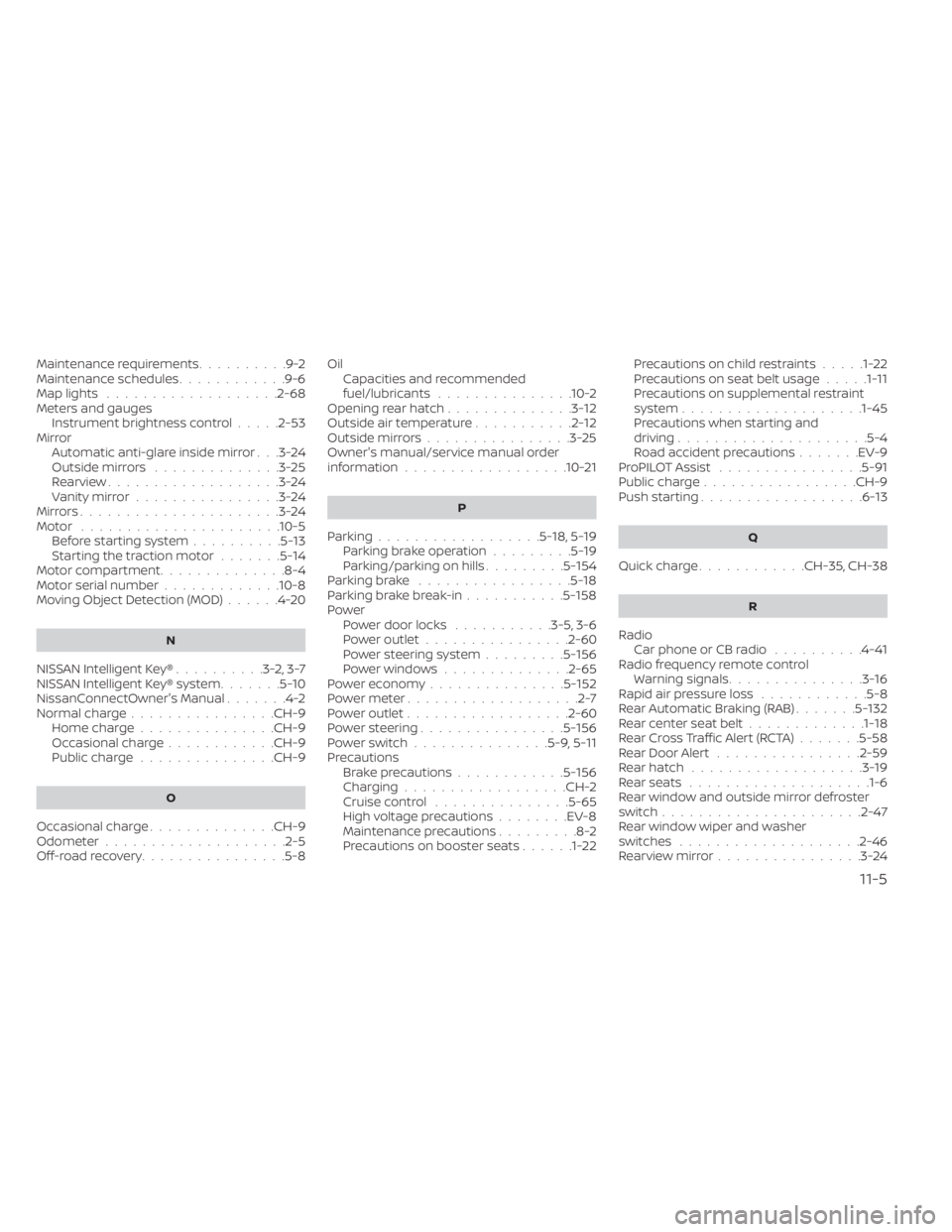
Maintenance requirements..........9-2Maintenance schedules............9-6Map lights...................2-68Meters and gauges
Instrument brightness control.....2-53MirrorAutomatic anti-glare inside mirror. . .3-24Outside mirrors..............3-25Rearview...................3-24Vanity mirror................3-24Mirrors......................3-24Motor..................... .10-5Before starting system..........5-13Starting the traction motor.......5-14Motor compartment..............8-4Motor serial number.............10-8Moving Object Detection (MOD)......4-20
N
NISSAN Intelligent Key®..........3-2,3-7NISSAN Intelligent Key® system.......5-10NissanConnectOwner's Manual.......4-2Normal charge................CH-9Home charge...............CH-9Occasional charge............CH-9Public charge...............CH-9
O
Occasional charge..............CH-9Odometer....................2-5Off-road recovery................5-8
Oil
Capacities and recommended
fuel/lubricants
...............10-2Opening rear hatch..............3-12Outside air temperature...........2-12Outside mirrors................3-25Owner's manual/service manual order
information................. .10-21
P
Parking..................5-18,5-19Parking brake operation.........5-19Parking/parking on hills.........5-154Parking brake.................5-18Parking brake break-in...........5-158Power
Power door locks...........3-5, 3-6Power outlet................2-60Power steering system.........5-156Power windows..............2-65Power economy...............5-152Power meter...................2-7Power outlet................. .2-60Power steering................5-156Power switch...............5-9, 5-11Precautions
Brake precautions............5-156Charging................. .CH-2Cruise control...............5-65High voltage precautions........EV-8Maintenance precautions.........8-2Precautions on booster seats......1-22
Precautions on child restraints.....1-22Precautions on seat belt usage.....1-11Precautions on supplemental restraint
system................... .1-45Precautions when starting and
driving.................... .5-4Road accident precautions.......EV-9ProPILOT Assist................5-91Public charge.................CH-9Push starting..................6-13
Q
Quick charge............CH-35, CH-38
R
Radio
Car phone or CB radio..........4-41Radio frequency remote controlWarning signals...............3-16Rapid air pressure loss............5-8Rear Automatic Braking (RAB).......5-132Rear center seat belt.............1-18Rear Cross Traffic Alert (RCTA).......5-58Rear Door Alert................2-59Rear hatch...................3-19Rear seats................... .1-6Rear window and outside mirror defroster
switch..................... .2-47Rear window wiper and washer
switches....................2-46Rearview mirror................3-24
11-5
Page 598 of 602
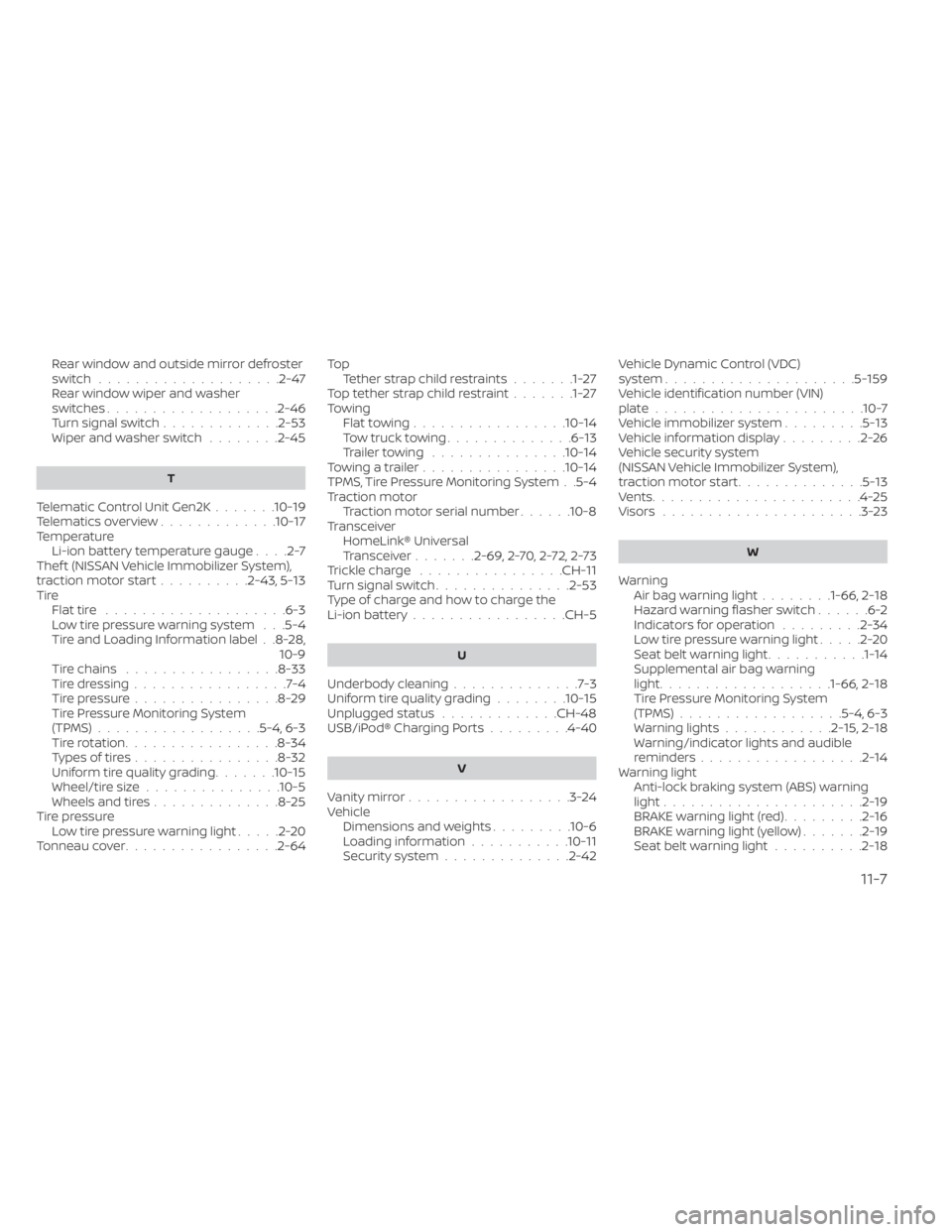
Rear window and outside mirror defroster
switch....................2-47Rear window wiper and washer
switches...................2-46Turn signal switch.............2-53Wiper and washer switch........2-45
T
Telematic Control Unit Gen2K.......10-19Telematics overview.............10-17Temperature
Li-ion battery temperature gauge. . . .2-7Thef t (NISSAN Vehicle Immobilizer System),
traction motor start..........2-43, 5-13TireFlat tire................... .6-3Low tire pressure warning system. . .5-4Tire and Loading Information label. .8-28,
10-9
Tire chains................ .8-33Tire dressing.................7-4Tire pressure................8-29Tire Pressure Monitoring System
(TPMS)................. .5-4, 6-3Tire rotation.................8-34Types of tires................8-32Uniform tire quality grading.......10-15Wheel/tire size...............10-5Wheels and tires..............8-25Tire pressure
Low tire pressure warning light.....2-20Tonneau cover................ .2-64
To p
Tether strap child restraints.......1-27Top tether strap child restraint.......1-27TowingFlat towing................ .10-14Tow truck towing..............6-13Trailer towing...............10-14Towing a trailer................10-14TPMS, Tire Pressure Monitoring System. .5-4Traction motor
Traction motor serial number......10-8TransceiverHomeLink® Universal
Transceiver
.......2-69, 2-70, 2-72, 2-73Trickle charge................CH-11Turn signal switch...............2-53Type of charge and how to charge the
Li-ion battery................ .CH-5
U
Underbody cleaning..............7-3Uniform tire quality grading........10-15Unplugged status.............CH-48USB/iPod® Charging Ports.........4-40
V
Vanity mirror..................3-24Vehicle
Dimensions and weights.........10-6Loading information...........10-11Security system..............2-42
Vehicle Dynamic Control (VDC)
system.....................5-159Vehicle identification number (VIN)
plate...................... .10-7Vehicle immobilizer system.........5-13Vehicle information display.........2-26Vehicle security system
(NISSAN Vehicle Immobilizer System),
traction motor start
..............5-13Vents.......................4-25Visors......................3-23
W
Warning
Air bag warning light........1-66, 2-18Hazard warning flasher switch......6-2Indicators for operation.........2-34Low tire pressure warning light.....2-20Seat belt warning light...........1-14Supplemental air bag warning
light.................. .1-66, 2-18Tire Pressure Monitoring System
(TPMS)..................5-4, 6-3Warning lights............2-15,2-18Warning/indicator lights and audible
reminders..................2-14Warning light
Anti-lock braking system (ABS) warning
light
......................2-19BRAKE warning light (red).........2-16BRAKE warning light (yellow).......2-19Seat belt warning light..........2-18
11-7