2021 NISSAN LEAF warning
[x] Cancel search: warningPage 512 of 602
WARNING
Do not allow wet seat belts to roll up in
the retractor. NEVER use bleach, dye, or
chemical solvents to clean the seat
belts, since these materials may se-
verely weaken the seat belt webbing.MOST COMMON FACTORS
CONTRIBUTING TO VEHICLE
CORROSION
• The accumulation of moisture-retaining dirt and debris in body panel sections,
cavities, and other areas.
• Damage to paint and other protective coatings caused by gravel and stone
chips or minor traffic accidents.
ENVIRONMENTAL FACTORS
INFLUENCE THE RATE OF
CORROSION
Moisture
Accumulation of sand, dirt and water on
the vehicle body underside can accelerate
corrosion. Wet floor coverings will not dry
completely inside the vehicle, and should
be removed for drying to avoid floor panel
corrosion.
Relative humidity
Corrosion will be accelerated in areas of
high relative humidity, especially those ar-
eas where the temperatures stay above
freezing, where atmospheric pollution ex-
ists, or where road salt is used.
Temperature
A temperature increase will accelerate the
rate of corrosion to those parts which are
not well ventilated.
Air pollution
Industrial pollution, the presence of salt in
the air in coastal areas, or heavy road salt
use will accelerate the corrosion process.
Road salt will also accelerate the disinte-
gration of paint surfaces.
PROTECT YOUR VEHICLE FROM
CORROSION
• Wash and wax your vehicle of ten to keepthe vehicle clean.
• Always check for minor damage to the paint and repair it as soon as possible.
• Keep drain holes at the bottom of the doors open to avoid water accumulation.
• Check the underbody for accumulation of sand, dirt or salt. If present, wash with
water as soon as possible.
CORROSION PROTECTION
Appearance and care7-7
Page 514 of 602

8 Do-it yourself
Maintenance precautions.......................8-2
Motor compartment check locations ...........8-4
Cooling system .................................8-5
Checking coolant level .......................8-6
Changing coolant ............................8-6
Reduction gear fluid .............................8-7
Brake fluid .......................................8-7
Windshield-washer fluid .........................8-8
12-volt battery ...................................8-9
Jump starting ................................ 8-11
Windshield wiper blades ........................8-12
Cleaning .................................... 8-12
Replacing ................................... 8-12
Rear window wiper blade ...................8-14
Brakes ......................................... 8-14
Brake pad wear warning ....................8-14Fuses
.......................................... 8-15
Motor compartment ........................ 8-15
Passenger compartment ...................8-18
Nissan Intelligent Key® battery replacement ....8-19
Lights .......................................... 8-21
Headlights .................................. 8-22
Fog lights (if so equipped) ...................8-22
Exterior and interior lights ...................8-23
Wheels and tires ............................... 8-25
Tire pressure ................................ 8-25
Tire labeling ................................. 8-30
Types of tires ................................ 8-32
Tire chains .................................. 8-33
Changing wheels and tires ..................8-34
Emergency tire puncture repair kit ..........8-37
Page 515 of 602

When performing any inspection or main-
tenance work on your vehicle, always take
care to prevent serious accidental injury to
yourself or damage to the vehicle. The fol-
lowing are general precautions that should
be closely observed.
WARNING
• The EV system uses high voltage up
to approximately DC 400 volt. The
system can be hot during and af ter
starting and when the vehicle is shut
off. Be careful of both the high volt-
age and the high temperature. Obey
the labels that are attached to the
vehicle.
• Never disassemble, remove or re-
place high-voltage parts and cables
as well as their connectors. High-
voltage cables are colored orange.
• Disassembling, removing or replac-
ing those parts or cables can cause
severe burns or electric shock that
may result in serious injury or death.
The vehicle high-voltage system has
no user serviceable parts. It is recom-
mended that you visit a NISSAN cer-
tified LEAF dealer for any necessary
maintenance. •
Park the vehicle on a level surface,
apply the parking brake securely and
chock the wheels to prevent the ve-
hicle from moving. Push the P (Park)
position switch on the shif t lever or
place the vehicle into the N (Neutral)
position.
• If you must work with the EV (Electric
Vehicle) system is turned on, keep
hands, clothing, hair and tools away
from moving fans and any other
moving parts.
• Make sure that the power switch is in
the OFF or LOCK position when per-
forming any part replacement or
repairs.
• It is advisable to secure or remove
any loose clothing and remove any
jewelry, such as rings, watches, etc.
before working on your vehicle.
• Always wear eye protection when-
ever you work on your vehicle.
• Never get under the vehicle while it is
supported only by a jack. If it is nec-
essary to work under the vehicle,
support it with safety stands.
• Keep smoking materials, flames and
sparks away from the 12-volt battery.
CAUTION
• Do not work under the hood while
the motor compartment is hot. Push
the power switch in the OFF position
and wait until it cools down.
• Avoid direct contact with used cool-
ant. Improperly disposed coolant
and/or other vehicle fluids can dam-
age the environment. Always con-
form to local regulations for the dis-
posal of vehicle fluids.
• Never connect or disconnect the bat-
tery or any transistorized compo-
nent while the power switch is in the
ON position.
• Your vehicle is equipped with an au-
tomatic cooling fan. It may come on
at any time without warning, even if
the power switch is not in the ACC, ON
or READY to drive position. To avoid
injury, always disconnect the nega-
tive 12-volt battery cable before
working near the fan.
• Before performing any electrical
maintenance work on the vehicle
such as the battery, fuses or bulb re-
placement, confirm the following:
– The charge connector is removed
from the vehicle.
MAINTENANCE PRECAUTIONS
8-2Do-it yourself
Page 518 of 602

The cooling system is filled at the factory
with a pre-diluted mixture of 50% Genuine
NISSAN Long Life Antifreeze/Coolant (blue)
and 50% water to provide year-round anti-
freeze and coolant protection. The anti-
freeze solution contains rust and corrosion
inhibitors. Additional cooling system addi-
tives are not necessary.
WARNING
• Never remove the coolant reservoir
cap when the motor compartment is
hot. Wait until the motor compart-
ment cools down.
• The coolant reservoir is equipped
with a pressure type coolant reser-
voir cap. To prevent damage to the
motor compartment, use only a
Genuine NISSAN coolant reservoir
cap.
CAUTION
• Never use any additives in the cool-
ant such as radiator sealer in the
cooling system. This may cause
damage to electrical equipment
such as the motor and inverter. •
When adding or replacing coolant, be
sure to use only a Genuine NISSAN
Long Life Antifreeze/Coolant (blue)
or equivalent. Genuine NISSAN Long
Life Antifreeze/Coolant (blue) is pre-
diluted to provide antifreeze protec-
tion to −34°F (−37°C) . If additional
freeze protection is needed due to
the weather conditions where you
operate your vehicle, add Genuine
NISSAN Long Life Antifreeze/Coolant
(blue) concentrate following the di-
rections on the container. If an
equivalent coolant other than Genu-
ine NISSAN Long Life Antifreeze/
Coolant (blue) is used, follow the
coolant manufacturer's instructions
to maintain minimum antifreeze
protection to −34°F (−37°C). The use
of other types of coolant solutions
other than Genuine NISSAN Long Life
Antifreeze/Coolant (blue) or equiva-
lent may damage the cooling
system. •
The life expectancy of the factory-fill
coolant is 125,000 miles (200,000
km) or 15 years. Mixing any other type
of coolant other than Genuine
NISSAN Long Life Antifreeze/Coolant
(blue)(or equivalent coolant), includ-
ing Genuine NISSAN Long Life
Antifreeze/Coolant (green), or the
use of non-distilled water may re-
duce the life expectancy of the
factory-filled coolant. For additional
information, refer to the “Mainte-
nance and schedules” section of this
manual.
COOLING SYSTEM
Do-it yourself8-5
Page 519 of 602

CHECKING COOLANT LEVEL
Check the coolant levelin the reservoir
when the high-voltage parts are cold. If
the coolant level is below the MIN level
OB,
open the reservoir cap and add coolant up
to the MAX level
OA. If the reservoir is empty,
check the coolant level in the coolant res-
ervoir when the high-voltage parts are
cold. If there is insufficient coolant in the
coolant reservoir, fill the coolant reservoir
with coolant up to the reservoir cap open-
ing and also add it to the reservoir up to the
MAX level
OA. Tighten the cap securely af ter adding
coolant.
For additional information on the location
of the coolant reservoir, see “Motor com-
partment check locations” (P. 8-4).
If the cooling system frequently requires
coolant, it is recommended that you visit
a NISSAN certified LEAF dealer.
CHANGING COOLANT
It is recommended that major cooling sys-
tem repairs should be performed by a
NISSAN certified LEAF dealer. The service
procedures can be found in the appropri-
ate NISSAN Service Manual.
Improper servicing can result in reduced
heater performance.
WARNING
• To avoid the danger of being scalded,
never change the coolant when the
motor compartment is hot.
• Never remove the coolant reservoir
cap when the motor compartment is
hot. Serious burns could be caused
by high-pressure fluid escaping from
the radiator.
• Avoid direct skin contact with used
coolant. If skin contact is made, wash
thoroughly with soap or hand
cleaner as soon as possible.
• Keep coolant out of reach of children
and pets.
Coolant must be disposed of properly.
Check your local regulations.
LDI3145
8-6Do-it yourself
Page 520 of 602

When checking or replacement is required,
it is recommended that you visit a NISSAN
certified LEAF dealer for this service.
CAUTION
• Use only Genuine NISSAN Matic S ATF.
Do not mix with other fluids.
• Using reduction gear fluid other than
Genuine NISSAN Matic S ATF will
cause deterioration in driveability
and reduction gear durability, and
may damage the reduction gear,
which is not covered by the NISSAN
New Vehicle Limited Warranty. For additional brake fluid information, see
“Recommended fluids/lubricants and ca-
pacities” (P. 10-2).WARNING
• Use only new fluid from a sealed con-
tainer. Old, inferior or contaminated
fluid may damage the brake system.
The use of improper fluids can dam-
age the brake system, and affect the
vehicle’s stopping ability.
• Clean the filler cap before removing.
• Brake fluid is poisonous and should
be stored carefully in marked con-
tainers out of the reach of children.
CAUTION
Do not spill the fluid on any painted sur-
faces. This will damage the paint. If fluid
is spilled, immediately wash the sur-
face with water. Check the fluid level in the reservoir. If the
fluid is below the MIN line
OBor the brake
warning light illuminates, add Genuine
NISSAN Super Heavy Duty Brake Fluid or
equivalent DOT 3fluid up to the MAX line
OA.
If fluid must be added frequently, the sys-
tem should be checked. It is recom-
mended that you visit a NISSAN certified
LEAF dealer for this service.
LDI3143
REDUCTION GEAR FLUID BRAKE FLUID
Do-it yourself8-7
Page 521 of 602
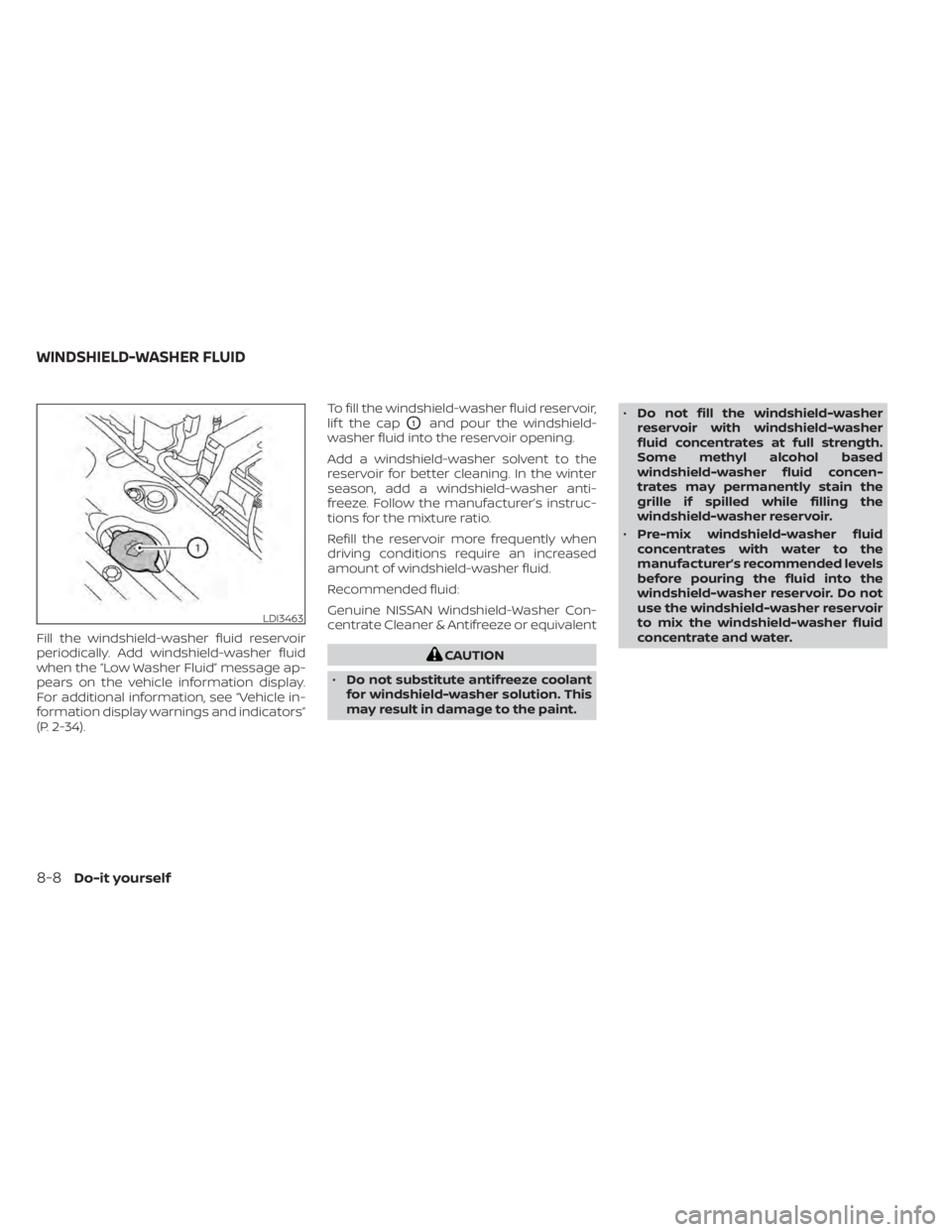
Fill the windshield-washer fluid reservoir
periodically. Add windshield-washer fluid
when the “Low Washer Fluid” message ap-
pears on the vehicle information display.
For additional information, see “Vehicle in-
formation display warnings and indicators”
(P. 2-34).To fill the windshield-washer fluid reservoir,
lif t the cap
O1and pour the windshield-
washer fluid into the reservoir opening.
Add a windshield-washer solvent to the
reservoir for better cleaning. In the winter
season, add a windshield-washer anti-
freeze. Follow the manufacturer’s instruc-
tions for the mixture ratio.
Refill the reservoir more frequently when
driving conditions require an increased
amount of windshield-washer fluid.
Recommended fluid:
Genuine NISSAN Windshield-Washer Con-
centrate Cleaner & Antifreeze or equivalent
CAUTION
• Do not substitute antifreeze coolant
for windshield-washer solution. This
may result in damage to the paint. •
Do not fill the windshield-washer
reservoir with windshield-washer
fluid concentrates at full strength.
Some methyl alcohol based
windshield-washer fluid concen-
trates may permanently stain the
grille if spilled while filling the
windshield-washer reservoir.
• Pre-mix windshield-washer fluid
concentrates with water to the
manufacturer’s recommended levels
before pouring the fluid into the
windshield-washer reservoir. Do not
use the windshield-washer reservoir
to mix the windshield-washer fluid
concentrate and water.
LDI3463
WINDSHIELD-WASHER FLUID
8-8Do-it yourself
Page 522 of 602
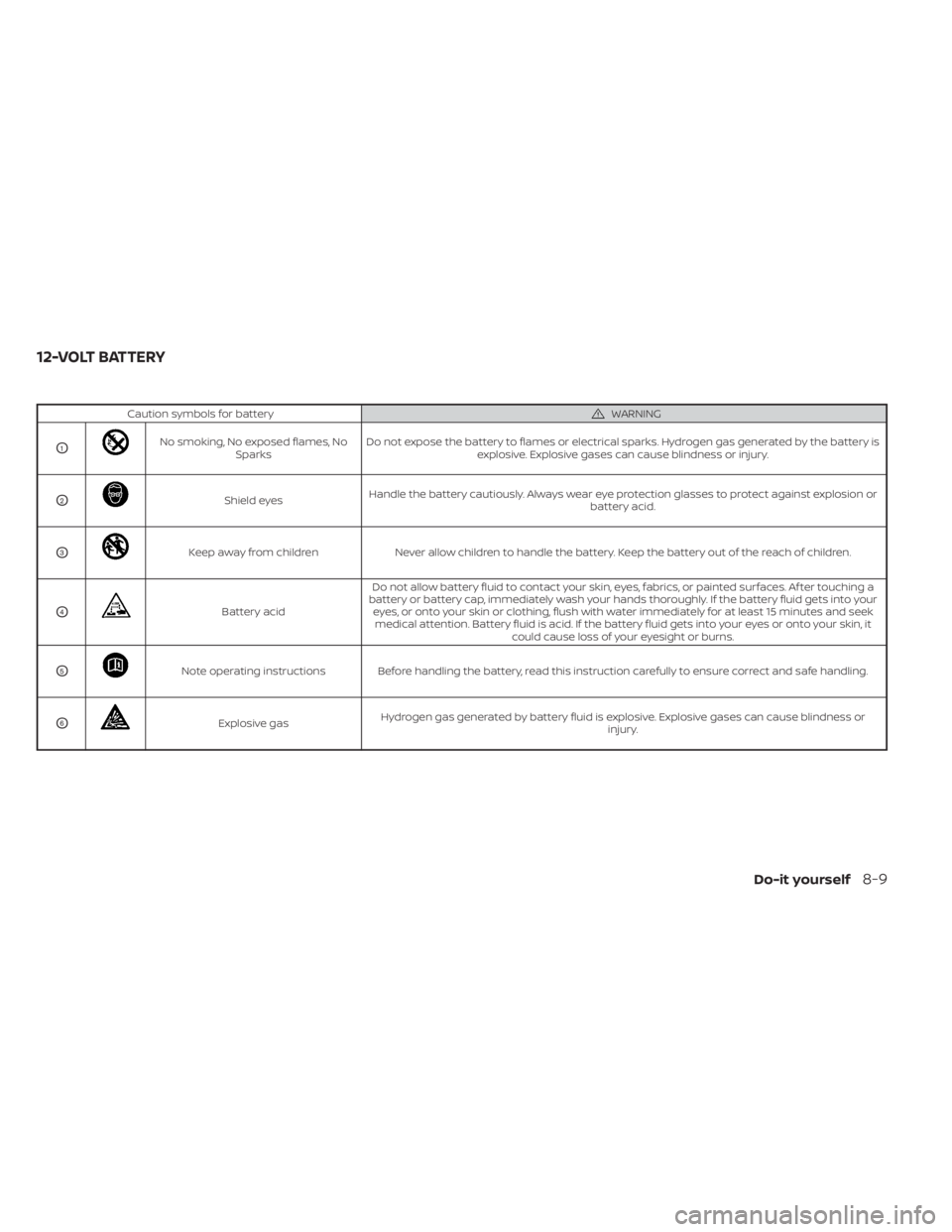
Caution symbols for batteryWARNING
O1No smoking, No exposed flames, NoSparks Do not expose the battery to flames or electrical sparks. Hydrogen gas generated by the battery is
explosive. Explosive gases can cause blindness or injury.
O2Shield eyes Handle the battery cautiously. Always wear eye protection glasses to protect against explosion or
battery acid.
O3Keep away from childrenNever allow children to handle the battery. Keep the battery out of the reach of children.
O4Battery acidDo not allow battery fluid to contact your skin, eyes, fabrics, or painted surfaces. Af ter touching a
battery or battery cap, immediately wash your hands thoroughly. If the battery fluid gets into your eyes, or onto your skin or clothing, flush with water immediately for at least 15 minutes and seekmedical attention. Battery fluid is acid. If the battery fluid gets into your eyes or onto your skin, it could cause loss of your eyesight or burns.
O5Note operating instructions Before handling the battery, read this instruction carefully to ensure correct and safe handling.
O6Explosive gas Hydrogen gas generated by battery fluid is explosive. Explosive gases can cause blindness or
injury.
12-VOLT BATTERY
Do-it yourself8-9