2021 MERCEDES-BENZ METRIS brake
[x] Cancel search: brakePage 129 of 290

#
Reverset he vehicle, being ready tobrak eat
all times. Reverses lowl y,and do no tdrive
fast erthan 6m ph (1 0km/h). Parking assis‐
ta nce is otherwise canceled and ActiveP ark‐
ing Assis tisstopped.
When thev ehicle approaches ther ear border
of thep arking space, ActiveP arking Assist
can brak eittoas tandstill. #
Stop at ther ear border of thep arking space.
St op when PARKTRONI Csounds thec ontinu‐
ous warning tone, if no tbefore.
Maneuverin gmaybe requ ired in tigh tparking
spaces .Obser vethem essages on them ultifunc‐
tion displa y.
On completion of thep arking procedure, the
Active Parking Assist Finished messageappears
and an acoustic signal sounds. ActiveP arking
Assis tnolonger supports youw iths teering inter‐
ve ntions and brak eappli cations.
Exiting aparkin gspac ewithA ctive Parking
Assist
Re quirements:
R The vehicle has been par kedp arallel tothe
direction of tra velu sing ActiveP arking Assist.
R The border of thep arking space mus tbehigh
enough at thef ront and ther ear ;ac urb, for
ins tance, is no tsufficient.
R The border of thep arking space mus tnotbe
to ow ide. Your vehicle can be maneuvered
int oap osition at amaximum angle of 45° to
th es tartin gp osition in thep arking space.
R Am aneuvering dis tance of at leas t40in
(1 m) mus tbea vailable.
Please no tethat youa re re sponsible fort he vehi‐
cle and sur rounding sduring thee ntir eparking
procedure. #
Startt he vehicle. #
Switc hont he tur nsignal on thes ide you
intend toexitth ep arking space. &
WARNING Risk of accident du etovehi‐
cle swinging out while parking or pulling
out of aparking space
While parking or exitin gap arkin gspace, the
ve hicle swings out and can driv eontoa reas
of theo ncoming lane.
This could cause youtoc ollide wi thobjects
or other road users. #
Paya ttention toobject sand other road
users. #
Wher enecessar y,stop thev ehicle or
cancel thep arking procedur ewith
Ac tiveP arking Assist. #
Shif tthe transmission toposition 005Bor005E.
The multifunction displa yshows the Start
Parking Assist ?Yes: OK No: ~message
and thel ocation of thep arking space. #
Tocancel thep rocess: pressthe~
st eering-wheel button or driv eoff.
or #
Toexitth ep arking space usin gactive
parking assistance: pressthe0076 steer‐
ing-wheel button.
The Parking Assist Active Accelerate and
Brake Observe Surroundings messageis
shown in them ultifunction displa y. #
Release thes teering wheel. #
Pull away and be ready tobrak eata ll times.
Re verses lowl y,and do no tdrive fast erthan
6m ph (1 0km/h). Parking assis tance is oth‐
erwise canceled and ActiveP arking Assis tis
st opped.
When thev ehicle approaches ther ear border
of thep arking space, ActiveP arking Assist
can brak eittoas tandstill.
Maneuvering ma yberequired in tight parking
spaces. Obser vethem essages on them ultifunc‐
tion displa y.
On completion of thep arking procedure, the
Active Parking Assist Finished messageappears
and an acoustic signal sounds. ActiveP arking
Assis tnolonger supports youw iths teering inter‐
ve ntions and brak eappli cations.
The pa rking assis tance function of ActiveP arking
Assis tisstopped. Youw illthen ha vetosteer and
mer geintot raf ficony ourown.PA RKTRONI Cis
st ill available. AT
TENTION ASSI ST Fu
nction of ATTENTION ASSI ST
AT TENTION ASSIS Tcan assis tyou on long,
mono tonou sjou rney s, e.g. on highw aysa nd trunk
ro ads. If ATTENTION ASSIS Tdetects ind icator sof
fa tigue or increased lapse sinconcentration on
th ep artoft he driver ,itsuggests taking abreak.
AT TENTION ASSIS Tisonlyana id. It cannot
alw aysd etect dr owsiness or increased lapses in Driving and parking
127
Page 133 of 290

R
yous teer actively ,e.g. swer vetoavoid an
obs tacle or chang elane quickl y.
R youc utthec orner on ashar pcurve. Tr
aile roperation Note
sont railer operation &
WARNING Risk of accident and inju ryif
th et ongue weight is exceeded
The car rier sy stem ma ydetac hf romt hevehi‐
cle, thereb yendangering other road users. #
Alwaysc ompl ywitht he permissible
to ngu eweight when using acarrier. &
WARNING Risk of accident du eto
unsuitable ball neck
If yo ui nstall an unsuitable ball nec k,the
traile rhitch and ther ear axle ma ybeoverloa‐
ded.
This can significantl yimp air thed riving char‐
acteristic sand thet railer ma ybecome loose.
Ther eisar isk offata linjur y. #
Only ins tallab all nec kthat complies
wit hthe permissible dimensions and is
designed fort he requ irements of trailer
operation. #
Do no tmodif ythe ball nec korthe
trailer hitch. Yo
uc an find specifications rega rding theb all
nec kont he trailer's identification plate. Youc an
fi nd specifications rega rding thet railer on the
to wing vehicle's identification plat eand in the
te ch nica ldata( /pag e233). &
WARNING Risk of accident and inju ry
due toan incor rectly ins talled ball cou‐
pling
If th eb all coupling is no tins talled and
engaged cor rectl y,it ma ybecom edetached
during tra vela nd endan gero ther road users.
Ther eisar isk offata linjur y. #
Install and secur ethe ball coupling as
described in theb all coupling manufac‐
turer's ins tallation instructions. #
When theb all coupling has been ins tal‐
led, ensur ethat it is cor rectly secu red
befor eevery trip. &
WARNING Risk of accident du etoan
incor rectl yins tal led and secured ball
coupling
If th eb all coupling has no tbeen cor rectly
ins talled and secured, thet railer can become
de tach ed. #
Install and secur ethe ball coupling as
described in theb all coupling manufac‐
turer's ins tallation instructions. #
When theb all coupling has been ins tal‐
led, ensur ethat it is cor rectly secu red
befor eevery trip. Yo
uc an attac hcarrier sy stems suc hasabicycle
ra ck or load-bearing implement totheb all nec k.
When using car rier sy stems on theb all nec k,the
maximu mloadc apacity is 165lb( 75kg).
Be sur etocomply wi th theoperating instructions
of them anufacturer of thet railer coupling and
th eb all nec k.
Place your vehicle/trailer combination on sur fa‐
ces that ar ease vena spossible and secu reit
agains trolling away ( /pag e108). Coupl eand
uncoupl ethe trailer carefully.
No tethef ollowing rega rding thet ongue weight:
R Mak efull use of them aximum tongu eweight,
wher epossible.
R Neverfall belo walegally prescribed minimum
to ngu eweight ;the tongu eweight must
alw aysbep ositive.
R Do no texceed or fall belo wthe permissible
to ngu eweights –this mus tbeobservedd ur‐
ing loading and unloading of thet railer.
Do no texceed thef ollowing values:
R Perm itted braked or unbraked towing capa‐
city
The maximum permissible towing capacity for
unbraked trailer sis1,653 lbs (750 kg).
R Perm issible rear axle load of thet ow ing vehi‐
cle
R Perm issible gross weight of thet ow ing vehi‐
cle
R Perm issible grossweight of thet railer
R Perm issible grosscombination weight
R Maximum permissible speed of thet railer Driving and parking
131
Page 134 of 290

The
releva nt pe rmitted values, whic hmustn otbe
exc eeded, can be found in thef ollowing places:
R Inyour vehicle documents
R Onthei dentification plat eofthe trailer hitch
R Onthet railer's identification plate
R Onthev ehicle identification plate
If th er ea rediscrepancies between thev alues, the
lo we stone shall appl y.
Befor edriving off, ensu rethef ollowing:
R The tir epressur eont herear axle of thet ow‐
ing vehicle has been se tfor them aximum
load.
R The headlamps ha vebeen se tcorrectly.
Va lues appr oved bythem anufacturer can be
fo und on thei dentification plates and in thes ec‐
tion fort he towing vehicle (/ page207).
If yo ur equir eexplanations rega rding thei nforma‐
tion in theO perator's Manual, contact a
Mercedes-Benz Commercial VanC enter.
Co mp ly wi th th emaximum permissible speed of
50 mph(80 km/h) or 62 mph(100k m/h), even
in countries in whic hhigher speeds ar epermit ted
fo rv ehicle/trailer combinations.
At tach onl yana pprove dtrailer hitc htoyourvehi‐
cle. Use onl yaball nec kthat has been appr oved
fo ry our vehicle. Further information about availa‐
bilit yand ins tallation ,including that of thet railer
electrics, is available from an yqualified specialist
wo rkshop.
% Yo
ur vehicle's bumper sarenots uitable for
ins talling de tach able trailer hit ches.
Do no tattac hanyrented traile rhitch es or any
ot her de tach able trailer hit ches totheb umpers.
Re duce ther isk of damag etothe ball nec k.Ifyou
do no tneed theb all nec k, removeit from theb all
nec km ount.
% During trailer operation,
remember that
PA RKTRONI Cisavailable onl ytoalimited
ex tent, if at all.
% The height of
theb all head will change
depending on thev ehicle's load. In this case,
use atrailer wit haheight-adjus table dr aw‐
bar. Coupling/uncoupling
atrailer Re
quirements:
R The ball nec kmustbee ngaged in asecurely
loc kedp osition.
Tr ailer swith7 -pin plugs can be connec tedtot he
ve hicle using thef ollowing adap ters:
R Adapterp lug
R Adapterc able
Coupling atrailer
* NO
TEDama getothes tarter batter ydue
to full discharge Charging
thet railer batter yusing thep ower
supply of thet railer can damag ethe star ter
batter y. #
Do no tuse thev ehicle's po wersupply
to charge thet railer batter y. #
Vehicles with automatic transmission:
shif tthe transmission toposition 005D. #
Appl ythe vehicle's parking brake. #
Close all thed oors. #
Position thet railer on alevel sur face behind
th ev ehicle.
% The height of
theb all head will change
depending on thev ehicle's load. In this case,
use atrailer wit haheight-adjus table dr aw‐
bar. #
Couple up thet railer. #
Toinstall an ada pter: open thec ove roft he
soc ket. #
Inse rtthep lug wit htab 1 intot he soc ket's
groo ve3 . #
Turn bayone tc oupling 2tother ight as far
as it will go. #
Letthe co vere ngage. 13 2
Driving and pa rking
Page 135 of 290

#
Attach thec able tothet railer wit hcable ties
(onl yint he case of adap terc able). #
Mak esuret hat thec able is alw ayss lac kfor
ease of mo vement during cornering. #
Establish all electrical and other connections
to thet railer .Inthe process, attac hthe trail‐
er's break away cable tothee yeletont he ball
nec k. #
Chec kthat thet railer's lighting sy stem works
properly. #
Indicat einbothd irections and checkw hether
th ec orresponding tur nsignal light on the
traile risflashing.
At railer is de tected only if thee lectrical con‐
nection is es tablished cor rectl ya nd thel ight‐
ing sy stem is in working order .The function
of other sy stems also depends on this, e.g.
ESP ®
,P ARKTRONIC, ActiveP arking Assist,
Blin dSpotA ssis torL aneKeeping Assist.
Even if thet railer is connected cor rectly ,am es‐
sag em aynevertheless appear on them ultifunc‐
tion displa yinthefollowing cases:
R LED shave been ins talled in thet railer's light‐
ing sy stem.
R The cur rent ha sfallen belo wthe trailer light‐
ing sy stem's minimum cur rent (50 mA)
% Yo
uc an connec taccesso ries up toam axi‐
mum of 240Wtot he permanent po wersup‐
ply. #
Remo veobject sordevices that pr event the
traile rfromr olling, e.g. choc ks. #
Release thet railer's parking brake.
Obser vethem aximum permissible trailer dimen‐
sions (widt hand length).
Mos tstatesa nd all Canadian pr ovinces pre‐
scribe:
R Safetyc hains between thet ow ing vehicle and
th et railer .The chains shoul dberouted in a
criss-cross patter nunde rthe dr awbar .They
mus tbec onnected tothet railer hitc hand not
to theb umper or tothev ehicle's axle.
Lea vesuf ficient sla ckinthec hains. This also
allo wsfors har pcornering.
R Asepa rate brak esystemf or speci fict railers.
R Safetys hutof ffor braked trailers. De term ine
th es pecific requirements acco rding tothe
re leva nt la ws. If
th et railer becomes de tach ed from thet ow‐
ing vehicle, thes afet ys hutof fwill activat ethe
trailer brakes.
Un coupling atrailer &
WARNING Risk of being crushed and
becoming trapped whe nuncoupling a
trailer
Whe nuncoupling atrailer wi than engaged
ine rtia-activated brake, your han dmay
become trapped between thev ehicle and the
traile rdrawbar. #
Do no tuncouple trailer swithan
engaged overrun brake. *
NO
TEDama gewhen uncouplin gina
st at eofo verrun Uncou
pling in astate ofoverru nc an damage
th ev ehicle. #
Do no tuncouple trailer swithan
engaged overrun brake. #
Shif tthe transmission toposition 005D. #
Appl ythe vehicle's parking brake. #
Close all thed oors. #
Appl ythe trailer's parking brake. #
Further secur ethe trailer agains trolling away
wit haw heelchoc kors imilar object. #
Remo vethet railer cables and saf etyc hains. #
Uncouple thet railer. Information about
towing atrailer Operatin
gatrailer is subject toman ystatutory
re gulations suc hasspeedrestrictions.
Man ystatesa lso requ ireana uxiliaryseparate
functional brakin gsystem when towing aweight
th at exc eeds acertain limit .For your saf ety, it is
re commended touse aseparat efunctional brak‐
ing sy stem on an ytowe dvehicle.
Mak esuret hat your trailer combinatio nmeets
local regulations. This no tonlya pplies to your
plac eofr esidence, but also to your destination.
In fo rm atio nont his can be obtained from the
police and local authorities.
Compl ywitht he following when driving wit ha
trailer:
R Practice cornering, stopping and backing up
in at raffic-free location. In this wa y,yo uw ill Drivin
gand parking 13 3
Page 136 of 290

ga
in driving experience and become accus‐
to med tothen ew handling characteristics.
R Befor edriving, checkt he following:
- that thet railer towh itch and ball coupling
ar es ecure
- that thes afet ys wit ch forb rake dt railer sis
functioning cor rectly
- that thes afet yc hains ar esecur eand
undamaged
- that thee lectrical connection saresecure
- that thel ights ar efunctioning cor rectly
- thew heels ford ama geand cor rect tire
pressur e(/ page 204)
R Adjus tthe outside mir rors so that youh ave a
clea rviewoft herear sectio nofthe trailer.
R Ifth et railer is equipped wit hanindividual
braking sy stem, checkb efor eeachj ourney
whe ther theb rake sa refunctioning cor rectl y.
R Ifth et railer has electronicall ycont rolled
brakes, pull away carefully wi th thevehicle/
trailer combination .Brake manually using the
brak econtroller and checkw hether the
brakes ar efunctioning cor rectl y.
R Secu rethel oad on thet railer in line wit hthe
re qu irements and rules forl oad-securing
me thods.
R When driving wit hatrailer ,chec katr egular
inter vals that thel oad is secur eand that the
light sand brakes ar efunctioning cor rectl y.
R Bea rinm indthat theh andling characteristics
ar em oreu nstable when towing atrailer than
when drivin gwithout atrailer .Avoid sudden
st eering mo vements.
R The vehicle/trailer combination is heavier,
accelerates mor eslowl y,has areduced
climbing ability and an increased braking dis‐
ta nce. It is mor esusceptible toside winds
and requ ires careful steering.
R If possible, do no tbrake suddenl y,but rath er
moderatel yatfirst so that thet railer can acti‐
va te its brakes. Then inc rease thep ressur eon
th eb rake pedal.
R Ifth ea utomatic transmission shifts between
ge arsonu phill or downhill gradients, restrict
th es hiftrange. Select shif trang e4,3,2or1.
Al owe rgear and reduced speed decrease the
ri sk of engine damage.
R When driving on adownhill gradient, shif ttoa
lo we rgear touse thee ngine' sbraking ef fect. Av
oid cons tant braking, as this could cause
th ev ehicle brakes and possibly also the
traile rbrake stoo verheat.
R Ifth ec oolant temp eratur eincreases signifi‐
cant lywhen thea ir-conditionin gsystemis
switched on, switc hthe air-conditioning sys‐
te mo ff.
Coolant heat can also be dissipated by
switching thea irflow and thet emperatur eof
th eh eater or air conditioning tothem aximum
le ve l. Open thew indo wsif necessar y.
R When overtak ing, pa yparticular attention to
th ei ncreased overtakin gdista nce of your
ve hicle/trailer combination.
Due tothel engt hofy ourvehicle/trailer com‐
bination youw illrequ ireal onger stre tchof
ro ad befor eswit ching bac ktothe original
lane. Pe
rm issible trailer loads and tongue weights We
ight information &
WARNING Risk of accident du etoan
unbraked trailer wit hanexcessiv egross
we ight
If yo up ull an unbraked trailer wit hagross
tr ailer weight (G TW)ofm oret han 1,653 lbs
(750 kg),th ev ehicle's brak esystem may
ove rheat.
This increases theb raking dis tance and may
eve ncause theb rake system tofail. #
Alwaysu seatrailer wit haseparate
braking sy stem if youa repullin gagross
trailer weight (G TW)ofm oret han
1, 653 lbs (750 kg). *
NO
TEDama getothed rive train, trans‐
mission or trailer towh itch due toexc ess
gross combination weight The permissible
grosscombination weight is
exc eeded.
The driv etrain, thet ransmission or thet railer
to wh itch ma ybed amaged. #
Compl ywitht he permissible gross com‐
bination weight. Fo
rv ehicles wit hapermissible gross weight of
6,6 14 lbs (3,00 0kg),thep ermissible gross com‐
bination weight is less than thes um of thep er‐
missible gross vehicle weight and thep ermissible 134
Driving and pa rking
Page 146 of 290

R
Cruise control
R Servic einter vals
Setting thet imea nd da te #
Press the0078button toselect thet ime and
dat edispla y. #
Use the0074or0075 button tosetthe hour sand
press 0078toconfirm. #
Use the0074or0075 button tosetthe minutes
and press 0078toconfirm. #
Use the0074or0075 button tosetthe da yand
press 0078toconfirm. #
Use the0074or0075 button tosetthe mont hand
press 0078toconfirm. #
Use the0074or0075 button tosetthe year and
press 0078toconfirm.
The displa yshows the Settings menu again. Menus and submenus (vehicles with
steer‐
ing-wheel but tons) Service menu
Overview
#
Use the0059 or0065 button toselect the
Service menu.
Depending on thee quipment, youh avet he fol‐
lowing option sinthe Service menu:
R Calling up displa ymessages in them essage
memor y(/pag e235).
R Checking thet irep ressur eelectronicall yor
re startin gthe tir epressur emonitoring sy stem
(/ page209).
R Calling up thes ervice due dat e(ASS YST
PLUS) (/ page175) Assistanc
emenu #
Use the0059 or0065 button toselect the
DriveAssist menu. Depending on
thev ehicle's equipment, youh ave
th ef ollowing options on theDriveAssist menu:
R Displaying thes tatus overview
R Showing thea ssis tant displ ay forActiv eBrake
Assi st (/ pag e113)orA ctiv eDista nce Assi st
DISTRONI C(/pa ge120).
R Swit ching ESP ®
on/of f(/pag e111,112 ).
R Switching ActiveB rake Assi ston/off
(/ page115).
R Setting thes ensitivity of ATTENTION ASSIST
(/ page128)
R Switchin gBlindS potA ssis ton/off
(/ page129)
R Setting thes ensitivity of Lane Keeping Assist
(/ page130)
St atus overview St
atus overview( example)
1 BlindSpotA ssis tswitched on and active
2 Rear wind owwiper swit ched on
3 ATTENTION ASSIS Tswitched on
4 Distance warning function of ActiveB rake
Assi stswitched on
5 Lane Keeping Assis tswitched on and ready
fo ru se #
Use the0064 or0063 button toselect the
ove rview. #
Press the0076 button.
The status overviews hows onlythe symbols
of thed riving sy stems or driving saf etys ys‐
te ms that ha vebeen switched on.
The symbols forB lind Spo tAssis tand Lane
Ke eping Assis tmayvary depending on the
sy stem status:
R Ifth es ymbol forB lind Spo tAssist 1
does no tshowa nyradar waves between
th et wo vehicles, Blind Spo tAssis thas
been switched on but is no tready foru se. 14 4
Instrument clus tera nd on-boar dcomputer
Page 184 of 290
fa
ces, e.g. MB SummerFit or MB Winter‐
Fit. Re
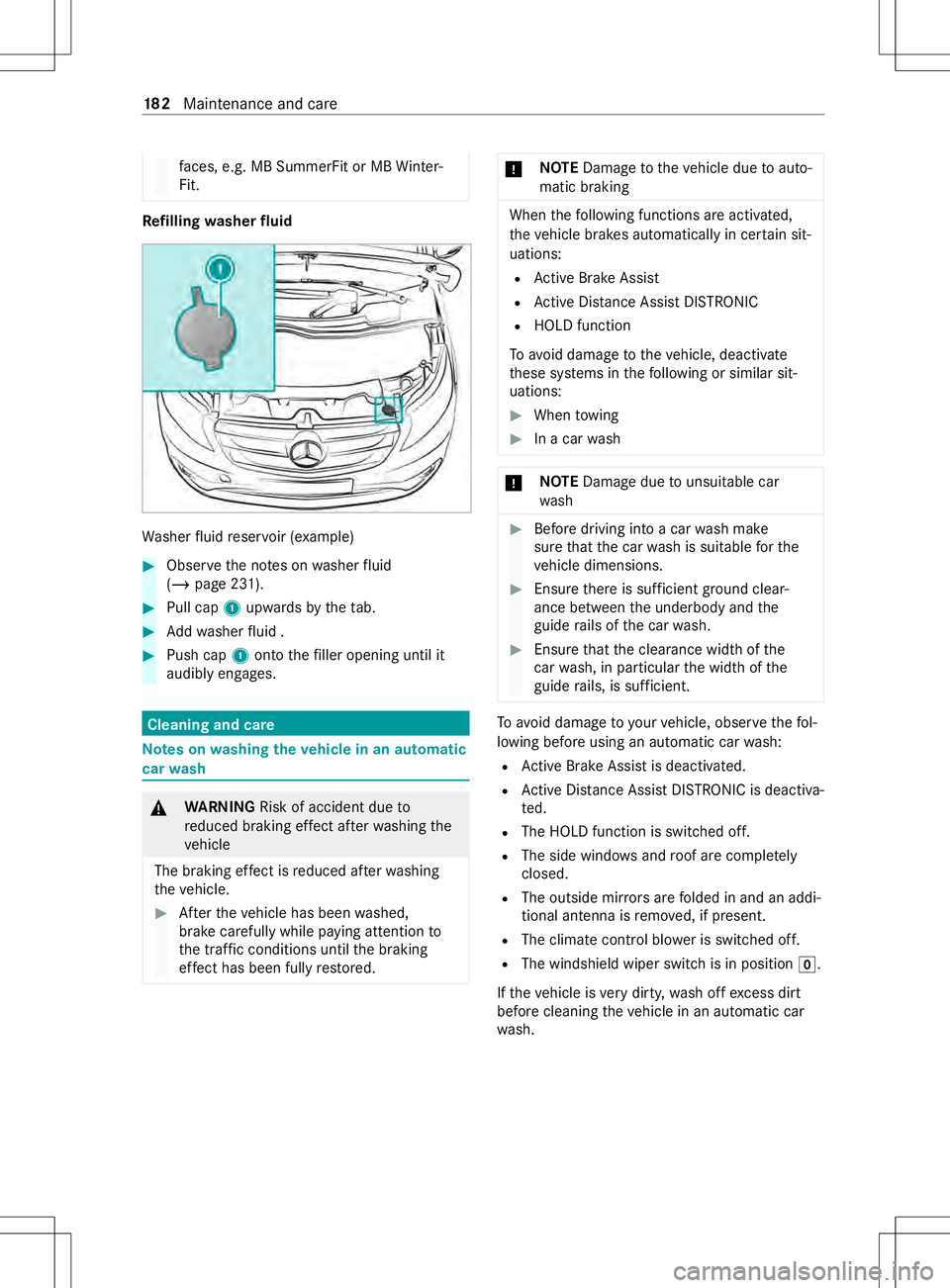
filling washer fluid Wa
sher fluid reser voir (e xamp le) #
Obser vethen otes on washer fluid
(/ page231). #
Pull cap 1upwards bythet ab. #
Addw ashe rfluid . #
Push cap 1ontothe filler openin guntil it
audibly engages. Cleaning and care
Note
sonw ashingthe vehicl einana utomatic
car wash &
WARNING Risk of accident du eto
re duced braking ef fect af terw ashing the
ve hicle
The braking ef fect is reduced af terw ashing
th ev ehicle. #
Aftert he vehicle has been washed,
brak ecarefully while paying attention to
th et raffic condition suntil theb raking
ef fect has bee nfully restored. *
NO
TEDama getothev ehicle due toauto‐
matic braking When
thef ollowing function sareactivated,
th ev ehicle brakes automatically in cer tain sit‐
uations:
R ActiveB rake Assi st
R ActiveD ista nce Assi stDISTRONIC
R HOLD function
To avo id damag etothevehicle, deactivate
th ese sy stems in thef ollowing or similars it‐
uations: #
When towing #
Inac arwa sh *
NO
TEDama gedue tounsuitable car
wa sh #
Befor edriving int oacarwa sh make
sur ethat thec arwa sh is suitable fort he
ve hicle dimensions. #
Ensur ether eiss ufficient ground clear‐
ance between theu nderbody and the
guide rails of thec arwa sh. #
Ensur ethat thec learance widt hofthe
car wash, in particular thew idthoft he
guide rails, is suf ficient. To
avo id damag etoyourvehicle, obser vethef ol‐
lowing befor eusing an automatic car wash:
R ActiveB rake Assi stis deactivated.
R ActiveD ista nce Assi stDISTRONI Cisdeacti va‐
te d.
R The HOLD function is switched off.
R The side windo wsand roof ar ecomple tely
closed.
R Theo utside mi rror sa refolded in and an addi‐
tional antenn aisremoved, if present.
R The climat econtrol blo weriss witched off.
R The windshieldw iper switchisinposition005A.
If th ev ehicle is very dirty ,wash of fexcess dirt
befor ecleaning thev ehicle in an automatic car
wa sh. 18 2
Maintenance and care
Page 187 of 290

To
avo id damag etothevehicle, follo wt he
instructions forc leaning and car eofthefollowing
ve hicle parts:
Wheels and rims
R Use watera nd acid-free alloy wheel cleaner.
R Do no tuse acidic allo ywheel cleaner sto
re mo vebrak edust. Otherwise, wheel bolts
and brak ecomponents could be damaged.
R Toavo id cor rosion of brak ediscs and brake‐
pads, driv efor afew minutes af terc leaning
befor eparking thev ehicle. The brak ediscs
and brakepads warm up and dr yout.
Wi ndo ws
R Clean thew indo wsinside and outsid ewitha
dam pcloth and wit hacleaning agent recom‐
mende dfor Mercedes-Benz.
R Do no tuse dr ycloth sora brasiv eorsolvent-
based cleaning agents toclea nthe inside of
windo ws.
Wi per blades
R Carefully clea nthe folded-a wayw iper blades
wit had ampcloth.
R Fold wiper ar mawayfromt herear wind ow
( / pag e87).
R Do no tclean thew iper blades tooo ften.
Exterior lighting
R Clean thec oversw ithaw etspong eand mild
cleaning agent, e.g .car sha mpoo.
R Onlyuse cleaning agents or clo thss uitable
fo rp last ic co vers.
Sensors R Clean thes ensor sinthe front and rear bump‐
er sw ithas oftc loth and car shampoo
(/ page110).
R When using apowe rwashe r,ke ep am inimum
dis tance of 12in (30 cm).
Re ar vie wcamera
R Vehicles with atailgate: switc hont he igni‐
tion and shif tthe transmission tothe 005Eposi‐
tion toopen thec amera co verw hen the
engine is switched of f(/pag e110).
R Usec lean wate rand asoftc loth toclea nthe
camer alens.
R Do no tuse ap owe rwashe r. Sliding door
R Remo vefore ign object sfromt he vicinity of
th ec ontact plates and contact pins of the
sliding door.
R Cleant he contact plates and contact pins
wit ham ild cleaning agent and asoftc loth.
R Do no toilor grease thec ontact plates and
th ec ontact pins.
Ta ilpipes
R Clean wit hacleanin gagent recommended for
Mercedes-Benz, especially in thew inter and
af te rw ashing thev ehicle.
R Do no tuse acidic cleaning agents.
Tr aile rhitch
Obse rvet he no tesonc areint he trailer hitch
manufacturer's operating instructions. Note
soni nterior care &
WARNING Risk of inju ryfrom pla stic
parts breakin goffafte rt he use of sol‐
ve nt-based care products
Ca reand cleaning products con tainin gsol‐
ve nts can cause su rfaces in thec ockpit to
become porous. When thea irbags are
deplo yed, plastic parts ma ybreak away. #
Do no tuse anyc areorc leaning prod‐
ucts containing sol vents toclea nthe
cockpit. &
WARNING Risk of inju ryor deat hfrom
bleached seat belts
Bleaching or dyeing seat belts can se verely
we aken them.
This can, fore xamp le, cause seat belt stotear
or fail in an accident. #
Neverb lea ch or dy eseat belts. To
avo id damag etothevehicle, obser vethef ol‐
lowing instructions forc leaning and care:
Seat belts
R Clean wit hlukewa rmsoap ywater.
R Do no tuse chemical cleaning agents.
R Do no tdryby heating abo ve176°F( 80 °C)
or in direct sunlight. Maintenance and care
18 5