2021 MAZDA MODEL CX-30 height
[x] Cancel search: heightPage 285 of 594

The vehicle is driven on roads with
lane lines other than white (yellow)
lines, such as an expressway.
Do not get out of the vehicle while
the stop hold control is operating.
(Automatic transmission vehicle)
Getting out of the vehicle while the
stop hold control is operating is
dangerous as the vehicle may move
unexpectedly and result in an accident.
Before getting out of the vehicle,
switch the TJA off, apply the parking
brake, and then shift the selector lever
to the P position.
CAUTION
Turn the system off when the vehicle is
running on a chassis roller.
Heed the following cautions so that
the TJA can operate normally.
Turn the system off when the vehicle
is running on a chassis roller.
Do not modify the vehicle's
suspensions.
Always use wheels of the specified
size for the front and rear wheels.
Consult an Authorized Mazda Dealer
for tire replacement.
NOTE
The headway control does not detect
the following as physical objects.
Vehicles approaching in the
opposite direction
Pe d e s t r i a n sStationary objects (stopped
vehicles, obstructions)
If a vehicle ahead is traveling at an
extremely low speed, the system may
not detect it correctly.
If there is a structure on the road or
an object (such as a monorail) at a
low height off the ground in front of
the vehicle, the system may operate.
Therefore, do not use the TJA.
Do not use the TJA under conditions
in which close proximity warnings
are frequently activated.
If it is necessary to accelerate for a
lane change or the vehicle ahead
brakes suddenly causing you to close
in on the vehicle rapidly, accelerate
using the accelerator pedal or
decelerate using the brake pedal
depending on the conditions.
While the TJA is in use, any intended
engine braking does not occur even
if you shift the shift lever (manual
transmission) or the selector lever
(automatic transmission). If
deceleration is required, lower the
vehicle speed setting or depress the
brake pedal.
While braking by the TJA control is
operating , you might hear an
operation sound, however, this does
not indicate a problem.
The brake lights turn on while
braking by the TJA control is
operating , however, they may not
turn on while the vehicle is on a
down slope at the set vehicle speed
or traveling at a constant speed and
following a vehicle ahead.
Under the following conditions, the
TJA may not be able to detect white
(yellow) lines or vehicles ahead
correctly and the TJA may not
operate normally.
The forward sensing camera (FSC)
cannot recognize the area in front
of the vehicle due to soiling or fog.
When Driving
i-ACTIVSENSE
4-139
CX-30_8JP5-EA-20K_Edition1_new 2020-7-22 15:50:09
Page 304 of 594

Do not apply a sticker to a rear
ultrasonic sensor and rear camera.
Otherwise, the rear ultrasonic
sensor and rear camera may not be
able to detect vehicles or
obstructions which could result in
an accident.
Do not disassemble a rear
ultrasonic sensor and rear camera.
If cracks or damage caused by
flying gravel or debris is visible
around a rear ultrasonic sensor and
rear camera, stop using the SBS-R
system immediately and have your
vehicle inspected by an Authorized
Mazda Dealer. If the vehicle
continues to be driven with cracks
or scratch marks left around an
ultrasonic sensor, the system may
operate unnecessarily and cause
an unexpected accident.
Refer to Stopping the Smart Brake
Support [Rear] (SBS-R) System
Operation on page 4-160.
Consult an Authorized Mazda
Dealer for rear bumper removal.
Do not modify the suspension:
If the vehicle height or inclination is
changed, the SBS-R system may not
operate correctly because it cannot
detect obstructions correctly.
Do not apply a strong force to a rear
ultrasonic sensor and rear camera:
When washing the vehicle, do not
spray highly pressurized water against a
rear ultrasonic sensor and rear camera,
or rub it strongly. In addition, do not
hit the rear bumper forcefully when
loading and unloading cargo.
Otherwise, the sensors may not detect
obstructions correctly which could
cause the SBS-R system to not operate
normally, or it could operate
unnecessarily.CAUTION
When driving
off-road in areas where
there is grass or foliage, it is
recommended that the SBS-R system
be turned off.
Always use tires of the specified size
and the same manufacturer, brand,
and tread pattern on all 4 wheels. In
addition, do not use tires with
significantly
different wear patterns
on the same vehicle. Otherwise, the SBS-R system may not operate
normally.
If ice or snow is stuck on the rear
ultrasonic sensor and rear camera
they may not be able to detect
obstructions correctly depending on
the conditions. In such cases, the
system may not be able to perform
controls correctly. Always drive
carefully and pay attention to the
rear of the vehicle.
NOTE
The vehicle posture changes
depending on the accelerator pedal,
brake pedal and steering wheel
operations, which could make it
difficult for the system to recognize
an obstruction, or it could facilitate
unnecessary detection. In such cases,
the SBS-R may or may not operate.
The SBS-R system will operate under
the following conditions.
The engine is running for 3 seconds
or more.
The shift lever (manual
transmission vehicle) or the
selector lever (automatic
transmission vehicle) is in the R
(reverse) position.
i-ACTIVSENSE warning indication/
warning light is not displayed in the
multi-information display.
When Driving
i-ACTIVSENSE
4-158
CX-30_8JP5-EA-20K_Edition1_new 2020-7-22 15:50:09
Page 305 of 594

The vehicle speed is between
about 2 to 8 km/h (2 to 4 mph).
The SBS-R is not turned off.The DSC is not malfunctioning.In the following cases, the rear
ultrasonic sensor and rear camera
cannot detect obstructions and the
SBS-R may not operate.
The height of the obstruction is
low such as low walls or trucks
with low loading platforms.
The height of the obstruction is
high such as trucks with high
loading platforms.
The obstruction is small.The obstruction is thin such as a
signpost.
The surface of the obstruction is
not pointed vertically relative to
the vehicle.
The obstruction is soft such as a
hanging curtain or snow stuck to a
vehicle.
The obstruction is shaped
irregularly.
The obstruction is extremely close.In the following cases, the rear
ultrasonic sensor and rear camera
cannot detect obstructions correctly
and the SBS-R may not operate.
Something is stuck on the bumper
near a rear ultrasonic sensor.
The brake or accelerator pedal is
operated.
There is another obstruction near
one obstruction.
During inclement weather such as
rain, fog and snow.
High or low humidity.High or low temperaturesStrong winds.The path of travel is not
flat.Heavy luggage is loaded in the
luggage compartment or on the
rear seat.
Objects such as a wireless antenna,
fog light, or illuminated license
plate is installed near a rear
ultrasonic sensor.
The orientation of a rear ultrasonic
sensor has deviated for reasons
such as a collision.
The vehicle is affected by other
sound waves such as the horn,
engine noise, ultrasonic sensor of
another vehicle.
In the following cases, a rear
ultrasonic sensor and rear camera
may detect something as a target
obstruction which could cause the
SBS-R system to operate.
There is a steep slope or bump.There are wheel blocks or a
curbstone.
There are hanging curtains, gate
poles such as at toll gates and
railroad crossing.
When traveling near objects such
as foliage, barriers, vehicles, walls,
and fences along a road.
When driving off-road in areas
where there is grass and forage.
When passing through low gates,
narrow gates, car washing
machines, and tunnels.
A trailer is connected.An exterior accessory such as a
bicycle carrier is installed around a
rear ultrasonic sensor.
(Manual transmission)
If the vehicle is stopped by the SBS-R
operation and the clutch pedal is not
depressed, the engine stops.
When the system operates, the user
is notified by the multi-information
display.
The collision warning beep sounds
intermittently while the SBS-R brake
is operating.
When Driving
i-ACTIVSENSE
4-159
CX-30_8JP5-EA-20K_Edition1_new 2020-7-22 15:50:09
Page 308 of 594

If cracks or damage caused by flying
gravel or debris is visible around a
rear radar and rear camera, stop
using the SBS-RC system
immediately and have your vehicle
inspected by an Authorized Mazda
Dealer. If the vehicle continues to be
driven with cracks or scratch marks
left around an ultrasonic sensor, the
system may operate unnecessarily
and cause an unexpected accident.
Refer to Stopping the Smart Brake
Support [Rear Crossing] (SBS-RC)
System Operation on page 4-164.
Consult an Authorized Mazda Dealer
for rear bumper removal.
Do not modify the suspension:
If the vehicle height or inclination is
changed, the SBS-RC system may not
operate correctly because it cannot
detect obstructions correctly.
Do not apply a strong force to a rear
radar and rear camera:
When washing the vehicle, do not
spray highly pressurized water against a
rear radar and rear camera, or rub it
strongly. In addition, do not hit the rear
bumper forcefully when loading and
unloading cargo. Otherwise, the
sensors may not detect obstructions
correctly which could cause the
SBS-RC system to not operate
normally, or it could operate
unnecessarily.NOTE
The SBS-RC system will operate
under the following conditions.
The engine is running for 3 seconds
or more.
The shift lever (manual
transmission vehicle) or the
selector lever (automatic
transmission vehicle) is in the R
(reverse) position.
i-ACTIVSENSE warning indication/
warning light is not displayed in the
multi-information display.
The vehicle speed is under about
10 km/h (6 mph).
The vehicle speed of an
approaching vehicle is about 3
km/h (2 mph) or faster.
The SBS-R is not turned off.The DSC is not malfunctioning.In the following cases, the
i-ACTIVSENSE warning indication/
warning light turns on and operation
of the system is stopped. If the
i-ACTIVSENSE warning indication/
warning light remains illuminated,
have the vehicle inspected at an
Authorized Mazda Dealer as soon as
possible.
Some problem with the system
including the SBS-RC system.
A large deviation in the installation
position of a rear side radar sensor
on the vehicle has occurred.
There is a large accumulation of
snow or ice on the rear bumper
near a rear side radar sensor.
Driving on snow-covered roads for
long periods.
The temperature near the radar
sensors becomes extremely hot
due to driving for long periods on
slopes during the summer.
The battery voltage has decreased.
When Driving
i-ACTIVSENSE
4-162
CX-30_8JP5-EA-20K_Edition1_new 2020-7-22 15:50:09
Page 324 of 594
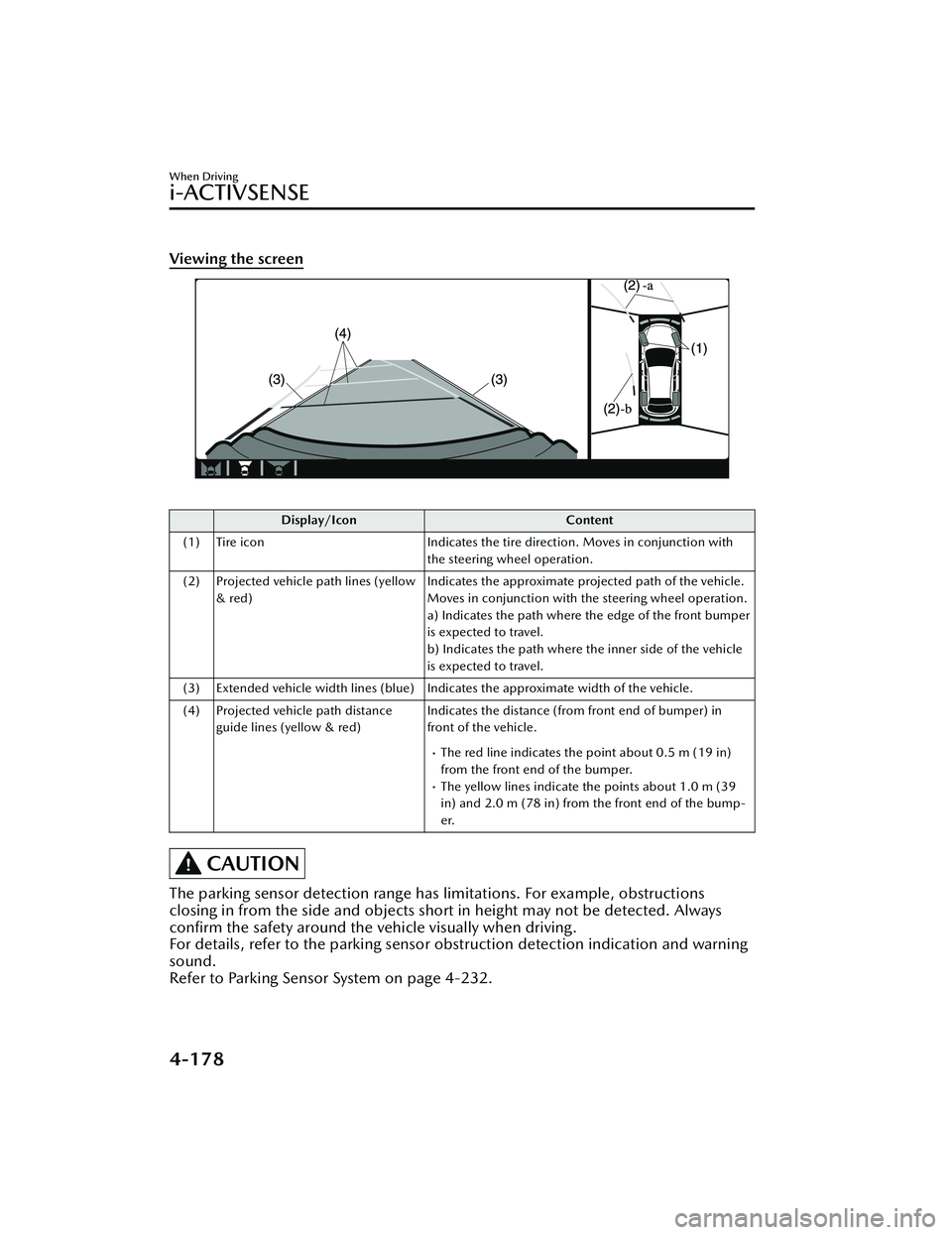
Viewing the screen
Display/IconContent
(1) Tire icon Indicates the tire direction. Moves in conjunction with
the steering wheel operation.
(2) Projected vehicle path lines (yellow & red) Indicates the approximate projected path of the vehicle.
Moves in conjunction with the steering wheel operation.
a) Indicates the path where the edge of the front bumper
is expected to travel.
b) Indicates the path where the inner side of the vehicle
is expected to travel.
(3) Extended vehicle width lines (blue) Indicates the approximate width of the vehicle.
(4) Projected vehicle path distance guide lines (yellow & red) Indicates the distance (from front end of bumper) in
front of the vehicle.
The red line indicates the point about 0.5 m (19 in)
from the front end of the bumper.
The yellow lines indicate the points about 1.0 m (39
in) and 2.0 m (78 in) from the front end of the bump-
er.
CAUTION
The parking sensor detection range has limitations. For example, obstructions
closing in from the side and objects shor
t in height may not be detected. Always
confirm the safety around the vehicle visually when driving.
For details, refer to the parking sensor obstruction detection indication and warning
sound.
Refer to Parking Sensor System on page 4-232.
When Driving
i-ACTIVSENSE
4-178
CX-30_8JP5-EA-20K_Edition1_new 2020-7-22 15:50:09
Page 330 of 594

How to use the projected vehicle path line function
1. (Screen display)
2. (Actual condition)
Make sure that there are no obstructions within the projected vehicle path lines.
Turn the steering wheel so that the projected vehicle path lines travel inside of the
obstruction (A), and drive the vehicle forward until it passes the obstruction.
If the projected vehicle path lines are on an obstruction (B) or outside of the
obstruction (C), the vehicle may contact the obstruction when turning the vehicle
sharply.
CAUTION
The parking sensor detection range has limitations. For example, obstructions
closing in from the side and objects short in height may not be detected. Always
confirm the safety around the vehicle visually when driving.
For details, refer to the parking sens or obstruction detection indication and
warning sound.
Refer to Parking Sensor System on page 4-232.
Do not turn the steering wheel any mo re until the vehicle has passed the
obstruction, even if the obstruction is no t visible on the side view image. If the
steering wheel is turned even more, the ve hicle may contact the obstruction if it is
turned sharply.
When Driving
i-ACTIVSENSE
4-184
CX-30_8JP5-EA-20K_Edition1_new 2020-7-22 15:50:09
Page 333 of 594

How to use the projected vehicle path line function
CAUTION
The front of the vehicle swings out wide when turning the steering wheel while
reversing. Maintain sufficient distance between the vehicle and an obstruction.
The parking sensor detection range has limitations. For example, obstructions
closing in from the side and objects short in height may not be detected. Always
confirm the safety around the vehicle visually when driving.
For details, refer to the parking sensor obstruction detection indication and
warning sound.
Refer to Parking Sensor System on page 4-232.
NOTE
Because there might be a
difference between the image displayed on the screen,
such as indicated in the following , and the actual conditions when parking, always
check the safety at the rear of the vehicle and the surrounding area directly with
your eyes.
Even though the back end of the parking space (or garage) displayed on the
screen and distance guide lines appear parallel, they may not actually be
parallel.
When parking in a space with a division line on only one side of the parking
space, even though the division line and the vehicle width guide line appear
parallel, they may not actually be parallel.
The following shows an example of vehicle parking with the steering wheel turned
to the left while backing up the vehicle. When backing into a parking space from
the opposite direction, the steering operation is reversed.
When Driving
i-ACTIVSENSE
4-187
CX-30_8JP5-EA-20K_Edition1_new 2020-7-22 15:50:09
Page 344 of 594

Forward Sensing Camera(FSC)
*
▼Forward Sensing Camera (FSC)
Your vehicle is equipped with a
Forward Sensing Camera (FSC). The
Forward Sensing Camera (FSC) is
positioned near the rearview mirror
and used by the following systems.
High Beam Control System (HBC)Lane Departure Warning System
(LDWS)
Tra ffi c
Sign Recognition System (TSR)Distance & Speed Alert (DSA)Driver Attention Alert (DAA)Mazda Radar Cruise Control
(MRCC)
Mazda Radar Cruise Control with
Stop & Go function (MRCC with
Stop & Go function)
Lane-keep Assist System (LAS)Tra ffi c Jam Assist (TJA)Smart Brake Support (SBS)
1. Forward Sensing Camera (FSC)
The Forward Sensing Camera (FSC)
determines the conditions ahead of
the vehicle while traveling at night and
detects traffic lanes. The distance in
which the Forward Sensing Camera
(FSC) can detect objects varies
depending on the surrounding
conditions.
WARNING
Do not modify the suspension:
If the vehicle height or inclination is
changed, the system will not be able to
correctly detect vehicles ahead. This
will result in the system not operating
normally or mistakenly operating,
which could cause a serious accident.
CAUTION
Do not apply accessories, stickers or
film to the windshield near the
Forward Sensing Camera (FSC).
If the area in front of the Forward
Sensing Camera (FSC) lens is
obstructed, it will cause the system
to not operate correctly.
Consequently, each system may not
operate normally which could lead
to an unexpected accident.
Do not disassemble or modify the
Forward Sensing Camera (FSC).
Disassembly or modification of the
Forward Sensing Camera (FSC) will
cause a malfunction or mistaken
operation. Consequently, each
system may not operate normally
which could lead to an unexpected
accident.
Heed the following cautions to
assure the correct operation of the
Forward Sensing Camera (FSC).
Be careful not to scratch the
Forward Sensing Camera (FSC)
lens or allow it to get dirty.
Do not remove the Forward
Sensing Camera (FSC) cover.
Do not place objects on the
dashboard which reflect light.
When Driving
i-ACTIVSENSE
4-198*Some models.
CX-30_8JP5-EA-20K_Edition1_new 2020-7-22 15:50:09