Page 574 of 612

7. Repeat with each tire, including thespare.
NOTE
Some spare tires require higher
inflation pressure.
8. Visually inspect the tires to make sure there are no nails or other
objects embedded that could poke
a hole in the tire and cause an air
leak.
9. Check the sidewalls to make sure there are no gouges, cuts, bulges,
cracks or other irregularities.
▼Glossary of Terms
Tire Placard:
A label indicating the OE
tire sizes, recommended inflation
pressure, and the maximum weight the
vehicle can carry.
Tire Identification Number (TIN):
A
number on the sidewall of each tire
providing information about the tire
brand and manufacturing plant, tire
size, and date of manufacture.
Inflation Pressure:
A measure of the
amount of air in a tire.
kPa: Kilopascal, the metric unit for air
pressure.
psi: Pounds per square inch, the
English unit for air pressure.
B-pillar: The structural member at the
side of the vehicle behind the front
door.
Original Equipment (OE): Describes
components originally equipped on
the vehicle.
Vehicle Load Limit: The maximum
value of the combination weight of
occupants and cargo.
Bead Area of the Tire: Area of the tire
next to the rim.
Sidewall Area of the Tire: Area
between the bead area and the tread.
Tread Area of the Tire: Area on the
perimeter of the tire that contacts the
road when it's mounted on the
vehicle.
Seating capacity means the total
allowable number of vehicle
occupants. Seating capacity is
described on the tire label.
Production options weight is the
combination weight of installed regular
production options weighing over 2.3
kilograms in excess of the standard
items which they replace, and not
previously considered in the curb
weight or accessory weight, including
heavy duty brakes, ride levelers, roof
rack, heavy duty battery, and special
trim.
Rim is the metal support (wheel) for a
tire or a tire and tube assembly upon
which the tire beads are seated.
Customer Information and Reporting Safety Defects
Tire Information (U.S.A.)
8-28
Mazda3_8JM2-EA-20H_Edition2_new 2020-8-19 13:13:07
Page 577 of 612
Ve h i c l e L o a d i n g
▼Ve h i c l e L o a d i n g
WARNING
Do not tow a trailer with this vehicle:
Towing a trailer with this vehicle is
dangerous because it has not been
designed to tow a trailer and doing so
will
affect the drive system which could
result in vehicle damage.
This section will guide you in the
proper loading of your vehicle, to keep
your loaded vehicle weight within its
design rating capability. Properly
loading your vehicle will provide
maximum return of vehicle design
performance. Before loading your
vehicle, familiarize yourself with the
following terms for determining your
vehicle's weight ratings, from the
vehicle's Safety Certification Label and
Tire and Load Information Label:
WARNING
Overloaded Vehicle:
Overloading a vehicle is dangerous.
The results of overloading can have
serious consequences in terms of
passenger safety. Too much weight on
a vehicle's suspension system can
cause spring or shock absorber failure,
brake failure, handling or steering
problems, irregular tire wear, tire
failure or other damage.
Overloading makes a vehicle harder to
drive and control. It also increases the
distance required for stopping. In cases
of serious overloading, brakes can fail
completely, particularly on steep
grades. The load a tire will carry safely
is a combination of the size of the tire,
its load range, and corresponding
inflation pressure.
Never overload the vehicle and always
observe the vehicle's weight ratings
from the vehicle's Safety Certification
and Tire and Load Information labels.
Base Curb Weight is the weight of the
vehicle including a full tank of fuel
and all standard equipment. It does
not include passengers, cargo, or
optional equipment.
Vehicle Curb Weight is the weight of
your new vehicle when you picked it
up from your dealer plus any
aftermarket equipment.
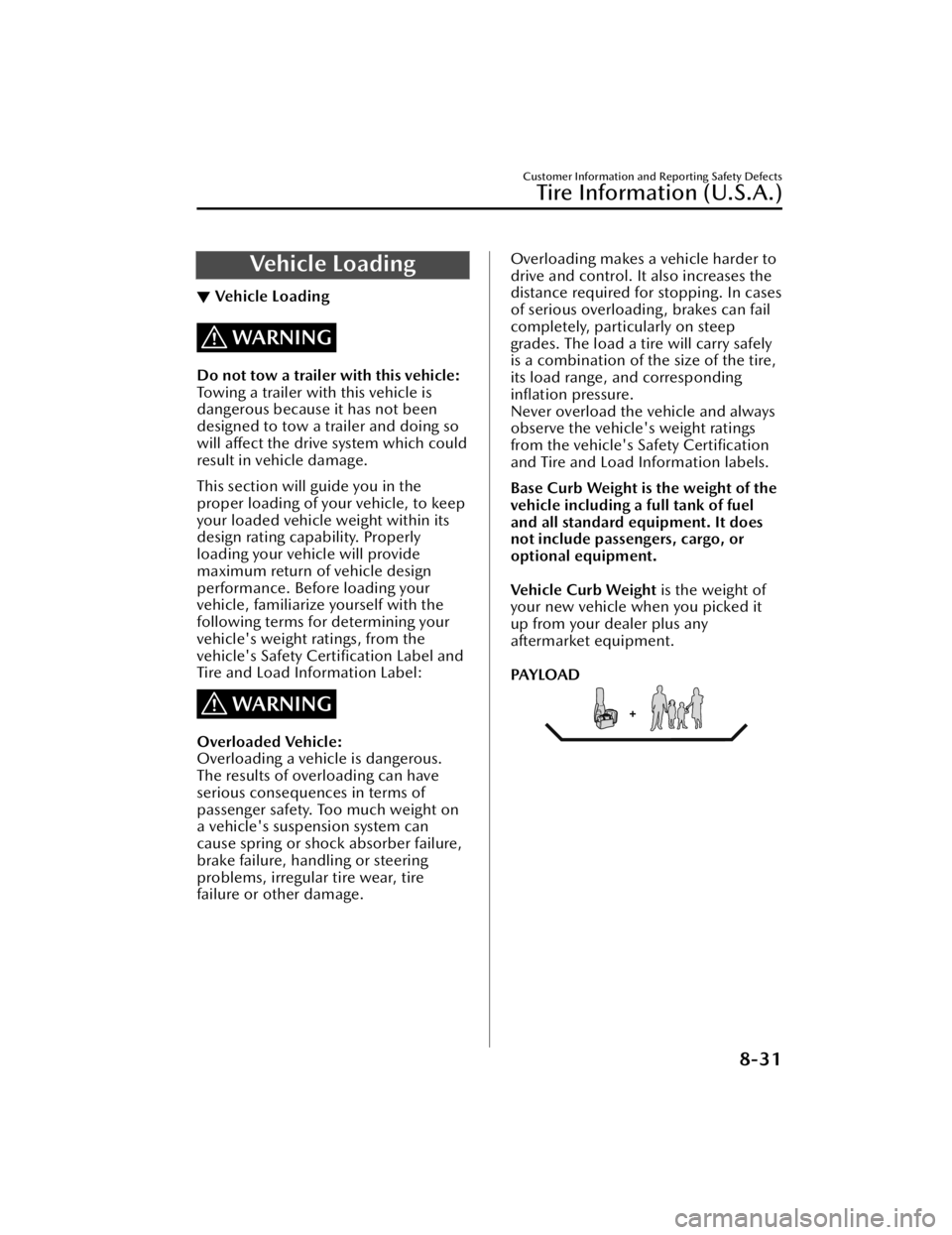
PAY LOA D
Customer Information and Reporting Safety Defects
Tire Information (U.S.A.)
8-31
Mazda3_8JM2-EA-20H_Edition2_new 2020-8-19 13:13:07
Page 595 of 612
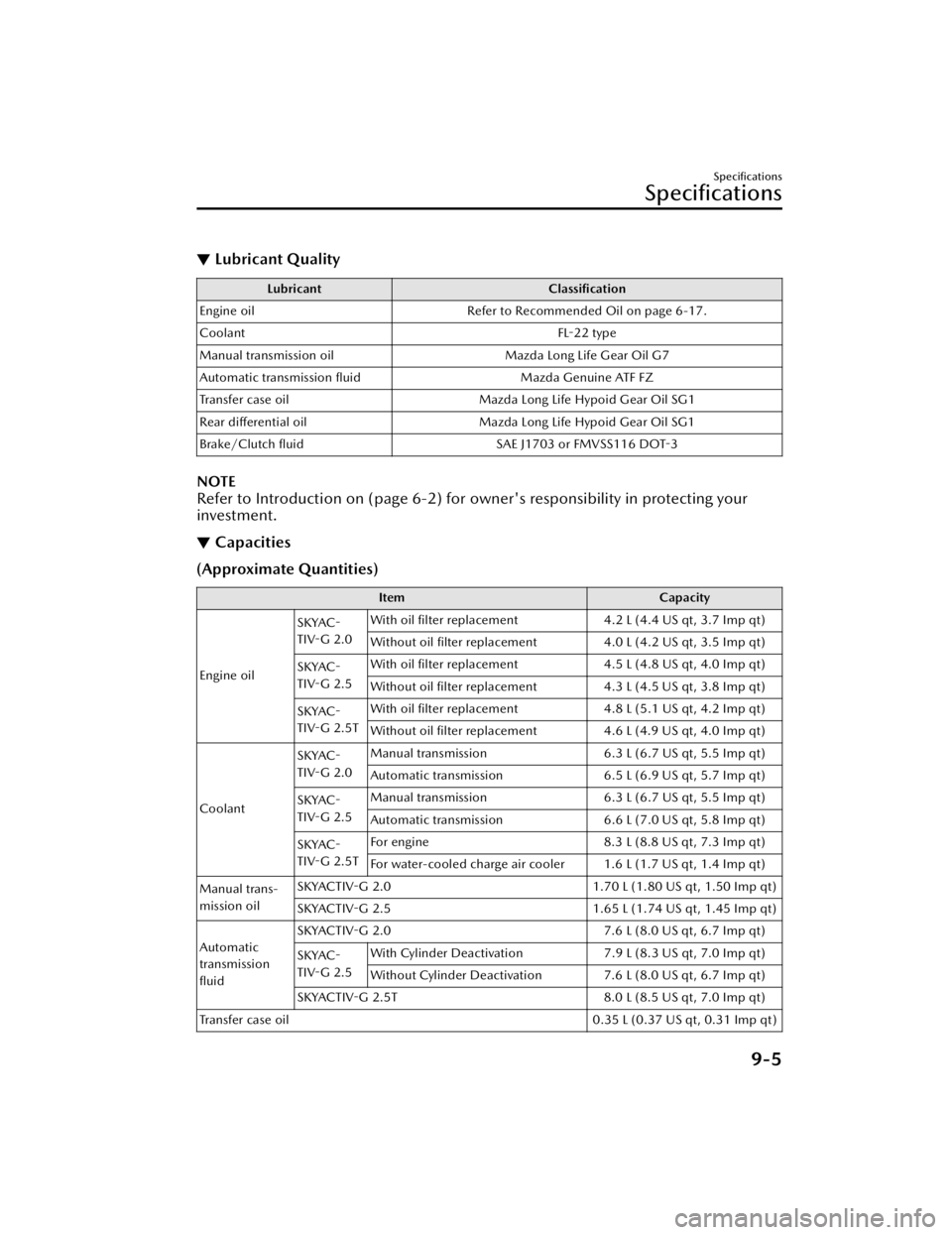
▼Lubricant Quality
Lubricant
Classification
Engine oil Refer to Recommended Oil on page 6-17.
Coolant FL-22 type
Manual transmission oil Mazda Long Life Gear Oil G7
Automatic transmission fluid Mazda Genuine ATF FZ
Transfer case oil Mazda Long Life Hypoid Gear Oil SG1
Rear differential oil Mazda Long Life Hypoid Gear Oil SG1
Brake/Clutch fluid SAE J1703 or FMVSS116 DOT-3
NOTE
Refer to Introduction on (page 6-2) for owner's responsibility in protecting your
investment.
▼Capacities
(Approximate Quantities)
Item
Capacity
Engine oil SKYAC-
TIV-G 2.0
With oil filter replacement
4.2 L (4.4 US qt, 3.7 Imp qt)
Without oil filter replacement 4.0 L (4.2 US qt, 3.5 Imp qt)
SKYAC-
TIV-G 2.5 With oil filter replacement
4.5 L (4.8 US qt, 4.0 Imp qt)
Without oil filter replacement 4.3 L (4.5 US qt, 3.8 Imp qt)
SKYAC-
TIV-G 2.5T With oil filter replacement
4.8 L (5.1 US qt, 4.2 Imp qt)
Without oil filter replacement 4.6 L (4.9 US qt, 4.0 Imp qt)
Coolant SKYAC-
TIV-G 2.0
Manual transmission
6.3 L (6.7 US qt, 5.5 Imp qt)
Automatic transmission 6.5 L (6.9 US qt, 5.7 Imp qt)
SKYAC-
TIV-G 2.5 Manual transmission
6.3 L (6.7 US qt, 5.5 Imp qt)
Automatic transmission 6.6 L (7.0 US qt, 5.8 Imp qt)
SKYAC-
TIV-G 2.5T For engine
8.3 L (8.8 US qt, 7.3 Imp qt)
For water-cooled charge air cooler 1.6 L (1.7 US qt, 1.4 Imp qt)
Manual trans-
mission oil SKYACTIV-G 2.0
1.70 L (1.80 US qt, 1.50 Imp qt)
SKYACTIV-G 2.5 1.65 L (1.74 US qt, 1.45 Imp qt)
Automatic
transmission
fluid SKYACTIV-G 2.0
7.6 L (8.0 US qt, 6.7 Imp qt)
SKYAC-
TIV-G 2.5 With Cylinder Deactivation
7.9 L (8.3 US qt, 7.0 Imp qt)
Without Cylinder Deactivation 7.6 L (8.0 US qt, 6.7 Imp qt)
SKYACTIV-G 2.5T 8.0 L (8.5 US qt, 7.0 Imp qt)
Transfer case oil 0.35 L (0.37 US qt, 0.31 Imp qt)
Specifications
Specifications
9-5
Mazda3_8JM2-EA-20H_Edition2_new 2020-8-19 13:13:07