2021 LEXUS RCF ECU
[x] Cancel search: ECUPage 323 of 408
3237-2. Steps to take in an emergency
7
When trouble arises
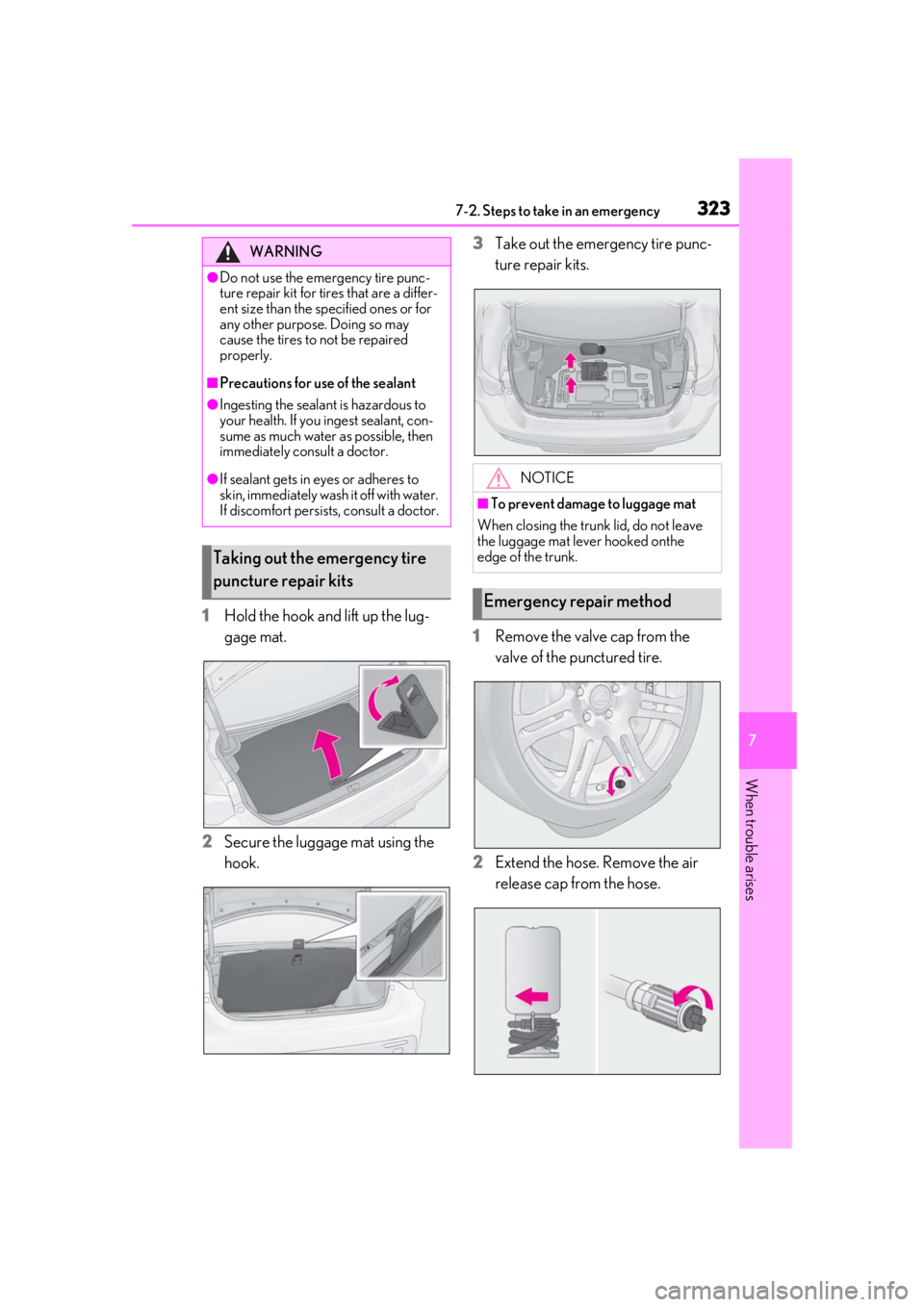
1Hold the hook and lift up the lug-
gage mat.
2 Secure the luggage mat using the
hook. 3
Take out the emergency tire punc-
ture repair kits.
1 Remove the valve cap from the
valve of the punctured tire.
2 Extend the hose. Remove the air
release cap from the hose.
WARNING
●Do not use the emergency tire punc-
ture repair kit for ti res that are a differ-
ent size than the specified ones or for
any other purpose. Doing so may
cause the tires to not be repaired
properly.
■Precautions for use of the sealant
●Ingesting the sealant is hazardous to
your health. If you ingest sealant, con-
sume as much water as possible, then
immediately consult a doctor.
●If sealant gets in eyes or adheres to
skin, immediately wash it off with water.
If discomfort persists, consult a doctor.
Taking out the emergency tire
puncture repair kits
NOTICE
■To prevent damage to luggage mat
When closing the trunk lid, do not leave
the luggage mat lever hooked onthe
edge of the trunk.
Emergency repair method
Page 324 of 408

3247-2. Steps to take in an emergency
You will use the air release cap again.
Therefore keep it in a safe place.
3Connect the hose to the valve.
Screw the end of the hose clockwise as far
as possible.
4Make sure that the compressor
switch is off.
5 Lift the rubber stopper on the com-
pressor. 6
Remove the power plug from the
compressor.
7 Connect the power plug to the
power outlet socket. ( P.228)
8 Connect the bottle to the compres-
sor.
Make sure that the bo ttle is securely con-
nected.
9 Attach the 2 stickers as shown.
Remove any dirt and moisture from the
wheel before attaching the label. If it is
impossible to attach the label, make sure to
tell your Lexus dealer when you have them
repair and replace the tire that sealant is
Page 327 of 408

3277-2. Steps to take in an emergency
7
When trouble arises
step 22.
21 Turn the compressor switch on to
inflate the tire until the recom-
mended tire inflation pressure is
reached. Drive for about 3 miles (5
km) and then perform step 19 .
22 Attach the air release cap to the
end of the hose.
If the air release cap is not attached, the
sealant may leak and the vehicle may get
dirty.
23Store the bottle in the trunk while it
is connected to the compressor.
24 Taking precautions to avoid sud-
den braking, sudd en acceleration
and sharp turns, drive carefully at
under 50 mph (80 km/h) to your
Lexus dealer that is less than 62
miles (100 km) away for tire repair
or replacement.
■After a tire is repaired with the emer-
gency tire puncture repair kit
●The tire pressure warning valve and
transmitter should be replaced.
●Even if the tire inflat ion pressure is at the
recommended level, the tire pressure
warning light may come on/flash.
■If the tire is inflated to more than the
recommended level
1 Disconnect the hose from the valve.
2 Install the air release cap to the end of
the hose and push th e protrusion on the air release cap into the valve to let some
air out.
3 Disconnect the hose from the valve,
remove the air release cap from the
hose and then reconnect the hose.
4 Turn the compressor switch on and wait
for several seconds, then turn it off.
Check that the air pressure indicator
shows the recommended level.
( P.347)
If the air pressure is lower than the rec-
ommended level, turn the compressor
switch on again and repeat the inflation
procedure until the recommended
pressure is reached.
WARNING
■When fixing the flat tire
Observe the following precautions.
Failure to do so may result in death or
serious injury.
●Stop your vehicle in a safe and flat
area.
●Do not touch the wheels or the area
around the brakes immediately after
the vehicle has been driven.
After the vehicle has been driven, the
wheels and the area around the brakes
may be extremely hot. Touching these
areas with hands, feet or other body
parts may result in burns.
●Connect the valve and hose securely
with the tire installed on the vehicle.
• If the hose is not properly connected to the valve, air leakage may occur or
sealant may be sprayed out.
Page 336 of 408

3367-2. Steps to take in an emergency
Once the engine starts, have the vehi-
cle inspected at your Lexus dealer as
soon as possible.
■Starting the engine when the battery is
discharged
The engine cannot be started by push-start-
ing.
■To prevent battery discharge
●Turn off the headlights and the audio sys-
tem while the engine is off.
●Turn off any unnecessary electrical com-
ponents when the vehicle is running at a
low speed for an extended period, such
as in heavy traffic.
■Charging the battery
The electricity stored in the battery will dis-
charge gradually even when the vehicle is
not in use, due to natural discharge and the
draining effects of certain electrical appli-
ances. If the vehicle is left for a long time,
the battery may discharge, and the engine
may be unable to start. (The battery
recharges automatically during driving.)
■When recharging or replacing the bat-
tery
●In some cases, it may not be possible to
unlock the doors using the smart access
system with push-button start when the
battery is discharged. Use the wireless
remote control or the mechanical key to
lock or unlock the doors.
●The engine may not start on the first
attempt after the battery has recharged
but will start normally after the second
attempt. This is not a malfunction.
●The engine switch mode is memorized by
the vehicle. When the battery is recon-
nected, the system will return to the
mode it was in before the battery was dis-
charged. Before di sconnecting the bat-
tery, turn the engine switch off.
If you are unsure what mode the engine
switch was in befo re the battery dis-
charged, be especially careful when
reconnecting the battery.
■When replacing the battery
●Use a battery that conforms to European
regulations.
●Use a battery that tha case size is same as
the previous one (LN3), 20 hour rate
capacity (20HR) is equivalent (70Ah) or
greater, and performance rating (CCA)
is equivalent (592A) or greater.
• If the sizes differ, the battery cannot be properly secured.
• If the 20 hour rate capacity is low, even if the time period where the vehicle is not
used is a short time, battery may dis-
charge and the engine may not be able to
start.
●For details, consult your Lexus dealer.
WARNING
■Avoiding battery fires or explosions
Observe the following precautions to
prevent accidentally igniting the flamma-
ble gas that may be emitted from the bat-
tery:
●Make sure each jumper cable is con-
nected to the correct terminal and that
it is not unintentionally in contact with
any other than the intended terminal.
●Do not allow the other end of the
jumper cable connected to the “+” ter-
minal to come into contact with any
other parts or meta l surfaces in the
area, such as brackets or unpainted
metal.
●Do not allow the + and - clamps of the
jumper cables to come into contact
with each other.
●Do not smoke, use matches, cigarette
lighters or allow open flame near the
battery.
■Battery precautions
The battery contains poisonous and cor-
rosive acidic electrol yte, while related
parts contain lead and lead compounds.
Observe the following precautions when
handling the battery:
Page 359 of 408

3598-1. Specifications
8
Vehicle specifications
*: Table 1 - Occupant loading and distribution for vehicle normal load for various desig-
nated seating capacities
Treadwear indicators (TWI)
The projections within the principal grooves
designed to give a visual indication of the degrees
of wear of the tread
Wheel-holding fixtureThe fixture used to hold the wheel and tire assembly
securely during testing
Tire related termMeaning
Designated seating capac- ity, Number of occupantsVehicle normal load, Num- ber of occupantsOccupant distribution in a normally loaded vehicle
2 through 422 in front
5 through 1032 in front, 1 in second seat
11 through 1552 in front, 1 in second seat, 1 in third seat, 1 in fourth seat
16 through 2072 in front, 2 in second seat, 2 in third seat, 1 in fourth seat
Page 363 of 408

3638-2. Customization
8
Vehicle specifications
■Smart access system with push-button start and wireless remote control
( P.92, 95)
■Smart access system with push-button start ( P.92, 95, 98)
■Wireless remote control ( P.88, 92, 95)
FunctionDefault settingCustomized setting
Operation buzzer volume5OffO—O1 to 7
Operation signal (Emer-
gency flashers)OnOffO—O
Time elapsed before auto-
matic door lock function is
activated if door is not
opened after being unlocked
60 seconds
Off
O—O30 seconds
120 seconds
Open door warning buzzerOnOff——O
Welcome light illumination
controlOnOffO—O
ABC
FunctionDefault settingCustomized setting
Smart access system with
push-button startOnOff——O
Smart door unlockingDriver’s doorBoth side doorsO—O
Number of consecutive door
lock operations2 timesAs many as desired——O
ABC
FunctionDefault settingCustomized setting
Wireless remote controlOnOff——O
Unlocking operation
Driver’s door
unlocked in one
step, both side doors unlocked in two steps
Both side doors
unlocked in one stepO—O
ABC
Page 380 of 408

3809-1. For owners
9-1.For owners
Déroulez la sangle diagonale de
telle sorte qu'elle passe bien sur
l'épaule, sans pour autant être en
contact avec le cou ou glisser de
l'épaule.
Placez la sangle abdominale le plus
bas possible sur les hanches.
Réglez la position du dossier de
siège. Asseyez-vous le dos droit et
calez-vous bien dans le siège.
Ne vrillez pas la ceinture de sécu-
rité.
Reporting safety defects for
U.S. owners
If you believe that your vehicle has a
defect which could cause a crash or
could cause injury or death, you
should immediately inform the
National Highway Traffic Safety
Administration (NHTSA) in addi-
tion to notifying the Lexus Division
of Toyota Motor Sa les, U.S.A., Inc.
(Toll-free: 1-800-25-LEXUS).
If NHTSA receives similar com-
plaints, it may open an investiga-
tion, and if it finds that a safety
defect exists in a group of vehicles,
it may order a recall and remedy
campaign. However, NHTSA can-
not become involved in individual
problems between you, your dealer,
or Lexus Division of Toyota Motor
Sales, U.S.A., Inc.
To contact NHTS A, you may call
the Vehicle Safety Hotline toll-free
at 1-888-327-4236 (TTY:
1-800-424-9153); go to
http://www.safercar.gov ; or write
to: Administrator, NHTSA, 1200
New Jersey Ave. SE., Washington,
DC 20590. You can also obtain
other information about motor
vehicle safety from http://www.saf-
ercar.gov.
Seat belt instructions for
Canadian owners (in French)
The following is a French explana-
tion of seat belt instructions
extracted from the seat belt section
in this manual.
See the seat belt section for more
detailed seat belt instructions in
English.
Utilisation correcte des cein-
tures de sécurité
Page 381 of 408

3819-1. For owners
9
For owners
Non vrillée
Vrillée
■Traitement des ceintures de sécu-
rité
Nettoyez avec un chiffon ou une
éponge humidifiés avec de l'eau savon-
neuse tiède. Vérifiez régulièrement
que les ceintures ne sont pas usées,
effilochées ou entaillées excessive-
ment.
Entretien et soin
AVERTISSEMENT
■Détérioration et usure des ceintures
de sécurité
Inspectez le système de ceintures de
sécurité régulière ment. Contrôlez
l'absence de coupures, d'effilochages et
de pièces desserrées. N'utilisez pas une
ceinture de sécurité endommagée avant
qu'elle ne soit remplacée. Une ceinture
de sécurité endommagée ne permet pas
de protéger un occupant de blessures
graves ou mortelles.
A
B