Page 110 of 464
1103-2. Opening, closing and locking the doors and trunk
lowing operations.
●Locking and unlocking the doors and
opening the trunk:
Use the wireless remote control or
mechanical key. (P.95, 101, 387)
●Starting the engine and changing engine
switch modes: P.388
●Stopping the engine: P.146
■Certification for the smart access system with push-button start
For vehicles sold in the U.S.A., Hawaii, Guam and Puerto Rico
Page 180 of 464
1804-5. Using the driving support systems
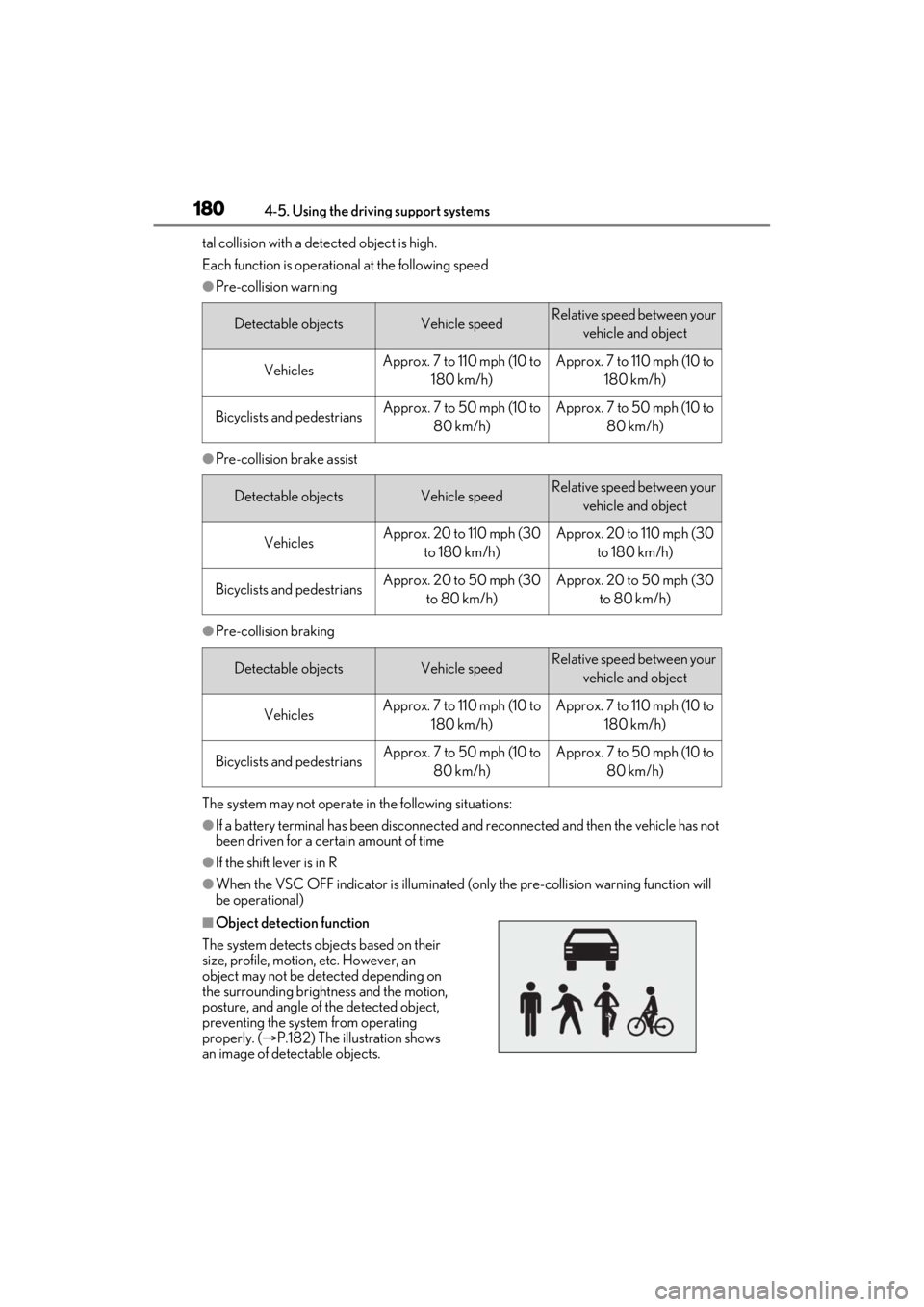
tal collision with a detected object is high.
Each function is operational at the following speed
●Pre-collision warning
●Pre-collision brake assist
●Pre-collision braking
The system may not operate in the following situations:
●If a battery terminal has been disconnected and reconnected and then the vehicle has not
been driven for a certain amount of time
●If the shift lever is in R
●When the VSC OFF indicator is illuminated (only the pre-collision warning function will
be operational)
■Object detection function
The system detects ob jects based on their
size, profile, motion, etc. However, an
object may not be detected depending on
the surrounding brightness and the motion,
posture, and angle of the detected object,
preventing the system from operating
properly. ( P.182) The illustration shows
an image of dete ctable objects.
Detectable objectsVehicle speedRelative speed between your
vehicle and object
VehiclesApprox. 7 to 110 mph (10 to 180 km/h)Approx. 7 to 110 mph (10 to 180 km/h)
Bicyclists and pedestriansApprox. 7 to 50 mph (10 to 80 km/h)Approx. 7 to 50 mph (10 to 80 km/h)
Detectable objectsVehicle speedRelative speed between your vehicle and object
VehiclesApprox. 20 to 110 mph (30 to 180 km/h)Approx. 20 to 110 mph (30 to 180 km/h)
Bicyclists and pedestriansApprox. 20 to 50 mph (30 to 80 km/h)Approx. 20 to 50 mph (30 to 80 km/h)
Detectable objectsVehicle speedRelative speed between your vehicle and object
VehiclesApprox. 7 to 110 mph (10 to 180 km/h)Approx. 7 to 110 mph (10 to 180 km/h)
Bicyclists and pedestriansApprox. 7 to 50 mph (10 to 80 km/h)Approx. 7 to 50 mph (10 to 80 km/h)
Page 405 of 464
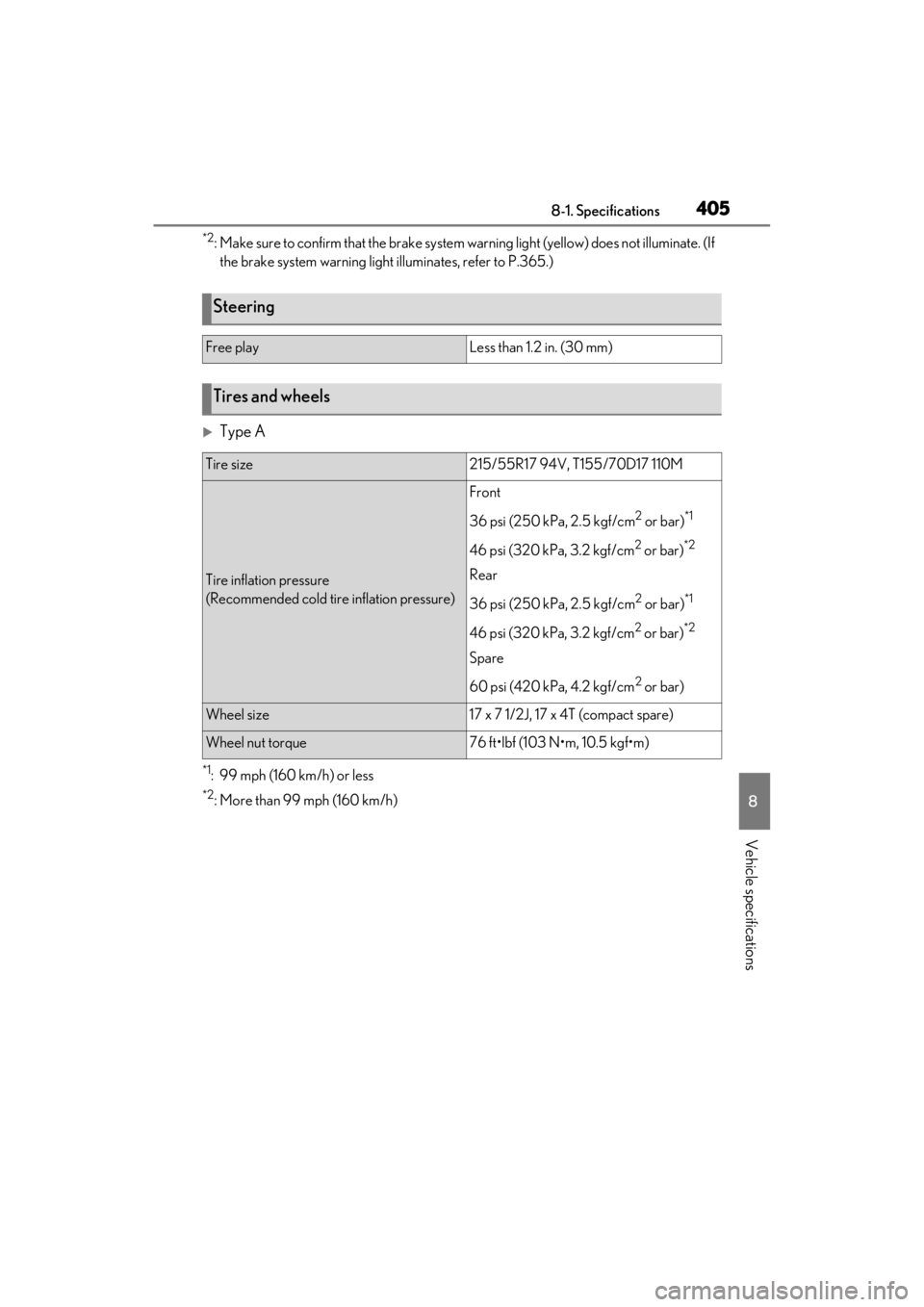
4058-1. Specifications
8
Vehicle specifications
*2: Make sure to confirm that the brake system warning light (yellow) does not illuminate. (If
the brake system warning light illuminates, refer to P.365.)
Type A
*1: 99 mph (160 km/h) or less
*2: More than 99 mph (160 km/h)
Steering
Free playLess than 1.2 in. (30 mm)
Tires and wheels
Tire size215/55R17 94V, T155/70D17 110M
Tire inflation pressure
(Recommended cold tire inflation pressure)
Front
36 psi (250 kPa, 2.5 kgf/cm
2 or bar)*1
46 psi (320 kPa, 3.2 kgf/cm2 or bar)*2
Rear
36 psi (250 kPa, 2.5 kgf/cm
2 or bar)*1
46 psi (320 kPa, 3.2 kgf/cm2 or bar)*2
Spare
60 psi (420 kPa, 4.2 kgf/cm
2 or bar)
Wheel size17 x 7 1/2J, 17 x 4T (compact spare)
Wheel nut torque76 ft•lbf (103 N•m, 10.5 kgf•m)
Page 406 of 464
4068-1. Specifications
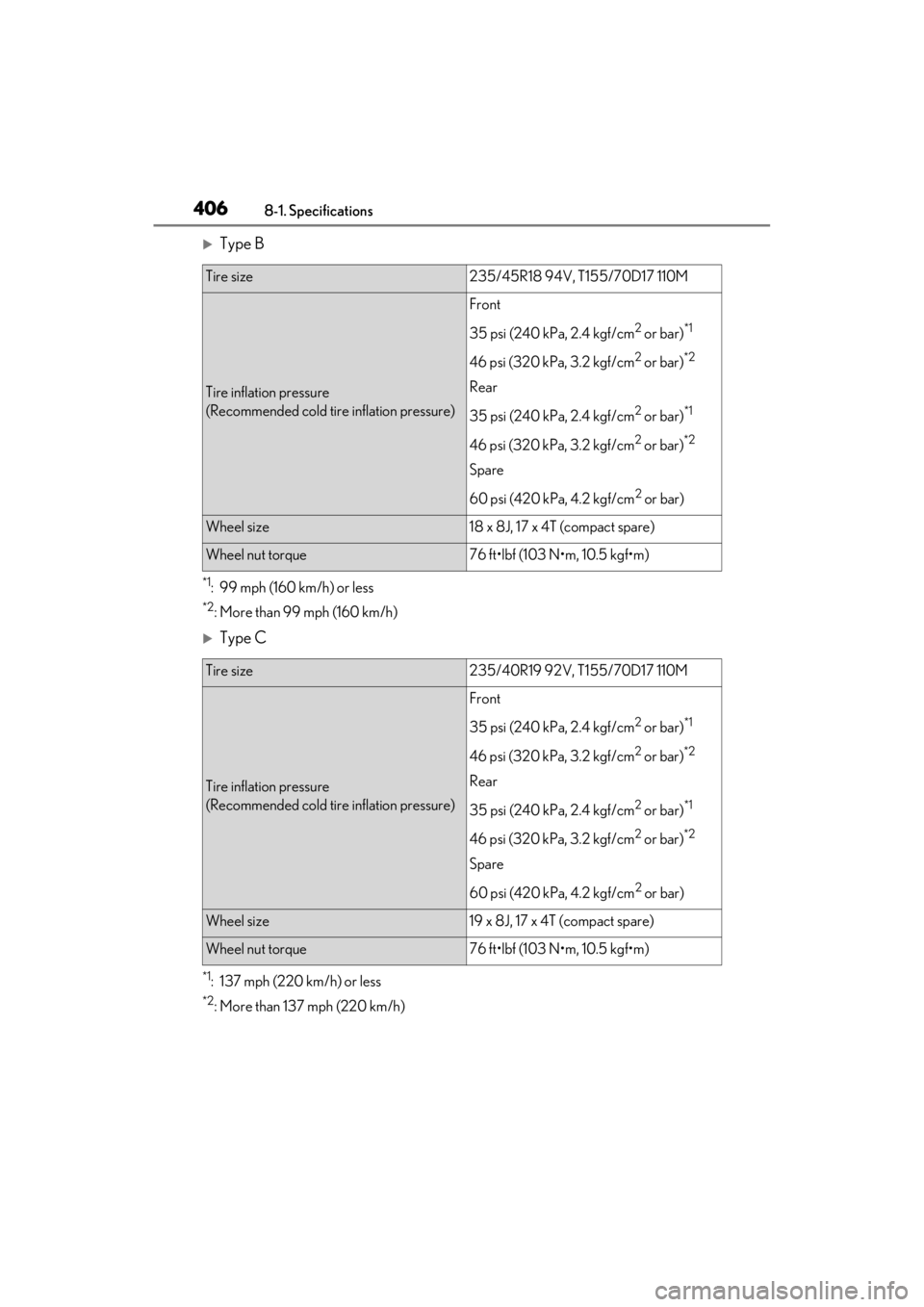
Type B
*1: 99 mph (160 km/h) or less
*2: More than 99 mph (160 km/h)
Type C
*1: 137 mph (220 km/h) or less
*2: More than 137 mph (220 km/h)
Tire size235/45R18 94V, T155/70D17 110M
Tire inflation pressure
(Recommended cold tire inflation pressure)
Front
35 psi (240 kPa, 2.4 kgf/cm
2 or bar)*1
46 psi (320 kPa, 3.2 kgf/cm2 or bar)*2
Rear
35 psi (240 kPa, 2.4 kgf/cm
2 or bar)*1
46 psi (320 kPa, 3.2 kgf/cm2 or bar)*2
Spare
60 psi (420 kPa, 4.2 kgf/cm
2 or bar)
Wheel size18 x 8J, 17 x 4T (compact spare)
Wheel nut torque76 ft•lbf (103 N•m, 10.5 kgf•m)
Tire size235/40R19 92V, T155/70D17 110M
Tire inflation pressure
(Recommended cold tire inflation pressure)
Front
35 psi (240 kPa, 2.4 kgf/cm
2 or bar)*1
46 psi (320 kPa, 3.2 kgf/cm2 or bar)*2
Rear
35 psi (240 kPa, 2.4 kgf/cm
2 or bar)*1
46 psi (320 kPa, 3.2 kgf/cm2 or bar)*2
Spare
60 psi (420 kPa, 4.2 kgf/cm
2 or bar)
Wheel size19 x 8J, 17 x 4T (compact spare)
Wheel nut torque76 ft•lbf (103 N•m, 10.5 kgf•m)
Page 418 of 464
4188-1. Specifications
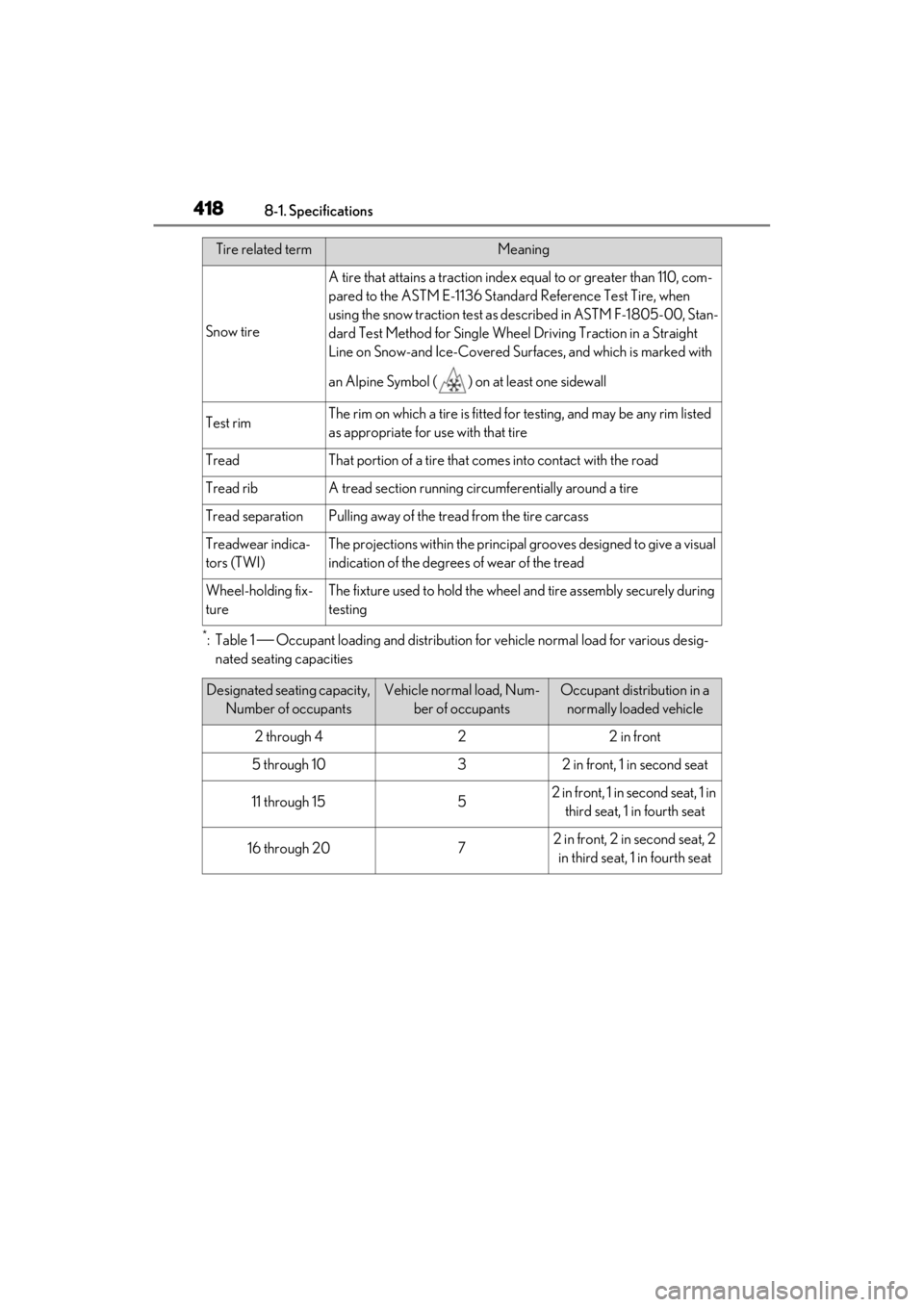
*:Table 1 Occupant loading and distribution for vehicle normal load for various desig-
nated seating capacities
Snow tire
A tire that attains a traction index equal to or greater than 110, com-
pared to the ASTM E-1136 Standa rd Reference Test Tire, when
using the snow traction test as de scribed in ASTM F-1805-00, Stan-
dard Test Method for Single Whee l Driving Traction in a Straight
Line on Snow-and Ice-Covered Surf aces, and which is marked with
an Alpine Symbol ( ) on at least one sidewall
Test rimThe rim on which a tire is fitted fo r testing, and may be any rim listed
as appropriate for use with that tire
TreadThat portion of a tire that comes into contact with the road
Tread ribA tread section running circumferentially around a tire
Tread separationPulling away of the tread from the tire carcass
Treadwear indica-
tors (TWI)The projections within th e principal grooves designed to give a visual
indication of the degree s of wear of the tread
Wheel-holding fix-
tureThe fixture used to hold the wheel and tire assembly securely during
testing
Designated seating capacity,
Number of occupantsVehicle normal load, Num- ber of occupantsOccupant distribution in a normally loaded vehicle
2 through 422 in front
5 through 1032 in front, 1 in second seat
11 through 1552 in front, 1 in second seat, 1 in
third seat, 1 in fourth seat
16 through 2072 in front, 2 in second seat, 2 in third seat, 1 in fourth seat
Tire related termMeaning