2021 HYUNDAI ELANTRA HYBRID tow
[x] Cancel search: towPage 469 of 555
Emergency Situations
8-24
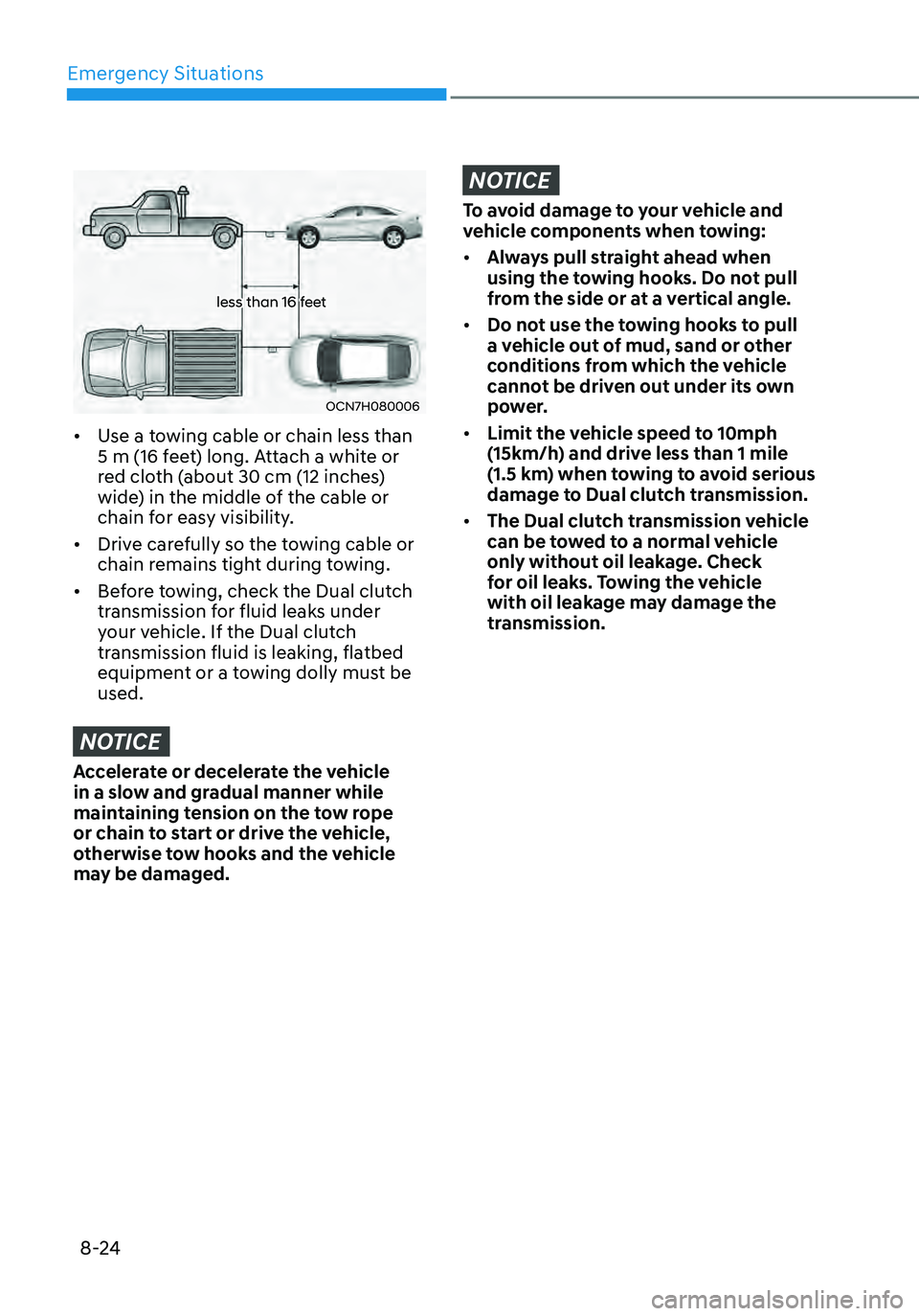
less than 16 feet
OCN7H080006
• Use a towing cable or chain less than
5 m (16 feet) long. Attach a white or
red cloth (about 30 cm (12 inches)
wide) in the middle of the cable or
chain for easy visibility.
• Drive carefully so the towing cable or
chain remains tight during towing.
• Before towing, check the Dual clutch
transmission for fluid leaks under
your vehicle. If the Dual clutch
transmission fluid is leaking, flatbed
equipment or a towing dolly must be
used.
NOTICE
Accelerate or decelerate the vehicle
in a slow and gradual manner while
maintaining tension on the tow rope
or chain to start or drive the vehicle,
otherwise tow hooks and the vehicle
may be damaged.
NOTICE
To avoid damage to your vehicle and
vehicle components when towing:
• Always pull straight ahead when
using the towing hooks. Do not pull
from the side or at a vertical angle.
• Do not use the towing hooks to pull
a vehicle out of mud, sand or other
conditions from which the vehicle
cannot be driven out under its own
power.
• Limit the vehicle speed to 10mph
(15km/h) and drive less than 1 mile
(1.5 km) when towing to avoid serious
damage to Dual clutch transmission.
• The Dual clutch transmission vehicle
can be towed to a normal vehicle
only without oil leakage. Check
for oil leaks. Towing the vehicle
with oil leakage may damage the
transmission.
Page 476 of 555
09
9 -7
Follow Normal Maintenance Schedule if the vehicle is usually operated where none of
the following conditions apply. If any of the following conditions apply, you must follow
the Maintenance Under Severe Usage Conditions.
• Repeatedly driving short distance of less than 8 km (5 miles) in normal temperature
of less than 16 km (10 miles) in freezing temperature.
• Extensive engine idling or low speed driving for long distances.
• Driving on rough, dusty, muddy, unpaved, graveled or salt- spread roads.
• Driving in areas using salt or other corrosive materials or in very cold weather.
• Driving in heavy dust condition.
• Driving in heavy traffic area.
• Driving on uphill, downhill, or mountain road repeatedly.
• Using for towing or camping, and driving with loading on the roof.
• Driving as a patrol car, taxi, other commercial use of vehicle towing.
• Frequently driving under high speed or rapid acceleration.
• Frequently driving in stop-and-go condition.
• Engine oil usage which is not recommended(Mineral type, Semisynthetic, Lower
grade spec, etc.)
SCHEDULED MAINTENANCE SERVICES
Page 482 of 555
09
9-13
Maintenance under severe usage conditions
Maintenance itemMaintenance
operation Maintenance Intervals
Driving condition
Steering gear rack,
linkage and boots IInspect more frequently
depending on the condition C, D, E, F, G
Front suspension ball
joints IInspect more frequently
depending on the condition C, D, E, F, G
Disc brakes and pads,
calipers and rotors IInspect more frequently
depending on the condition C, D, E, G, H
Parking brake IInspect more frequently
depending on the condition C, D, G, H
Driveshaft and boots IInspect more frequently
depending on the condition C, D, E, F, G, H, I, J
Cabin air filter RReplace more frequently
depending on the condition C, E
Severe driving conditions
A. Repeatedly driving short distance of less than 5 miles (8 km) in normal temperature
or less than 10 miles (16 km) in freezing temperature
B. Extensive engine idling or low speed driving for long distances
C. Driving on rough, dusty, muddy, unpaved, graveled or saltspread roads
D. Driving in areas using salt or other corrosive materials or in very cold weather
E. Driving in the condition of inflowing sand or dust into engine
F. Driving in heavy traffic area
G. Driving on uphill, downhill, or mountain roads
H. Using for towing or camping, and driving with loading on the roof.
I. Driving for patrol car, taxi, commercial car or vehicle towing
J. Frequently driving under high speed or rapid acceleration.
K. Frequently driving in stop-and-go conditions
L. Engine oil usage which is not recommended (Mineral type, Semi-synthetic, Lower
grade spec, etc.)
Page 488 of 555
09
9-19
WARNING
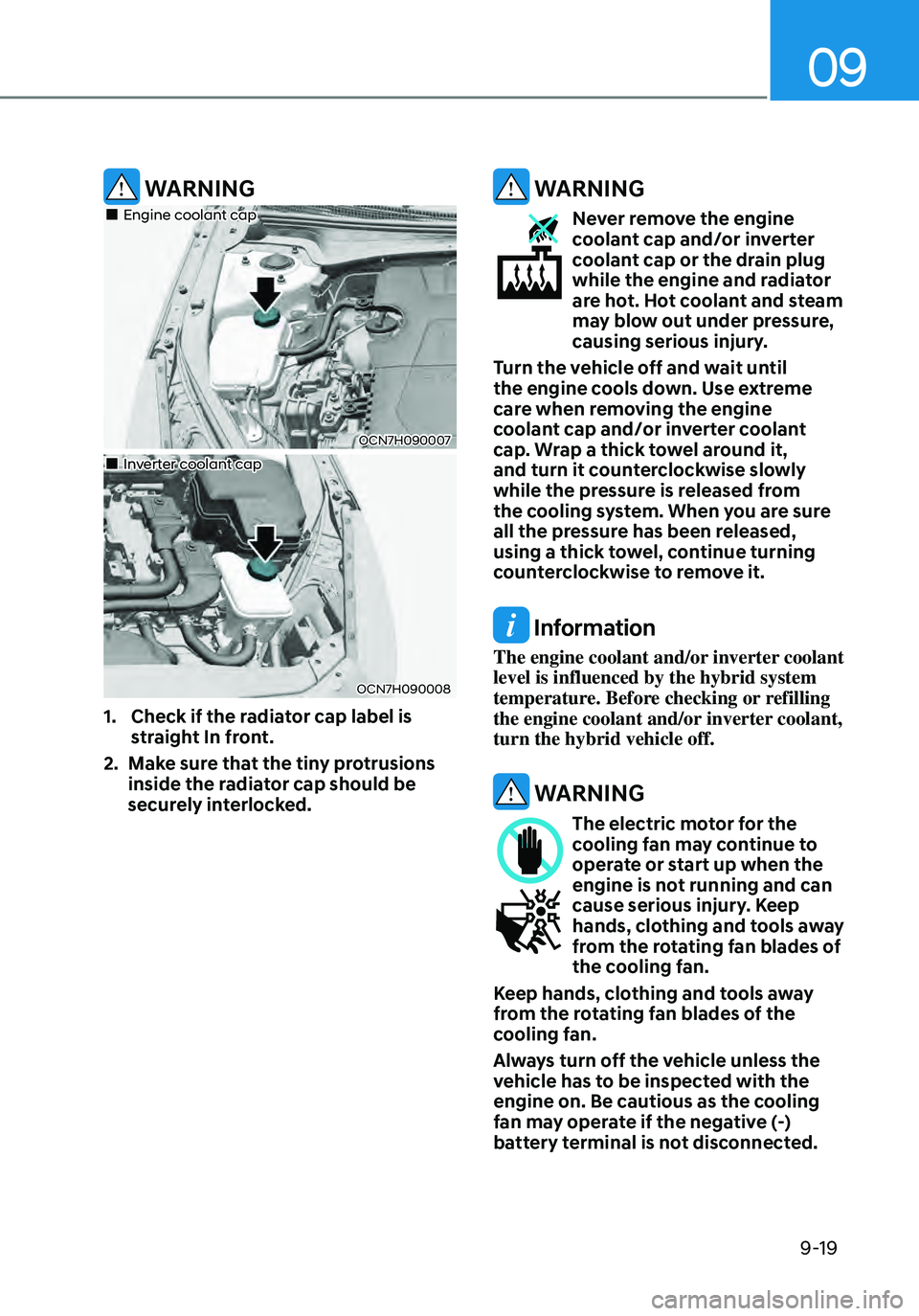
OCN7H090007
„„Engine coolant cap
OCN7H090008
„„Inverter coolant cap
1. Check if the radiator cap label is
straight In front.
2. Make sure that the tiny protrusions
inside the radiator cap should be
securely interlocked.
WARNING
Never remove the engine coolant cap and/or inverter
coolant cap or the drain plug
while the engine and radiator
are hot. Hot coolant and steam
may blow out under pressure,
causing serious injury.
Turn the vehicle off and wait until
the engine cools down. Use extreme
care when removing the engine
coolant cap and/or inverter coolant
cap. Wrap a thick towel around it,
and turn it counterclockwise slowly
while the pressure is released from
the cooling system. When you are sure
all the pressure has been released,
using a thick towel, continue turning
counterclockwise to remove it.
Information
The engine coolant and/or inverter coolant
level is influenced by the hybrid system
temperature. Before checking or refilling
the engine coolant and/or inverter coolant,
turn the hybrid vehicle off.
WARNING
The electric motor for the cooling fan may continue to
operate or start up when the
engine is not running and can
cause serious injury. Keep
hands, clothing and tools away
from the rotating fan blades of
the cooling fan.
Keep hands, clothing and tools away
from the rotating fan blades of the
cooling fan.
Always turn off the vehicle unless the
vehicle has to be inspected with the
engine on. Be cautious as the cooling
fan may operate if the negative (-)
battery terminal is not disconnected.
Page 490 of 555
09
9-21
WARNING
The electric motor for the cooling fan may continue to
operate or start up when the
engine is not running and can
cause serious injury. Keep
hands, clothing and tools away
from the rotating fan blades of
the cooling fan.
The electric motor for the cooling
fan is controlled by engine coolant
temperature, refrigerant pressure and
vehicle speed. As the engine coolant
temperature decreases, the electric
motor will automatically shut off. This is a
normal condition.
Changing Engine Coolant
Have coolant changed by an authorized
HYUNDAI dealer according to the
Maintenance Schedule at the beginning
of this chapter.
WARNING
Do not use engine coolant or antifreeze
in the washer fluid reservoir.
Engine coolant can severely obscure
visibility when sprayed on the
windshield and may cause loss of
vehicle control resulting in an accident.
Engine coolant may also cause damage
to paint and body trim.
NOTICE
To prevent damage to engine parts, put
a thick towel around the radiator cap
before refilling the coolant to prevent
the coolant from overflowing into
engine parts, such as the alternator.
Page 531 of 555
Maintenance
9-62
WARNING
After washing the vehicle, test the
brakes while driving slowly to see
if they have been affected by water
before getting on the road. If braking
performance is impaired, dry the
brakes by applying them lightly while
maintaining a slow forward speed.
NOTICE
• Do not use strong soap, chemical
detergents or hot water, and do not
wash the vehicle in direct sunlight
or when the body of the vehicle is
warm.
• Be careful when washing the side
windows of your vehicle.
Especially, with high-pressure water,
water may leak through the windows
and wet the interior.
• To prevent damage to the plastic
parts, do not clean with chemical
solvents or strong detergents.OCN7H090002
NOTICE
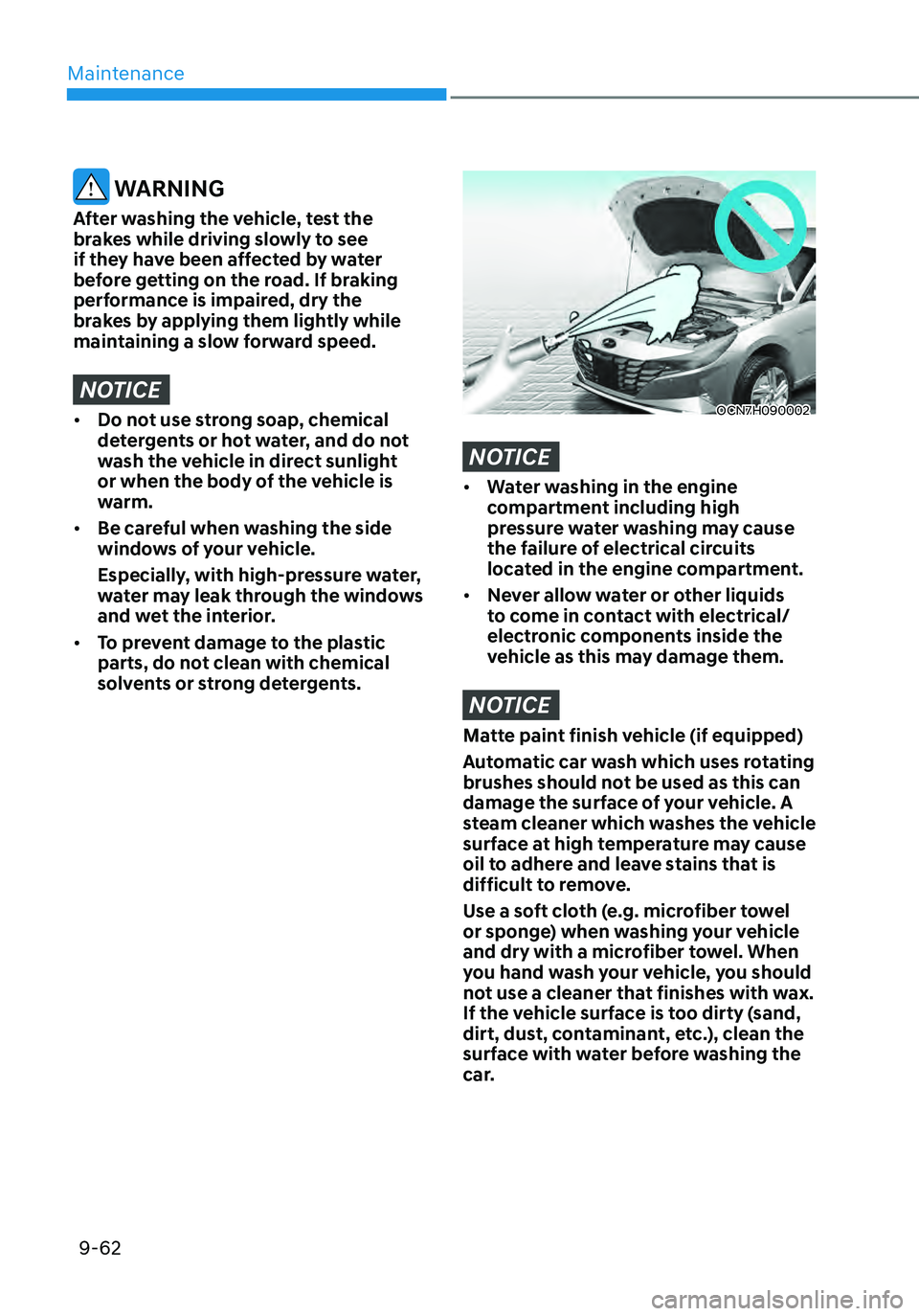
• Water washing in the engine
compartment including high
pressure water washing may cause
the failure of electrical circuits
located in the engine compartment.
• Never allow water or other liquids
to come in contact with electrical/
electronic components inside the
vehicle as this may damage them.
NOTICE
Matte paint finish vehicle (if equipped)
Automatic car wash which uses rotating
brushes should not be used as this can
damage the surface of your vehicle. A
steam cleaner which washes the vehicle
surface at high temperature may cause
oil to adhere and leave stains that is
difficult to remove.
Use a soft cloth (e.g. microfiber towel
or sponge) when washing your vehicle
and dry with a microfiber towel. When
you hand wash your vehicle, you should
not use a cleaner that finishes with wax.
If the vehicle surface is too dirty (sand,
dirt, dust, contaminant, etc.), clean the
surface with water before washing the
car.
Page 554 of 555

Index
I-12
Tire Sidewall Labeling ........................................................................\
.............9-34
Tire Terminology and Definitions ....................................................................9-37
Tire Traction ........................................................................\
.............................9-34
Wheel Alignment and Tire Balance .................................................................9-32
Wheel Replacement ........................................................................\
..................9-34
Towing
........................................................................\
.........................................8-21
Emergency towing ........................................................................\
....................8-23
Emergency Towing ........................................................................\
..................8-22
Removable towing hook ........................................................................\
...........8-22
Towing Service ........................................................................\
.........................8-21
Trailer Towing
........................................................................\
.............................6-53
Trunk
........................................................................\
............................................5-64
Emergency trunk safety release ........................................................................\
5-65
Smart Trunk release ........................................................................\
..................5-66
V
Vehicle Break-In Process
........................................................................\
...............1-7
Vehicle Certification Label
........................................................................\
..........2-13
Vehicle Data Collection and Event Data Recorders
..............................................1-8
Vehicle Identification Number ( VIN)
.................................................................2-13
Vehicle load limit
........................................................................\
.........................6-48
Tire Loading Information Label .......................................................................6-49
Vehicle Modifications
........................................................................\
....................1-7
Volume and Weight
........................................................................\
......................2-10