2021 FORD MUSTANG brakes
[x] Cancel search: brakesPage 224 of 530

When Towing a Trailer
•
Do not drive faster than 70 mph
(113 km/h) during the first 500 mi
(800 km).
• Do not make full-throttle starts.
• Check your hitch, electrical connections
and trailer wheel lug nuts thoroughly
after you have traveled 50 mi (80 km).
• When stopped in congested or heavy
traffic during hot weather, place the
transmission in park (P) or neutral (N)
to aid engine and transmission cooling
and to help air conditioning
performance.
• Switch off the speed control with
heavy loads or in hilly terrain. The
speed control may turn off
automatically when you are towing on
long, steep grades.
• Shift to a lower gear when driving down
a long or steep hill. Do not apply the
brakes continuously, as they may
overheat and become less effective.
• If your transmission is equipped with a
Grade Assist or Tow/Haul feature, use
this feature when towing. This provides
engine braking and helps eliminate
excessive transmission shifting for
optimum fuel economy and
transmission cooling.
• Allow more distance for stopping with
a trailer attached. Anticipate stops and
brake gradually.
• Avoid parking on a slope. However, if
you must park on a slope:
1. Turn the steering wheel to point your vehicle tires away from traffic flow.
2. Set your vehicle parking brake.
3. Place the automatic transmission in park (P) or manual transmission in a
low gear. 4. Place wheel chocks in front and back
of the trailer wheels. Chocks are not
included with your vehicle.
Launching or Retrieving a Boat or
Personal Watercraft (PWC)
Note: Disconnect the wiring to the trailer
before
backing the trailer into the water.
Note: Reconnect the wiring to the trailer
after
removing the trailer from the water.
When backing down a ramp during boat
launching or retrieval:
• Do not allow the static water level to
rise above the bottom edge of the rear
bumper.
• Do not allow waves to break higher
than
6 in (15 cm) above the bottom
edge of the rear bumper.
Exceeding these limits may allow water to
enter vehicle components:
• Causing internal damage to the
components.
• Affecting driveability, emissions, and
reliability.
Any time the rear axle submerges in water,
replace the rear axle lubricant. Water may
contaminate the rear axle lubricant, which
is not a normal maintenance inspection
item unless there is a possibility of a leak
or other axle repair is required.
221
Mustang (CZG) Canada/United States of America, Vehicles Built From: 14-09-2020, enUSA, Edition date: 202010, Second-Printing Towing
Page 233 of 530

•
Do not warm up your vehicle on cold
mornings.
• Reduce the use of air conditioning and
heat.
• Avoid using speed control in hilly
terrain.
• Do not rest your foot on the brake
pedal while driving.
• Avoid carrying unnecessary weight.
• Avoid adding particular accessories to
your vehicle (e.g. bug deflectors,
rollbars/light bars, running boards, ski
racks).
• Avoid driving with the wheels out of
alignment.
COLD WEATHER
PRECAUTIONS
The functional operation of some
components and systems can be affected
at temperatures below approximately
-13°F (-25°C).
BREAKING-IN
Your vehicle requires a break-in period. For
the first 1,000 mi (1,600 km), avoid driving
at high speeds, heavy braking, aggressive
shifting or using your vehicle to tow. During
this time, your vehicle may exhibit some
unusual driving characteristics.
Ground Clearance
Since ground clearance is reduced, use
caution when approaching curbs or curb
stops from the front and rear as vehicle
damage may occur. Additionally, when
crossing speed bumps or driveway curbs,
you should approach at a 45 degree angle
to reduce the risk of vehicle damage. DRIVING THROUGH WATER WARNING:
Do not drive through
flowing or deep water as you may lose
control of your vehicle.
Note: Driving through standing water can
cause vehicle damage.
Note: Engine damage can occur if water
enters the air filter.
Before driving through standing water,
check the depth. Never drive through water
that is higher than the bottom of the front
rocker area of your vehicle. When driving through standing water, drive
very slowly and do not stop your vehicle.
Your brake performance and traction may
be limited. After driving through water and
as soon as it is safe to do so:
•
Lightly press the brake pedal to dry the
brakes and to check that they work.
• Check that the horn works.
• Check that the exterior lights work.
• Turn the steering wheel to check that
the steering power assist works.
230
Mustang (CZG) Canada/United States of America, Vehicles Built From: 14-09-2020, enUSA, Edition date: 202010, Second-Printing Driving Hints E266447
Page 252 of 530

Protected Component
Fuse Rating
Fuse or Relay
Number
Auxiliary power point.
20A 2
54
Electronic fan 2 (base).
25A 2
55
Not used (GT500).
—
Not used.
—
56
Air conditioning clutch relay.
—
57
Not used.
—
58
Exhaust valves relay.
—
59
Powertrain control module.
5A 3
60
Not used.
—
61
Anti-lock brakes run/start switch.
5A 3
62
Not used.
—
63
Electronic power assist steering.
5A 3
64
Not used.
—
65
Blind spot information system.
5A 3
66 Rear view camera.
Rear window defroster relay coils.
Vehicle dynamics module.
Not used.
—
67
Headlamp leveling switch (base).
10A 3
68
Signature lighting (GT500).
10A 3
Cigar lighter relay.
—
69
Auxiliary power point relay.
Mass air flow sensor (base).
5A 3
74
Not used (GT500).
—
Rain sensor module (base).
5A 3
75
249
Mustang (CZG) Canada/United States of America, Vehicles Built From: 14-09-2020, enUSA, Edition date: 202010, Second-Printing Fuses
Page 281 of 530
Line Lock
Line lock is a feature intended for use at
tracks only and should not be used on
public roadways. Use of this feature may
result in significantly increased rear tire
wear. It is intended to condition the rear
tires to maximize traction prior to track use.
Line lock maintains brake force at the front
wheels, allowing the rear wheels to spin
with minimal vehicle movement.
This feature is located in the Track Apps
menu. Make selections through the 5-way
information display control and OK button
located on the steering wheel.
Using Line Lock
There are three line lock stages:
•
Initiated.
• Engaged.
• Off.
Initiating Line Lock
The initiation stage verifies that the vehicle
is ready for line lock function, and confirms
driver intent. Follow the prompts in the
information display to initiate line lock.
The following conditions must be met to
initialize line lock:
• The vehicle is on a level surface.
• The engine is running.
• The vehicle is traveling less than
25 mph (40 km/h).
• Selectable drive mode is not in wet
mode (if equipped).
• There are no electronic stability control
faults. If you want to cancel line lock once it is
initialized, press the left information
display control. Once initiated, line lock is
prepared for activation and remains
initiated up to 25 mph (40 km/h). If vehicle
speed exceeds 25 mph (40 km/h), line lock
automatically cancels.
Engaging Line Lock
Follow the prompts in the information
display to engage line lock after it is
initialized. To engage, firmly apply the
brakes. Then press the OK button. Once
engaged, release the brake pedal. The
front brakes remain applied and the rear
brakes release. At this point, the
engagement timer is initiated and shown
on the driver information display.
The following conditions must be met to
engage line lock:
•
The vehicle is on a level surface.
• The engine is running.
• The vehicle is stopped.
• The parking brake is not applied.
• The driver door is closed.
• The transmission is in a forward gear.
• Selectable drive mode is not in wet
mode (if equipped).
• There are no electronic stability control
faults.
• The steering wheel must be in the
straight ahead position.
Releasing Line Lock
While line lock is engaged, you can exit
(release) the feature using the OK button.
When you press the OK button, line lock
releases immediately and normal vehicle
function resumes. When line lock engages,
a countdown timer shows the remaining
278
Mustang (CZG) Canada/United States of America, Vehicles Built From: 14-09-2020, enUSA, Edition date: 202010, Second-Printing Track Use
Page 285 of 530
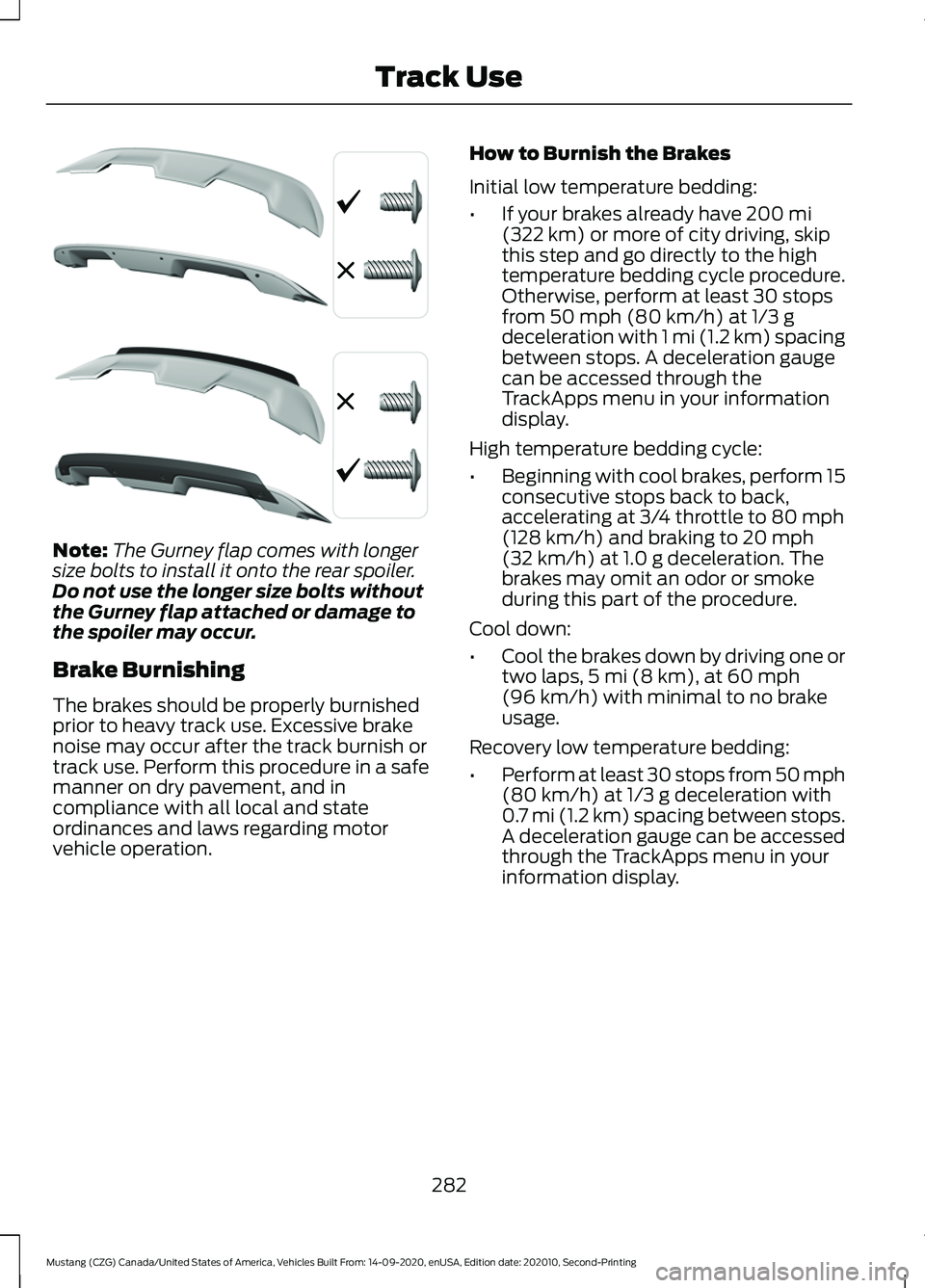
Note:
The Gurney flap comes with longer
size bolts to install it onto the rear spoiler.
Do not use the longer size bolts without
the Gurney flap attached or damage to
the spoiler may occur.
Brake Burnishing
The brakes should be properly burnished
prior to heavy track use. Excessive brake
noise may occur after the track burnish or
track use. Perform this procedure in a safe
manner on dry pavement, and in
compliance with all local and state
ordinances and laws regarding motor
vehicle operation. How to Burnish the Brakes
Initial low temperature bedding:
•
If your brakes already have 200 mi
(322 km) or more of city driving, skip
this step and go directly to the high
temperature bedding cycle procedure.
Otherwise, perform at least 30 stops
from
50 mph (80 km/h) at 1/3 g
deceleration with 1 mi (1.2 km) spacing
between stops. A deceleration gauge
can be accessed through the
TrackApps menu in your information
display.
High temperature bedding cycle:
• Beginning with cool brakes, perform 15
consecutive stops back to back,
accelerating at 3/4 throttle to
80 mph
(128 km/h) and braking to 20 mph
(32 km/h) at 1.0 g deceleration. The
brakes may omit an odor or smoke
during this part of the procedure.
Cool down:
• Cool the brakes down by driving one or
two laps, 5 mi (8 km)
, at 60 mph
(96 km/h) with minimal to no brake
usage.
Recovery low temperature bedding:
• Perform at least 30 stops from 50 mph
(80 km/h)
at 1/3 g deceleration with
0.7 mi (1.2 km) spacing between stops.
A deceleration gauge can be accessed
through the TrackApps menu in your
information display.
282
Mustang (CZG) Canada/United States of America, Vehicles Built From: 14-09-2020, enUSA, Edition date: 202010, Second-Printing Track UseE310471 E310472
Page 288 of 530
Initiating Line Lock
The initiation stage verifies that the vehicle
is ready for line lock function, and confirms
driver intent. Follow the prompts in the
information display to initiate line lock.
The following conditions must be met to
initialize line lock:
•
The vehicle is on a level surface.
• The engine is running.
• The vehicle is traveling less than
25 mph (40 km/h).
• Selectable drive mode is not in wet
mode (if equipped).
• There are no electronic stability control
faults.
If you want to cancel line lock once it is
initialized, press the left information
display control. Once initiated, line lock is
prepared for activation and remains
initiated up to 25 mph (40 km/h). If vehicle
speed exceeds 25 mph (40 km/h), line lock
automatically cancels.
Engaging Line Lock
Follow the prompts in the information
display to engage line lock after it is
initialized. To engage, firmly apply the
brakes. Then press the OK button. Once
engaged, release the brake pedal. The
front brakes remain applied and the rear
brakes release. At this point, the
engagement timer is initiated and shown
on the driver information display.
The following conditions must be met to
engage line lock:
• The vehicle is on a level surface.
• The engine is running.
• The vehicle is stopped.
• The parking brake is not applied.
• The driver door is closed.
• The transmission is in a forward gear. •
Selectable drive mode is not in wet
mode (if equipped).
• There are no electronic stability control
faults.
• The steering wheel must be in the
straight ahead position.
Releasing Line Lock
While line lock is engaged, you can exit
(release) the feature using the OK button.
When you press the OK button, line lock
releases immediately and normal vehicle
function resumes. When line lock engages,
a countdown timer shows the remaining
time before line lock is released
automatically. If you exceed the time limit,
or another vehicle condition requires line
lock to release, the system safely
disengages and normal vehicle function
resumes.
Note: If you apply the brake pedal while
line lock is engaged, line lock automatically
cancels and normal brake function resumes.
Performance Shift Indicator
The performance shift indicator displays
a row of colored lights that represent
engine RPM.
The performance shift indicator menu
allows you to:
• Choose whether the indicator is shown
on the windshield or information
display.
• Set a shift point within the allowable
RPM range in increments of 100.
• Enable or disable the associated shift
tone, based on the set shift point.
• Set the between off, change with drive
mode, tach, track and drag.
• Set the light intensity. The intensity
adjusts between day time and night
time.
285
Mustang (CZG) Canada/United States of America, Vehicles Built From: 14-09-2020, enUSA, Edition date: 202010, Second-Printing Track Use
Page 290 of 530
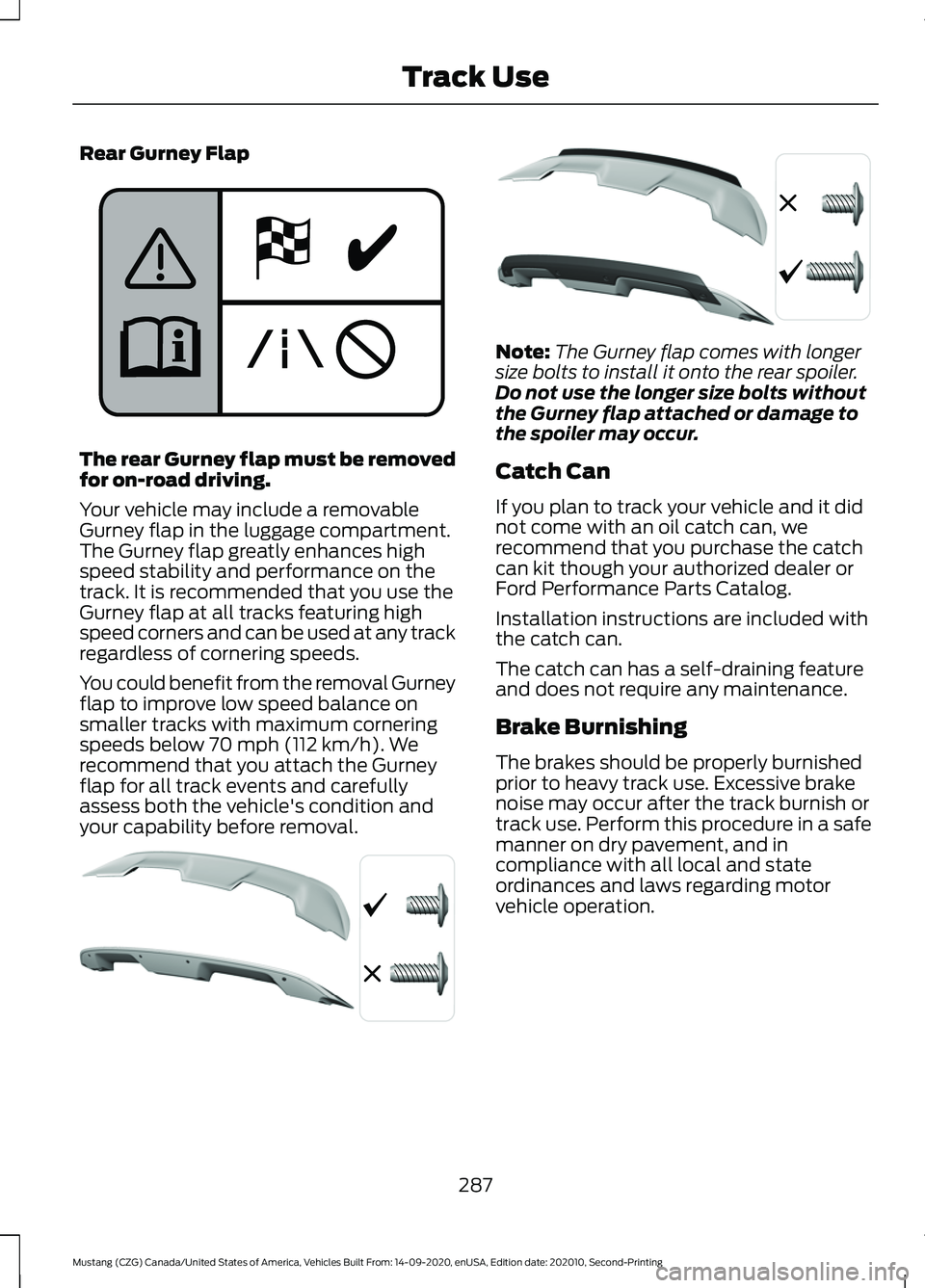
Rear Gurney Flap
The rear Gurney flap must be removed
for on-road driving.
Your vehicle may include a removable
Gurney flap in the luggage compartment.
The Gurney flap greatly enhances high
speed stability and performance on the
track. It is recommended that you use the
Gurney flap at all tracks featuring high
speed corners and can be used at any track
regardless of cornering speeds.
You could benefit from the removal Gurney
flap to improve low speed balance on
smaller tracks with maximum cornering
speeds below 70 mph (112 km/h). We
recommend that you attach the Gurney
flap for all track events and carefully
assess both the vehicle's condition and
your capability before removal. Note:
The Gurney flap comes with longer
size bolts to install it onto the rear spoiler.
Do not use the longer size bolts without
the Gurney flap attached or damage to
the spoiler may occur.
Catch Can
If you plan to track your vehicle and it did
not come with an oil catch can, we
recommend that you purchase the catch
can kit though your authorized dealer or
Ford Performance Parts Catalog.
Installation instructions are included with
the catch can.
The catch can has a self-draining feature
and does not require any maintenance.
Brake Burnishing
The brakes should be properly burnished
prior to heavy track use. Excessive brake
noise may occur after the track burnish or
track use. Perform this procedure in a safe
manner on dry pavement, and in
compliance with all local and state
ordinances and laws regarding motor
vehicle operation.
287
Mustang (CZG) Canada/United States of America, Vehicles Built From: 14-09-2020, enUSA, Edition date: 202010, Second-Printing Track UseE307008 E310471 E310472
Page 291 of 530
How to Burnish the Brakes
Initial low temperature bedding:
•
If your brakes already have 200 mi
(322 km) or more of city driving, skip
this step and go directly to the high
temperature bedding cycle procedure.
Otherwise, perform at least 30 stops
from
50 mph (80 km/h) at 1/3 g
deceleration with 1 mi (1.2 km) spacing
between stops. A deceleration gauge
can be accessed through the
TrackApps menu in your instrument
display.
High temperature bedding cycle:
• Beginning with cool brakes, perform 15
consecutive stops back to back,
accelerating at 3/4 throttle to
80 mph
(128 km/h) and braking to 20 mph
(32 km/h) at 1.0 g deceleration. The
brakes may omit an odor or smoke
during this part of the procedure.
Cool down:
• Cool the brakes down by driving one or
two laps, 5 mi (8 km)
, at 60 mph
(96 km/h) with minimal to no brake
usage.
Recovery low temperature bedding:
• Perform at least 30 stops from 50 mph
(80 km/h)
at 13 g deceleration with
0.7 mi (1.2 km) spacing between stops.
A deceleration gauge can be accessed
through the TrackApps menu in the
instrument cluster display.
288
Mustang (CZG) Canada/United States of America, Vehicles Built From: 14-09-2020, enUSA, Edition date: 202010, Second-Printing Track Use