2021 FORD F-150 fuel filter gasoline
[x] Cancel search: fuel filter gasolinePage 19 of 796

Crash and Breakdown
Information
Roadside Assistance .................................483
High Voltage Battery Vehicle Precautions - Hybrid Electric Vehicle (HEV) ........
484
Switching the Hazard Flashers On and Off ................................................................
485
Jump Starting the Vehicle .......................
485
Post-Crash Alert System .........................
487
Automatic Crash Shutoff ........................
487
Recovery Towing ........................................
488
Transporting the Vehicle .........................
489
Towing Your Vehicle
Towing Your Vehicle Precautions ........
490
Recreationally Towing Your Vehicle - 4x4 ..............................................................
490
Recreationally Towing Your Vehicle - 4x2 ........................................................................\
492
Emergency Towing ....................................
492
Towing Your Vehicle – Troubleshooting ........................................................................\
492
Fuses
Fuse Precautions ........................................
493
Under Hood Fuse Box ...............................
493
Body Control Module Fuse Box ............
499
Identifying Fuse Types ..............................
502
Fuses – Troubleshooting .........................
502
Maintenance
Maintenance Precautions .......................
503
Opening and Closing the Hood .............
503
Under Hood Overview - 2.7L EcoBoost™ .......................................................................
504
Under Hood Overview - 3.0L Diesel .....
505
Under Hood Overview - 3.3L .................
506
Under Hood Overview - 3.5L Ecoboost™ ........................................................................\
507
Under Hood Overview - 3.5L, Hybrid Electric Vehicle (HEV) .........................
508Under Hood Overview - 5.0L
.................
509
Engine Oil .......................................................
510
Checking the Coolant .................................
511
Engine Air Filter .............................................
515
Draining the Fuel Filter Water Trap - Diesel ...........................................................
518
Changing the Fuel Filter - Diesel ...........
519
Changing the Fuel Filter - Gasoline ......
519
Changing the 12V Battery .........................
519
Adjusting the Headlamps .........................
521
Exterior Bulbs ...............................................
522
Interior Bulbs .................................................
531
Drive Belt Routing - 2.7L EcoBoost™, Vehicles With: Dual Generators .........
531
Drive Belt Routing - 2.7L EcoBoost™, Vehicles With: Single Generator ........
531
Drive Belt Routing - 3.0L Diesel ..............
531
Drive Belt Routing - 3.3L ...........................
532
Drive Belt Routing - 3.5L Ecoboost™, Vehicles With: Dual Generators ........
532
Drive Belt Routing - 3.5L Ecoboost™, Vehicles With: Single Generator .......
532
Drive Belt Routing - 3.5L, Hybrid Electric Vehicle (HEV) ..........................................
532
Drive Belt Routing - 5.0L, Vehicles With: Single Generator .....................................
533
Drive Belt Routing - 5.0L, Vehicles With: Dual Generators ......................................
533
Vehicle Care
Cleaning Products ......................................
534
Cleaning the Exterior .................................
535
Cleaning the Interior ...................................
537
Repairing Minor Paint Damage .............
539
Waxing Your Vehicle ..................................
539
Storing Your Vehicle
Preparing Your Vehicle for Storage ......
540
Removing Your Vehicle From Storage ........................................................................\
.
541
15
F-150 (TFD) Canada/United States of America, enUSA, Edition date: 202104, Second-Printing Table of Contents
Page 263 of 796
Biodiesel
WARNING: Do not mix diesel with
gasoline, gasohol or alcohol. This could
cause an explosion.
Note: Do not use home heating oil,
agricultural fuel, raw fats and oils, waste
cooking greases, biodiesel greater than 20%
or any diesel not intended for highway use.
Damage to the fuel injection system, engine
and exhaust catalyst, and diesel particulate
filter can occur if you use an improper fuel.
Red dye is used to identify fuels intended
for agricultural and non-highway use.
You can operate your vehicle on diesel
fuels containing up to 20% biodiesel, also
known as B20.
Biodiesel fuel is a chemically converted
product from renewable fuel sources, such
as vegetable oils, animal fats and waste
cooking greases.
To help achieve acceptable engine
performance and durability when using
biodiesel in your vehicle:
• Confirm the biodiesel content of the
fuel to be B20 (20% biodiesel) or less.
• Only use biodiesel fuel of good quality
that complies with industry standards.
• Follow the recommended service
maintenance intervals. See
General
Maintenance Information (page 664).
• Do not store biodiesel fuel in the fuel
tank for more than 1 month.
• Consider changing brands or reducing
biodiesel content if you have cold
temperature fuel gelling issues or a
frequently appearing LOW FUEL
PRESSURE message. Use of biodiesel in concentrations greater
than 20% can cause damage to your
vehicle, including engine and/or exhaust
after-treatment hardware (exhaust
catalyst and particulate filter) failures.
Concentrations greater than 20% can also
cause fuel filter restrictions that could
result in a lack of power or damage to fuel
system components, including fuel pump
and fuel injector failures.
We recommend SAE 5W-40 oil for fuels
with greater than 5% biodiesel (B5). For
more information about oil change
intervals and other maintenance when
operating on biodiesel.
See Special
Operating Conditions Scheduled
Maintenance
(page 675).
Look for a label on the fuel pump to
confirm the amount of biodiesel contained
in diesel fuel. Ask the service station
attendant to confirm the biodiesel content
of diesel fuel, if you do not see a label on
the fuel pump.
If you plan to park or store your vehicle for
more than 1 month, then you should empty
your vehicle fuel tank of biodiesel fuel. You
should fill the tank with a pure
petroleum-based diesel fuel and run your
vehicle for a minimum of 30 minutes.
Note: Degraded or oxidized biodiesel can
damage fuel system seals and plastics and
corrode steel parts.
During cold weather, if you have problems
operating on biodiesel, you may need to
use diesel fuel with lower biodiesel
content, try another brand or discontinue
the use of biodiesel.
Diesel Fuel Additives
It should not be necessary to add any
aftermarket additives to your fuel if you
use a high-quality diesel fuel that conforms
to ASTM industry specifications.
Aftermarket additives can damage the fuel
injector system or engine.
259
F-150 (TFD) Canada/United States of America, enUSA, Edition date: 202104, Second-Printing Fuel and Refueling
Page 523 of 796

5. Start the engine.
6. Check for leaks.
Note:
The water in fuel warning lamp turns
off after approximately two seconds with
the engine running.
Note: The in-tank pump will turn off
automatically after approximately 30
seconds.
CHANGING THE FUEL FILTER
- DIESEL
Your fuel filters must be changed at the
correct service interval or when you see the
low fuel pressure message appear. Refer
to scheduled maintenance for the correct
service interval.
CHANGING THE FUEL FILTER
- GASOLINE
Your vehicle has a lifetime fuel filter that
integrates with the fuel tank. It does not
need regular maintenance or replacement.
CHANGING THE 12V BATTERY WARNING: Batteries normally
produce explosive gases which can
cause personal injury. Therefore, do not
allow flames, sparks or lighted
substances to come near the battery.
When working near the battery, always
shield your face and protect your eyes.
Always provide correct ventilation. WARNING:
When lifting a
plastic-cased battery, excessive pressure
on the end walls could cause acid to flow
through the vent caps, resulting in
personal injury and damage to the
vehicle or battery. Lift the battery with a
battery carrier or with your hands on
opposite corners. WARNING:
Keep batteries out of
reach of children. Batteries contain
sulfuric acid. Avoid contact with skin,
eyes or clothing. Shield your eyes when
working near the battery to protect
against possible splashing of acid
solution. In case of acid contact with skin
or eyes, flush immediately with water for
a minimum of 15 minutes and get prompt
medical attention. If acid is swallowed,
call a physician immediately. WARNING:
Battery posts,
terminals and related accessories
contain lead and lead compounds,
chemicals known to the State of
California to cause cancer and
reproductive harm. Wash your hands
after handling
. WARNING:
This vehicle may have
more than one battery. Removing the
battery cables from only one battery
does not disconnect your vehicle
electrical system. Make sure you
disconnect the battery cables from all
batteries when disconnecting power.
Failure to do so may cause serious
personal injury or property damage.
The battery is in the engine compartment.
See
Under Hood Overview (page 504).
Your vehicle has a maintenance-free
battery. It does not require additional
water during service.
519
F-150 (TFD) Canada/United States of America, enUSA, Edition date: 202104, Second-Printing Maintenance
Page 591 of 796
ENGINE OIL CAPACITY AND
SPECIFICATION - 2.7L
ECOBOOST™
Use oil that meets the defined
specification and viscosity grade.
If you do not use oil that meets the defined
specification and viscosity grade, it could
result in:
•
Component damage that your vehicle
warranty does not cover.
• Longer engine cranking periods.
• Increased emission levels.
• Reduced vehicle performance.
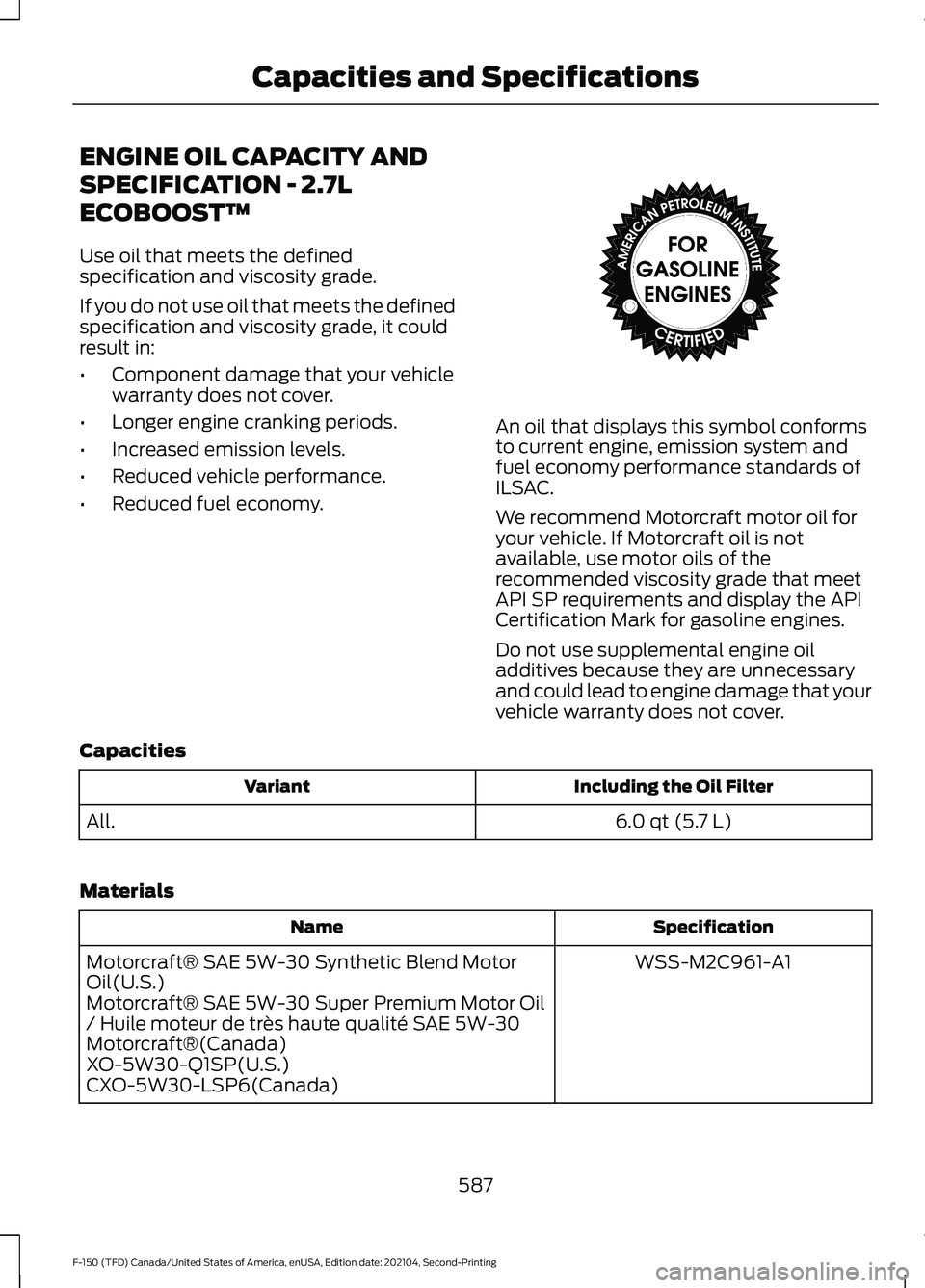
• Reduced fuel economy. An oil that displays this symbol conforms
to current engine, emission system and
fuel economy performance standards of
ILSAC.
We recommend Motorcraft motor oil for
your vehicle. If Motorcraft oil is not
available, use motor oils of the
recommended viscosity grade that meet
API SP requirements and display the API
Certification Mark for gasoline engines.
Do not use supplemental engine oil
additives because they are unnecessary
and could lead to engine damage that your
vehicle warranty does not cover.
Capacities Including the Oil Filter
Variant
6.0 qt (5.7 L)
All.
Materials Specification
Name
WSS-M2C961-A1
Motorcraft® SAE 5W-30 Synthetic Blend Motor
Oil(U.S.)
Motorcraft® SAE 5W-30 Super Premium Motor Oil
/ Huile moteur de très haute qualité SAE 5W-30
Motorcraft®(Canada)
XO-5W30-Q1SP(U.S.)
CXO-5W30-LSP6(Canada)
587
F-150 (TFD) Canada/United States of America, enUSA, Edition date: 202104, Second-Printing Capacities and SpecificationsE142732
Page 595 of 796
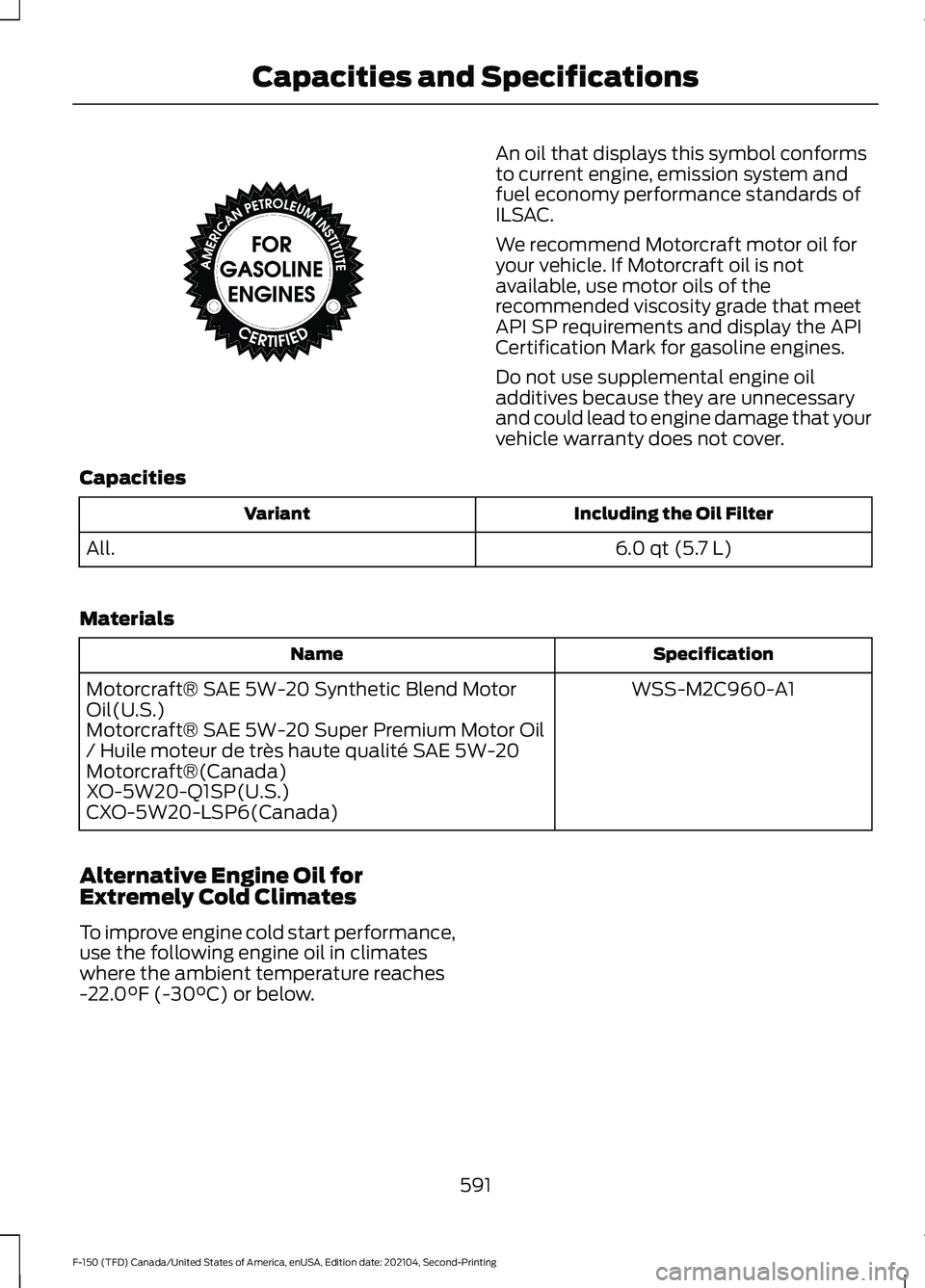
An oil that displays this symbol conforms
to current engine, emission system and
fuel economy performance standards of
ILSAC.
We recommend Motorcraft motor oil for
your vehicle. If Motorcraft oil is not
available, use motor oils of the
recommended viscosity grade that meet
API SP requirements and display the API
Certification Mark for gasoline engines.
Do not use supplemental engine oil
additives because they are unnecessary
and could lead to engine damage that your
vehicle warranty does not cover.
Capacities Including the Oil Filter
Variant
6.0 qt (5.7 L)
All.
Materials Specification
Name
WSS-M2C960-A1
Motorcraft® SAE 5W-20 Synthetic Blend Motor
Oil(U.S.)
Motorcraft® SAE 5W-20 Super Premium Motor Oil
/ Huile moteur de très haute qualité SAE 5W-20
Motorcraft®(Canada)
XO-5W20-Q1SP(U.S.)
CXO-5W20-LSP6(Canada)
Alternative Engine Oil for
Extremely Cold Climates
To improve engine cold start performance,
use the following engine oil in climates
where the ambient temperature reaches
-22.0°F (-30°C) or below.
591
F-150 (TFD) Canada/United States of America, enUSA, Edition date: 202104, Second-Printing Capacities and SpecificationsE142732
Page 678 of 796

Off-Road Operation
Change the engine oil and filter. 1
Every 7,500 mi (12,000 km)
or 300 engine hours
Replace the engine-mounted and frame-mounted fuel
filters.
Every
30,000 mi
(48,000 km), six months or
600 engine hours
Replace the air inlet foam filter.
Every
30,000 mi
(48,000 km)
1 Reset the oil change reminder after engine oil and filter changes. See
Resetting the
Engine Oil Change Reminder (page 511). Using Biodiesel, Up to and Including 20% Biodiesel (B20)
Change the engine oil and filter as indicated by the
information display, and perform the services listed in the
scheduled maintenance chart.
As required
Replace the engine-mounted and frame-mounted fuel
filters.
Every
30,000 mi
(48,000 km), six months or
300 engine hours
Exceptions
There are several exceptions to the Normal
Schedule.
Axle and Transfer Case Maintenance
Axle(s) and transfer case, four-wheel drive
vehicles, fluid changes or level checks are
not required unless a leak is suspected, or
the assembly has been submerged in
water. Contact an authorized dealer for
service. California Fuel Filter Replacement
If you register your vehicle in California, the
California Air Resources Board has
determined that the failure to perform this
maintenance item does not nullify the
emission warranty or limit recall liability
before the completion of your vehicle's
useful life. Ford Motor Company, however,
urges you to have all recommended
maintenance services performed at the
specified intervals and to record all vehicle
service.
Hot Climate Oil Change Intervals
For vehicles operating in the Middle East,
North Africa, Sub-Saharan Africa or
locations with similar climates using an oil
that meets our specification or has an
American Petroleum Institute (API)
Certified for Gasoline Engines (Certification
mark) oil, the normal oil change interval is
3,000 mi (4,800 km)
.
674
F-150 (TFD) Canada/United States of America, enUSA, Edition date: 202104, Second-Printing Scheduled Maintenance
Page 682 of 796

an "H" for hours). The idle meter only
accumulates time while the vehicle is in
park (P) or neutral (N). Displayed time is
cumulative for the vehicle and cannot be
reset to zero. Police vehicles often
experience long periods of idling, during
which engine oil continues to break down
but distance is not accumulated on the
odometer. Engine Idle Hours have been
incorporated into the Intelligent Oil-Life
Monitor.
Exceptions
There are several exceptions to the Normal
Schedule.
Axle and Transfer Case Maintenance
In four-wheel drive vehicles, axle(s) and
transfer case fluid changes or level checks
are not required unless a leak is suspected
or the assembly has been submerged in
water. Contact an authorized dealer for
service.
California Fuel Filter Replacement
If you register your vehicle in California, the
California Air Resources Board has
determined that the failure to perform this
maintenance item does not nullify the
emission warranty or limit recall liability
before the completion of your vehicle's
useful life. Ford Motor Company urges you
to have all recommended maintenance
services performed at the specified
intervals and to record all vehicle service.
Hot Climate Oil Change Intervals
Vehicles operating in the Middle East,
North Africa, Sub-Saharan Africa or
locations with similar climates using an oil
that meets our specification or has an
American Petroleum Institute certified for
gasoline engines (certification mark) oil,
the normal oil change interval is 3,000 mi
(4,800 km). Engine Air Filter Replacement
The life of the engine air filter is dependent
on exposure to dusty and dirty conditions.
Vehicles operated in these conditions
require frequent inspection and
replacement of the engine air filter.
SPECIAL OPERATING
CONDITIONS SCHEDULED
MAINTENANCE - RAPTOR
If you operate your vehicle primarily in any
of the following conditions, you need to
perform extra maintenance, as indicated.
If you operate your vehicle occasionally
under any of these conditions, it is not
necessary to perform the extra
maintenance. For specific
recommendations, see your dealership
service advisor or technician.
Perform the services shown in the
following tables when specified or within
3,000 mi (4,800 km)
of the oil change
required message appearing in the
information display.
• Example 1: The message comes on at
28,751 mi (46,270 km)
. Perform the
30,000 mi (48,000 km) automatic
transmission fluid replacement.
• Example 2: The message has not come
on, but the odometer reads 30,000 mi
(48,000 km)
, for example, the oil
change reminder was reset at
25,000 mi (40,000 km)
. Perform the
engine air filter replacement.
678
F-150 (TFD) Canada/United States of America, enUSA, Edition date: 202104, Second-Printing Scheduled Maintenance
Page 685 of 796

Exceptions
There are several exceptions to the Normal
Schedule.
Axle and Transfer Case Maintenance
In four-wheel drive vehicle's axle(s) and
transfer case, fluid changes or level checks
are not required unless a leak is suspected
or the assembly has been submerged in
water. Contact an authorized dealer for
service.
California Fuel Filter Replacement
If you register your vehicle in California, the
California Air Resources Board has
determined that the failure to perform this
maintenance item does not nullify the
emission warranty or limit recall liability
before the completion of your vehicle's
useful life. Ford Motor Company urges you
to have all recommended maintenance
services performed at the specified
intervals and to record all vehicle service.
Hot Climate Oil Change Intervals
Vehicles operating in the Middle East,
North Africa, Sub-Saharan Africa or
locations with similar climates using an oil
that meets our specification or has an
American Petroleum Institute certified for
gasoline engines (certification mark) oil,
the normal oil change interval is 3,000 mi
(4,800 km).
Engine Air Filter Replacement
The life of the engine air filter is dependent
on exposure to dusty and dirty conditions.
Vehicles operated in these conditions
require frequent inspection and
replacement of the engine air filter.
681
F-150 (TFD) Canada/United States of America, enUSA, Edition date: 202104, Second-Printing Scheduled Maintenance