2021 FORD F-150 Continuous deep sand
[x] Cancel search: Continuous deep sandPage 295 of 796

HOW DOES FOUR-WHEEL
DRIVE WORK - RAPTOR
The 2-speed automatic four-wheel drive
system utilizes an electronically controlled
on-demand 2-speed transfer case. This
system monitors various vehicle sensory
inputs to provide an increased level of
performance. This system offers the driver
two-wheel drive high, four-wheel drive
auto, four-wheel drive high, and four-wheel
drive low as available modes of operation.
When four-wheel drive auto is selected,
the system continuously varies power to
the front wheels for optimum performance
for all on-road conditions. When either
four-wheel drive high or four-wheel drive
low are selected, the system provides
mechanically locked power to the front
and rear wheels for use in off-road or
slippery conditions such as deep snow,
sand or mud. Selecting four-wheel drive
low also provides additional gearing for
increased torque multiplication for
conditions like deep sand, steep slopes, or
pulling heavy objects. Additionally, the
system is capable of recreational flat
towing by putting the transfer case into
neutral (N). See Recreationally Towing
Your Vehicle (page 490).
There is further information on driving in
unique driving conditions.
See Off-Road
Driving (page 470).
HOW DOES FOUR-WHEEL
DRIVE WORK
Using the Electronic Shift On the
Fly System
(If Equipped)
This four-wheel drive system utilizes a
2-speed Electronic Shift On the Fly (ESOF)
transfer case which is also known as a
part-time system. This system offers the
driver two-wheel drive high, four-wheel
drive high, and four-wheel drive low as available modes of operation. When either
four-wheel drive high or four-wheel drive
low are selected, the system provides
mechanically locked four-wheel drive
power to both the front and rear wheels
for use in off-road or slippery conditions
such as deep snow, sand or mud. Selecting
four-wheel drive low also provides
additional gearing for increased torque
multiplication for conditions like deep
sand, steep slopes, or pulling heavy
objects. Additionally, the system is capable
of recreational flat towing by putting the
transfer case into neutral (N). See
Recreationally Towing Your Vehicle
(page
490).
There is further information on driving in
unique driving conditions.
See Off-Road
Driving (page 470).
Using the 2-Speed Automatic
Four-Wheel Drive System (If Equipped)
The 2-speed automatic four-wheel drive
system utilizes an electronically controlled
on-demand 2-speed transfer case. This
system monitors various vehicle sensory
inputs to provide an increased level of
performance. This system offers the driver
two-wheel drive high, four-wheel drive
auto, four-wheel drive high, and four-wheel
drive low as available modes of operation.
When four-wheel drive auto is selected,
the system continuously varies power to
the front wheels for optimum performance
for all on-road conditions. When either
four-wheel drive high or four-wheel drive
low are selected, the system provides
electronically or mechanically locked
power to the front and rear wheels for use
in off-road or slippery conditions such as
deep snow, sand or mud. Selecting
four-wheel drive low also provides
additional gearing for increased torque
multiplication for conditions like deep
291
F-150 (TFD) Canada/United States of America, enUSA, Edition date: 202104, Second-Printing Four-Wheel Drive
(If Equipped)
Page 300 of 796
FOUR-WHEEL DRIVE HIGH -
RAPTOR
Four-wheel drive high provides
mechanically locked four-wheel drive
power to both the front and rear wheels
for use in off-road or winter conditions
such as deep snow, sand or mud. This
mode is not for use on dry pavement.
Note:
Four-wheel drive high can turn on or
off automatically based on Drive Mode
selection. See Selecting a Drive Mode
(page 373).
FOUR-WHEEL DRIVE HIGH
Four-wheel drive high provides
electronically or mechanically locked
four-wheel drive power to both the front
and rear wheels for use in off-road or
winter conditions such as deep snow, sand
or mud. This mode is not for use on dry
pavement.
Note: Four-wheel drive high can turn on or
off automatically based on Drive Mode
selection.
See Selecting a Drive Mode
(page 373).
FOUR-WHEEL DRIVE LOW -
RAPTOR
Four-Wheel Drive Low provides
mechanically locked four-wheel drive
power to both the front and rear wheels
for use on low traction surfaces, but does
so with additional gearing for increased
torque multiplication. The intent of this
mode is only for off-road conditions such
as deep sand, steep slopes, or pulling
heavy objects.
Note: Four-wheel drive low can turn on or
off automatically based on drive mode
selection.
See Selecting a Drive Mode
(page 373). FOUR-WHEEL DRIVE LOW
Four-wheel drive low provides
electronically or mechanically locked
four-wheel drive power to both the front
and rear wheels for use on low traction
surfaces, but does so with additional
gearing for increased torque multiplication.
This mode is only for off-road conditions
such as deep sand, steep slopes, or pulling
heavy objects.
Note:
Four-wheel drive low can turn on or
off automatically based on drive mode
selection.
See Selecting a Drive Mode
(page 373).
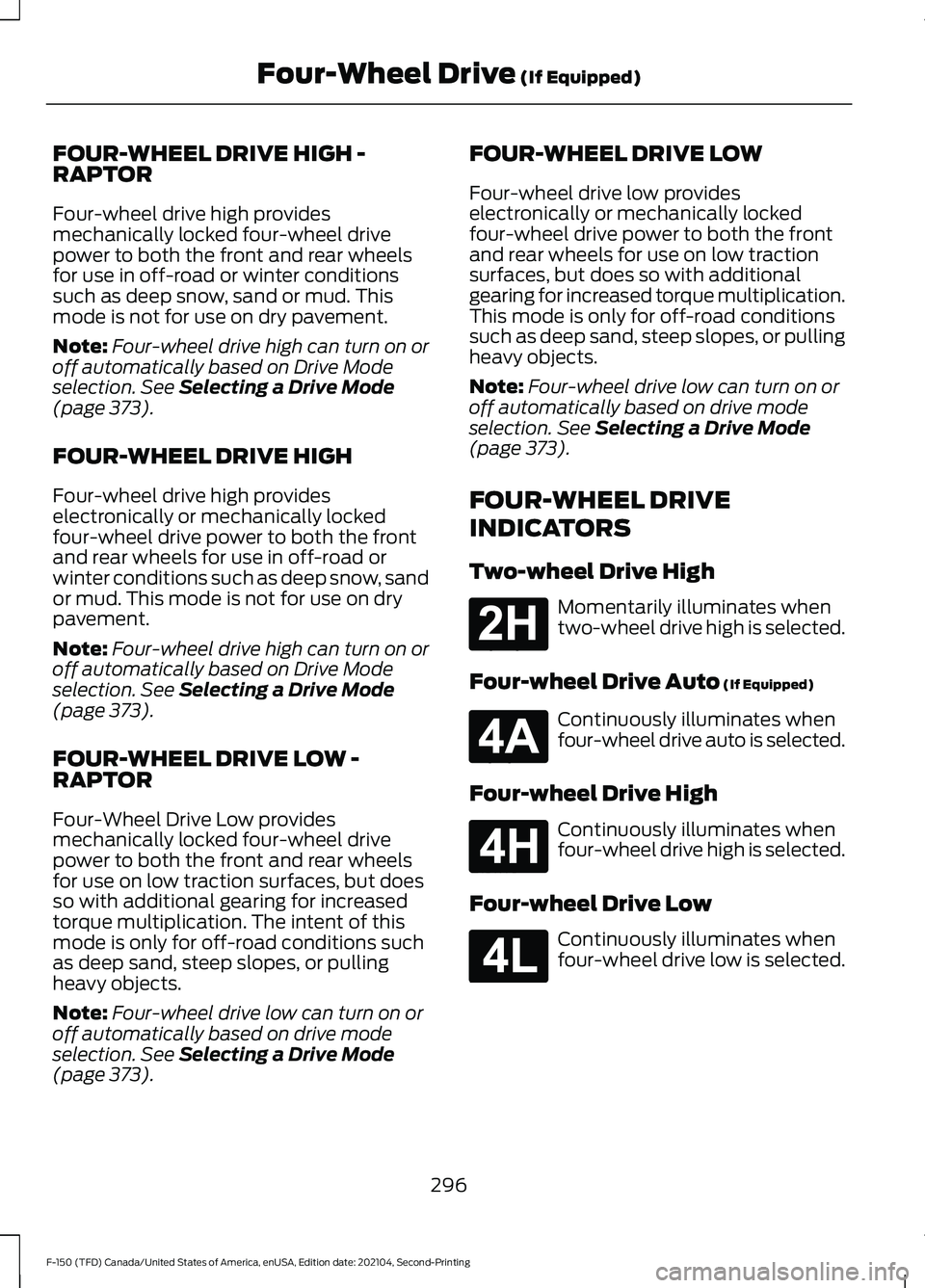
FOUR-WHEEL DRIVE
INDICATORS
Two-wheel Drive High Momentarily illuminates when
two-wheel drive high is selected.
Four-wheel Drive Auto
(If Equipped) Continuously illuminates when
four-wheel drive auto is selected.
Four-wheel Drive High Continuously illuminates when
four-wheel drive high is selected.
Four-wheel Drive Low Continuously illuminates when
four-wheel drive low is selected.
296
F-150 (TFD) Canada/United States of America, enUSA, Edition date: 202104, Second-Printing Four-Wheel Drive
(If Equipped)E181778 E181781 E181779 E181780
Page 684 of 796
Exclusive Use of E85 - Flex Fuel Vehicles Only
If ran exclusively on E85, fill the fuel tank full with regular
unleaded fuel.
Every oil change interval
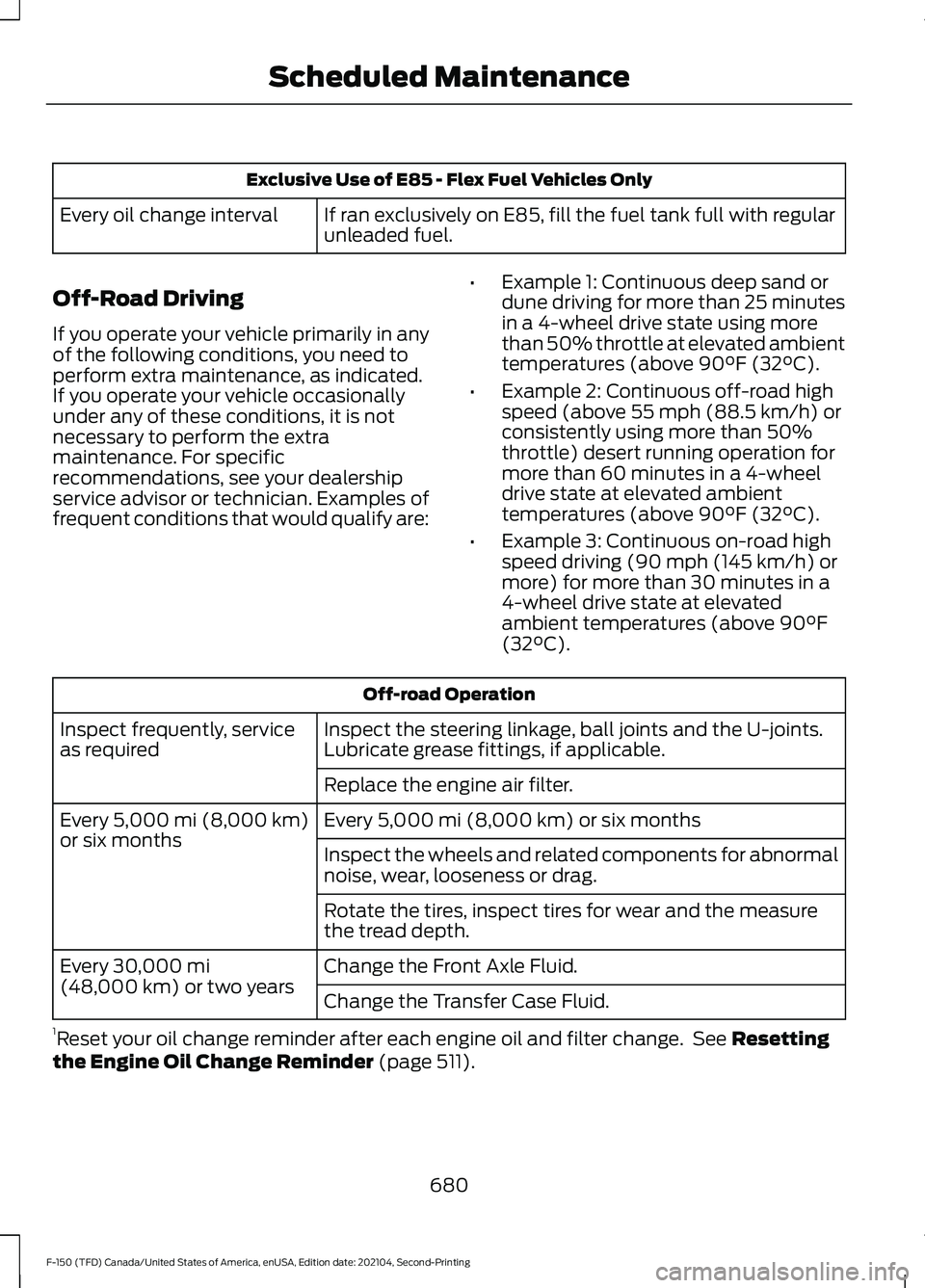
Off-Road Driving
If you operate your vehicle primarily in any
of the following conditions, you need to
perform extra maintenance, as indicated.
If you operate your vehicle occasionally
under any of these conditions, it is not
necessary to perform the extra
maintenance. For specific
recommendations, see your dealership
service advisor or technician. Examples of
frequent conditions that would qualify are: •
Example 1: Continuous deep sand or
dune driving for more than 25 minutes
in a 4-wheel drive state using more
than 50% throttle at elevated ambient
temperatures (above 90°F (32°C).
• Example 2: Continuous off-road high
speed (above
55 mph (88.5 km/h) or
consistently using more than 50%
throttle) desert running operation for
more than 60 minutes in a 4-wheel
drive state at elevated ambient
temperatures (above
90°F (32°C).
• Example 3: Continuous on-road high
speed driving (
90 mph (145 km/h) or
more) for more than 30 minutes in a
4-wheel drive state at elevated
ambient temperatures (above
90°F
(32°C). Off-road Operation
Inspect the steering linkage, ball joints and the U-joints.
Lubricate grease fittings, if applicable.
Inspect frequently, service
as required
Replace the engine air filter.
Every
5,000 mi (8,000 km) or six months
Every 5,000 mi (8,000 km)
or six months Inspect the wheels and related components for abnormal
noise, wear, looseness or drag.
Rotate the tires, inspect tires for wear and the measure
the tread depth.
Change the Front Axle Fluid.
Every
30,000 mi
(48,000 km) or two years Change the Transfer Case Fluid.
1 Reset your oil change reminder after each engine oil and filter change. See
Resetting
the Engine Oil Change Reminder (page 511).
680
F-150 (TFD) Canada/United States of America, enUSA, Edition date: 202104, Second-Printing Scheduled Maintenance