Page 266 of 500

HOW DOES TRAILER SWAY
CONTROL WORK
The system applies the brakes to the
individual wheels and reduces engine
torque to aid vehicle stability.
If the trailer begins to sway, the stability
control lamp flashes and the message
Trailer Sway Reduce Speed appears in
the information display.
Stop your vehicle as soon as it is safe to
do so. Check the vertical weight on the
tow ball and trailer load distribution.
TRAILER SWAY CONTROL
PRECAUTIONS WARNING: Turning off trailer sway
control increases the risk of loss of
vehicle control, serious injury or death.
Ford does not recommend disabling this
feature except in situations where speed
reduction may be detrimental (such as
hill climbing), the driver has significant
trailer towing experience, and can control
trailer sway and maintain safe operation.
Note: This feature only activates when
significant trailer sway occurs.
Note: This feature does not prevent trailer
sway, but reduces it once it begins.
Note: This feature cannot stop all trailers
from swaying.
Note: In some cases, if vehicle speed is too
high, the system may activate multiple
times, gradually reducing vehicle speed.
SWITCHING TRAILER SWAY
CONTROL ON AND OFF
1. Press
Features on the touchscreen. 2. Press
Towing.
3. Switch
Trailer Sway Control on or off.
The system turns on each time you start
your vehicle.
262
2021 Edge (CDQ) Canada/United States of America, enUSA, Edition date: 202011, First-Printing Trailer Sway Control
Page 267 of 500

COLD WEATHER
PRECAUTIONS
The functional operation of some
components and systems can be affected
at temperatures below approximately
-13°F (-25°C).
BREAKING-IN
Tires
You need to break in new tires for
approximately
300 mi (480 km). During
this time, your vehicle may exhibit some
unusual driving characteristics.
Brakes and Clutch
Avoid heavy use of the brakes and clutch
if possible for the first
100 mi (160 km) in
town and for the first 1,000 mi (1,600 km)
on freeways.
DRIVING THROUGH WATER WARNING:
Do not drive through
flowing or deep water as you may lose
control of your vehicle.
Note: Driving through standing water can
cause vehicle damage.
Note: Engine damage can occur if water
enters the air filter.
Before driving through standing water,
check the depth. Never drive through water
that is higher than the bottom of the front
rocker area of your vehicle. When driving through standing water, drive
very slowly and do not stop your vehicle.
Your brake performance and traction may
be limited. After driving through water and
as soon as it is safe to do so:
•
Lightly press the brake pedal to dry the
brakes and to check that they work.
• Check that the horn works.
• Check that the exterior lights work.
• Turn the steering wheel to check that
the steering power assist works.
DRIVING ECONOMICALLY
The following helps to improve fuel
consumption:
• Drive smoothly, accelerate gently and
anticipate the road ahead to avoid
heavy braking.
• Regularly check your tire pressures and
make sure that they are inflated to the
correct pressure.
• Follow the recommended maintenance
schedule and carry out the
recommended checks.
• Plan your journey and check the traffic
before you set off. It is more efficient
to combine errands into a single trip
whenever possible.
263
2021 Edge (CDQ) Canada/United States of America, enUSA, Edition date: 202011, First-Printing Driving HintsE259345
Page 274 of 500

TOWING YOUR VEHICLE
PRECAUTIONS
Use the following guidelines when towing
your vehicle. Failure to follow this
instruction could result in vehicle damage
not covered by the vehicle warranty.
Note:
Make sure you properly secure your
vehicle to the tow vehicle.
Note: If you are unsure of the vehicle ’s
configuration, contact an authorized dealer.
RECREATIONALLY TOWING
YOUR VEHICLE - 2.0L
ECOBOOST™, AWD
You cannot recreational tow your vehicle
with all wheels on the ground because
vehicle or transmission damage could
occur. You must recreational tow your
vehicle with all four wheels off the ground,
such as when using a car-hauling trailer.
Otherwise, you cannot recreational tow
your vehicle.
RECREATIONALLY TOWING
YOUR VEHICLE - 2.0L
ECOBOOST™, FWD
You cannot recreational tow your vehicle
with all wheels on the ground because
vehicle or transmission damage could
occur. Place the front wheels on a
two-wheel tow dolly. If you are using a tow
dolly, follow the instructions specified by
the equipment provider.
Note: Release the parking brake before
towing your vehicle. See Manually
Releasing the Electric Parking Brake
(page
190). RECREATIONALLY TOWING
YOUR VEHICLE - 2.7L
ECOBOOST™
Note:
Put your climate control system in
recirculated air mode to prevent exhaust
fumes from entering the vehicle. See
Climate Control
(page 128).
Follow these guidelines if you have a need
for recreational towing. An example of
recreational towing would be towing your
vehicle behind a motorhome. We designed
these guidelines to prevent damage to your
transmission.
You can recreational tow your vehicle with
all four wheels on the ground using the
Manual Park Release procedure, or with
all four wheels off the ground using a
vehicle transport trailer. If you are using a
vehicle transport trailer, follow the
instructions specified by the equipment
provider.
If you recreational tow your vehicle with all
four wheels on the ground:
• Only tow your vehicle in the forward
direction.
• Use the manual park release
procedure. See
Using Manual Park
Release (page 180). Failure to do so
may result in damage to the
transmission.
• Do not exceed
65 mph (105 km/h).
270
2021 Edge (CDQ) Canada/United States of America, enUSA, Edition date: 202011, First-Printing Towing Your Vehicle
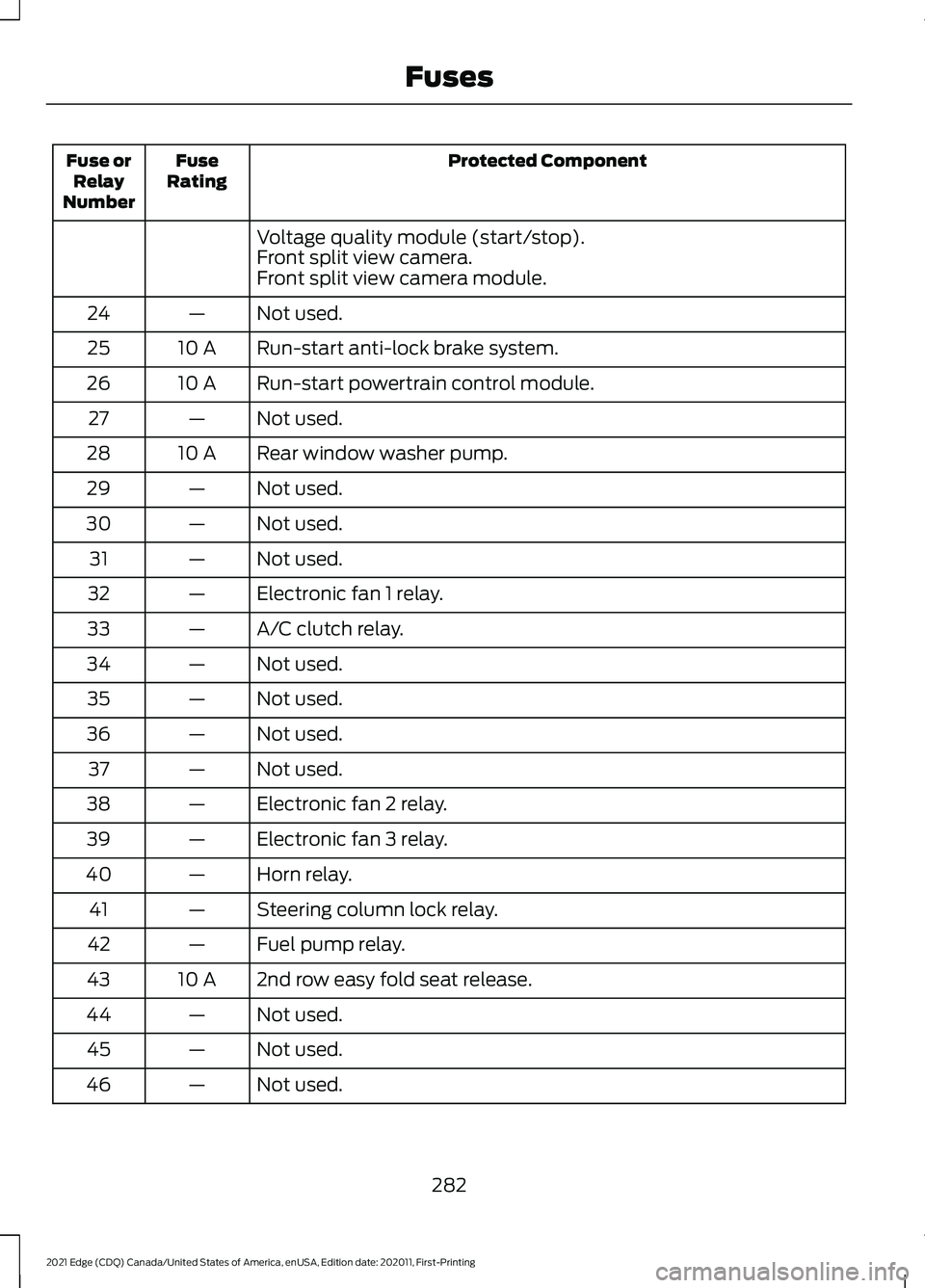
Page 286 of 500
Protected Component
Fuse
Rating
Fuse or
Relay
Number
Voltage quality module (start/stop).
Front split view camera.
Front split view camera module.
Not used.
—
24
Run-start anti-lock brake system.
10 A
25
Run-start powertrain control module.
10 A
26
Not used.
—
27
Rear window washer pump.
10 A
28
Not used.
—
29
Not used.
—
30
Not used.
—
31
Electronic fan 1 relay.
—
32
A/C clutch relay.
—
33
Not used.
—
34
Not used.
—
35
Not used.
—
36
Not used.
—
37
Electronic fan 2 relay.
—
38
Electronic fan 3 relay.
—
39
Horn relay.
—
40
Steering column lock relay.
—
41
Fuel pump relay.
—
42
2nd row easy fold seat release.
10 A
43
Not used.
—
44
Not used.
—
45
Not used.
—
46
282
2021 Edge (CDQ) Canada/United States of America, enUSA, Edition date: 202011, First-Printing Fuses
Page 287 of 500
Protected Component
Fuse
Rating
Fuse or
Relay
Number
Not used.
—
47
Steering column lock relay power.
15 A
48
Not used.
—
49
Horn.
20 A
50
Not used.
—
51
Not used.
—
52
Not used.
—
53
Brake on-off switch.
10 A
54
Alternator sensor.
10 A
55
Not used.
–
86
283
2021 Edge (CDQ) Canada/United States of America, enUSA, Edition date: 202011, First-Printing Fuses
Page 289 of 500
Protected Component
Fuse
Rating
Fuse or
Relay
Number
Not used.
—
64
Front heated seat.
20 A
65
Not used (spare).
15 A
66
Body control module 2.
50 A
67
Heated rear window.
40 A
68
Anti-lock brake system valves.
30 A
69
Passenger seat.
30 A
70
Not used.
—
71
Not used.
—
72
Rear heated seats.
20 A
73
Driver seat module.
30 A
74
Driver seat power.
Wiper motor 1.
25 A
75
Power liftgate module.
30 A
76
Climate control seat module.
30 A
77
Trailer lighting module.
40 A
78
Blower motor.
40 A
79
Wiper motor 2.
25 A
80
110 V inverter.
40 A
81
Not used.
–
82
Not used.
—
83
Starter motor solenoid.
30 A
84
Not used.
—
85
Anti-lock brake system pump.
60 A
87
285
2021 Edge (CDQ) Canada/United States of America, enUSA, Edition date: 202011, First-Printing Fuses
Page 294 of 500

MAINTENANCE PRECAUTIONS
Service your vehicle regularly to help
maintain its roadworthiness and resale
value. There is a large network of
authorized dealers that are there to help
you with their professional servicing
expertise. We believe that their specially
trained technicians are best qualified to
service your vehicle properly and expertly.
They are supported by a wide range of
highly specialized tools developed
specifically for servicing your vehicle.
If your vehicle requires professional service,
an authorized dealer can provide the
necessary parts and service. Check your
warranty information to find out which
parts and services are covered.
Use only recommended fuels, lubricants,
fluids and service parts conforming to
specifications. See Capacities and
Specifications (page 348).
• Do not work on a hot engine.
• Make sure that nothing gets caught in
moving parts.
• Do not work on a vehicle with the
engine running in an enclosed space,
unless you are sure you have enough
ventilation.
• Keep all open flames and other burning
material, such as cigarettes, away from
the battery and all fuel related parts.
• Set the parking brake, shift the
transmission to park (P) and block the
wheels. OPENING AND CLOSING THE
HOOD
Opening the Hood
1.
Inside the vehicle, pull the hood release
handle located under the left-hand
side of the instrument panel. 2. Slightly lift the hood.
290
2021 Edge (CDQ) Canada/United States of America, enUSA, Edition date: 202011, First-Printing MaintenanceE142457 E277804
Page 295 of 500
3. Release the hood latch by pushing the
secondary release lever to your
left-hand side. 4. Open the hood. The hood strut
automatically supports the hood.
Closing the Hood
1. Lower the hood and allow it to drop under its own weight for the last
8–12 in (20– 30 cm).
Note: Make sure that the hood is correctly
closed.
UNDER HOOD OVERVIEW - 2.0L ECOBOOST™ Engine coolant reservoir. See
Checking the Coolant (page 294).
A
Engine oil dipstick. See
Engine Oil Dipstick Overview (page 293).
B
Engine oil filler cap. See
Adding Engine Oil (page 293).
C
Brake fluid reservoir. See
Checking the Brake Fluid (page 187).
D
Battery. See
Changing the 12V Battery (page 299).
E
Power distribution box. See Accessing the Under Hood Fuse Box (page 279).
F
291
2021 Edge (CDQ) Canada/United States of America, enUSA, Edition date: 202011, First-Printing MaintenanceE191432
4 E294775