2021 CHEVROLET COLORADO heating
[x] Cancel search: heatingPage 15 of 89

Chevrolet/GMC 2.8L Duramax Diesel Engine Supplement (GMNA-Localizing-
U.S./Canada-14465442) - 2021 - CRC - 2/3/20
14 Driving and Operating
Observe the wait-to-start light. See
Wait-to-Start Light010. This light may
not come on if the engine is warm.
2. If the wait-to-start light is on, wait until this light goes off. Turn the ignition key
to START, then release the ignition key.
The engine will continue to crank until
the engine starts.
The engine has a fast warm-up glow
plug system. The wait-to-start light will
illuminate for a much shorter time than
most diesel engines, due to the rapid
heating of the glow plug system.
Caution
If the wait-to-start light stays on after
starting the vehicle, the vehicle may not
run properly. Have the vehicle serviced
right away.
3. If the engine does not start after 15 seconds of cranking, turn the ignition
off. Wait one minute for the cranking
motor to cool, then try the same steps
again.
If you are trying to start the engine after
you have run out of fuel, follow the steps in
Running Out of Fuel 030. When the engine is cold, let it run for a few
minutes before driving. This lets oil pressure
build up. The engine will sound louder when
it is cold.
For turbo protection, engine power at
speeds above idle may be limited if the
engine is cold. This protection can last up to
a maximum of 40 seconds at extreme cold
coolant and ambient temperatures.
Cold Weather Starting
Use the recommended engine oil when the
outside temperature drops below freezing.
See
Engine Oil 055. When the outside
temperature drops below –18 °C (0 °F), use
of the engine coolant heater is
recommended.
If you experience longer cranking times,
notice an unusual amount of exhaust smoke,
or are at higher elevations (over 2 135 m or
7,000 ft), you may use the engine coolant
heater. See Engine Heater 017.
See Fuel for Diesel Engines 025 for
information on what fuel to use in cold
weather.
If the Diesel Engine Will Not Start
If the vehicle runs out of fuel, see Running
Out of Fuel 030. If the vehicle is not out of fuel, and the
engine will not start:
Turn the ignition key to ON/RUN. After the
wait-to-start light goes off, turn the ignition
key to START.
If the light does not go off, wait a few
seconds, then try starting the engine again.
See your dealer as soon as possible for a
starting system check.
If the light comes on and then goes off and
you know the batteries are charged, but the
engine still will not start, the vehicle needs
service.
If the light does not come on when the
engine is cold, the vehicle needs service.
If the batteries do not have enough charge
to start the engine, see
“Battery”in the
owner’s manual.
Check that the correct engine oil has been
used and changed at appropriate intervals.
If the wrong oil is used, the engine may be
harder to start.
Be sure you are using the proper fuel for
existing weather conditions. See Fuel for
Diesel Engines 025.
If the engine starts, runs a short time, then
stops, the vehicle needs service.
Page 19 of 89

Chevrolet/GMC 2.8L Duramax Diesel Engine Supplement (GMNA-Localizing-
U.S./Canada-14465442) - 2021 - CRC - 2/3/20
18 Driving and Operating
Pickups
Vans2. Open the hood and unwrap the electrical
cord. The cord is in the engine
compartment, on the driver side behind
the battery for pickups, and on the
passenger side for vans.
3. Clean and dry the heater cord and connector ends. Check the heater cord
for damage. If it is damaged, do not use
it. See your dealer for a replacement.
Inspect the cord for damage yearly.
4. Plug it into a normal, grounded 110-volt AC outlet.
{Warning
Improper use of the heater cord or an
extension cord can damage the cord and
may result in overheating and fire.
.Plug the cord into a three-prong
electrical utility receptacle that is
protected by a ground fault detection
function. An ungrounded outlet could
cause an electric shock.
.Use a weatherproof, heavy-duty,
15 amp-rated extension cord if needed.
Failure to use the recommended
extension cord in good operating
condition, or using a damaged heater
(Continued)
Warning (Continued)
or extension cord, could make it
overheat and cause a fire, property
damage, electric shock, and injury.
.Do not operate the vehicle with the
heater cord permanently attached to
the vehicle. Possible heater cord and
thermostat damage could occur.
.While in use, do not let the heater
cord touch vehicle parts or sharp
edges. Never close the hood on the
heater cord.
.Before starting the vehicle, unplug the
cord, reattach the cover to the plug,
and securely fasten the cord. Keep the
cord away from any moving parts.
5. Before starting the engine, be sure to unplug and store the cord as it was
before to keep it away from moving
engine parts and prevent damage.
The length of time the heater should remain
plugged in depends on the outside
temperature. You may wish to use the
coolant heater to improve ease of starting
at temperatures between −18 °C (0 °F) and
−29 °C (−20 °F). Keep the coolant heater
plugged in for a minimum of four hours. At
Page 27 of 89
Chevrolet/GMC 2.8L Duramax Diesel Engine Supplement (GMNA-Localizing-
U.S./Canada-14465442) - 2021 - CRC - 2/3/20
26 Driving and Operating
Caution
Use of fuel that does not comply with
the required technical standards can lead
to engine power loss, increased wear,
or engine damage and may void your
warranty.
Some improper fuels are:
.Diesel fuel with the addition of
gasoline.
.Diesel fuel mixed with engine oil or
automatic transmission fluid.
.Triglyceride fuels, such as raw
vegetable oil or animal fat, in any
form, including with blends of diesel
or biodiesel.
.Marine diesel fuel and fuel oils.
.Diesel-water emulsions, such as
Aquazole.
.Aftermarket diesel fuel additives,
which contain alcohols, organo-metallic
additives, or water emulsifiers.
Caution
If the vehicle is accidentally refueled with
gasoline, do not continue driving the
vehicle. Driving the vehicle will damage
the fuel system. Have the vehicle towed
to a qualified technician to have the
gasoline removed from the tank and fuel
system. Refuel with Ultra Low Sulfur
Diesel fuel. It is also recommended to
have the fuel system flushed with Ultra
Low Sulfur Diesel, to ensure all gasoline
is removed.
Some conditions, such as dirty fuel, may
decrease fuel filter life and a CHANGE FUEL
FILTER message may come on in the Driver
Information Center (DIC).
Climate Grade Diesel Fuels
At temperatures below 0 °C (32 °F), avoid
using biodiesel blends above 5% by volume.
Using such a fuel may cause fuel filter
plugging, system gelling, and freezing, which
may adversely impact vehicle starting.
Severe winter grade diesel fuel, such as 1-D
diesel fuel or Arctic grade diesel fuel, can be
used in extreme cold temperatures (below
−18 °C or 0 °F); however, doing so will reduce power and fuel economy. Avoid
using severe winter grade fuel in warm or
hot climates. It can result in stalling, poor
starting, and damage to the fuel injection
system.
Fuels improperly blended for cold
temperature operation may result in
restricted fuel filters. The vehicle is equipped
with a fuel heating system to prevent
gelling or waxing of conventional diesel fuel
and biodiesel blends, but may not prevent
all cases.
In case of severe winter conditions, the fuel
filter may become clogged by wax naturally
present in the fuel. To unclog it, move the
vehicle to a warm garage area and allow the
filter to warm up. The fuel filter may need
to be replaced. See
Fuel Filter Replacement
0 30.Biodiesel
Biodiesel is a renewable fuel produced from
vegetable oils or animal fats that have been
chemically modified to make it compatible
with diesel fuel.
Page 35 of 89
Chevrolet/GMC 2.8L Duramax Diesel Engine Supplement (GMNA-Localizing-
U.S./Canada-14465442) - 2021 - CRC - 2/3/20
34 Driving and Operating
Filling a Portable Fuel Container
{Warning
Never fill a portable fuel container while
it is in the vehicle. Static electricity
discharge from the container can ignite
the fuel vapor. You or others could be
badly burned and the vehicle could be
damaged. To help avoid injury to you
and others:
.Dispense fuel only into approved
containers.
.Do not fill a container while it is
inside a vehicle, in a vehicle's trunk, in
a pickup bed, or on any surface other
than the ground.
.Bring the fill nozzle in contact with
the inside of the fill opening before
operating the nozzle. Maintain contact
until filling is complete.(Continued)
Warning (Continued)
.Keep sparks, flames, and smoking
materials away from fuel.
.Avoid using electronic devices while
pumping fuel.
Trailer Towing
When towing at high elevation on steep
uphill grades, consider the following:
Engine coolant at higher elevation will boil
at a lower temperature than at or near sea
level. If the engine is turned off immediately
after towing at high elevation on steep
uphill grades, the vehicle may show signs
similar to engine overheating. To avoid this,
let the engine run while parked (preferably
on level ground) with the transmission in
P (Park) and the parking brake applied for at
least five minutes before turning the engine
off. If the overheat warning comes on, see
Engine Overheating062. Use the following chart to determine the
maximum the trailer can weigh, based upon
your vehicle model and options.
All axles of the trailer must be equipped
with brakes adequate for the intended use.
Trailer braking equipment conforming to
Canadian Standards Association (CSA)
requirement CAN3-D313, or its equivalent, is
recommended.
Page 53 of 89

Chevrolet/GMC 2.8L Duramax Diesel Engine Supplement (GMNA-Localizing-
U.S./Canada-14465442) - 2021 - CRC - 2/3/20
52 Vehicle Care
Vehicle Care
General Information
Accessories and Modifications . . . . . . . . . . 52
Vehicle Checks
Engine Compartment Overview . . . . . . . . . 53
Engine Oil . . . . . . . . . . . . . . . . . . . . . . . . . . . . . . 55
Engine Oil Life System . . . . . . . . . . . . . . . . . 58
Automatic Transmission Fluid . . . . . . . . . . 58
Engine Air Cleaner/Filter . . . . . . . . . . . . . . . . 58
Cooling System . . . . . . . . . . . . . . . . . . . . . . . . 60
Engine Overheating . . . . . . . . . . . . . . . . . . . . 62
Battery (4-Cylinder Pickup Only) . . . . . . . . 63
Electrical System
Engine Compartment Fuse Block . . . . . . . 64
Appearance Care
Exterior Care . . . . . . . . . . . . . . . . . . . . . . . . . . . . 71
General Information
Accessories and Modifications
Adding non-dealer accessories or making
modifications to the vehicle can affect
vehicle performance and safety, including
such things as airbags, braking, stability,
ride and handling, emissions systems,
aerodynamics, durability, and electronic
systems like antilock brakes, traction control,
and stability control. These accessories or
modifications could even cause malfunction
or damage not covered by the vehicle
warranty.
Damage to vehicle components resulting
from modifications or the installation or use
of non-GM certified parts, including control
module or software modifications, is not
covered under the terms of the vehicle
warranty and may affect remaining
warranty coverage for affected parts.
GM Accessories are designed to complement
and function with other systems on the
vehicle. See your dealer to accessorize the
vehicle using genuine GM Accessories
installed by a dealer technician.
See the warranty manual.
Aftermarket Engine Performance
Enhancement Products and Modifications
Some aftermarket engine performance
products and modifications promise a way
to increase the horsepower and torque
levels of the vehicle's powertrain. You should
be aware that these products could have
harmful effects on the performance and life
of the engine, exhaust emission system,
transmission, and drivetrain. The engine,
transmission, and drivetrain have been
designed and built to offer industry leading
durability and performance in the most
demanding applications. Engine power
enhancement products may enable the
engine to operate at horsepower and torque
levels that could damage, create failure,
or reduce the life of the engine, engine
emission system, transmission, and
drivetrain. Damage, failure, or reduced life of
the engine, transmission, emission system,
drivetrain, or other vehicle components
caused by aftermarket engine performance
enhancement products or modifications
might not be covered under the vehicle
warranty.
Page 61 of 89

Chevrolet/GMC 2.8L Duramax Diesel Engine Supplement (GMNA-Localizing-
U.S./Canada-14465442) - 2021 - CRC - 2/3/20
60 Vehicle Care
Caution
If the air cleaner/filter is off, dirt can
easily get into the engine, which could
damage it. Always have the air cleaner/
filter in place when driving.
Cooling System
The cooling system allows the engine to
maintain the correct working temperature.
2.8L 4-Cylinder Engine Pickup Models
See“Cooling System” in the owner’s
manual.
2.8L 4-Cylinder Engine Van Models
1. Coolant Surge Tank
2. Coolant Surge Tank Pressure Cap
3. Engine Cooling Fan (Out of View)
{Warning
An underhood electric fan can start up
even when the engine is not running and
can cause injury. Keep hands, clothing,
and tools away from any underhood
electric fan.
{Warning
Do not touch heater or radiator hoses,
or other engine parts. They can be very
hot and can burn you. Do not run the
engine if there is a leak; all coolant could
leak out. That could cause an engine fire
and can burn you. Fix any leak before
driving the vehicle.
Engine Coolant
The cooling system in the vehicle is
filled with DEX-COOL engine coolant
mixture. See Recommended Fluids and
Lubricants 078 and
Maintenance Schedule 073 or
Maintenance Schedule 077. The following explains the cooling system
and how to add coolant when it is low.
If there is a problem with engine
overheating, see
Engine Overheating 062.
A 50/50 mixture of clean, drinkable water
and DEX-COOL coolant will:
.Give freezing protection down to −37 °C
(−34 °F).
.Give boiling protection up to 129 °C
(265 °F).
.Protect against rust and corrosion.
.Help keep the proper engine temperature.
.Let the warning lights and gauges work
as they should.
What to Use
{Warning
Plain water, or other liquids such as
alcohol, can boil before the proper
coolant mixture will. With plain water or
the wrong mixture, the engine could get
too hot but there would not be an
overheat warning. The engine could catch
fire and you or others could be burned.
Page 63 of 89
Chevrolet/GMC 2.8L Duramax Diesel Engine Supplement (GMNA-Localizing-
U.S./Canada-14465442) - 2021 - CRC - 2/3/20
62 Vehicle Care
Warning (Continued)
including the pressure cap, is hot. Wait
for the cooling system and pressure cap
to cool.
If no coolant is visible in the surge tank, add
coolant as follows:
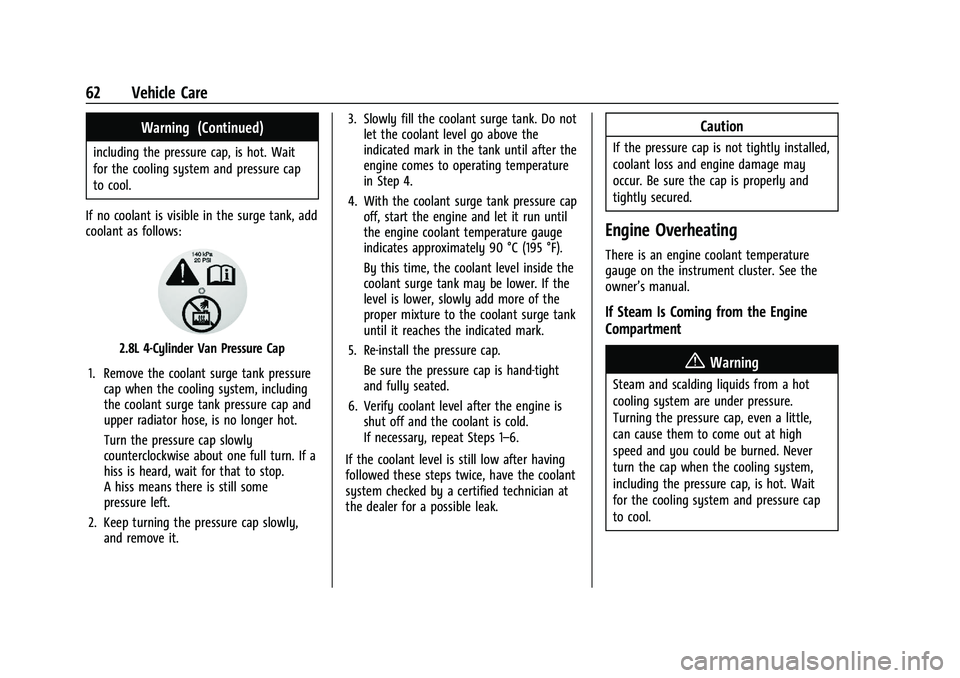
2.8L 4-Cylinder Van Pressure Cap
1. Remove the coolant surge tank pressure cap when the cooling system, including
the coolant surge tank pressure cap and
upper radiator hose, is no longer hot.
Turn the pressure cap slowly
counterclockwise about one full turn. If a
hiss is heard, wait for that to stop.
A hiss means there is still some
pressure left.
2. Keep turning the pressure cap slowly, and remove it. 3. Slowly fill the coolant surge tank. Do not
let the coolant level go above the
indicated mark in the tank until after the
engine comes to operating temperature
in Step 4.
4. With the coolant surge tank pressure cap off, start the engine and let it run until
the engine coolant temperature gauge
indicates approximately 90 °C (195 °F).
By this time, the coolant level inside the
coolant surge tank may be lower. If the
level is lower, slowly add more of the
proper mixture to the coolant surge tank
until it reaches the indicated mark.
5. Re-install the pressure cap. Be sure the pressure cap is hand-tight
and fully seated.
6. Verify coolant level after the engine is shut off and the coolant is cold.
If necessary, repeat Steps 1–6.
If the coolant level is still low after having
followed these steps twice, have the coolant
system checked by a certified technician at
the dealer for a possible leak.
Caution
If the pressure cap is not tightly installed,
coolant loss and engine damage may
occur. Be sure the cap is properly and
tightly secured.
Engine Overheating
There is an engine coolant temperature
gauge on the instrument cluster. See the
owner’s manual.
If Steam Is Coming from the Engine
Compartment
{Warning
Steam and scalding liquids from a hot
cooling system are under pressure.
Turning the pressure cap, even a little,
can cause them to come out at high
speed and you could be burned. Never
turn the cap when the cooling system,
including the pressure cap, is hot. Wait
for the cooling system and pressure cap
to cool.
Page 86 of 89

Chevrolet/GMC 2.8L Duramax Diesel Engine Supplement (GMNA-Localizing-
U.S./Canada-14465442) - 2021 - CRC - 2/3/20
Index 85
IndexA
Accessories and Modifications . . . . . . . . . . . . .52
Air Cleaner/Filter, Engine . . . . . . . . . . . . . . . . . 58
Appearance CareExterior . . . . . . . . . . . . . . . . . . . . . . . . . . . . . . . . . . 71
Automatic Transmission Fluid . . . . . . . . . . . . . . . . . . . . . . 58
B
Battery . . . . . . . . . . . . . . . . . . . . . . . . . . . . . . . . . . . 63
Biodiesel . . . . . . . . . . . . . . . . . . . . . . . . . . . . . . . . . . 26
BrakeExhaust . . . . . . . . . . . . . . . . . . . . . . . . . . . . . . . . . 24
C
Canadian Vehicle Owners . . . . . . . . . . . . . . . . . . . 1
Capacities and Specifications . . . . . . . . . . . . . . 82
CheckEngine Light (Malfunction Indicator) . . . . . 9
Cleaning Exterior Care . . . . . . . . . . . . . . . . . . . . . . . . . . . . . 71
Cluster, Instrument . . . . . . . . . . . . . . . . . . . . . . . . 4
Cold Weather Operation . . . . . . . . . . . . . . . . . . .27
Cooling System . . . . . . . . . . . . . . . . . . . . . . . . . . . 60
Covers Winter . . . . . . . . . . . . . . . . . . . . . . . . . . . . . . . . . . 16
D
DieselStarting Your Engine . . . . . . . . . . . . . . . . . . . . . 13
Diesel Exhaust Fluid . . . . . . . . . . . . . . . . . . . . . . .22
Diesel Exhaust Fluid (DEF) Warning Light . . . . . . . . . . . . . . . . . . . . . . . . . . . . . . . . . . . . 10
Diesel Particulate Filter . . . . . . . . . . . . . . . . . . . .19
Drive Belt Routing, Engine . . . . . . . . . . . . . . . . 84
Driver Information Center (DIC) . . . . . . . . . . . 10
E
Electrical System Engine Compartment Fuse Block . . . . . . . . 64
Engine Air Cleaner/Filter . . . . . . . . . . . . . . . . . . . . . . . 58
Check Light (Malfunction Indicator) . . . . . . 9
Compartment Overview . . . . . . . . . . . . . . . . . 53
Cooling System . . . . . . . . . . . . . . . . . . . . . . . . . 60
Drive Belt Routing . . . . . . . . . . . . . . . . . . . . . . 84
Heater . . . . . . . . . . . . . . . . . . . . . . . . . . . . . . . . . . . 17
Oil Life System . . . . . . . . . . . . . . . . . . . . . . . . . 58
Oil Pressure Gauge . . . . . . . . . . . . . . . . . . . . . . 8
Overheating . . . . . . . . . . . . . . . . . . . . . . . . . . . . 62
Starting Your Diesel . . . . . . . . . . . . . . . . . . . . . 13
Engines Diesel Fuel . . . . . . . . . . . . . . . . . . . . . . . . . . . . . . 25
Exhaust Brake . . . . . . . . . . . . . . . . . . . . . . . . . . . . 24