2021 AUDI Q2 sim
[x] Cancel search: simPage 287 of 364
Airbag system
Description of front airbags How the
front
airbags work
CO
â
rN
IV
rN
•-i
§
•H
00
The
airbag system is not a substitute for the seat
belts.
When fully inflated, the airbags reduce the risk
of head or chest
injury.
Fig.
228 Steering wheel: Driver's airbag
SiMlP
Fig.
229 Dashboard: Front passenger
s
airbag
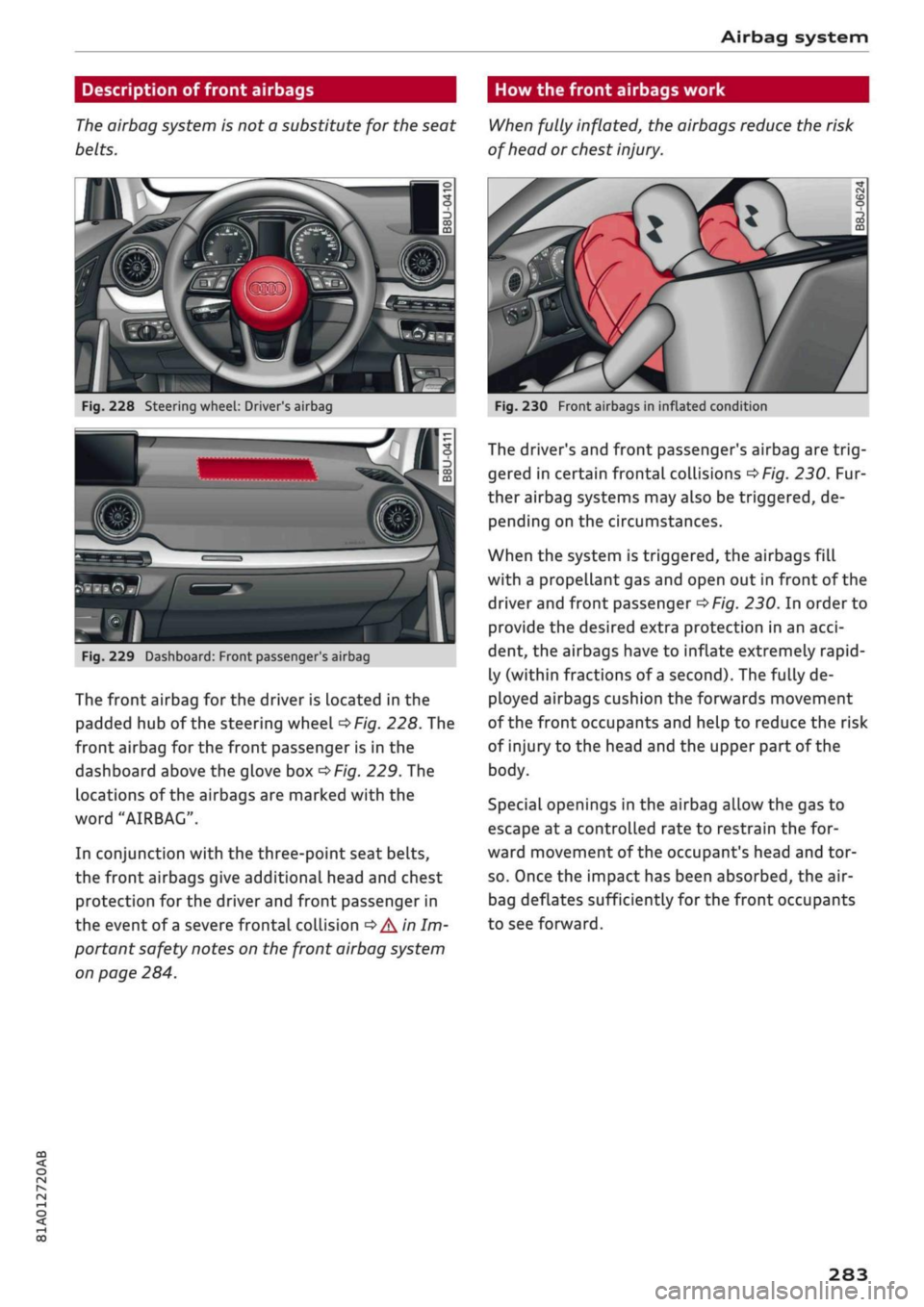
The front airbag for the driver is Located in the
padded hub of the steering wheel
^Fig.
228. The
front airbag for the front passenger is in the
dashboard above the glove box
^Fig.
229. The
locations of the airbags are marked with the
word "AIRBAG".
In conjunction with the three-point seat belts,
the front airbags give additional head and chest
protection for the driver and front passenger in
the event of
a
severe frontal collision
•=>
A'n
Im
portant safety notes on the front airbag system
on page 284.
Fig.
230 Front airbags in inflated condition
The driver's and front passenger's airbag are
trig
gered in certain frontal collisions
^>Fig.
230. Fur
ther airbag systems may also be triggered, de
pending on the circumstances.
When the system is triggered, the airbags fill
with a propellant gas and open out in front of the
driver and front passenger
^>Fig.
230. In order to
provide the desired extra protection in an
acci
dent, the airbags have to inflate extremely rapid
ly (within fractions of
a
second). The fully de
ployed airbags cushion the forwards movement
of the front occupants and help to reduce the risk
of injury to the head and the upper part of the
body.
Special openings in the airbag allow the gas to
escape at
a
controlled rate to restrain the for
ward movement of the occupant's head and tor
so.
Once the impact has been absorbed, the air-
bag deflates sufficiently for the front occupants
to see forward.
283
Page 295 of 364

Checking and topping up fluids
CO
<
O
rN
IV
rN
t-H
o <
- Make sure you never spill fuel in the
vehi
cle or in the luggage compartment. Fuel
vapour is explosive - danger to life!
© Note
(7) CAUTION
- If any fuel is spilt onto the vehicle, it should
be removed immediately as it could other
wise damage the paintwork.
- Never run the tank completely dry. If there
is an irregular fuel supply, misfiring can oc
cur. As a result unburnt fuel can enter the
exhaust system and cause damage to the
catalytic converter(s).
- Applies to vehicles with diesel engine: When
filling the fuel tank after having run it com
pletely dry, the ignition must be switched
on for at least 30 seconds before the engine
is started. When you then start the engine it
may take longer than normal (up to one mi
nute) for the engine to start firing. This is
because air needs to be bled from the fuel
system while starting.
® For the sake of the envir
Do not try to put in more fuel after the auto
matic filler nozzle has switched off; this may
cause the fuel to overflow if it becomes warm.
(T)
Note
Applies to: vehicles with diesel engine
Diesel vehicles are equipped with an incorrect
fuelling protection
system1).
This system en
sures that the tank can only be fuelled from a
diesel filler nozzle.
- If the filler nozzle is old, damaged or too
small,
it may not be able to open the pro
tection mechanism on the fuel tank. In this
case,
try turning the filler nozzle before in
serting it in the fuel filler neck, use a differ
ent filling pump or seek professional assis
tance.
- The protection mechanism will not open if
you try to add fuel from a spare fuel canis
ter. You can get round this simply by adding
the diesel fuel slowly.
1)
May vary in different countries
The tank flap is not locked when you lock the
vehicle from the inside.
Releasing the tank flap manually
The
tank flap can be released manually if the
central locking system should fail to operate.
Fig.
240 Luggage compartment (rear right): Manual re
lease under luggage compartment floor
The manual release mechanism is located under
the floor panel in the side trim on the right of the
luggage compartment.
•
Lift up the floor panel until it is fixed in position
behind the retaining tabs on the two side sec
tions
•=>
page 319.
• Take the screwdriver out of the vehicle tooL kit
^>page
319. Use the flat-blade side of the re
versible insert.
•
Use the screwdriver to prise off the cover
(l)
and remove
it(|).
• Release the ring from its holder and carefully
pull the ring
(S)
-arrow-
•=>([)•
The tank flap is
then released.
•
Press the left side of the tank flap to open it
•=>
page 290, Fig. 238.
© CAUTION
Stop pulling the ring when you feel resistance
at the ring/cover (the release mechanism is
not audible). Otherwise, you could damage
the manual release mechanism.
291
Page 309 of 364

Wheels
WheeLs
Tyres and rims
General notes
•
Inspect the tyres regularly for damage (cuts,
cracks or blisters, etc.). Remove any foreign
bodies embedded in the treads.
•
If
you
have to drive over
a
kerb or similar obsta
cle,
drive very slowly and as near as possible at
a right angle to the kerb.
• Damaged rims or tyres must be replaced imme
diately.
•
Keep grease, oil and fuel off the tyres.
•
Mark the wheels before taking them off so that
they rotate in the same direction when refitted.
•
When removed, the wheels should be stored
flat in a
cool,
dry and preferably dark place.
CO
<
O
rN
IV
rN
t-H
o <
(l)
CAUTION
- Please note that summer and winter tyres
are optimised for the prevailing road condi
tions at different times of
year.
We recom
mend that you use winter tyres during the
winter months. At low temperatures, sum
mer tyres lose their elasticity and grip, and
braking performance also suffers as a re
sult. Cracks can form in the tread block on
summer tyres if they are used at very cold
temperatures, and this can cause perma
nent damage to the tyres. An increase in
rolling noise and tyre imbalance may result
from this damage.
- Machined, polished or chrome-plated rims
must not be used in winter conditions. The
process used to manufacture these types of
wheel rim does not provide adequate sur
face protection against corrosion, and the
rims can be permanently damaged by road
salt or similar.
New wheels or tyres
It is best to have all servicing of wheels and tyres
performed by a qualified workshop, since they
have the necessary special tools and replacement
parts in addition to trained personnel.
•
New tyres do not yet give maximum grip. When
driving with new tyres, drive at moderate
speeds and be especially careful during the first
500 km.
•
All four wheels must be fitted with tyres of the
same type, size (rolling circumference) and
preferably the same tread pattern.
• Tyres should be replaced in pairs and not
indi
vidually (i.e. both front tyres or both rear tyres
together).
•
We recommend the use of Audi Genuine Tyres.
If
you
wish to use other tyres, please note that
the actual size can differ from the nominal size
marked on the tyre
•=> /\.
•
If
you
wish to purchase a different combination
of rims and tyres than the ones fitted on the ve
hicle during production, it is advisable to
con
sult
a
qualified workshop beforehand
<=> /\.
The sizes of the rims and tyres approved
for
your
vehicle are listed in the vehicle's documents (e.g.
EC
Certificate of Conformity or COC
document1)).
The vehicle documents vary depending on the
country in which the vehicle is registered.
If the spare wheel* is
not
the same type as the
tyres fitted on the car (for example if the car has
winter tyres or wide-section tyres) you should on
ly use the spare wheel* if
a
puncture occurs, and
then
only
for
a
short period of time. In this case,
please drive with extra care. Refit
a
normal road
wheel as soon as possible.
Applies to vehicles with four-wheel drive: All four
wheels must always be fitted with tyres of the
same type, make and tread pattern, as the drive-
line could otherwise be damaged by variations in
the wheel speeds. For the same reason, only use
a spare wheel* which has the same rolling cir
cumference as the normal road wheels.
Manufacturing date
The manufacturing date is indicated on the tyre
sidewall (possibly only on the inner side of the
wheel): •
15 COC
= Certificate of conformity
305
Page 320 of 364

Care of vehicle and cleaning
- Never clean the camera lens with cleaning
agents which are abrasive or contain alco
hol - danger of scratches and cracks ap
pearing.
- Windows and windscreen
- Remove snow and ice from windows and
exterior mirrors with a plastic scraper on
ly. To avoid scratches, the scraper should
only be pushed in one direction and not
moved to and fro.
- Never use warm or hot water to remove
snow and ice from windows and mirrors.
This could cause the glass to crack!
-To avoid damaging the heating element,
do not put stickers on the inner side of the
rear window.
- Ornamental trim/mouldings
- Do not use chrome cleaning agents.
- Paintwork
- The vehicle must be free of dirt and dust
before applying polish/wax - otherwise
the paintwork may be damaged.
- Do not polish/wax the vehicle in direct
sunLight - this can damage the paint!
- Do not attempt to polish out surface rust
deposits - this can damage the paint!
- Remove cosmetics and sun Lotion immedi
ately - otherwise the paintwork may be
damaged.
- Displays/instrument cluster
-The displays/instrument cluster and the
surrounding trim must not be cleaned
with a dry cloth - this can scratch the sur
faces!
- Before cleaning, ensure that the instru
ment cluster is switched off and
cool.
- Do not let any Liquid get between the in
strument cluster and the trim - risk of
damage!
- Do not exert heavy pressure on the head-
up display* when cleaning it. This could
push the dispLay out of its guide rails - risk
of damage!
- Control consoles
- Do not let any liquid get inside the control
consoles - risk of damage!
- Seat belts
- Do not remove the seat belts to clean
them.
- Do not use chemical cleaning agents, cor
rosive liquids, solvents or sharp instru
ments to clean the seat belts or their com
ponents - this can damage the belt web
bing!
- If
you
find any damage to the belt web
bing,
the belt fittings, the belt retractor or
the buckle, have the belt in question re
placed by
a
qualified workshop.
- Fabrics/leatherette/Alcantara
- Do not use leather care products,
sol
vents,
wax polish, shoe cream, stain
re
movers, or any similar products on leath
erette/Alcantara fabrics.
-To avoid damage, stubborn stains should
be removed by
a
qualified workshop.
- Never use steam cleaners, brushes, hard
sponges or similar utensils.
- Do not use the seat heating* to dry the
seats.
- Sharp-edged objects on clothing, such as
zip fasteners, rivets or belts, can also
damage the surface of the fabric.
- Please make sure you close any velcro fas
teners, e.g. on your clothing, as these
could otherwise damage the upholstery.
- Natural leather
- Do not use solvents, wax polish, shoe
cream,
stain removers, or any similar
products on leather fabrics.
- Sharp-edged objects on clothing, such as
zip fasteners, rivets or belts, can also
damage the surface of the fabric.
- Never use steam cleaners, brushes, hard
sponges or similar utensils.
- Do not use the seat heating* to dry the
seats.
- Avoid exposing leather to direct sunlight
for long periods, otherwise it may tend to
lose some of its colour. If the car is
Left
for
a prolonged period in the bright sun, it is
best
to cover the leather. •
316
Page 326 of 364

Mobility
\J Note
Note the code number of the anti-theft wheel
bolt and keep it in a safe place - not in your
vehicle. If
you
need a replacement adapter,
give the code number to your Audi dealer.
Loosening the wheel bolts
Raising the vehicle
Fig.
261 Wheel: Loosening the wheel bolts
•
Fit
the box spanner (provided in the vehicle's
tool kit) as far as it will go over the wheeL
bolt1'.
• Turn the wheel bolt approx. one turn
anti
clockwise -arrow-. To apply the necessary tor
que,
hold the box spanner
near
the end. If the
wheel bolt is very tight, you may be able to
loosen it by pushing down the end of the span
ner carefully with your foot. Hold on to the car
for support and take care not to slip.
WARNING
To avoid accidents, the wheel bolts should on
ly be loosened slightly (one turn) before rais
ing the vehicle with the jack*.
:v<
:
Fig.
262 Sills: markings (example)
Fig.
263 Door
sill:
Applying the jack under the door sill
• Always provide a firm base for the jack* on the
ground.
(The jack can be found in the vehicle's
tool kit). If necessary use a large, strong board
or similar support. On a
hard,
slippery surface
(such as tiles) use a rubber mat or similar to
prevent
the
jack from slipping
^> /\.
• Locate the marking (recess or rib) on the door
sill closest to the wheel being changed
^>Fig.
262. The jacking point is located behind
the marking under the door
sill.
• Wind up
the
jack* under
the
jacking point until
the claw
(A)
•=>
Fig.
263 of the jack is directly
be
low the jacking point.
• Align
the
jack* so
that
the
claw
(A)
grips the
jacking point under the door sill and the mova
ble base plate of the jack
(B)
is flat on the
ground.
The base plate
(B)
must be positioned
vertically underneath
the
jacking point®.
• Raise the vehicle until the defective wheel is
clear of the ground.
11
An adapter is required to unscrew or tighten the anti-theft
wheel bolts
opage
321.
322
Page 332 of 364

Mobility
7. Connect one end of the black lead preferably
to the earth point or alternatively to the
neg
ative battery terminal © on the vehicle pro
viding assistance®.
8. Connect the other end of the
black
jump lead
only to the earth point © of the jump-start
connection on your vehicle ©
<=>(£).
9. Position the jump leads in such a way that
they cannot come into contact with any mov
ing parts in the engine compartment.
Starting the engine
10.
Start the engine of the vehicle with the
boosting battery and let it run at idling
speed.
11.
Start the engine of the
car
with the dis
charged battery and wait two or three mi
nutes until the engine is running smoothly.
12.
If the engine fails to start: do not operate the
starter for longer than 10 seconds. Wait for
about 30 seconds and try again.
13.
Switch on the blower and the rear window
heating on the vehicle which has been jump-
started in order to offset excessive voltage
which may occur when disconnecting the
leads.
The headlights must be switched off!
14.
Disconnect the leads in exactly the opposite
sequence to that described in
*page
327
with the engines running. Make sure that the
Leads cannot come into contact with any
moving parts in the engine compartment.
15.
Fold the cover back onto the battery in its
correct position.
16.
Switch off the blower and the rear window
heating again.
PLease refer to
<=>
A in Before starting the engine
on page 326 and
•=>©
in Before starting the en
gine on page 327.
© CAUTION
Do not use the negative battery terminal
when jump-starting (this could cause a
mal
function in the on-board electrical system).
- Connect the battery clamps so they have
good metal-to-metal contact with the bat
tery terminals.
- The vehicle battery is vented to the outside
to prevent gases entering the vehicle's inte
rior.
Tow-
start
ing / towing
away
General notes
Some experience is required to tow or tow-start a
vehicle, especially when using a tow-rope. Both
drivers should be familiar with the technique re
quired for towing. Inexperienced drivers should
not attempt to tow-start or tow away another ve
hicle.
Do not pull too hard with the towing vehicle and
take care to avoid jerking the tow-rope. When
towing off-road, there is aLways a risk that the
anchorage points may be overloaded.
Tow-bar / tow-rope
It is easier and safer to tow the vehicle with a
tow-bar. You should only use a tow-rope if you do
not have a tow-bar. It is advisable to use a tow-
rope made of elastic synthetic fibre or similarly
elastic material.
Notes on towing vehicles
The vehicle can be towed with a tow-bar or tow-
rope.
When the engine is not running, the
gear
box will not be adequately lubricated if the
fol
lowing speed/distance restrictions are not ob
served:
- The vehicle must not be towed faster than
50 km/h.
- The vehicle must not be towed further than
50 km. •
328
Page 339 of 364

Fuses and bulbs
CO
rN
IV
rN
•-i
00
- Make sure that the covers are correctly seat
ed on the headlights and the rear lights.
This will ensure that water cannot enter the
housings and cause the lights to malfunc
tion.
- Do not touch the glass part of the bulb with
your bare hands; use a cloth or paper towel
instead.
Otherwise, the fingerprints left on
the glass will vaporise as a result of the heat
generated by the bulb, be deposited on the
reflector and impair its surface.
© CAUTION
When removing or installing the rear light,
take care not to cause any damage.
- Removing the rear light in particular can
lead to the paintwork or rear light becoming
damaged.
This is another reason why we
recommend having the bulbs changed by a
qualified workshop.
- Never use metal tools (e.g. a screwdriver) or
sharp or pointed plastic tools to lever out
the rear light - risk of damaging the paint.
- Make sure you have a soft cloth ready to
place under the glass on the rear light, to
avoid any scratches.
® For the sake of the environment
A qualified workshop can advise you how to
dispose of used bulbs in the proper manner.
© Note
- Please check at regular intervals that
alL
lighting (especially the exterior Lighting) on
your vehicle is functioning properly. This is
not only in the interest of your own safety,
but also in that of all other road users.
- Before changing a bulb, make sure you have
the correct new bulb.
Bulbs at front of vehicle
Applies to: vehicles with halogen headlights
Fig.
279 Halogen headlights: Overview of left side of
vehi
cle
You must only replace a bulb with a bulb of the
same type. Information regarding e.g. the wat
tage can be found on the base of the bulb.
The description for changing the bulb refers to
the left headlight; the procedure for the right
headlight is similar.
Halogen headlights
The following bulbs can be changed:
Bulb (12 V)
(T)Main
beam headlight
© Dipped headlight
© Daytime running light
© Turn signal
Version
H7LL(55
W)
H7LL(55W)
PW24W
PWY24W
Bulbs at rear of vehicle
Applies to: vehicles with bulbs
Fig.
280
Rear
of
vehicle:
Bulbs on
leftside
of vehicle
335
Page 340 of 364

Fuses and bulbs
You must only replace a bulb with a bulb of the
same type. Information regarding e.g. the wat
tage can be found on the glass or base of the
bulb.
The description for changing the bulb refers to
the Left rear light unit; the procedure for the
right rear Light unit is similar.
You can change the
foLLowing
bulbs yourself:
Changing bulb for turn signals
Applies to: vehicles with halogen headlights
Bulb (12 V)
©Tail
light
© Brake light
© Reversing Light
(4)
Turn signal
©Rearfog
light3'
Version
W16W
P21W
W16W
PY21W
W16W
a'
The bulb for the rear fog light is fitted on one side only. It
is located on the left side on LHD vehicles and on the right
side on RHD vehicles.
Changing headlight
bulbs
Removing cover (engine compartment)
Applies to: vehicles with halogen headlights
^
Fig.
281 Headlight: Cover for turn signal and main beam
headlight
• Switch off the ignition and the lights.
• Open the bonnet.
• Turn the headlight cover anti-clockwise
*Fig.
281 and remove it
*/^
in General notes
on page 334.
• Change the bulb for the turn signal
*page
336 or the main beam headlight
*page
337.
Fig.
282 Headlight: Plastic connector for turn signal
Fig.
283 Headlight: Fitting plastic connector for turn
sig
nal
Removing
• Pull the plastic connector together with the
buLb out of the headlight housing
*Fig.
282.
• Disconnect the plastic connector from the base
of the bulb
*^
in General notes on page 334.
Installing
• Push the new bulb into the plastic connector so
that it is securely seated
*^
in General notes
on page 334.
• Insert the bulb into the headlight housing.
•
Fit
the plastic connector
*Fig.
283 into the
housing and press it in until the side catches
engage.
• Put the cover back on.
• Check whether the new bulb is working.
336