2021 ALFA ROMEO GIULIA engine coolant
[x] Cancel search: engine coolantPage 222 of 284
SERVICING AND MAINTENANCE
220
Exhaust System
Adequate maintenance of the engine exhaust
system represents the best protection against
leaks of carbon monoxide into the passenger
compartment.
If an unusual noise from the exhaust or the
presence of smoke in the passenger compart-
ment is identified, or if the underbody or rear
section of the vehicle have been damaged,
have the entire exhaust system and adjoining
bodywork areas checked at an authorized
dealer to identify any components which are
broken, damaged, worn or have moved from
their correct fitting position.
Open welding or loose connections may permit
exhaust gas to enter the passenger compart -
ment.
Have the exhaust system checked every time
the vehicle is raised. Replace the components
where necessary (for these operations,
contact an authorized dealer).
In normal operating conditions, the catalytic
converter does not require maintenance. To
ensure that it operates correctly, however, and
prevent it from getting damaged, it is
extremely important that the engine operates
perfectly. To minimize the risk of damaging the catalytic
converter, proceed as follows:Do not stop the engine or deactivate the
ignition with gear engaged and vehicle in
motion.
Do not attempt to start the engine by bump
starting.
Do not persist in using the vehicle if idling is
very irregular or the operating conditions
are very notably irregular.
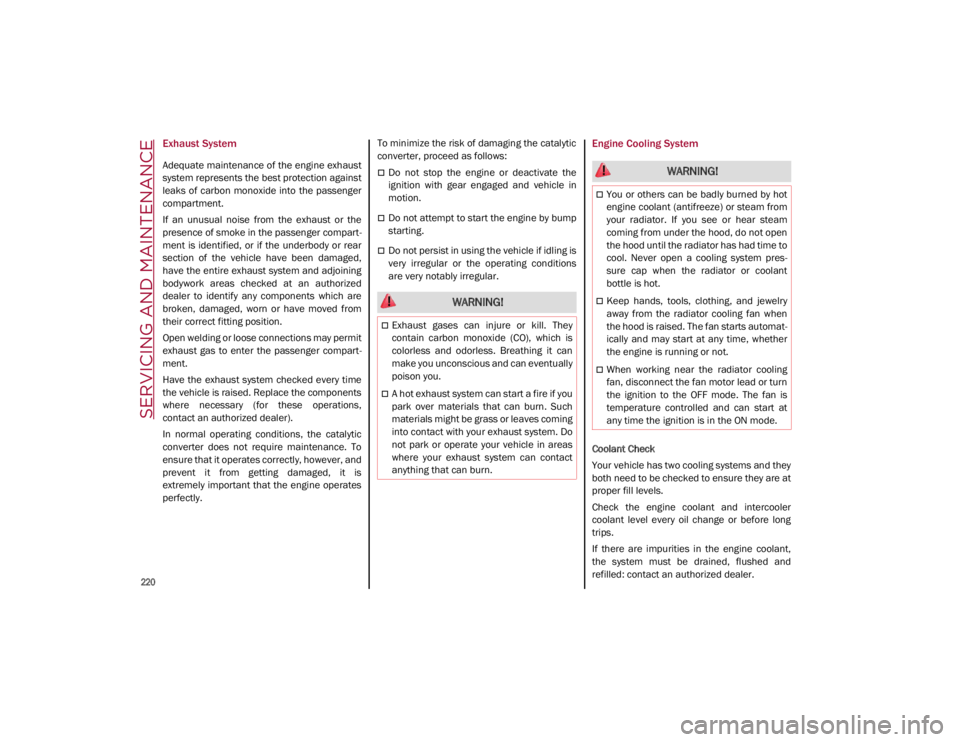
Engine Cooling System
Coolant Check
Your vehicle has two cooling systems and they
both need to be checked to ensure they are at
proper fill levels.
Check the engine coolant and intercooler
coolant level every oil change or before long
trips.
If there are impurities in the engine coolant,
the system must be drained, flushed and
refilled: contact an authorized dealer.
WARNING!
Exhaust gases can injure or kill. They
contain carbon monoxide (CO), which is
colorless and odorless. Breathing it can
make you unconscious and can eventually
poison you.
A hot exhaust system can start a fire if you
park over materials that can burn. Such
materials might be grass or leaves coming
into contact with your exhaust system. Do
not park or operate your vehicle in areas
where your exhaust system can contact
anything that can burn.
WARNING!
You or others can be badly burned by hot
engine coolant (antifreeze) or steam from
your radiator. If you see or hear steam
coming from under the hood, do not open
the hood until the radiator has had time to
cool. Never open a cooling system pres
-
sure cap when the radiator or coolant
bottle is hot.
Keep hands, tools, clothing, and jewelry
away from the radiator cooling fan when
the hood is raised. The fan starts automat -
ically and may start at any time, whether
the engine is running or not.
When working near the radiator cooling
fan, disconnect the fan motor lead or turn
the ignition to the OFF mode. The fan is
temperature controlled and can start at
any time the ignition is in the ON mode.
21_GA_OM_EN_USC_t.book Page 220
Page 223 of 284
221
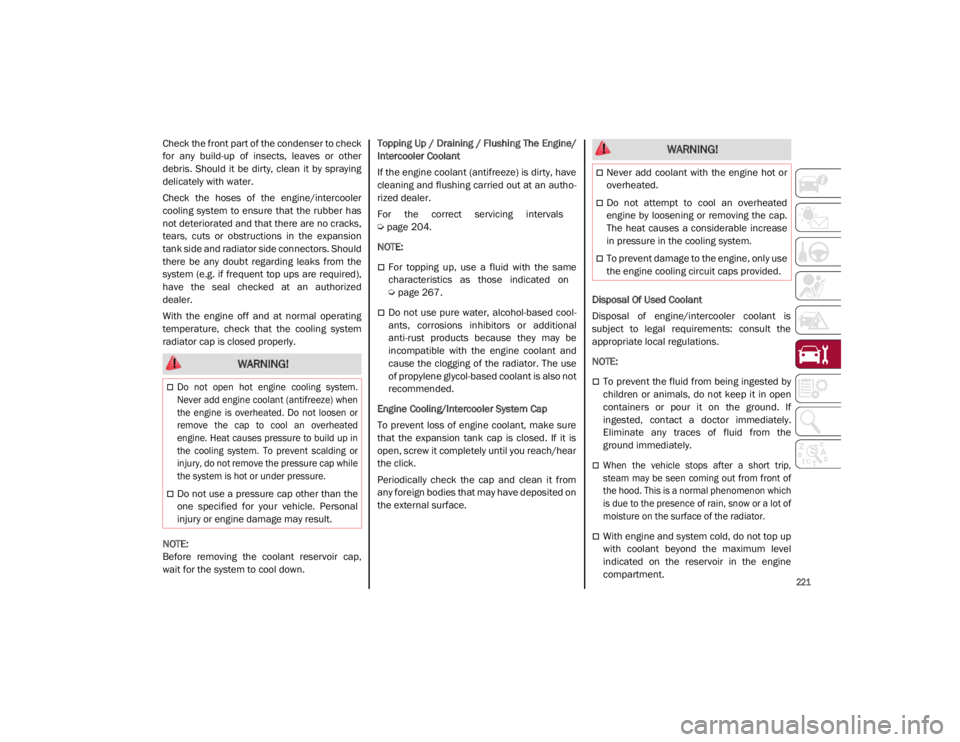
Check the front part of the condenser to check
for any build-up of insects, leaves or other
debris. Should it be dirty, clean it by spraying
delicately with water.
Check the hoses of the engine/intercooler
cooling system to ensure that the rubber has
not deteriorated and that there are no cracks,
tears, cuts or obstructions in the expansion
tank side and radiator side connectors. Should
there be any doubt regarding leaks from the
system (e.g. if frequent top ups are required),
have the seal checked at an authorized
dealer.
With the engine off and at normal operating
temperature, check that the cooling system
radiator cap is closed properly.
NOTE:
Before removing the coolant reservoir cap,
wait for the system to cool down.Topping Up / Draining / Flushing The Engine/
Intercooler Coolant
If the engine coolant (antifreeze) is dirty, have
cleaning and flushing carried out at an autho
-
rized dealer.
For the correct servicing intervals
Ú
page 204.
NOTE:
For topping up, use a fluid with the same
characteristics as those indicated on
Ú
page 267.
Do not use pure water, alcohol-based cool -
ants, corrosions inhibitors or additional
anti-rust products because they may be
incompatible with the engine coolant and
cause the clogging of the radiator. The use
of propylene glycol-based coolant is also not
recommended.
Engine Cooling/Intercooler System Cap
To prevent loss of engine coolant, make sure
that the expansion tank cap is closed. If it is
open, screw it completely until you reach/hear
the click.
Periodically check the cap and clean it from
any foreign bodies that may have deposited on
the external surface. Disposal Of Used Coolant
Disposal of engine/intercooler coolant is
subject to legal requirements: consult the
appropriate local regulations.
NOTE:
To prevent the fluid from being ingested by
children or animals, do not keep it in open
containers or pour it on the ground. If
ingested, contact a doctor immediately.
Eliminate any traces of fluid from the
ground immediately.
When the vehicle stops after a short trip,
steam may be seen coming out from front of
the hood. This is a normal phenomenon which
is due to the presence of rain, snow or a lot of
moisture on the surface of the radiator.
With engine and system cold, do not top up
with coolant beyond the maximum level
indicated on the reservoir in the engine
compartment.
WARNING!
Do not open hot engine cooling system.
Never add engine coolant (antifreeze) when
the engine is overheated. Do not loosen or
remove the cap to cool an overheated
engine. Heat causes pressure to build up in
the cooling system. To prevent scalding or
injury, do not remove the pressure cap while
the system is hot or under pressure.
Do not use a pressure cap other than the
one specified for your vehicle. Personal
injury or engine damage may result.
WARNING!
Never add coolant with the engine hot or
overheated.
Do not attempt to cool an overheated
engine by loosening or removing the cap.
The heat causes a considerable increase
in pressure in the cooling system.
To prevent damage to the engine, only use
the engine cooling circuit caps provided.
21_GA_OM_EN_USC_t.book Page 221
Page 270 of 284
TECHNICAL SPECIFICATIONS
268
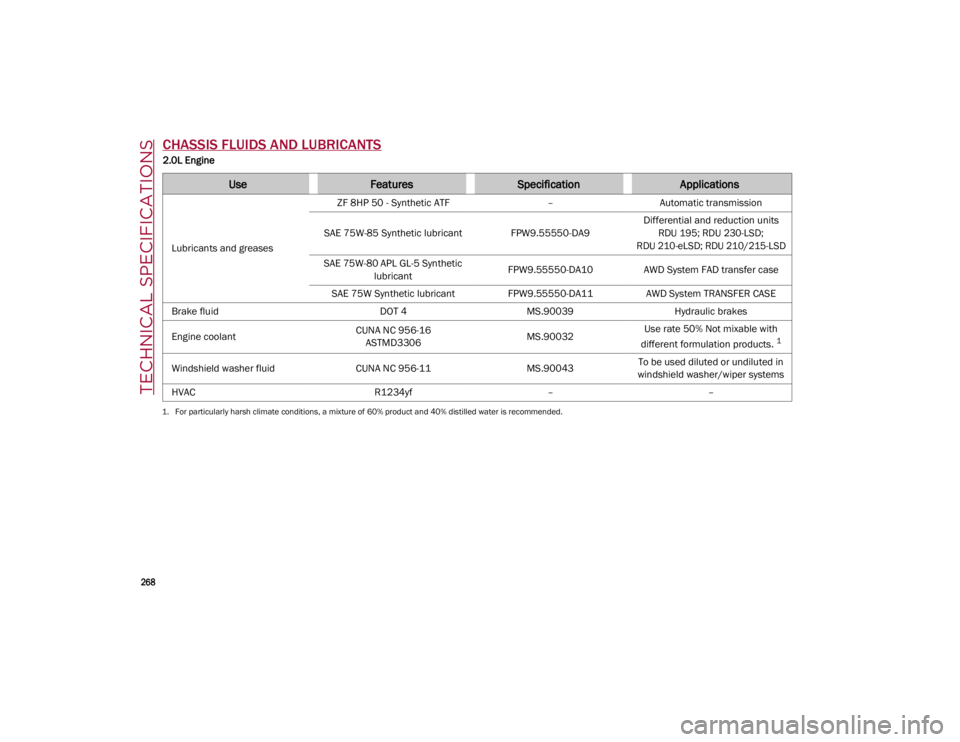
CHASSIS FLUIDS AND LUBRICANTS
2.0L Engine
UseFeaturesSpecificationApplications
Lubricants and greasesZF 8HP 50 - Synthetic ATF
–Automatic transmission
SAE 75W-85 Synthetic lubricant FPW9.55550-DA9 Differential and reduction units
RDU 195; RDU 230-LSD;
RDU 210-eLSD; RDU 210/215-LSD
SAE 75W-80 APL GL-5 Synthetic lubricant FPW9.55550-DA10 AWD System FAD transfer case
SAE 75W Synthetic lubricant FPW9.55550-DA11AWD System TRANSFER CASE
Brake fluid DOT 4MS.90039 Hydraulic brakes
Engine coolant CUNA NC 956-16
ASTMD3306 MS.90032Use rate 50% Not mixable with
different formulation products.
1 1.
For particularly harsh climate conditions, a mixture of 60 % product and 40 % distilled water is recommended.
Windshield washer fluid CUNA NC 956-11MS.90043To be used diluted or undiluted in
windshield washer/wiper systems
HVAC R1234yf––
21_GA_OM_EN_USC_t.book Page 268
Page 271 of 284
269
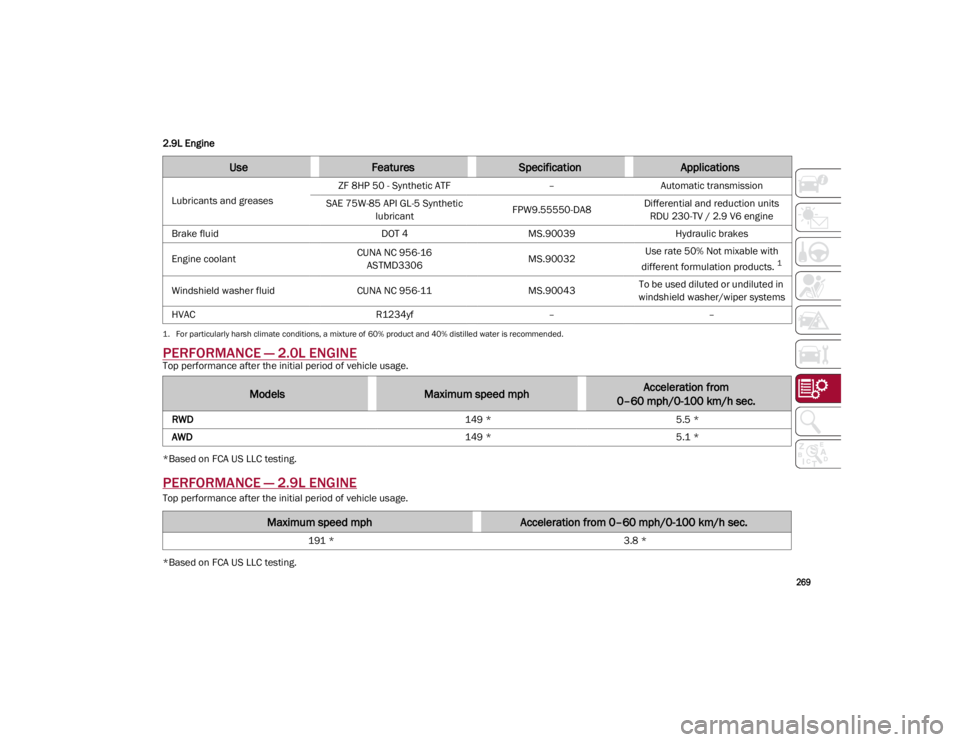
2.9L Engine
*Based on
FCA US LLC testing.
PERFORMANCE — 2.9L ENGINE
Top performance after the initial period of vehicle usage.
*Based on FCA US LLC testing.
UseFeaturesSpecificationApplications
Lubricants and greases ZF 8HP 50 - Synthetic ATF
–Automatic transmission
SAE 75W-85 API GL-5 Synthetic lubricant FPW9.55550-DA8Differential and reduction units
RDU 230-TV / 2.9 V6 engine
Brake fluid DOT 4MS.90039 Hydraulic brakes
Engine coolant CUNA NC 956-16
ASTMD3306 MS.90032Use rate 50% Not mixable with
different formulation products.
1 1.
For particularly harsh climate conditions, a mixture of 60% product and 40% distilled water is recommended.
PERFORMANCE — 2.0L ENGINE
Top performance after the initial period of vehicle usage.
Windshield washer fluid CUNA NC 956-11MS.90043To be used diluted or undiluted in
windshield washer/wiper systems
HVAC R1234yf––
ModelsMaximum speed mphAcceleration from
0–60 mph/0-100 km/h sec.
RWD 149 *5.5 *
AWD 149 *5.1 *
Maximum speed mphAcceleration from 0–60 mph/0-100 km/h sec.
191 * 3.8 *
21_GA_OM_EN_USC_t.book Page 269
Page 277 of 284

275
Door Ajar ................................................ 78, 79
Door Ajar Light ....................................... 78, 79
Door LocksAutomatic ................................................. 26
Door Opener, Garage ................................... 38
Drive Train Control (DTC) System ..............142
Driving Modes .............................................. 99
Dynamic Steering Torque (DST) System ... 142
E
Electric Park Brake....................................... 90
Electronic Speed Control
(Cruise Control) ..........................................105
Electronic Stability Control (ESC)
System ........................................................142
Electronic Throttle Control Warning
Light .............................................................. 78
Emergency In Case Of ......................................190, 194
SOS Emergency Call .............................. 190
Emergency, In Case Of Jump Starting .........................................198
Overheating ............................................ 200
Tow Hooks ..............................................202
Towing.....................................................201
Emission Control System Maintenance...... 85
Engine ......................................................... 256 Block Heater............................................. 89
Engine Coolant Level .............................214
Exhaust Gas Caution .............................189
Fuel Requirements ................................ 263Jump Starting .........................................199
Overheating ............................................ 200
Engine Compartment .................................211
Engine Compartment (Washing) ...............253 Engine Oil
Level Check............................................ 213
Enhanced Accident Response
Feature .............................................. 172, 203
Ethanol ....................................................... 263
Exhaust Gas Cautions ............................... 189
Exhaust System ......................................... 189
Exterior Lights ............................ 42, 188, 231
F
Flashers Turn Signals .................................... 77, 188
Fluid Leaks ................................................. 188
Fog Lights, Rear ........................................... 44
Forward Collision Warning ........................ 151
Fuel Additives................................................. 264
Clean Air ................................................. 263
Ethanol ................................................... 263
Light .......................................................... 79
Materials Added .................................... 264
Methanol ................................................ 263
Fuses ................................................. 223, 224
G
Garage Door Opener (HomeLink) ............... 38
Gasoline, Clean Air .................................... 263
Gasoline, Reformulated ............................ 263
Gauges Engine Oil Temperature .......................... 67
Fuel ........................................................... 68
Speedometer ........................................... 68
Tachometer .............................................. 67 Glove Compartment Storage .......................55
GVWR ......................................................... 137
H
Hazard Warning Flashers.......................... 190
Head Restraints............................................35
Head Rests ...................................................35
Headlights .....................................................42 Automatic..................................................42
Delay .........................................................43
High Beam ................................................42
Switch .......................................................42
Headlights (Cleaning) ................................ 253
Heated Mirrors..............................................38
Heated Seats ......................................... 33, 34
Heated Steering Wheel ................................27
Heater, Engine Block.................................... 89
Hill Start Assist (HSA) System ................... 143
HomeLink (Garage Door Opener) ................38
Hood Closing ......................................................62Opening.....................................................62
Hood Release ...............................................62
I
Ignition ..........................................................19 Switch .......................................................19
Immobilizer (Sentry Key) ..............................18
In Case Of Emergency ............................... 190
Installing Electrical/Electronic Devices......... 3
Instrument Cluster Descriptions..............................................77
Display ......................................................68
21_GA_OM_EN_USC_t.book Page 275