2020 YAMAHA NMAX 125 maintenance
[x] Cancel search: maintenancePage 96 of 114

Periodic maintenance and adjustment
9-33
910. Close the seat.
EAU60701
TroubleshootingAlthough Yamaha vehicles receive a
thorough inspection before shipment
from the factory, trouble may occur
during operation. Any problem in the
fuel, compression, or ignition systems,
for example, can cause poor starting
and loss of power.
The following troubleshooting charts
represent quick and easy procedures
for checking these vital systems your-
self. However, should your vehicle re-
quire any repair, take it to a Yamaha
dealer, whose skilled technicians have
the necessary tools, experience, and
know-how to service the vehicle prop-
erly.
Use only genuine Yamaha replace-
ment parts. Imitation parts may look
like Yamaha parts, but they are often
inferior, have a shorter service life and
can lead to expensive repair bills.
WARNING
EWA15142
When checking the fuel system, do
not smoke, and make sure there are
no open flames or sparks in the ar-
ea, including pilot lights from waterheaters or furnaces. Gasoline or
gasoline vapors can ignite or ex-
plode, causing severe injury or prop-
erty damage.
EAU76551
Smart key system troubleshooting
Please check the following items when
the smart key system does not work.
Is the smart key turned on? (See
page 3-4.)
Is the smart key battery dis-
charged? (See page 3-6.)
Is the smart key battery installed
correctly? (See page 3-6.)
Is the smart key being used in a lo-
cation with strong radio waves or
other electromagnetic noise? (See
page 3-1.)
Are you using the smart key that is
registered to the vehicle?
Is the vehicle battery discharged?
When the vehicle battery is dis-
charged, the smart key system will
not operate. Please have the vehi-
cle battery charged or replaced.
(See page 9-28.)
Tightening torque:
Grab bar bolt:
17 N·m (1.7 kgf·m, 13 lb·ft)
UBALE0E0.book Page 33 Wednesday, September 30, 2020 1:37 PM
Page 97 of 114

Periodic maintenance and adjustment
9-34
9 If the smart key system does not work
after checking the above items, have a
Yamaha dealer check the smart key
system.
TIPSee Emergency mode on page 9-38
for information on starting the engine
without the smart key.
EAU76843
Stop and Start System trouble-
shooting
If a problem occurs, check the follow-
ing before taking the vehicle to a
Yamaha dealer.
The Stop and Start System indicator
light does not come on.
1. Is the main switch turned on?
2. Is the Stop and Start System
switch set to “ ”?
3. Was the engine warmed up suffi-
ciently after starting?
4. After the engine was warmed up,
was the engine left idling for a cer-
tain period of time?
5. Did the vehicle travel at a speed of
10 km/h or higher?Even if the preceding conditions are
met, the Stop and Start System may
not activate in order to preserve bat-
tery power. In this case, continue to
drive the vehicle.
In addition, the Stop and Start System
indicator light does not come on if the
engine trouble warning light is on.
If the Stop and Start System indicator
light still does not come on after you
checked the preceding conditions,
have a Yamaha dealer check the vehi-
cle as soon as possible.
The Stop and Start System indicator
light comes on, but the engine does
not stop automatically.
1. Was the vehicle stopped com-
pletely?
The engine may not stop automat-
ically until the vehicle is stopped
for a certain period of time. Try
bringing the vehicle to a complete
stop.
2. Is the throttle grip turned?
The engine does not stop auto-
matically if the throttle grip is not in
the fully closed position.Turn the throttle grip to the fully
closed position.
If the engine still does not stop auto-
matically after you checked the pre-
ceding conditions, have a Yamaha
dealer check the vehicle as soon as
possible.
After the engine was stopped by the
Stop and Start System, the engine
does not restart even if the throttle
grip is turned.
1. Is the Stop and Start System
switch set to “ ”?
If the Stop and Start System
switch is set to “ ” while the Stop
and Start System is activated, the
Stop and Start System will be
turned off.
2. Was the sidestand operated?
When the sidestand is lowered,
the Stop and Start System is de-
activated.
3. Was the engine left stopped by
the Stop and Start System for a
long period of time?
A
AA
UBALE0E0.book Page 34 Wednesday, September 30, 2020 1:37 PM
Page 98 of 114

Periodic maintenance and adjustment
9-35
9If the engine is left stopped by the
Stop and Start System for a long
period of time, the battery could
become discharged.
If the engine still does not restart after
you checked the preceding conditions,
have a Yamaha dealer check the vehi-
cle as soon as possible.
UBALE0E0.book Page 35 Wednesday, September 30, 2020 1:37 PM
Page 99 of 114

Periodic maintenance and adjustment
9-36
9
EAU86350
Troubleshooting chart
Check the fuel level in
the fuel tank.1. Fuel
There is enough fuel.
There is no fuel.
Check the battery.
Supply fuel.
The engine does not start.
Check the battery.
Try starting the engine.4. Compression
There is compression.
There is no compression.
The engine does not start.
Have a Yamaha dealer check the vehicle.Have a Yamaha dealer check the vehicle.
Remove the spark plug
and check the electrodes.3. Ignition
Wipe off with a dry cloth and correct the
spark plug gap, or replace the spark plug(s).
Have a Yamaha dealer check the vehicle.
The engine does not start.
Check the compression.
Operate the electric starter.2. Battery
The engine turns over
quickly.
The engine turns over
slowly.
The battery is good.
DryWet
Try starting the engine. Check the battery lead connections,
and charge the battery if necessary.
The engine does not start.
Check the ignition.
UBALE0E0.book Page 36 Wednesday, September 30, 2020 1:37 PM
Page 100 of 114
Periodic maintenance and adjustment
9-37
9
EAU86420
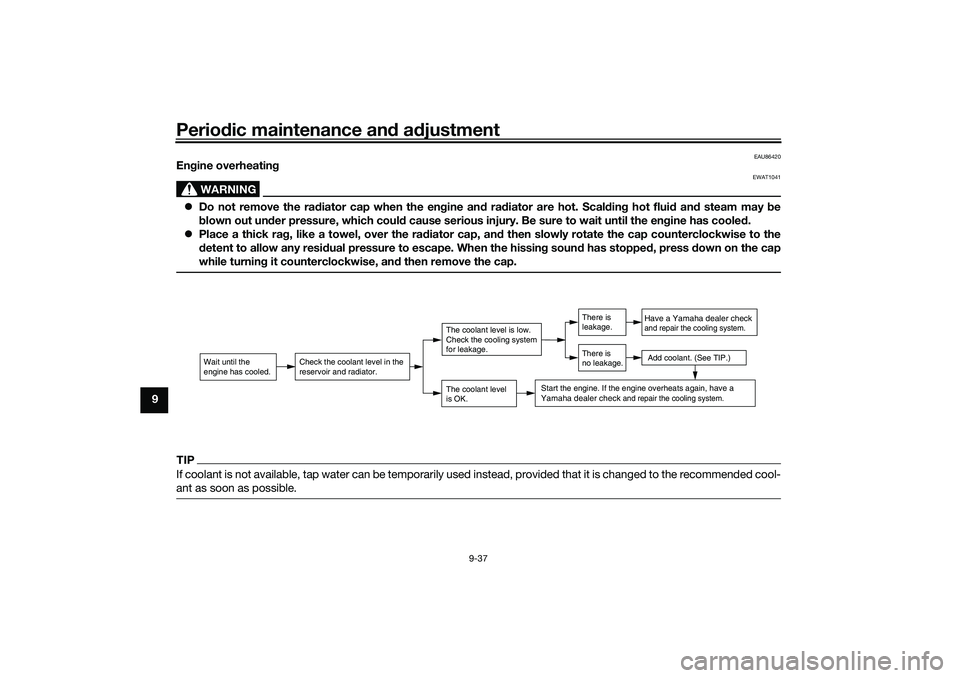
Engine overheating
WARNING
EWAT1041
Do not remove the radiator cap when the engine and radiator are hot. Scalding hot fluid and steam may be
blown out under pressure, which could cause serious injury. Be sure to wait until the engine has cooled.
Place a thick rag, like a towel, over the radiator cap, and then slowly rotate the cap counterclockwise to the
detent to allow any residual pressure to escape. When the hissing sound has stopped, press down on the cap
while turning it counterclockwise, and then remove the cap.TIPIf coolant is not available, tap water can be temporarily used instead, provided that it is changed to the recommended cool-
ant as soon as possible.
Wait until the
engine has cooled.
Check the coolant level in the
reservoir and radiator.
The coolant level
is OK.The coolant level is low.
Check the cooling system
for leakage.
Have a Yamaha dealer checkand repair the cooling system.Add coolant. (See TIP.)
Start the engine. If the engine overheats again,
have a
Yamaha dealer check
and repair the cooling system.
There is
leakage.
There is
no leakage.
UBALE0E0.book Page 37 Wednesday, September 30, 2020 1:37 PM
Page 101 of 114

Periodic maintenance and adjustment
9-38
9
EAU76561
Emergency mode When the smart key is lost or dam-
aged, or its battery has discharged, the
vehicle can still be turned on and the
engine started. You will need the smart
key system identification number.
To operate the vehicle in emergency
mode
1. Stop the vehicle in a safe place
and turn the main switch to “OFF”.
2. Push the main switch knob for 5
seconds until the smart key sys-
tem indicator light flashes once,
then release it. Repeat two more
times. The smart key system indi-
cator light will come on for three
seconds to indicate the transition
to emergency mode.3. After the smart key system indica-
tor light goes off, input the identifi-
cation number as follows.
4. Inputting the identification number
is done by counting the number of
flashes of the smart key system in-
dicator light.For example, if the identification
number is 123456:
Push and hold the knob.
↓
The smart key system indicator
light will start to flash.
↓
Release the knob after the smart
key system indicator light flashes
once.
↓
The first digit of the identification
number has been set as “1”.
↓
Push and hold the knob again.
↓
1. Smart key system indicator light “ ”
1. Identification number card
1
868588
1
UBALE0E0.book Page 38 Wednesday, September 30, 2020 1:37 PM
Page 102 of 114

Periodic maintenance and adjustment
9-39
9Release the knob after the smart
key system indicator light flashes
twice.
↓
The second digit has been set as
“2”.
↓
Repeat the above procedure until
all digits of the identification num-
ber have been set. The smart key
system indicator light will flash for
10 seconds if the correct identifi-
cation number was entered.
TIPWhen one of the following situations
applies, emergency mode will be ter-
minated and the smart key system in-
dicator light will flash quickly for 3
seconds. In this case, start over again
from step 2.
When there are no knob opera-
tions for 10 seconds during the
identification number input pro-
cess.
When the smart key system indi-
cator light is allowed to flash nine
or more times.The identification number is not
entered correctly.
5. While the smart key system indi-
cator light is on, push the knob
once more to complete emergen-
cy mode access. The smart key
indicator light will go off and then
come back on for approximately 4
seconds.
6. While the smart key system indi-
cator light is on, turn the main
switch to “ON”. The vehicle can
now be operated normally.
UBALE0E0.book Page 39 Wednesday, September 30, 2020 1:37 PM
Page 106 of 114

Motorcycle care and storage
10-4
101. Make all necessary repairs and
perform any outstanding mainte-
nance.
2. Follow all instructions in the Care
section of this chapter.
3. Fill up the fuel tank, adding fuel
stabilizer according to product in-
structions. Run the engine for 5
minutes to distribute treated fuel
through the fuel system.
4. For vehicles equipped with a fuel
cock: Turn the fuel cock lever to
the off position.
5. For vehicles with a carburetor: To
prevent fuel deposits from build-
ing up, drain the fuel in the carbu-
retor float chamber into a clean
container. Retighten the drain bolt
and pour the fuel back into the fuel
tank.
6. Use a quality engine fogging oil
according to product instructions
to protect internal engine compo-
nents from corrosion. If engine
fogging oil is not available, per-
form the following steps for each
cylinder:
a. Remove the spark plug cap
and spark plug.b. Pour a teaspoonful of engine
oil into the spark plug bore.
c. Install the spark plug cap onto
the spark plug, and then place
the spark plug on the cylinder
head so that the electrodes are
grounded. (This will limit spark-
ing during the next step.)
d. Turn the engine over several
times with the starter. (This will
coat the cylinder wall with oil.)
WARNING! To prevent dam-
age or injury from sparking,
make sure to ground the
spark plug electrodes while
turning the engine over.
[EWA10952]
e. Remove the spark plug cap
from the spark plug, and then
install the spark plug and the
spark plug cap.
7. Lubricate all control cables, piv-
ots, levers and pedals, as well as
the sidestand and centerstand (if
equipped).
8. Check and correct the tire air
pressure, and then lift the vehicle
so that all wheels are off the
ground. Otherwise, turn thewheels a little once a month in or-
der to prevent the tires from be-
coming degraded in one spot.
9. Cover the muffler outlet with a
plastic bag to prevent moisture
from entering it.
10. Remove the battery and fully
charge it, or attach a maintenance
charger to keep the battery opti-
mally charged. NOTICE: Confirm
that the battery and its charger
are compatible. Do not charge a
VRLA battery with a convention-
al charger.
[ECA26330]
TIPIf the battery will be removed,
charge it once a month and store
it in a temperate location between
0-30 °C (32-90 °F).
See page 9-28 for more informa-
tion on charging and storing the
battery.
UBALE0E0.book Page 4 Wednesday, September 30, 2020 1:37 PM