2020 YAMAHA MT-125 clutch
[x] Cancel search: clutchPage 42 of 96

Operation and important riding points
5-4
5
EAU16674
Shifting
Shifting gears lets you control the
amount of engine power available for
starting off, accelerating, climbing hills,
etc.
The gear positions are shown in the il-
lustration.
TIP
To shift the transmission into the neu-
tral position ( ), press the shift pedal
down repeatedly until it reaches the
end of its travel, and then slightly raise
it.
NOTICE
ECA10261
Even with the transmission in
the neutral position, do not
coast for long periods of time
with the engine off, and do not
tow the motorcycle for long dis-
tances. The transmission is
properly lubricated only when
the engine is running. Inade-
quate lubrication may damage
the transmission.
Always use the clutch while
changing gears to avoid dam-
aging the engine, transmission,and drive train, which are not
designed to withstand the
shock of forced shifting.
EAU85370To start out and accelerate
1. Pull the clutch lever to disengage
the clutch.
2. Shift the transmission into first
gear. The neutral indicator light
should go out.
3. Open the throttle gradually, and at
the same time, release the clutch
lever slowly.
4. After starting out, close the throt-
tle, and at the same time, quickly
pull the clutch lever in.
5. Shift the transmission into second
gear. (Make sure not to shift the
transmission into the neutral posi-
tion.)
6. Open the throttle part way and
gradually release the clutch lever.
7. Follow the same procedure when
shifting to the next higher gear.
EAU85380To decelerate
1. Release the throttle and apply
both the front and the rear brakes
smoothly to slow the motorcycle.
2. As the vehicle decelerates, shift to
a lower gear.
3. When the engine is about to stall
or runs roughly, pull the clutch le-
ver in, use the brakes to slow the
motorcycle, and continue to
downshift as necessary.
4. Once the motorcycle has
stopped, the transmission can be
shifted into the neutral position.
1. Neutral position
2. Shift pedal
1 2 3 4 5
6
1
2 N
UB6GE0E0.book Page 4 Wednesday, August 28, 2019 11:11 AM
Page 43 of 96

Operation and important riding points
5-5
5 The neutral indicator light should
come on and then the clutch lever
can be released.
WARNING
EWA17380
Improper braking can cause
loss of control or traction. Al-
ways use both brakes and apply
them smoothly.
Make sure that the motorcycle
and the engine have sufficiently
slowed before shifting to a low-
er gear. Engaging a lower gear
when the vehicle or engine
speed is too high could make
the rear wheel lose traction or
the engine to over-rev. This
could cause loss of control, an
accident and injury. It could also
cause engine or drive train dam-
age.
EAU16811
Tips for reducing fuel con-
sumption
Fuel consumption depends largely on
your riding style. Consider the follow-
ing tips to reduce fuel consumption:
Shift up swiftly, and avoid high en-
gine speeds during acceleration.
Do not rev the engine while shift-
ing down, and avoid high engine
speeds with no load on the en-
gine.
Turn the engine off instead of let-
ting it idle for an extended length
of time (e.g., in traffic jams, at traf-
fic lights or at railroad crossings).
UB6GE0E0.book Page 5 Wednesday, August 28, 2019 11:11 AM
Page 48 of 96

Periodic maintenance and adjustment
6-4
6
EAU71361
General maintenance and lubrication chart
NO. ITEM
1*Diagnostic system
check• Perform dynamic inspection us-
ing Yamaha diagnostic tool.
• Check the error codes.√√√√√√
2*Air filter element• Replace.√√
3Air filter case
check hose• Clean.√√√√√
4Clutch• Check operation.
•Adjust.√√√√√
5*Front brake• Check operation, fluid level, and
for fluid leakage.
• Replace brake pads if neces-
sary.√√√√√√
6*Rear brake• Check operation, fluid level, and
for fluid leakage.
• Replace brake pads if neces-
sary.√√√√√√
7*Brake hoses• Check for cracks or damage.√√√√√
• Replace. Every 4 years
8*Brake fluid• Change. Every 2 years
9*Wheels• Check runout and for damage.
• Replace if necessary.√√√√
10*Tires• Check tread depth and for dam-
age.
• Replace if necessary.
• Check air pressure.
• Correct if necessary.√√√√√
11*Wheel bearings• Check bearing for looseness or
damage.√√√√
12*Swingarm pivot
bearings• Check operation and for exces-
sive play.√√√√
• Lubricate with lithium-soap-
based grease.Every 24000 km (14000 mi)X 1000 km CHECK OR
MAINTENANCE JOB
X 1000 miODOMETER
READINGANNUAL CHECK
1 6 12 18 24
0.6 3.5 7 10.5 14
UB6GE0E0.book Page 4 Wednesday, August 28, 2019 11:11 AM
Page 49 of 96

Periodic maintenance and adjustment
6-5
6
13 Drive chain• Check chain slack, alignment
and condition.
• Adjust and lubricate chain with a
special O-ring chain lubricant
thoroughly.Every 1000 km (600 mi) and af-
ter washing the motorcycle, rid-
ing in the rain or riding in wet
areas
14*Steering bearings• Check bearing assemblies for
looseness.√√√√
• Moderately repack with lithium-
soap-based grease.√
15*Chassis fasteners• Make sure that all nuts, bolts
and screws are properly tight-
ened.√√√√√
16Brake lever pivot
shaft• Lubricate with silicone grease.√√√√√
17Brake pedal pivot
shaft• Lubricate with lithium-soap-
based grease.√√√√√
18Clutch lever pivot
shaft• Lubricate with lithium-soap-
based grease.√√√√√
19Shift pedal pivot
shaft• Lubricate with lithium-soap-
based grease.√√√√√
20 Sidestand• Check operation.
• Lubricate with lithium-soap-
based grease.√√√√√
21*Sidestand switch• Check operation and replace if
necessary.√√√√√√
22*Front fork• Check operation and for oil leak-
age.
• Replace if necessary.√√√√
23*Shock absorber
assembly• Check operation and for oil leak-
age.
• Replace if necessary.√√√√
24*Rear suspension
relay arm and
con-
necting arm pivot-
ing points• Check operation.√√√√
• Lubricate with lithium-soap-
based grease.√√
25 Engine oil• Change (warm engine before
draining).
• Check oil level and vehicle for oil
leakage.At the initial interval and
every 3000 km (1800 mi)
thereafter.√ NO. ITEM
X 1000 km CHECK OR
MAINTENANCE JOB
X 1000 mi
ODOMETER
READING
ANNUAL CHECK
16121824
0.63.5710.514
UB6GE0E0.book Page 5 Wednesday, August 28, 2019 11:11 AM
Page 54 of 96

Periodic maintenance and adjustment
6-10
67. Install the oil filter element cover
by installing the bolts, then tight-
ening them to the specified
torque.
TIP
Make sure that the O-ring is properly
seated.
8. Install the engine oil strainer, com-
pression spring, O-ring and the
engine oil drain bolt, and then
tighten it to the specified torque.
NOTICE: Before installing the
engine oil drain bolt, do not for-
get to install the O-ring, com-
pression spring, and oil strainer
in position.
[ECA10422]
9. Refill with the specified amount of
the recommended engine oil, and
then install and tighten the oil filler
cap.
NOTICE
ECA11621
In order to prevent clutch slip-
page (since the engine oil also
lubricates the clutch), do not
mix any chemical additives. Do
not use oils with a diesel speci-
fication of “CD” or oils of a high-
er quality than specified. In
addition, do not use oils labeled
“ENERGY CONSERVING II” or
higher.
Make sure that no foreign mate-
rial enters the crankcase.
10. Start the engine, and then let it idle
for several minutes while checking
it for oil leakage. If oil is leaking,
immediately turn the engine off
and check for the cause.
11. Turn the engine off, and then
check the oil level and correct it if
necessary.
1. Oil filter element
2. O-ring
Tightening torque:
Oil filter element cover bolt:
10 N·m (1.0 kgf·m, 7.4 lb·ft)
Tightening torque:
Engine oil drain bolt:
32 N·m (3.2 kgf·m, 24 lb·ft)
Recommended engine oil:
See page 8-1.
Oil quantity:
Oil change:
0.85 L (0.90 US qt, 0.75 Imp.qt)
With oil filter removal:
0.95 L (1.00 US qt, 0.84 Imp.qt)
UB6GE0E0.book Page 10 Wednesday, August 28, 2019 11:11 AM
Page 62 of 96

Periodic maintenance and adjustment
6-18
6
EAU21963
Cast wheels
To maximize the performance, durabil-
ity, and safe operation of your vehicle,
note the following points regarding the
specified wheels.
The wheel rims should be
checked for cracks, bends, warp-
age or other damage before each
ride. If any damage is found, have
a Yamaha dealer replace the
wheel. Do not attempt even the
smallest repair to the wheel. A de-
formed or cracked wheel must be
replaced.
The wheel should be balanced
whenever either the tire or wheel
has been changed or replaced. An
unbalanced wheel can result in
poor performance, adverse han-
dling characteristics, and a short-
ened tire life.
EAU22047
Adjusting the clutch lever free
play
Measure the clutch lever free play as
shown.
Periodically check the clutch lever free
play and, if necessary, adjust it as fol-
lows.
1. Slide the rubber cover back at the
clutch lever.
2. Loosen the locknut.
3. To increase the clutch lever free
play, turn the clutch lever free play
adjusting bolt in direction (a). To
decrease the clutch lever free
play, turn the adjusting bolt in di-
rection (b).
TIP
If the specified clutch lever free play
could be obtained as described above,
skip steps 4…7.
4. Fully turn the adjusting bolt at the
clutch lever in direction (a) to loos-
en the clutch cable.
1. Rubber cover
2. Clutch lever free play adjusting bolt
3. Locknut
4. Clutch lever free play
Clutch lever free play:
10.0–15.0 mm (0.39–0.59 in)
4
12 (a) (b)
3
UB6GE0E0.book Page 18 Wednesday, August 28, 2019 11:11 AM
Page 63 of 96
Periodic maintenance and adjustment
6-19
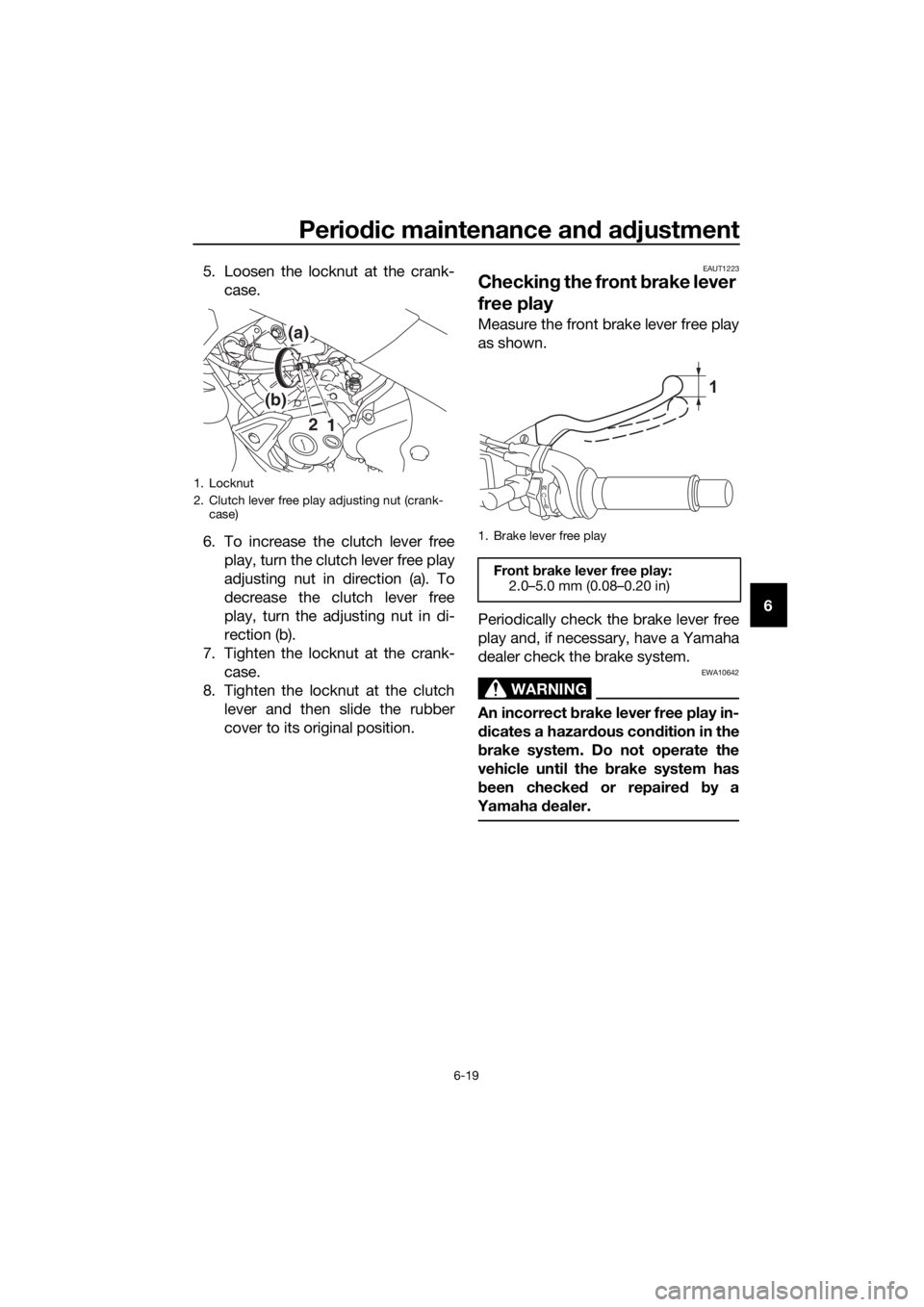
6 5. Loosen the locknut at the crank-
case.
6. To increase the clutch lever free
play, turn the clutch lever free play
adjusting nut in direction (a). To
decrease the clutch lever free
play, turn the adjusting nut in di-
rection (b).
7. Tighten the locknut at the crank-
case.
8. Tighten the locknut at the clutch
lever and then slide the rubber
cover to its original position.
EAUT1223
Checking the front brake lever
free play
Measure the front brake lever free play
as shown.
Periodically check the brake lever free
play and, if necessary, have a Yamaha
dealer check the brake system.
WARNING
EWA10642
An incorrect brake lever free play in-
dicates a hazardous condition in the
brake system. Do not operate the
vehicle until the brake system has
been checked or repaired by a
Yamaha dealer.
1. Locknut
2. Clutch lever free play adjusting nut (crank-
case)
1 2 (a)
(b)
1. Brake lever free play
Front brake lever free play:
2.0–5.0 mm (0.08–0.20 in)
1
UB6GE0E0.book Page 19 Wednesday, August 28, 2019 11:11 AM
Page 71 of 96

Periodic maintenance and adjustment
6-27
6
EAU23144
Checking and lubricating the
brake and clutch levers
The operation of the brake and clutch
levers should be checked before each
ride, and the lever pivots should be lu-
bricated if necessary.
Brake lever
Clutch lever
EAU23203
Checking and lubricating the
sidestand
The operation of the sidestand should
be checked before each ride, and the
sidestand pivot and metal-to-metal
contact surfaces should be lubricated
if necessary.
WARNING
EWA10732
If the sidestand does not move up
and down smoothly, have a Yamaha
dealer check or repair it. Otherwise,
the sidestand could contact the
ground and distract the operator, re-
sulting in a possible loss of control.
Recommended lubricants:
Brake lever:
Silicone grease
Clutch lever:
Lithium-soap-based grease
Recommended lubricant:
Lithium-soap-based grease
UB6GE0E0.book Page 27 Wednesday, August 28, 2019 11:11 AM