2020 TOYOTA 4RUNNER load
[x] Cancel search: loadPage 3 of 596

3
1
8 7
6
5
4
3
2
9
4RUNNER (U)4-1. Before driving
Driving the vehicle ............. 176
Cargo and luggage............ 186
Vehicle load limits ............. 191
Trailer towing..................... 192
Dinghy towing.................... 208
4-2. Driving procedures Engine (ignition) switch (vehicles without a
smart key system) ........... 209
Engine (ignition) switch (vehicles with a
smart key system) ........... 212
Automatic transmission ..... 218
Turn signal lever................ 223
Parking brake .................... 224
4-3. Operating the lights and wipers
Headlight switch ................ 225
Automatic High Beam ....... 231
Fog light switch ................. 235
Windshield wipers and washer ............................ 237
Rear window wiper and washer ............................ 240
4-4. Refueling Opening the fuel tank cap .................................. 243 4-5. Using the driving
support systems
Toyota Safety Sense P ...... 246
PCS (Pre-Collision System)..... 254
LDA (Lane Departure Alert)..... 265
Dynamic radar cruise control.............................. 273
Intuitive parking assist ....... 286
Four-wheel drive system (part-time 4WD
models)............................ 293
Four-wheel drive system (full-time 4WD
models)............................ 297
Active traction control system ............................. 301
AUTO LSD system ............ 303
Rear differential lock system ............................. 305
Downhill assist control system ............................. 308
Crawl Control ..................... 311
Multi-terrain Select............. 314
Driving assist systems ....... 321
4-6. Driving tips Winter driving tips .............. 330
Off-road precautions .......... 334
4Driving
Page 50 of 596

501-1. For safe use
4RUNNER (U)
WARNING
■Front passenger occupant classification system precautions
Observe the following precautions regarding the front passenger occupant
classification system.
Failure to do so may cause death or serious injury.
● Wear the seat belt properly.
● Make sure the front passenger’s seat belt plate has not been le ft inserted
into the buckle before someone sits in the front passenger seat .
● Make sure the “AIR BAG OFF” indicator light is not illuminated when using
the seat belt extender for the front passenger seat. If the “AI R BAG OFF”
indicator light is illuminated, disconnect the extender tongue from the seat
belt buckle, and reconnect the seat belt. Reconnect the seat be lt extender
after making sure the “AIR BAG ON” indicator light is illuminat ed. If you
use the seat belt extender while the “AIR BAG OFF” indicator li ght is illumi-
nated, the SRS airbags for the front passenger will not activate, which
could cause death or serious injury in the event of a collision .
● Do not apply a heavy load to the front passenger seat or equipm ent.
● Do not put weight on the front passenger seat by putting your hands or
feet on the front passenger seat seatback from the rear passeng er seat.
● Do not let a rear passenger lift the front passenger seat with their feet or
press on the seatback with their legs.
● Do not put objects under the front passenger seat.
Page 132 of 596
1323-2. Opening, closing and locking the doors
4RUNNER (U)
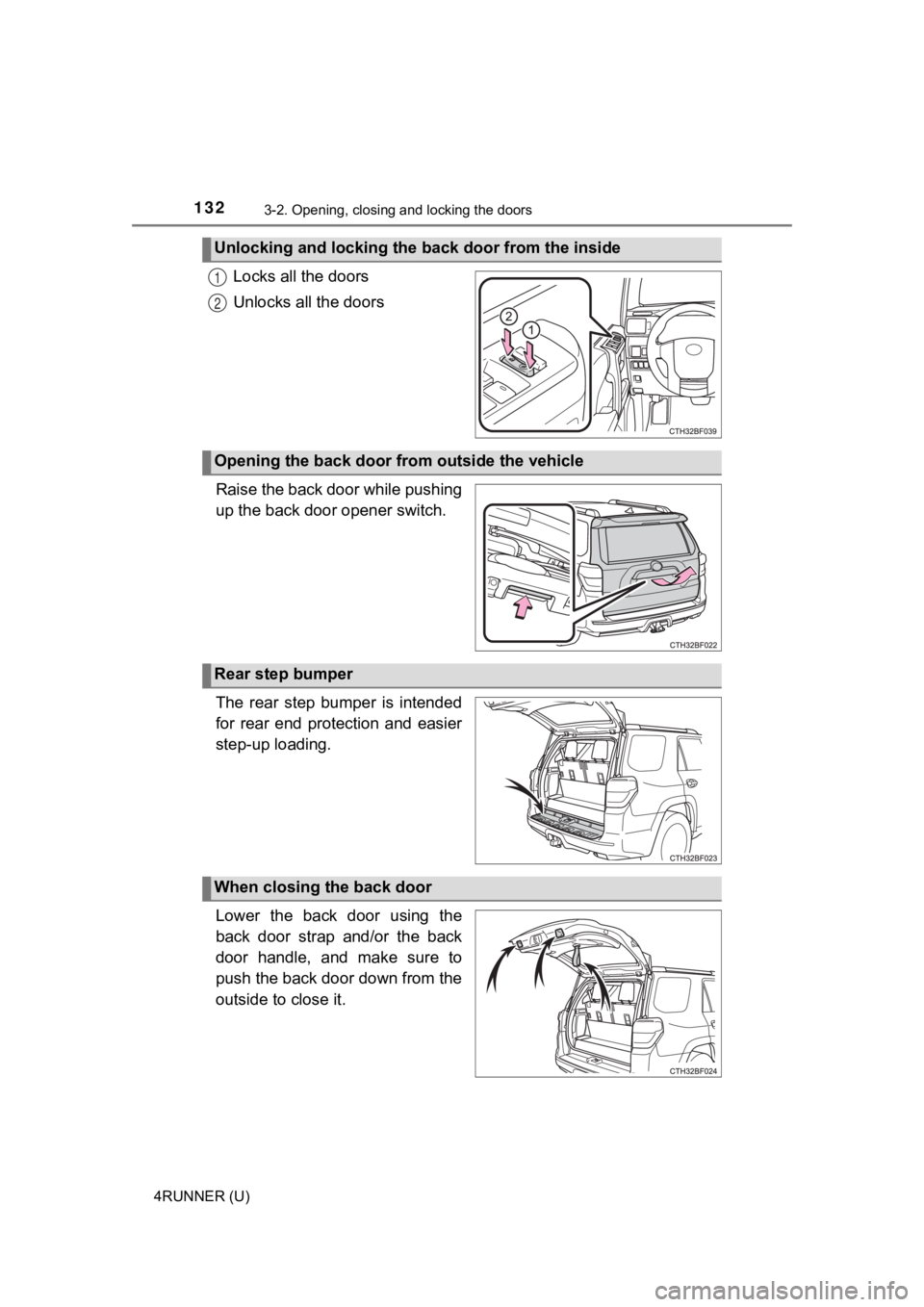
Locks all the doors
Unlocks all the doors
Raise the back door while pushing
up the back door opener switch.
The rear step bumper is intended
for rear end protection and easier
step-up loading.
Lower the back door using the
back door strap and/or the back
door handle, and make sure to
push the back door down from the
outside to close it.
Unlocking and locking the back door from the inside
1
2
Opening the back door from outside the vehicle
Rear step bumper
When closing the back door
Page 134 of 596
1343-2. Opening, closing and locking the doors
4RUNNER (U)
WARNING
■Operating the back door
Observe the following precautions.
Failure to do so may cause parts of the body to be caught, resu lting in death
or serious injury.
● Remove any heavy loads, such as snow and ice, from the back doo r
before opening it. Failure to do so may cause the back door to suddenly
shut again after it is opened.
● When opening or closing the back door, thoroughly check to make sure
the surrounding area is safe.
● If anyone is in the vicinity, make sure they are safe and let t hem know that
the back door is about to open or close.
● Use caution when opening or closing the back door in windy weat her as it
may move abruptly in strong wind.
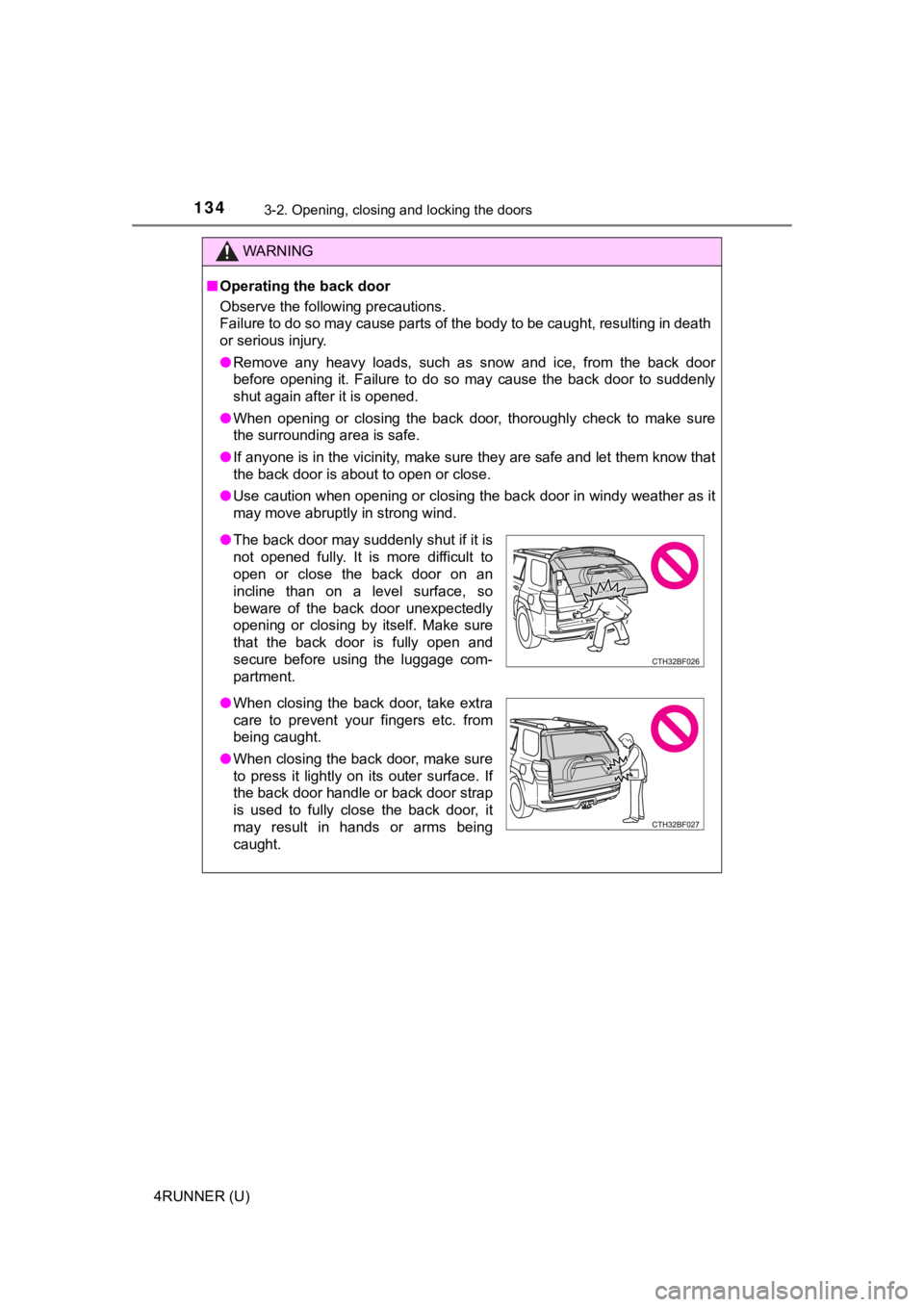
● The back door may suddenly shut if it is
not opened fully. It is more difficult to
open or close the back door on an
incline than on a level surface, so
beware of the back door unexpectedly
opening or closing by itself. Make sure
that the back door is fully open and
secure before using the luggage com-
partment.
● When closing the back door, take extra
care to prevent your fingers etc. from
being caught.
● When closing the back door, make sure
to press it lightly on its outer surface. If
the back door handle or back door strap
is used to fully close the back door, it
may result in hands or arms being
caught.
Page 175 of 596

175
Driving4
4RUNNER (U)4-1. Before driving
Driving the vehicle ............. 176
Cargo and luggage ........... 186
Vehicle load limits ............. 191
Trailer towing..................... 192
Dinghy towing ................... 208
4-2. Driving procedures Engine (ignition) switch (vehicles without a
smart key system) ........... 209
Engine (ignition) switch (vehicles with a
smart key system) ........... 212
Automatic transmission ..... 218
Turn signal lever................ 223
Parking brake .................... 224
4-3. Operating the lights and wipers
Headlight switch ................ 225
Automatic High Beam ....... 231
Fog light switch ................. 235
Windshield wipers and washer ............................ 237
Rear window wiper and washer ............................ 240
4-4. Refueling Opening the fuel tank cap .................................. 243 4-5. Using the driving
support systems
Toyota Safety Sense P ..... 246
PCS (Pre-Collision System) .... 254
LDA (Lane Departure Alert) .... 265
Dynamic radar cruise control ............................. 273
Intuitive parking assist....... 286
Four-wheel drive system (part-time 4WD
models) ........................... 293
Four-wheel drive system (full-time 4WD
models) ........................... 297
Active traction control system ............................ 301
AUTO LSD system (2WD models) ................. 303
Rear differential lock system ............................ 305
Downhill assist control system ............................ 308
Crawl Control .................... 311
Multi-terrain Select ............ 314
Driving assist systems ...... 321
4-6. Driving tips Winter driving tips ............. 330
Off-road precautions ......... 334
Page 182 of 596

1824-1. Before driving
4RUNNER (U)
WARNING
Observe the following precautions.
Failure to do so may result in death or serious injury.
■When the vehicle is parked
● Do not leave glasses, cigarette lighters, spray cans, or soft d rink cans in
the vehicle when it is in the sun.
Doing so may result in the following:
• Gas may leak from a cigarette lighter or spray can, and may le ad to a
fire.
• The temperature inside the vehicle may cause the plastic lenses and plastic material of glasses to deform or crack.
• Soft drink cans may fracture, causing the contents to spray ov er the
interior of the vehicle, and may also cause a short circuit in the vehicle’s
electrical components.
● Do not leave cigarette lighters in the vehicle. If a cigarette lighter is in a
place such as the glove box or on the floor, it may be lit acci dentally when
luggage is loaded or the seat is adjusted, causing a fire.
● Do not attach adhesive discs to the windshield or windows. Do n ot place
containers such as air fresheners on the instrument panel or da shboard.
Adhesive discs or containers may act as lenses, causing a fire in the vehi-
cle.
● Do not leave a door or window open if the curved glass is coate d with a
metallized film such as a silver-colored one. Reflected sunligh t may cause
the glass to act as a lens, causing a fire.
● Always apply the parking brake, shift the shift lever to P, stop the engine
and lock the vehicle.
Do not leave the vehicle unattended while the engine is running .
If the vehicle is parked with the shift lever in P but the park ing brake is not
set, the vehicle may start to move, possibly leading to an acci dent.
● Do not touch the exhaust pipes while the engine is running or i mmediately
after turning the engine off.
Doing so may cause burns.
Page 186 of 596
1864-1. Before driving
4RUNNER (U)
Cargo and luggage
Take notice of the following information about storage precau-
tions, cargo capacity and load:● Stow cargo and luggage in the luggage compartment whenever
possible.
● Be sure all items are secured in place.
● To maintain vehicle balance while driving, position luggage evenly
within the luggage compartment.
● For better fuel economy, do no t carry unnecessary weight.
Page 187 of 596

1874-1. Before driving
4
Driving
4RUNNER (U)
Cargo capacity depends on the total weight of the occupants.
(Cargo capacity) = (Total load capacity) — (Total weight of occ upants)
Steps for Determining Correct Load Limit —
(1) Locate the statement “The co mbined weight of occupants and
cargo should never exceed XXX kg or XXX lbs.” on your vehicle’s
placard.
(2) Determine the combined weight of the driver and passengers t hat
will be riding in your vehicle.
(3) Subtract the combined weight of the driver and passengers fr om
XXX kg or XXX lbs.
(4) The resulting figure equals the available amount of cargo an d lug-
gage load capacity.
For example, if the “XXX” amount equals 1400 lbs. and there wil l be
five 150 lb passengers in your vehicle, the amount of available
cargo and luggage load capacity is 650 lbs. (1400 750 (5150) =
650 lbs.)
(5) Determine the combined weight of luggage and cargo being loa ded
on the vehicle. That weight may n ot safely exceed the available
cargo and luggage load capac ity calculated in Step 4.
(6) If your vehicle will be towing a trailer, load from your tra iler will be
transferred to your vehicle. Consult this manual to determine h ow
this reduces the available cargo and luggage load capacity of y our
vehicle.
( P. 522)
Capacity and distribution