2020 TOYOTA 4RUNNER fuel pressure
[x] Cancel search: fuel pressurePage 5 of 596

5
1
8 7
6
5
4
3
2
9
4RUNNER (U)6-1. Maintenance and care
Cleaning and protecting the vehicle exterior .......... 390
Cleaning and protecting the vehicle interior ........... 393
6-2. Maintenance Maintenance requirements ................... 396
General maintenance ........ 398
Emission inspection and maintenance (I/M)
programs ......................... 401
6-3. Do-it-yourself maintenance
Do-it-yourself service precautions ..................... 402
Hood.................................. 405
Engine compartment ......... 406
Tires .................................. 420
Tire inflation pressure........ 434
Wheels .............................. 437
Air conditioning filter .......... 440
Wireless remote control/ electronic key battery ...... 442
Checking and replacing fuses ............................... 445
Light bulbs ......................... 448 7-1. Essential information
Emergency flashers ........... 464
If your vehicle has to be stopped in
an emergency.................. 465
If the vehicle is trapped in rising water .................. 467
7-2. Steps to take in an emergency
If your vehicle needs to be towed ...................... 468
If you think something is wrong ........................... 475
Fuel pump shut off system ............................. 476
If a warning light turns on or a warning buzzer
sounds ............................. 477
If a warning message is displayed...................... 487
If you have a flat tire .......... 492
If the engine will not start ................................. 507
If you cannot operate back door opener ............ 509
If the electronic key does not operate
properly ........................... 510
If the vehicle battery is discharged ................... 513
If your vehicle overheats......................... 517
If the vehicle becomes stuck ................................ 520
6Maintenance and care7When trouble arises
Page 84 of 596
842. Instrument cluster
4RUNNER (U)
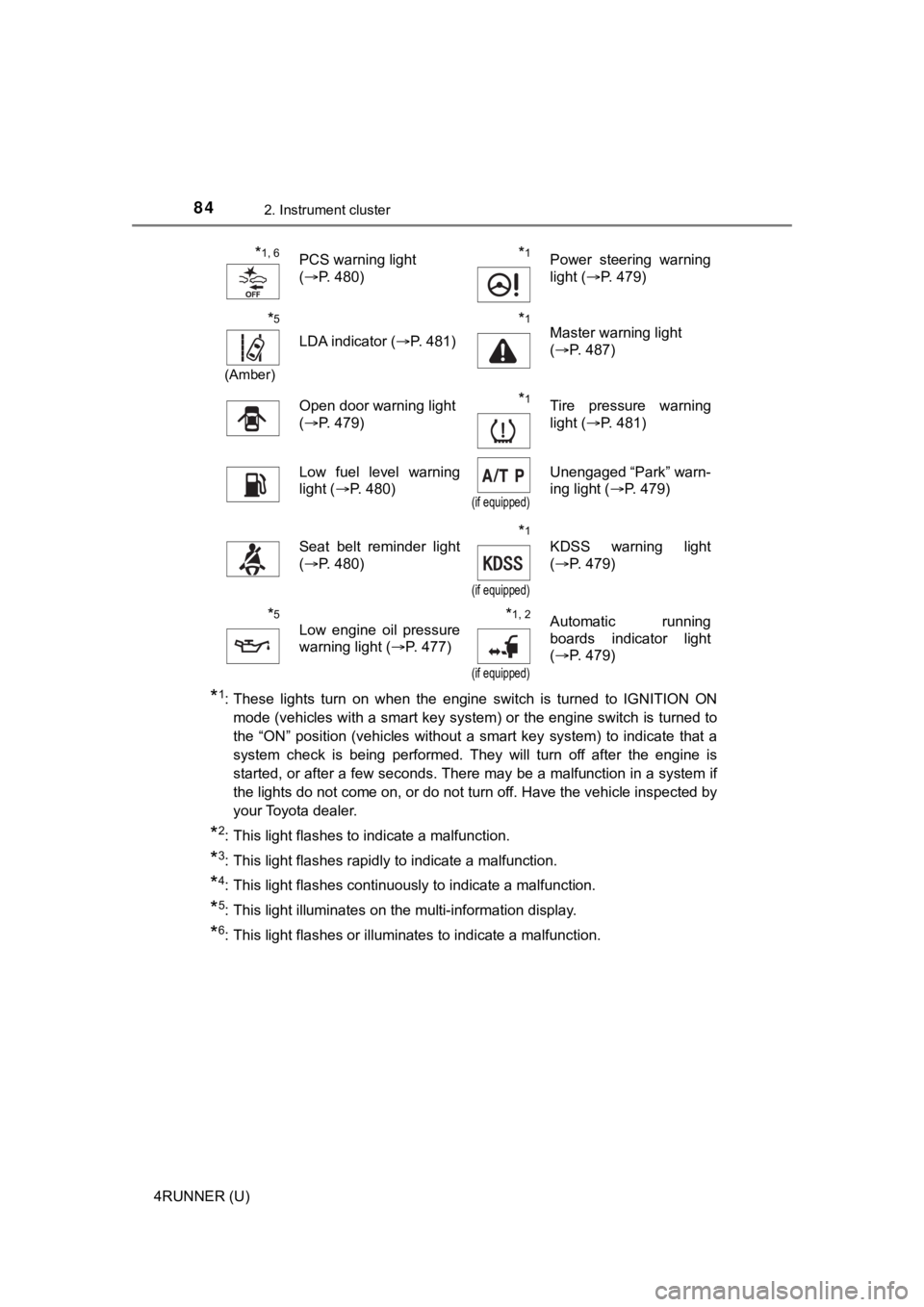
*1: These lights turn on when the engine switch is turned to IGNITION ON
mode (vehicles with a smart key system) or the engine switch is turned to
the “ON” position (vehicles without a smart key system) to indi cate that a
system check is being performed. They will turn off after the engine is
started, or after a few seconds. There may be a malfunction in a system if
the lights do not come on, or do not turn off. Have the vehicle inspected by
your Toyota dealer.
*2: This light flashes to indicate a malfunction.
*3: This light flashes rapidly to indicate a malfunction.
*4: This light flashes continuously to indicate a malfunction.
*5: This light illuminates on the multi-information display.
*6: This light flashes or illuminates to indicate a malfunction.
*1, 6PCS warning light
( P. 480)*1Power steering warning
light ( P. 479)
*5
(Amber)
LDA indicator ( P. 481)
*1Master warning light
(P. 487)
Open door warning light
(P. 479)*1Tire pressure warning
light ( P. 481)
Low fuel level warning
light (P. 480)
(if equipped)
Unengaged “Park” warn-
ing light ( P. 479)
Seat belt reminder light
(P. 480)*1
(if equipped)
KDSS warning light
(P. 479)
*5
Low engine oil pressure
warning light ( P. 477)*1, 2
(if equipped)
Automatic running
boards indicator light
(P. 479)
Page 351 of 596
3515-1. Using the air conditioning system and defogger
5
Interior features
4RUNNER (U)■
Fogging up of the windows
●The windows will easily fog up when the humidity in the vehicle is high.
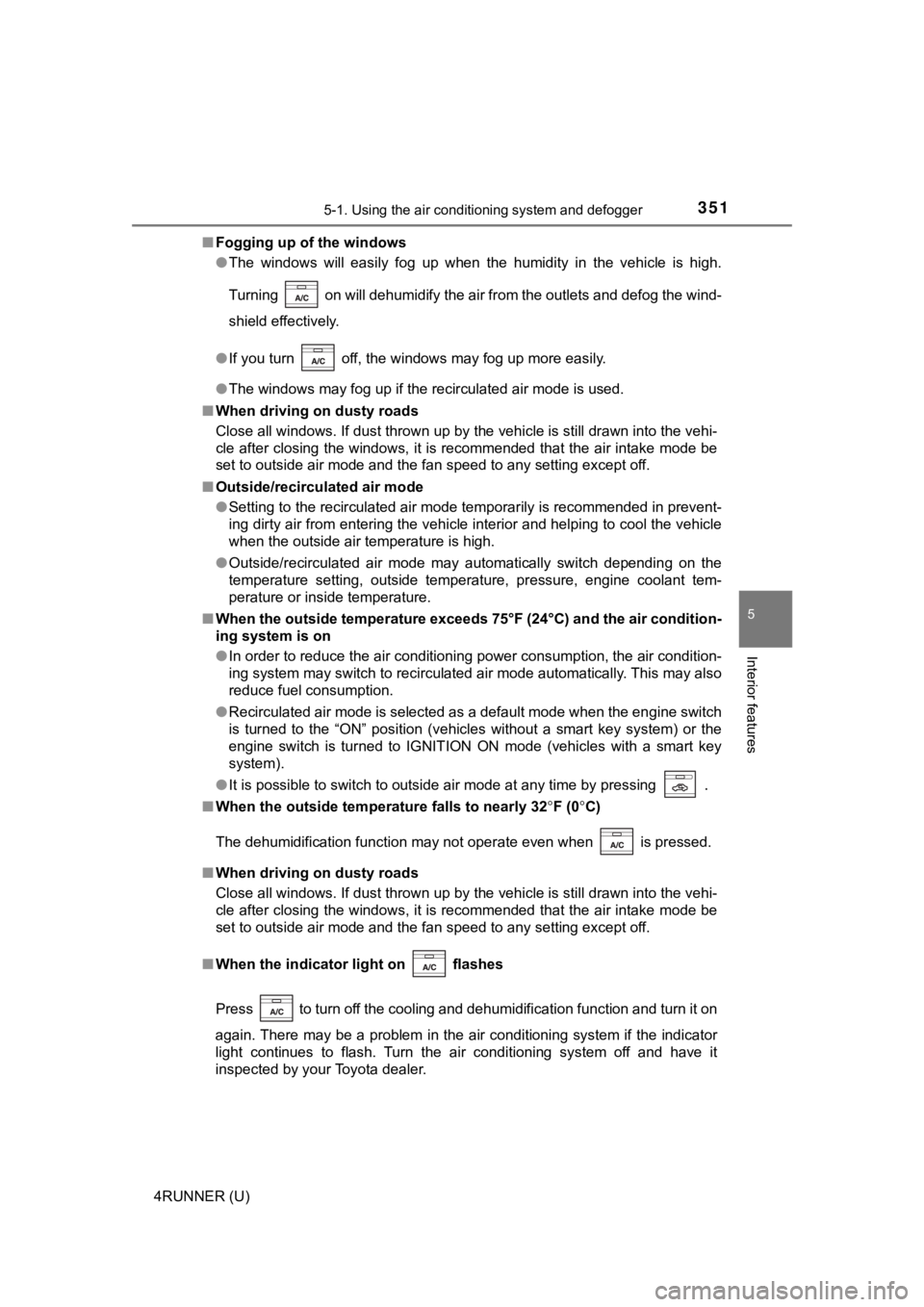
Turning on will dehumidify the air from the outlets and defog the wind-
shield effectively.
● If you turn off, the windows may fog up more easily.
● The windows may fog up if the recirculated air mode is used.
■ When driving on dusty roads
Close all windows. If dust thrown up by the vehicle is still drawn into the vehi-
cle after closing the windows, it is recommended that the air intake mode be
set to outside air mode and the fan speed to any setting except off.
■ Outside/recirculated air mode
●Setting to the recirculated air mode temporarily is recommended in prevent-
ing dirty air from entering the vehicle interior and helping to cool the vehicle
when the outside air temperature is high.
● Outside/recirculated air mode may automatically switch dependin g on the
temperature setting, outside temperature, pressure, engine cool ant tem-
perature or inside temperature.
■ When the outside temperature exceeds 75°F (24°C) and the air co ndition-
ing system is on
● In order to reduce the air conditioning power consumption, the air condition-
ing system may switch to recirculated air mode automatically. This may also
reduce fuel consumption.
● Recirculated air mode is selected as a default mode when the en gine switch
is turned to the “ON” position (vehicles without a smart key system) or the
engine switch is turned to IGNITION ON mode (vehicles with a sm art key
system).
● It is possible to switch to outside air mode at any time by pre ssing
.
■When the outside tempera ture falls to nearly 32F (0 C)
The dehumidification function may not operate even when is pre ssed.
■ When driving on dusty roads
Close all windows. If dust thrown up by the vehicle is still drawn into the vehi-
cle after closing the windows, it is recommended that the air intake mode be
set to outside air mode and the fan speed to any setting except off.
■ When the indicator light on flashes
Press
to turn off the cooling and dehumidification function and turn it on
again. There may be a problem in the air conditioning system if the indicator
light continues to flash. Turn the air conditioning system off and have it
inspected by your Toyota dealer.
Page 435 of 596
4356-3. Do-it-yourself maintenance
6
Maintenance and care
4RUNNER (U)
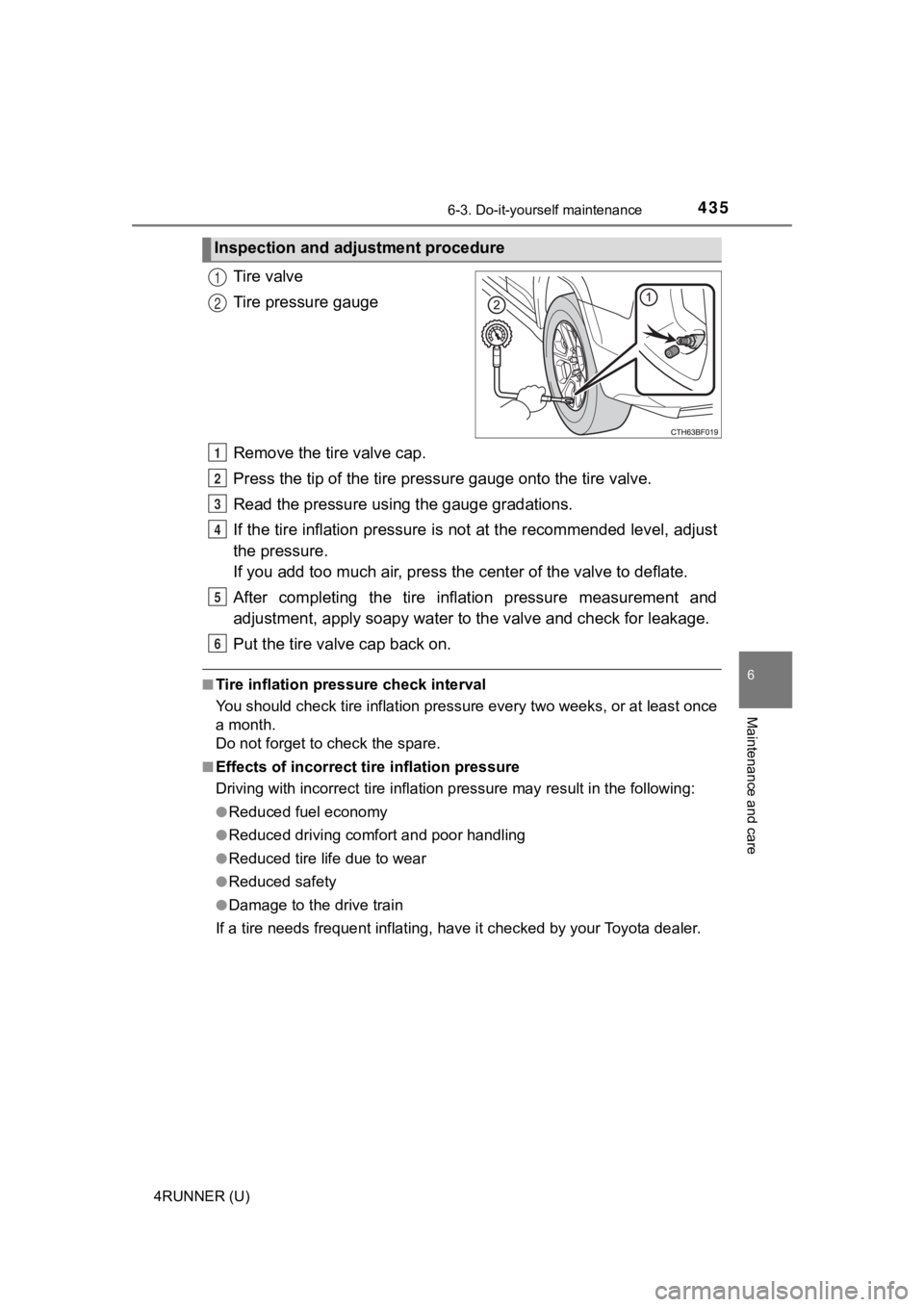
Tire valve
Tire pressure gauge
Remove the tire valve cap.
Press the tip of the tire pressure gauge onto the tire valve.
Read the pressure using the gauge gradations.
If the tire inflation pressure is not at the recommended level, adjust
the pressure.
If you add too much air, press the center of the valve to defla te.
After completing the tire inflation pressure measurement and
adjustment, apply soapy water to the valve and check for leakage.
Put the tire valve cap back on.
■Tire inflation pressure check interval
You should check tire inflation p ressure every two weeks, or at least once
a month.
Do not forget to check the spare.
■Effects of incorrect tire inflation pressure
Driving with incorrec t tire inflation pressure may result in th e following:
●Reduced fuel economy
●Reduced driving comfort and poor handling
●Reduced tire life due to wear
●Reduced safety
●Damage to the drive train
If a tire needs frequent inflating , have it checked by your Toyota dealer.
Inspection and adjustment procedure
1
2
1
2
3
4
5
6
Page 483 of 596
4837-2. Steps to take in an emergency
7
When trouble arises
4RUNNER (U)■
If the malfunction indicator lamp comes on while driving
First check the following:
●Is the fuel tank empty?
If it is, fill the fuel tank immediately.
● Is the fuel tank cap loose?
If it is, tighten it securely.
The light will go off after several driving trips.
If the light does not go off even after several trips, contact your Toyota dealer
as soon as possible.
■ When the tire pressure warning light comes on
Inspect the appearance of the tire to check that the tire is no t punctured.
If the tire is punctured: P. 492
If the tire is not punctured:
Carry out the following procedure after the tire temperature ha s lowered suffi-
ciently.
● Check the tire inflation pressure and adjust to the appropriate level.
● If the warning light does not go out even after several minutes , check that
the tire inflation pressure is at the specified level and carry out initialization.
( P. 422)
The warning light may come on again if the above operations are conducted
without first allowing the tire temperature to lower sufficient ly.
■
The tire pressure warning light may come on due to natural caus es
The tire pressure warning light may come on due to natural caus es such
as natural air leaks and tire inflation pressure changes caused by tem-
perature. In this case, adjusting the tire inflation pressure w ill turn off the
warning light (afte r a few minutes).
■When a tire is replace d with a spare tire
Vehicles without P245/60R20 tires
The spare tire is not equipped with a tire pressure warning val ve and
transmitter. If a tire goes flat, the tire pressure warning lig ht will not turn off
even though the flat tire has been replaced with the spare tire . Replace
the spare tire with the repaired tire and adjust the tire infla tion pressure.
The tire press ure warning light will go off after a few minutes.
Vehicles with P245/60R20 tires
The spare tire is also equipped with a tire pressure warning va lve and
transmitter. The tire pressure warning light will turn on if the tire inflation
pressure of the spare tire is low. If a tire goes flat, the tire pressure warn-
ing light will not turn off even though the flat tire has been replaced with
the spare tire. Replace the spar e tire with the repaired tire and adjust the
tire inflation pressure. The t ire pressure warning light will go off after a few
minutes.
Page 485 of 596
4857-2. Steps to take in an emergency
7
When trouble arises
4RUNNER (U)
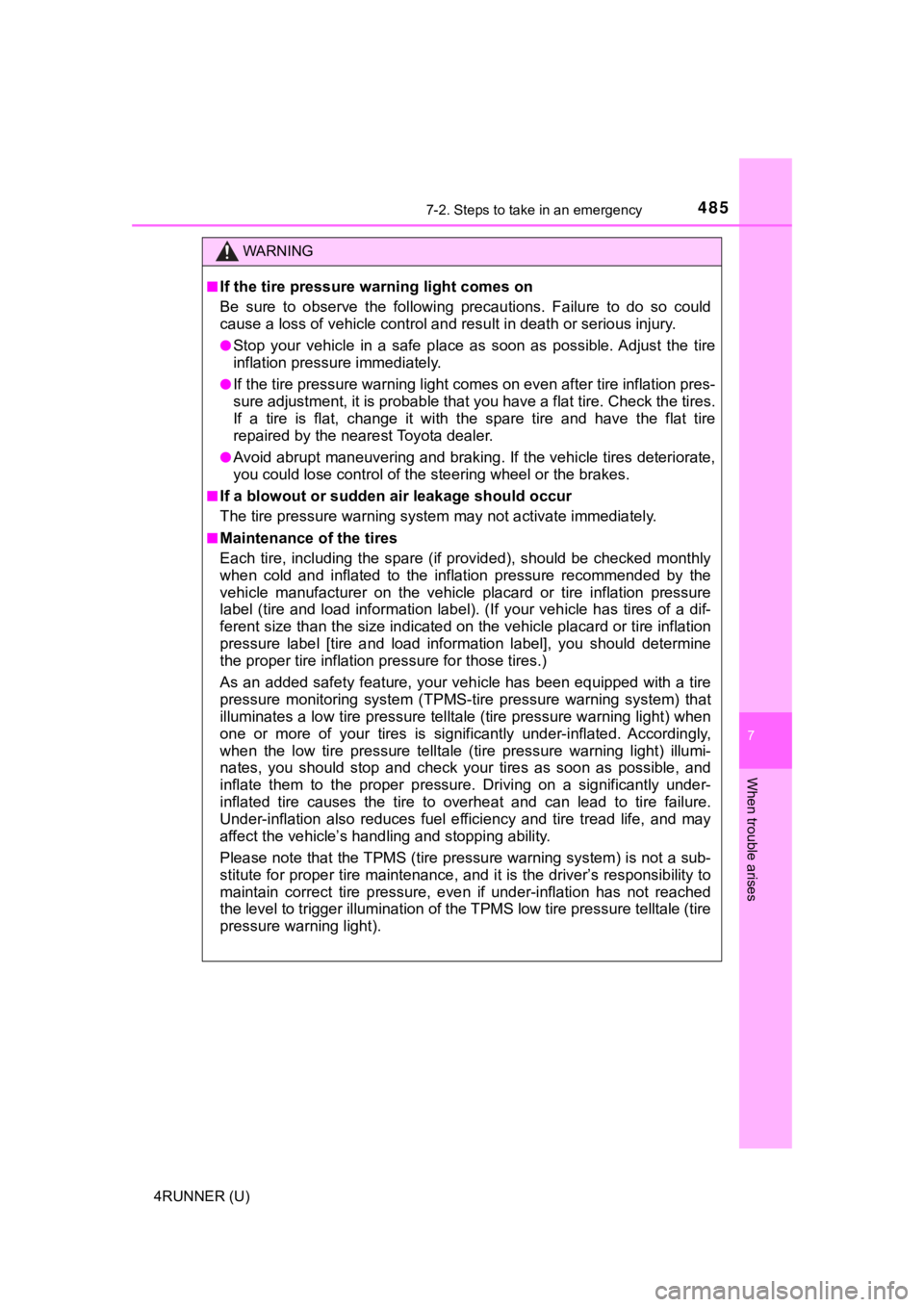
WARNING
■If the tire pressure warning light comes on
Be sure to observe the following precautions. Failure to do so could
cause a loss of vehicle control and result in death or serious injury.
●Stop your vehicle in a safe place as soon as possible. Adjust t he tire
inflation pressure immediately.
●If the tire pressure warning light comes on even after tire inf lation pres-
sure adjustment, it is probable that you have a flat tire. Chec k the tires.
If a tire is flat, change it with the spare tire and have the f lat tire
repaired by the nearest Toyota dealer.
●Avoid abrupt maneuvering and braking. If the vehicle tires dete riorate,
you could lose control of the steering wheel or the brakes.
■If a blowout or sudden air leakage should occur
The tire pressure warning system may not activate immediately.
■Maintenance of the tires
Each tire, including the spare (if provided), should be checked monthly
when cold and inflated to the inflation pressure recommended by the
vehicle manufacturer on the vehicle placard or tire inflation p ressure
label (tire and load information label). (If your vehicle has t ires of a dif-
ferent size than the size indica ted on the vehicle placard or tire inflation
pressure label [tire and load information label], you should de termine
the proper tire inflation p ressure for those tires.)
As an added safety feature, your vehicle has been equipped with a tire
pressure monitoring system (TPMS -tire pressure warning system) that
illuminates a low tire pressure telltale (tire pressure warning light) when
one or more of your tires is significantly under-inflated. Acco rdingly,
when the low tire pressure telltale (tire pressure warning ligh t) illumi-
nates, you should stop and check your tires as soon as possible , and
inflate them to the proper pressure. Driving on a significantly under-
inflated tire causes the tire to overheat and can lead to tire failure.
Under-inflation also reduces fuel efficiency and tire tread lif e, and may
affect the vehicle’s handl ing and stopping ability.
Please note that the TPMS (tire pressure warning system) is not a sub-
stitute for proper tire maintena nce, and it is the driver’s responsibility to
maintain correct tire pressure, even if under-inflation has not reached
the level to trigger illumination of the TPMS low tire pressure telltale (tire
pressure warning light).
Page 541 of 596
5418-1. Specifications
8
Vehicle specifications
4RUNNER (U)
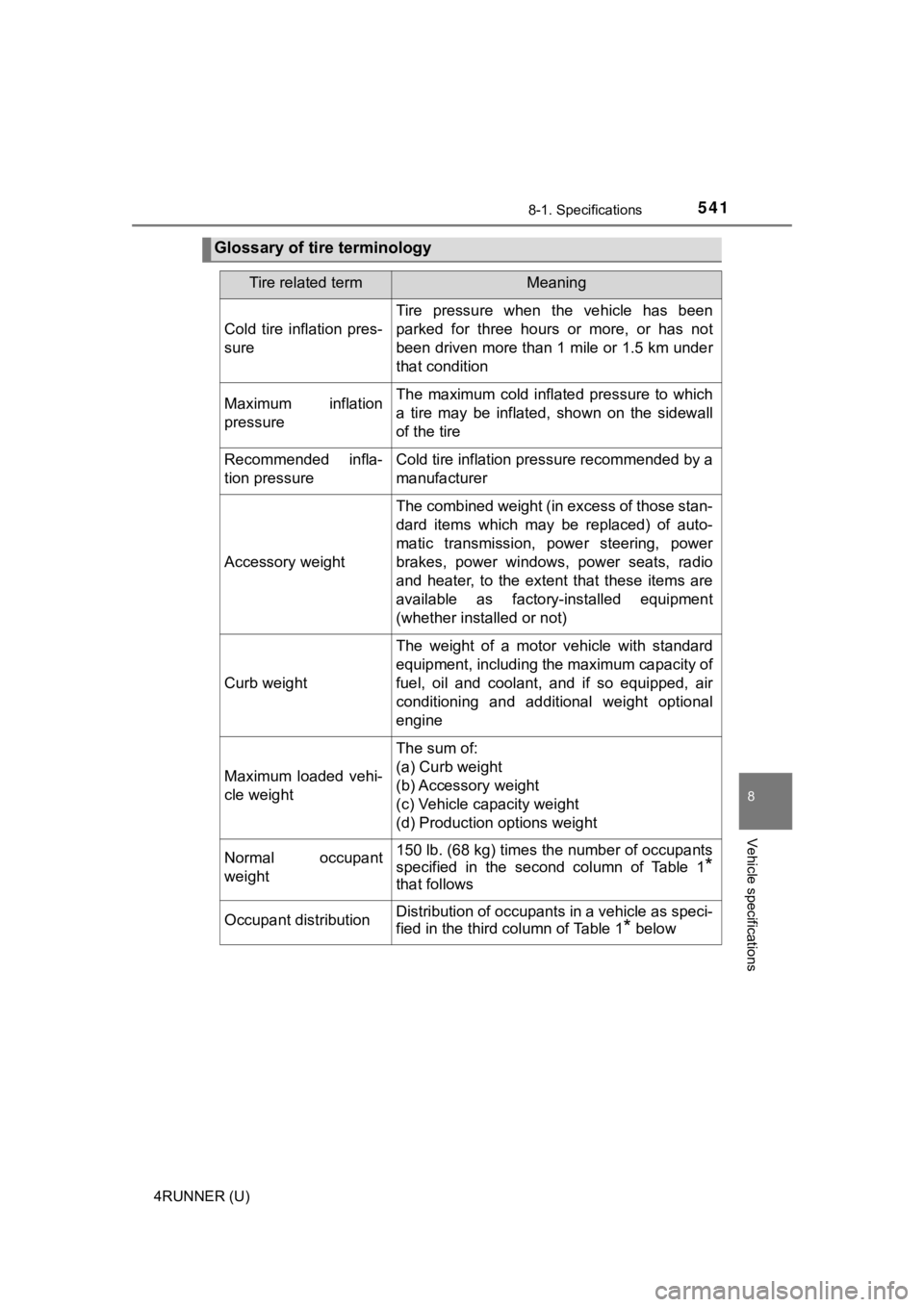
Glossary of tire terminology
Tire related termMeaning
Cold tire inflation pres-
sure
Tire pressure when the vehicle has been
parked for three hours or more, or has not
been driven more than 1 mile or 1.5 km under
that condition
Maximum inflation
pressureThe maximum cold inflated pressure to which
a tire may be inflated, shown on the sidewall
of the tire
Recommended infla-
tion pressureCold tire inflation pressure recommended by a
manufacturer
Accessory weight
The combined weight (in excess of those stan-
dard items which may be replaced) of auto-
matic transmission, power steering, power
brakes, power windows, power seats, radio
and heater, to the extent that these items are
available as factory-installed equipment
(whether installed or not)
Curb weight
The weight of a motor vehicle with standard
equipment, including the maximum capacity of
fuel, oil and coolant, and if so equipped, air
conditioning and additional weight optional
engine
Maximum loaded vehi-
cle weight
The sum of:
(a) Curb weight
(b) Accessory weight
(c) Vehicle capacity weight
(d) Production options weight
Normal occupant
weight150 lb. (68 kg) times the number of occupants
specified in the second column of Table 1
*
that follows
Occupant distributionDistribution of occupants in a vehicle as speci-
fied in the third column of Table 1
* below
Page 594 of 596
594Alphabetical index
4RUNNER (U)
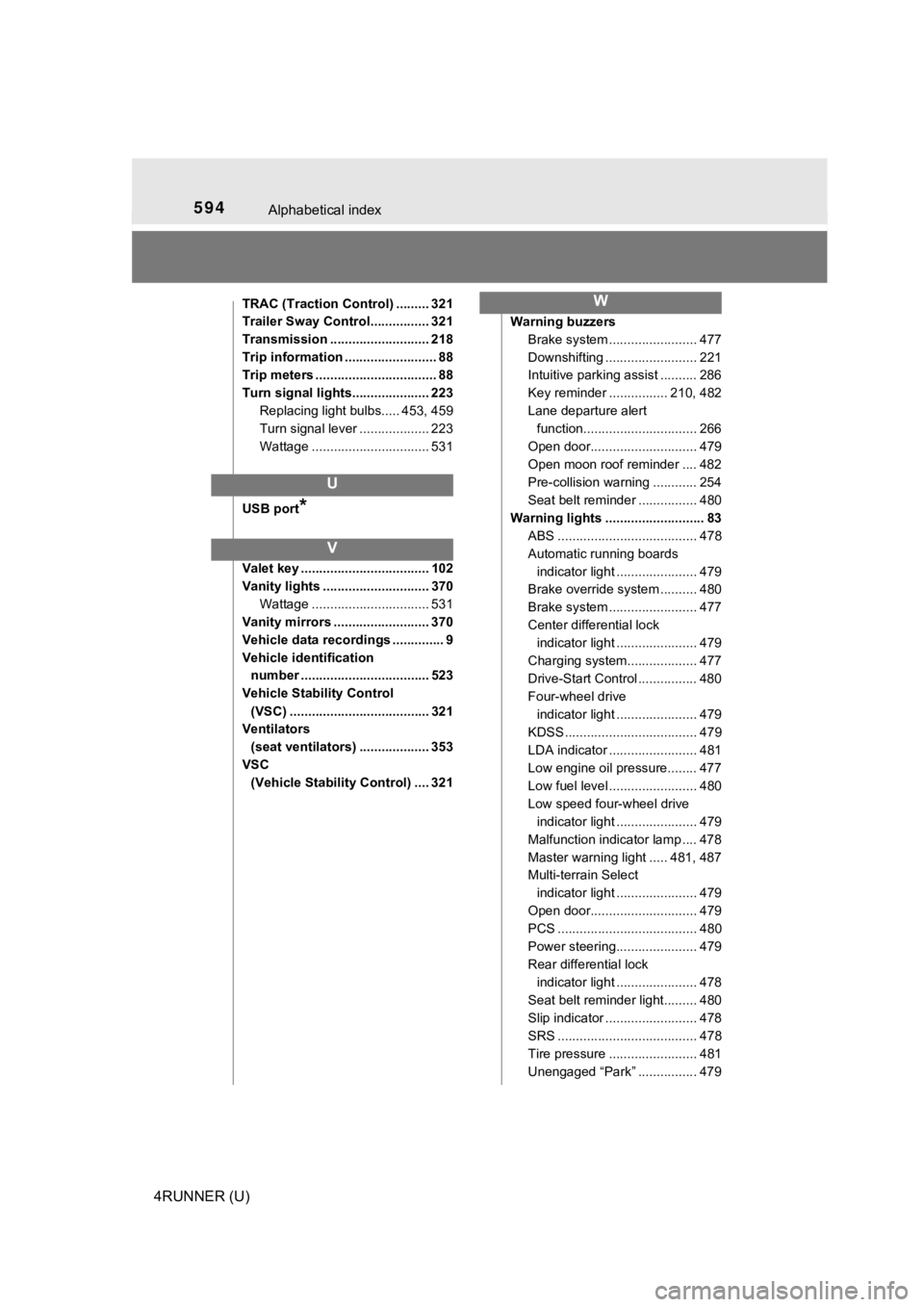
TRAC (Traction Control) ......... 321
Trailer Sway Control................ 321
Transmission ........................... 218
Trip information ......................... 88
Trip meters ................................. 88
Turn signal lights..................... 223Replacing light bulbs..... 453, 459
Turn signal lever ................... 223
Wattage ................................ 531
USB port
*
Valet key ................................... 102
Vanity lights ............................. 370 Wattage ................................ 531
Vanity mirrors .......................... 370
Vehicle data recordings .............. 9
Vehicle identification number ................................... 523
Vehicle Stability Control (VSC) ...................................... 321
Ventilators
(seat ventilators) ................... 353
VSC (Vehicle Stability Control) .... 321 Warning buzzers
Brake system ....... ................. 477
Downshifting ......................... 221
Intuitive parking assist .......... 286
Key reminder ................ 210, 482
Lane departure alert function............................... 266
Open door............................. 479
Open moon roof reminder .... 482
Pre-collision warning ............ 254
Seat belt reminder ................ 480
Warning lights ........................... 83 ABS ...................................... 478
Automatic running boards
indicator light ...................... 479
Brake override system .......... 480
Brake system ....... ................. 477
Center differential lock indicator light ...................... 479
Charging system................... 477
Drive-Start Control ................ 480
Four-wheel drive indicator light ...................... 479
KDSS .................................... 479
LDA indicator ........................ 481
Low engine oil pressure........ 477
Low fuel level ........................ 480
Low speed four-wheel drive indicator light ...................... 479
Malfunction indicator lamp .... 478
Master warning light ..... 481, 487
Multi-terrain Select indicator light ...................... 479
Open door............................. 479
PCS ...................................... 480
Power steering...................... 479
Rear differential lock indicator light ...................... 478
Seat belt reminder light......... 480
Slip indicator ......................... 478
SRS ...................................... 478
Tire pressure ........................ 481
Unengaged “Park” ................ 479
U
V
W