2020 Ram 2500 transmission
[x] Cancel search: transmissionPage 261 of 553

STARTING AND OPERATING259
slowly proceed over the top. If the wheels
start to slip as you approach the crest of a
hill, ease off the accelerator and maintain
headway by turning the steering wheel no
more than a quarter turn quickly back and
forth. This will provide a fresh "bite" into the
surface and will usually provide enough trac -
tion to complete the climb. If you do not make
it to the top, place the vehicle in REVERSE
and back straight down the grade using
engine resistance along with the vehicle
brakes.
Driving Downhill – Before driving down a
steep hill you need to determine if it is too
steep for a safe descent. What is the surface
traction? Is the grade too steep to maintain a
slow controlled descent? Are there obsta -
cles? Is it a straight descent? Is there plenty
of distance at the base of the hill to regain
control if the vehicle descends too fast? If
you feel confident in your ability to proceed then make sure you are in 4WD LOW with the
transmission in FIRST gear (manually select
FIRST gear on automatic transmissions) and
proceed with caution. Allow engine braking to
control the descent and apply your brakes if
necessary, but do not allow the tires to lock.
Driving Across An Incline
– If at all possible
avoid driving across an incline. If it is neces -
sary, know your vehicle's abilities. Driving
across an incline places more weight on the
downhill wheels, which increases the possi -
bilities of a downhill slide or rollover. Make
sure the surface has good traction with firm
and stable soils. If possible transverse the
incline at an angle heading slightly up or
down.
If You Stall Or Begin To Lose Headway – If you
stall or begin to lose headway while climbing
a steep hill, allow your vehicle to come to a
stop and immediately apply the brake.
Restart the engine and shift into REVERSE.
Back slowly down the hill allowing the
compression braking of the engine and trans -
mission to help regulate your speed. If the
brakes are required to control vehicle speed,
apply them lightly and avoid locking or skid-
ding the tires.
WARNING!
Never attempt to climb a hill at an angle or
turn around on a steep grade. Driving across
an incline increases the risk of a roll over,
which may result in severe injury or death.
WARNING!
Do not descend a steep grade in NEUTRAL.
Use vehicle brakes in conjunction with engine
braking. Descending a grade too fast could
cause you to lose control and be seriously
injured or killed.
WARNING!
Driving across an incline increases the risk of
a rollover, which may result in severe injury.
WARNING!
If the engine stalls or you lose headway or
cannot make it to the top of a steep hill or
grade, never attempt to turn around. To do so
may result in tipping and rolling the vehicle,
which may result in severe injury. Always back
carefully straight down a hill in REVERSE.
Never back down a hill in NEUTRAL using only
the vehicle brakes. Never drive diagonally
across a hill, always drive straight up or down.
5
20_DJD2_OM_EN_USC_t.book Page 259
Page 262 of 553

260STARTING AND OPERATING
Driving Through Water
Extreme care should be taken crossing any type
of water. Water crossings should be avoided if
possible and only be attempted when neces -
sary, in a safe responsible manner. You should
only drive through areas which are designated
and approved. You should tread lightly and
avoid damage to the environment. You should
know your vehicle's abilities and be able to
recover it if something goes wrong. You should
never stop or shut a vehicle off when crossing
deep water unless you ingested water into the
engine air intake. If the engine stalls do not
attempt to restart it. Determine if it has ingested
water first. The key to any crossing is low and
slow. You want to use FIRST gear in 4WD LOW
and proceed very slowly with a constant slow
speed (3-5 mph [5–8 km/h] maximum) and
light throttle. Keep the vehicle moving; do not
try to accelerate through the crossing. After
crossing any water higher than the bottom of
the axle differentials, you should inspect all of
the vehicle fluids for signs of water ingestion.
Before You Cross Any Type Of Water – As you
approach any type of water you need to
determine if you can cross it safely and
responsibly. If necessary, get out and walk
through the water or probe it with a stick. You
need to be sure of its depth, approach angle,
current and bottom condition. Be careful of
murky or muddy waters, check for hidden
obstacles. Make sure you will not be
intruding on any wildlife and you can recover
the vehicle if necessary. The key to a safe
crossing is the water depth, current and
bottom conditions. On soft bottoms the
vehicle will sink in, effectively increasing the
water level on the vehicle. Be sure to
consider this when determining the depth
and the ability to safely cross.
Crossing Puddles, Pools, Flooded Areas Or
Other Standing Water – Puddles, pools,
flooded or other standing water areas
normally contain murky or muddy waters.
These water types normally contain hidden
obstacles and make it difficult to determine
an accurate water depth, approach angle,
and bottom condition. Murky or muddy water
holes are where you want to hook up tow
straps prior to entering. This makes for a
faster, cleaner and easier vehicle recovery. If
you are able to determine you can safely
cross, than proceed using the low and slow
method.
Crossing Ditches, Streams, Shallow Rivers Or
Other Flowing Water – Flowing water can be
extremely dangerous. Never attempt to cross
a fast running stream or river even in shallow
water. Fast moving water can easily push
your vehicle downstream sweeping it out of
control. Even in very shallow water, a high
current can still wash the dirt out from
CAUTION!
Water ingestion into the axles, transmission,
transfer case, engine or vehicle interior can
occur if you drive too fast or through too deep
of water. Water can cause permanent
damage to engine, driveline or other vehicle
components and your brakes will be less
effective once wet and/or muddy.
CAUTION!
Muddy waters can reduce the cooling system
effectiveness by depositing debris onto the
radiator.
20_DJD2_OM_EN_USC_t.book Page 260
Page 271 of 553

STARTING AND OPERATING269
6. Secure to the anchor point. Once you have
established your anchor point, secure the
tree-trunk protector or choker-chain around
the object.
Tree Trunk Protector
NOTE:
How to choose an anchor point: A secure
anchor is critical to winching operations. An
anchor must be strong enough to hold while
winching. Natural anchors include trees,
stumps and rocks. Hook the cable as low as
possible. If no natural anchors are available
when recovering another vehicle, your vehicle becomes the anchor point. In this case, be sure
to put the transmission in NEUTRAL, apply the
hand brake and block its wheels to prevent your
vehicle from moving. Ideally, you'll want an
anchor point that will enable you to pull straight
in the direction the vehicle will move. This
allows the synthetic rope to wind tightly and
evenly onto the spooling drum. An anchor point
as far away as possible will provide the winch
with its greatest pulling power.
7. Attach the Clevis/D-Shackle and Tree Trunk
Protector. Attach the shackle to the two
ends of the strap or chain and through the
hook, being careful not to over tighten
(tighten and back-off 1/2 turn).
Clevis/D-Shackles
8. Lock the clutch. Lock the winch drum by
rotating the clutch lever on the winch to
engage.
NOTE:
Always ensure the clutch is fully engaged or
disengaged.
9. Connect the remote control to the winch control box, located on the front bumper. Be
careful not to let the remote control cord
dangle in front of the winch. If you choose to
control the winch from inside your vehicle,
always pass the remote through a window
to avoid pinching the cord in the door.
Always disconnect the remote control when
not in use.
Winch Box Remote Control Connector
CAUTION!
Always be certain the anchor you select will
withstand the load.
5
20_DJD2_OM_EN_USC_t.book Page 269
Page 273 of 553

STARTING AND OPERATING271
14. Begin winching. With the winching vehicles
engine on and light tension already on the
synthetic rope, begin winching slowly and
steadily. Be sure that the rope is winding
evenly and tightly around the spooling
drum. For additional assistance, the
winched vehicle can be slowly driven while
being pulled by the winch. Continue pulling
until the vehicle is on stable ground. If you
are able to drive the vehicle, the winching
operation is complete.
Using The Remote Control
NOTE:
Avoid overheating the winch motor. For extended winching, stop at reasonable
intervals to allow the winch motor to cool
down.
What to look for under load: The synthetic rope must always spool onto the drum as
indicated by the drum rotation decal on
the winch. As you power-in, make sure
the synthetic rope winds evenly and
tightly on the drum. This prevents the
outer rope wraps from drawing into the
inner wraps, binding and damaging the
synthetic rope. Avoid shock loads by
using the control switch intermittently to
take up rope slack. Shock loads can
momentarily far exceed the winch and
synthetic rope ratings. During side pulls
the synthetic rope tends to stack up at
one end of the drum. This stack can
become large enough to cause serious
damage to the winch. So, line up pulls as
straight ahead as possible and stop
winching if the synthetic rope comes
close to the tie rods or mounting plate. To
fix an uneven stack, spool out that
section of the rope and reposition it to
the opposite end of the drum, which will
free up space for continued winching.
15. Secure vehicle. Once recovery of the vehicle is complete, be sure to secure the vehicle's
brakes and shift the transmission to PARK.
Release tension in the synthetic rope. 16. Disconnect the synthetic rope, and discon
-
nect from the anchor.
17. Rewind the synthetic rope. The person handling the synthetic rope should walk the
rope in and not let it slide through the hand,
control the winch at all times.
Rewinding The Synthetic Rope
WARNING!
To prevent serious injury, NEVER put your
fingers inside the hook area as you are
powering-in.
5
20_DJD2_OM_EN_USC_t.book Page 271
Page 277 of 553

STARTING AND OPERATING275
Metric Speed (km/h)
Pushing the SET (-) button once will result in
a 1 km/h decrease in set speed. Each subse -
quent tap of the button results in a decrease
of 1 km/h.
If the button is continually pushed, the set
speed will continue to decrease until the
button is released, then the new set speed
will be established.
To Accelerate For Passing
Press the accelerator as you would normally.
When the pedal is released, the vehicle will
return to the set speed.
Using Speed Control On Hills
The transmission may downshift on hills to
maintain the vehicle set speed.
NOTE:
The Speed Control system maintains speed up
and down hills. A slight speed change on
moderate hills is normal.
On steep hills, a greater speed loss or gain may
occur so it may be preferable to drive without
Speed Control.
To Resume Speed
To resume a previously set speed, push the RES
(+) button and release. Resume can be used at
any speed above 20 mph (32 km/h).
To Deactivate
A soft tap on the brake pedal, pushing the
CANCEL button, or normal brake pressure while
slowing the vehicle will deactivate the Speed
Control without erasing the set speed from
memory.
Pushing the on/off button, or placing the igni -
tion in the OFF position, erases the set speed
from memory. The following conditions will also deactivate the
Speed Control without erasing the set speed
from memory:
Vehicle parking brake is applied
Stability event occurs
Gear selector is moved out of DRIVE
Engine overspeed occurs
ADAPTIVE CRUISE CONTROL (ACC) — IF
EQUIPPED
Adaptive Cruise Control (ACC) increases the
driving convenience provided by cruise control
while traveling on highways and major road
-
ways. However, it is not a safety system and not
designed to prevent collisions. Speed Control
function performs differently. Please refer to
the proper section within this chapter.
ACC will allow you to keep cruise control
engaged in light to moderate traffic conditions
without the constant need to reset your cruise
control. ACC utilizes a radar sensor and a
forward facing camera designed to detect a
vehicle directly ahead of you.
WARNING!
Speed Control can be dangerous where the
system cannot maintain a constant speed.
Your vehicle could go too fast for the
conditions, and you could lose control and
have an accident. Do not use Speed Control
in heavy traffic or on roads that are winding,
icy, snow-covered or slippery.
5
20_DJD2_OM_EN_USC_t.book Page 275
Page 279 of 553

STARTING AND OPERATING277
Adaptive Cruise Control (ACC) Operation
The speed control buttons (located on the right
side of the steering wheel) operate the ACC
system.
Adaptive Cruise Control Buttons
NOTE:
Any chassis/suspension or tire size modifica -
tions to the vehicle will affect the performance
of the Adaptive Cruise Control and Forward
Collision Warning System.
Activating Adaptive Cruise Control (ACC)
You can only engage ACC if the vehicle speed is
above 0 mph (0 km/h).
The minimum set speed for the ACC system is
20 mph (32 km/h).
When the system is turned on and in the ready
state, the instrument cluster display will read
“ACC Ready.”
When the system is off, the instrument cluster
display will read “Adaptive Cruise Control (ACC)
Off.”
NOTE:
You cannot engage ACC under the following
conditions:
When in Four-Wheel Drive Low.
When you apply the brakes.
When the parking brake is applied.
When the automatic transmission is in PARK,
REVERSE or NEUTRAL.
When the vehicle speed is outside of the
speed range.
You should switch off the ACC system:
When driving in fog, heavy rain, heavy
snow, sleet, heavy traffic, and complex
driving situations (i.e., in highway construc
-
tion zones).
When entering a turn lane or highway off
ramp; when driving on roads that are
winding, icy, snow-covered, slippery, or
have steep uphill or downhill slopes.
When towing a trailer up or down steep
slopes.
When circumstances do not allow safe
driving at a constant speed.
WARNING! (Continued)
1 — Adaptive Cruise Control On/Off Button
2 — Distance Button
3 — RES (+)
4 — SET (-)
5 — CANCEL
6 — Normal (Fixed Speed) Cruise Control On/Off
Button
5
20_DJD2_OM_EN_USC_t.book Page 277
Page 326 of 553

324STARTING AND OPERATING
(Continued)
Towing Requirements — Tires
Do not attempt to tow a trailer while using a
compact spare tire.
Do not drive more than 50 mph (80 km/h) when towing while using a full size spare tire.
Proper tire inflation pressures are essential
to the safe and satisfactory operation of your
vehicle. Refer to “Tires” in “Servicing And
Maintenance” for proper tire inflation proce -
dures.
Check the trailer tires for proper tire inflation
pressures before trailer usage.
Check for signs of tire wear or visible tire
damage before towing a trailer. Refer to
“Tires” in “Servicing And Maintenance” for
the proper inspection procedure.
When replacing tires, refer to “Tires” in
“Servicing And Maintenance” for the proper
tire replacement procedures. Replacing tires
with a higher load carrying capacity will not
increase the vehicle's GVWR and GAWR
limits.
Towing Requirements — Trailer Brakes
Do not interconnect the hydraulic brake
system or vacuum system of your vehicle
with that of the trailer. This could cause inad -
equate braking and possible personal injury.
An electronically actuated trailer brake
controller is required when towing a trailer
with electronically actuated brakes. When
towing a trailer equipped with a hydraulic
surge actuated brake system, an electronic
brake controller is not required.
Trailer brakes are recommended for trailers
over 1,000 lbs (453 kg) and required for
trailers in excess of 2,000 lbs (907 kg).
When hauling cargo or towing a trailer, do
not overload your vehicle or trailer. Over -
loading can cause a loss of control, poor
performance or damage to brakes, axle,
engine, transmission, steering, suspension,
chassis structure or tires.
Safety chains must always be used
between your vehicle and trailer. Always
connect the chains to the hook retainers of
the vehicle hitch. Cross the chains under
the trailer tongue and allow enough slack
for turning corners.
Vehicles with trailers should not be parked
on a grade. When parking, apply the
parking brake on the tow vehicle. Put the
tow vehicle transmission in PARK. For
four-wheel drive vehicles, make sure the
transfer case is not in NEUTRAL. Always,
block or "chock" the trailer wheels.
GCWR must not be exceeded.
WARNING! (Continued)
Total weight must be distributed between
the tow vehicle and the trailer such that the
following four ratings are not exceeded :
GVWR
GTW
GAWR
Tongue weight rating for the trailer
hitch utilized.
WARNING! (Continued)
20_DJD2_OM_EN_USC_t.book Page 324
Page 330 of 553
328STARTING AND OPERATING
NOTE:
Disconnect trailer wiring connector from the
vehicle before launching a boat (or any other
device plugged into vehicle’s electrical
connect) into water.
Be sure to reconnect once clear from water
area.
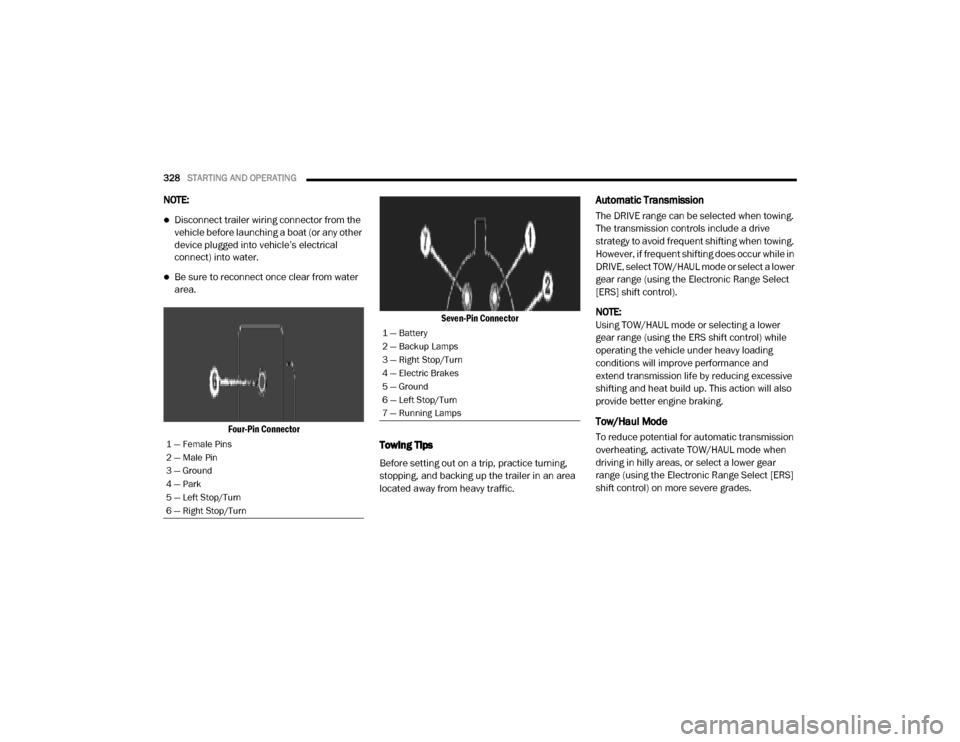
Four-Pin Connector Seven-Pin Connector
Towing Tips
Before setting out on a trip, practice turning,
stopping, and backing up the trailer in an area
located away from heavy traffic.
Automatic Transmission
The DRIVE range can be selected when towing.
The transmission controls include a drive
strategy to avoid frequent shifting when towing.
However, if frequent shifting does occur while in
DRIVE, select TOW/HAUL mode or select a lower
gear range (using the Electronic Range Select
[ERS] shift control).
NOTE:
Using TOW/HAUL mode or selecting a lower
gear range (using the ERS shift control) while
operating the vehicle under heavy loading
conditions will improve performance and
extend transmission life by reducing excessive
shifting and heat build up. This action will also
provide better engine braking.
Tow/Haul Mode
To reduce potential for automatic transmission
overheating, activate TOW/HAUL mode when
driving in hilly areas, or select a lower gear
range (using the Electronic Range Select [ERS]
shift control) on more severe grades.1 — Female Pins
2 — Male Pin
3 — Ground
4 — Park
5 — Left Stop/Turn
6 — Right Stop/Turn
1 — Battery
2 — Backup Lamps
3 — Right Stop/Turn
4 — Electric Brakes
5 — Ground
6 — Left Stop/Turn
7 — Running Lamps
20_DJD2_OM_EN_USC_t.book Page 328