2020 Peugeot Boxer SCR
[x] Cancel search: SCRPage 116 of 196

11 4
In the event of a breakdown
Front/Rear► Press the points indicated by the arrows, then remove the courtesy lamp.► Open the protective flap.► Remove the bulb by separating the two contacts.► Check that the new bulbs are securely held between the two contacts.► Close the protective flap.► Fix the courtesy lamp in its housing and make sure it is locked.
Rear lamps
1.Brake lamps
Type B, P21W - 21W
2. Brake lamps / Sidelamps
Type B, P21/5W - 21W et 5W
3. Direction indicators
Type B, PY21W - 21W
4. Reversing lamps
Type A, W16W - 16W
5. Foglamp
Type A, W16W - 16W
For more information on the Types of
bulbs , refer to the corresponding
section.
► Remove the faulty bulb, then open the rear doors.
► Remove the corresponding access flap by removing its seven fixing screws (van)
or
► Remove the corresponding access flap by pulling its handle to unclip it (combi).► Disconnect the electrical connector by pressing on its central tab.► Remove the two fixing nuts from the lens unit.► From the outside, pull the lens unit.
► Remove the six fixing screws from the bulb holder.► Open the three retaining tabs and pull the bulb holder out of its housing.► Change the bulb.► Carry out the operations in reverse order to reposition each bulb.
Number plate lamps
Type C, C5W - 5W
Page 117 of 196

11 5
In the event of a breakdown
8
► Remove the six fixing screws from the bulb holder.► Open the three retaining tabs and pull the bulb holder out of its housing.► Change the bulb.► Carry out the operations in reverse order to reposition each bulb.
Number plate lamps
Type C, C5W - 5W
► Press the dot, indicated by the arrow, and remove the clear plastic.► Remove the faulty bulb by separating the two contacts.► Once the bulb is replaced, make sure that the new bulb is locked between the two contacts.► Replace the clear plastic and press down to lock it.
Third brake lamp
Type A, W5W - 5W (x 4)
► Remove the two fixing screws from the lamp unit.► Pull the lamp unit out towards you.
► Remove the bulb holder by pinching the two tabs inwards.► Remove the faulty bulb by pulling on it.► Change the bulb.
Page 118 of 196

11 6
In the event of a breakdown
Changing a fuse
The three fuseboxes are located on the
dashboard on the left-hand side, in the pillar
on the right-hand side and in the engine
compartment.
The designations provided are only for the fuses
that can be replaced by the user. For any other
work, visit a PEUGEOT dealer or a qualified
workshop.
Professional repairers: for full information
on the fuses and relays, consult the
wiring information and diagrams available
from a PEUGEOT dealer.
Removing and fitting a fuse
Good
Failed
Before changing a fuse, the cause of the fault
must be found and rectified. The numbers of the
fuses are indicated on the fuse box.
Always replace a faulty fuse with a fuse of
the same rating.
PEUGEOT accepts no responsibility for
the cost incurred in repairing your vehicle
or for rectifying malfunctions resulting from
the installation of accessories not supplied or
not recommended by PEUGEOT and not
installed in accordance with its
recommendations, in particular when the
combined power consumption of all of the
additional equipment connected exceeds 10
milliamperes.
Left-hand side dashboard
fuses
► Remove the screws and tilt the casing to access the fuses.
Page 119 of 196

11 7
In the event of a breakdown
8FusesA (amperes)Allocation
12 7.5Right-hand dipped beam headlamp
13 7.5Left-hand dipped beam headlamp
32 7.5Passenger compartment lighting (+ battery)
34 7.5Minibus passenger compartment lighting - Hazard warning lamps
36 10Audio system - Air conditioning controls - Alarm - Tachograph - Battery cut-off computer - Additional
heating programmer (+ battery)
37 7.5Brake lamps switch - Third brake lamp - Instrument panel (+ key)
38 20Door central locking (+ battery)
42 5ABS sensor and computer - ASR sensor - DSC sensor - Brake lamps switch
43 20Windscreen wiper motor (+ key)
47 20Driver-side electric window motor
48 20Passenger-side electric window motor
49 5Park assist computer - Audio system - Steering-mounted controls - Central and side control pane\
ls -
Auxiliary control panel - Battery cut-off computer (+ key)
50 7.5Airbags and pretensioners computer
51 5Tachograph - Power steering computer - Air conditioning - Reversing lamps - Diesel fuel filter water
sensor - Flowmeter (+ key)
53 7.5Instrument panel (+ battery)
90 7.5Left-hand main beam headlamp
91 7.5Right-hand main beam headlamp
92 7.5Left-hand foglamp
93 7.5Right-hand foglamp
Page 120 of 196

11 8
In the event of a breakdown
Right-hand side pillar fuses
► Unclip the cover.When you have finished, close the cover very
carefully.
Fuses A (amperes)Allocation
55 15Heated seats
56 15Rear passenger 12 V socket
57 10Under-seat additional heating
58 15Left-hand rear screen defrosting
59 15Right-hand rear screen defrosting
63 10Rear passenger additional heating control
65 30Rear passenger additional heating ventilator
Engine compartment fuses
► Remove the nuts and tilt the casing to access the fuses. When you have finished, close the cover very
carefully.
Page 122 of 196
120
In the event of a breakdown
FusesA (amperes)Allocation
14 15Front 12 V socket (+ battery)
15 15Cigarette lighter (+ battery)
19 7.5Air conditioning compressor
20 30Screenwash/headlamp wash pump
21 15Fuel pump supply
23 30ABS solenoid valves
24 7.5Auxiliary control panel - Door mirror control and folding (+ key)
30 15Door mirror defrosting
12 V battery
Procedure for starting the engine using another
battery or charging a discharged battery.
Lead-acid starter batteries
Batteries contain harmful substances
such as sulphuric acid and lead.
They must be disposed of in accordance
with regulations and must not, in any
circumstances, be discarded with household
waste.
Take used remote control batteries and
vehicle batteries to a special collection point.
Protect your eyes and face before
handling the battery.
All operations on the battery must be carried
out in a well ventilated area and away from
naked flames and sources of sparks, so as to
avoid the risk of explosion or fire.
Wash your hands afterwards.
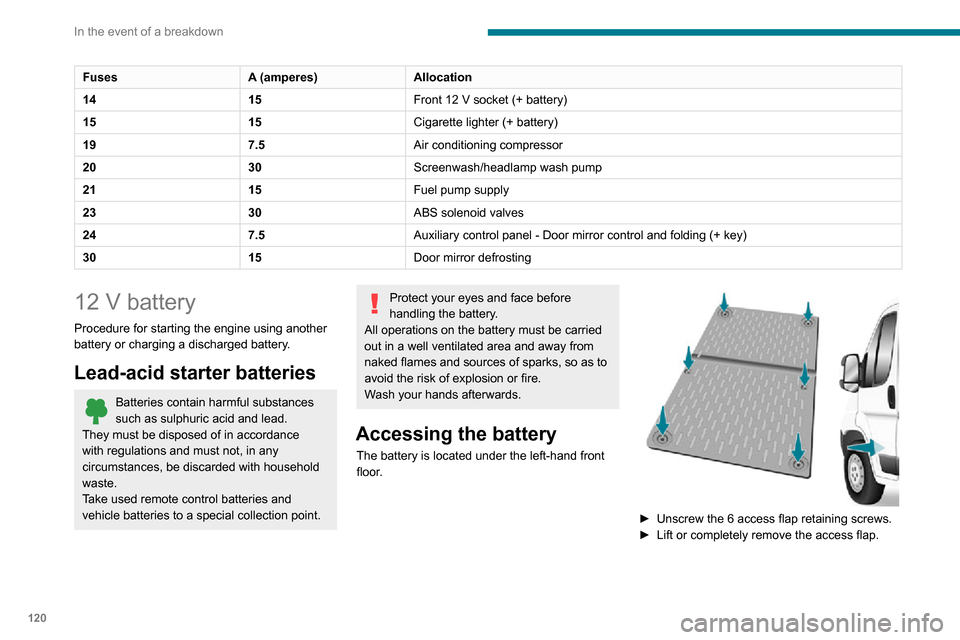
Accessing the battery
The battery is located under the left-hand front
floor.
► Unscrew the 6 access flap retaining screws.
► Lift or completely remove the access flap.
Page 123 of 196

121
In the event of a breakdown
8
► Tilt lever 1 downwards to release the
terminals.
► Remove terminals 2 from the negative (-)
terminal.
Wait approximately 6 minutes after
switching off the ignition before
disconnecting the battery.
Do not disconnect the terminals while the
engine is running.
Do not charge a battery without disconnecting
the terminals first.
Close the windows and the doors before
disconnecting the battery.
After reconnecting the battery, turn on the ignition and wait 1 minute before starting the engine, to enable the electronic systems to
initialise. If minor problems nevertheless persist
following this operation, contact a PEUGEOT
dealer or a qualified workshop.
It is recommended to disconnect the (-) terminal of the battery if the vehicle is to be left unused for more than one month.
The description of the battery charging
procedure is only indicative.
After prolonged battery disconnection, it may be
necessary to reinitialise the following functions:
– the display parameters (date, time, language, distance and temperature units),– the stations of the audio system,– the central locking.Some settings are cancelled and must be
entered once again; contact a PEUGEOT dealer.
If the vehicle is equipped with a tachograph or
an alarm, it is recommended that the (-) terminal of the battery (located under the floor on the
left-hand side, in the cab) be disconnected if the
vehicle is not going to be used for more than 5
days.
Starting using another
battery
Never start the engine by connecting a
battery charger.
Never use a 24 V or higher battery booster.
Check beforehand that the backup battery
has a nominal voltage of 12 V and a capacity
at least equal to that of the discharged
battery.
The two vehicles must not be in contact with
each other.
Switch off all the electrical consumers on both
vehicles (audio system, wipers, lighting, etc.).
Make sure that the jump leads are not close
to the moving parts of the engine (fan, belt,
etc.).
Do not disconnect the (+) terminal while the
engine is running.
A. Positive metallic terminal of your vehicle
B. Backup battery
C. Earth of your vehicle
The positive metallic terminal A is accessible
through a flap located on the side of the fuse
box.
Connect only to the terminals indicated
and illustrated above. In case of
non-compliance, risk of short circuit!
Page 124 of 196

122
In the event of a breakdown
► Connect the red cable to metallic terminal A,
then to the (+) terminal of backup battery B.
► Connect one end of the green or black cable to the negative (-) terminal of backup battery B.► Connect the other end of the green or black cable to earth point C of your vehicle.► Operate the starter , let the engine run.► Wait for the engine to return to idle and disconnect the cables.
Charging the battery using a
battery charger
► Access the battery, located in the left-hand front floor.► Disconnect the battery .► Follow the instructions for use provided by the manufacturer of the charger.► Reconnect starting with the (-) terminal.► Check the cleanliness of the terminals. If they are covered with sulphate (whitish or greenish
deposit), remove and clean them.
The charging operation must be carried
out in a well-ventilated area and away
from naked flames and any sources of sparks
so as to avoid the risk of explosion or fire.
Do not try to recharge a frozen battery: it
must first be thawed to avoid the risk of
explosion. If it has frozen, before charging it,
have the battery checked by a specialist who
will check that the interior components have
not been damaged and that the container is
not cracked, which would involve a risk of
leakage of toxic and corrosive acid.
Perform a slow charge at low amperage for
about 24 hours maximum to avoid damaging
the battery.
The presence of this label, in particular with the Stop & Start system, indicates
the use of a 12 V lead-acid battery with
special technology and specification; the
involvement of a PEUGEOT dealer or a
qualified workshop is essential when
replacing or disconnecting the battery.
After refitting the battery at a PEUGEOT dealer or a qualified workshop, the Stop
& Start system will only be active after a
continuous period of immobilisation of the
vehicle, a period which depends on the
climatic conditions and the state of charge of
the battery (up to about 8 hours).
Towing
General recommendations
Observe the legislation in force in the
country where you are driving.
Ensure that the weight of the towing vehicle is
higher than that of the towed vehicle.
The driver must remain at the wheel of the
towed vehicle and must have a valid driving
licence.
When towing a vehicle with all four wheels on
the ground, always use an approved towing
arm; rope and straps are prohibited.
The towing vehicle must move off gently.
When the vehicle is towed with its engine
off, there is no longer braking and steering
assistance.
A professional towing service must be
called if:
– Broken down on a motorway or main road.– Not possible to put the gearbox into neutral, unlock the steering, or release the parking
brake.
– Not possible to tow a vehicle with an automatic gearbox, with the engine running.– Towing with only two wheels on the ground.– Four-wheel drive vehicle.– No approved towbar available.
Towing your vehicle
The removable towing eye is located in the tool
box under the front passenger seat.
► Unclip the cover using a flat tool.
► Screw the removable towing eye in fully.► Attach the approved towbar to the removable towing eye.