2020 MERCEDES-BENZ METRIS seats
[x] Cancel search: seatsPage 94 of 320
G
WARNING
If the rear bench seat is not installed as
described or an unsuitable rear bench seat
is installed, the seat belts may not provide
protection as intended. There is an
increased risk of injury.
Install the rear bench seat as described.
Only use rear bench seats that are approved
for your vehicle by the distributor named on
the inside cover page.
The only way to ensure that the rear bench
seat will engage securely is to always keep the
seat anchorages clean and free of foreign
objects.
Always observe the notes about the seating
variants (Y page
90). :
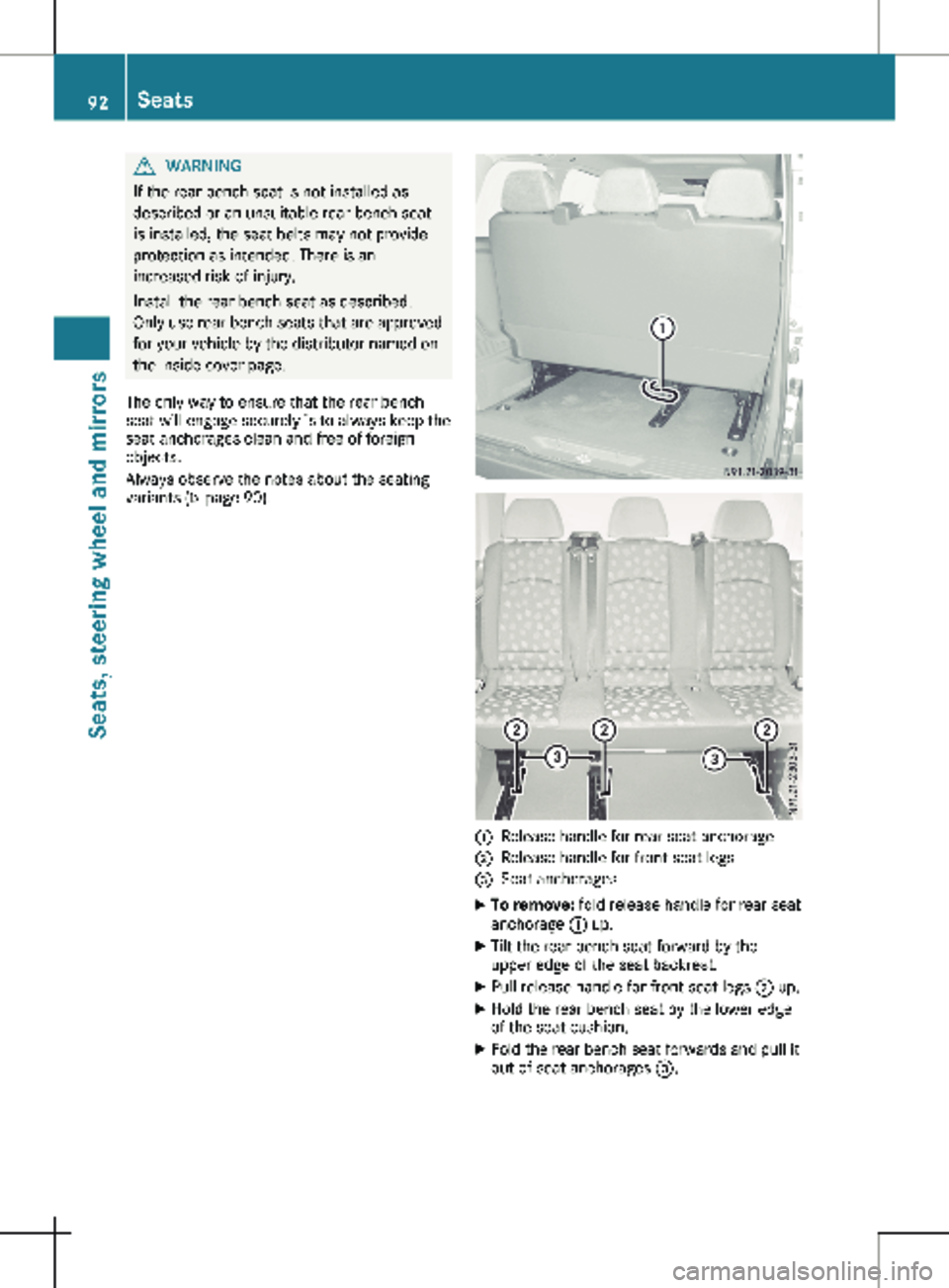
Release handle for rear seat anchorage
; Release handle for front seat legs
= Seat anchorages
X To remove: fold release handle for rear seat
anchorage : up.
X Tilt the rear bench seat forward by the
upper edge of the seat backrest.
X Pull release handle for front seat legs ; up.
X Hold the rear bench seat by the lower edge
of the seat cushion.
X Fold the rear bench seat forwards and pull it
out of seat anchorages =.92
Seats
Seats, steering wheel and mirrors
Page 95 of 320
X
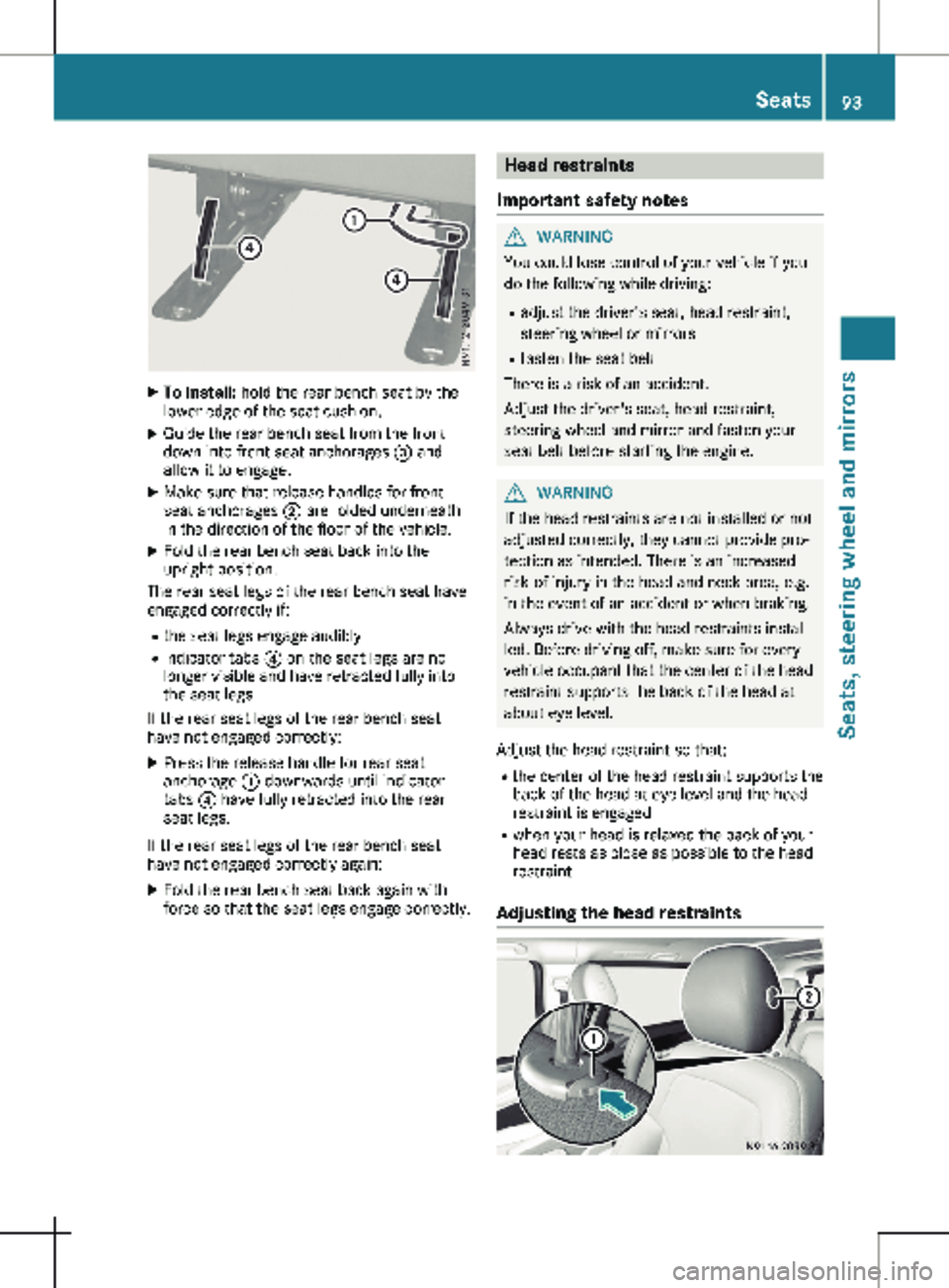
To install: hold the rear bench seat by the
lower edge of the seat cushion.
X Guide the rear bench seat from the front
down into front seat anchorages = and
allow it to engage.
X Make sure that release handles for front
seat anchorages ; are folded underneath
in the direction of the floor of the vehicle.
X Fold the rear bench seat back into the
upright position.
The rear seat legs of the rear bench seat have
engaged correctly if:
R the seat legs engage audibly
R indicator tabs ? on the seat legs are no
longer visible and have retracted fully into
the seat legs
If the rear seat legs of the rear bench seat
have not engaged correctly:
X Press the release handle for rear seat
anchorage : downwards until indicator
tabs ? have fully retracted into the rear
seat legs.
If the rear seat legs of the rear bench seat
have not engaged correctly again: X Fold the rear bench seat back again with
force so that the seat legs engage correctly. Head restraints
Important safety notes G
WARNING
You could lose control of your vehicle if you
do the following while driving:
R adjust the driver's seat, head restraint,
steering wheel or mirrors
R fasten the seat belt
There is a risk of an accident.
Adjust the driver's seat, head restraint,
steering wheel and mirror and fasten your
seat belt before starting the engine. G
WARNING
If the head restraints are not installed or not
adjusted correctly, they cannot provide pro-
tection as intended. There is an increased
risk of injury in the head and neck area, e.g.
in the event of an accident or when braking.
Always drive with the head restraints instal-
led. Before driving off, make sure for every
vehicle occupant that the center of the head
restraint supports the back of the head at
about eye level.
Adjust the head restraint so that: R the center of the head restraint supports the
back of the head at eye level and the head
restraint is engaged
R when your head is relaxed the back of your
head rests as close as possible to the head
restraint
Adjusting the head restraints Seats
93Seats, steering wheel and mirrors Z
Page 96 of 320
X
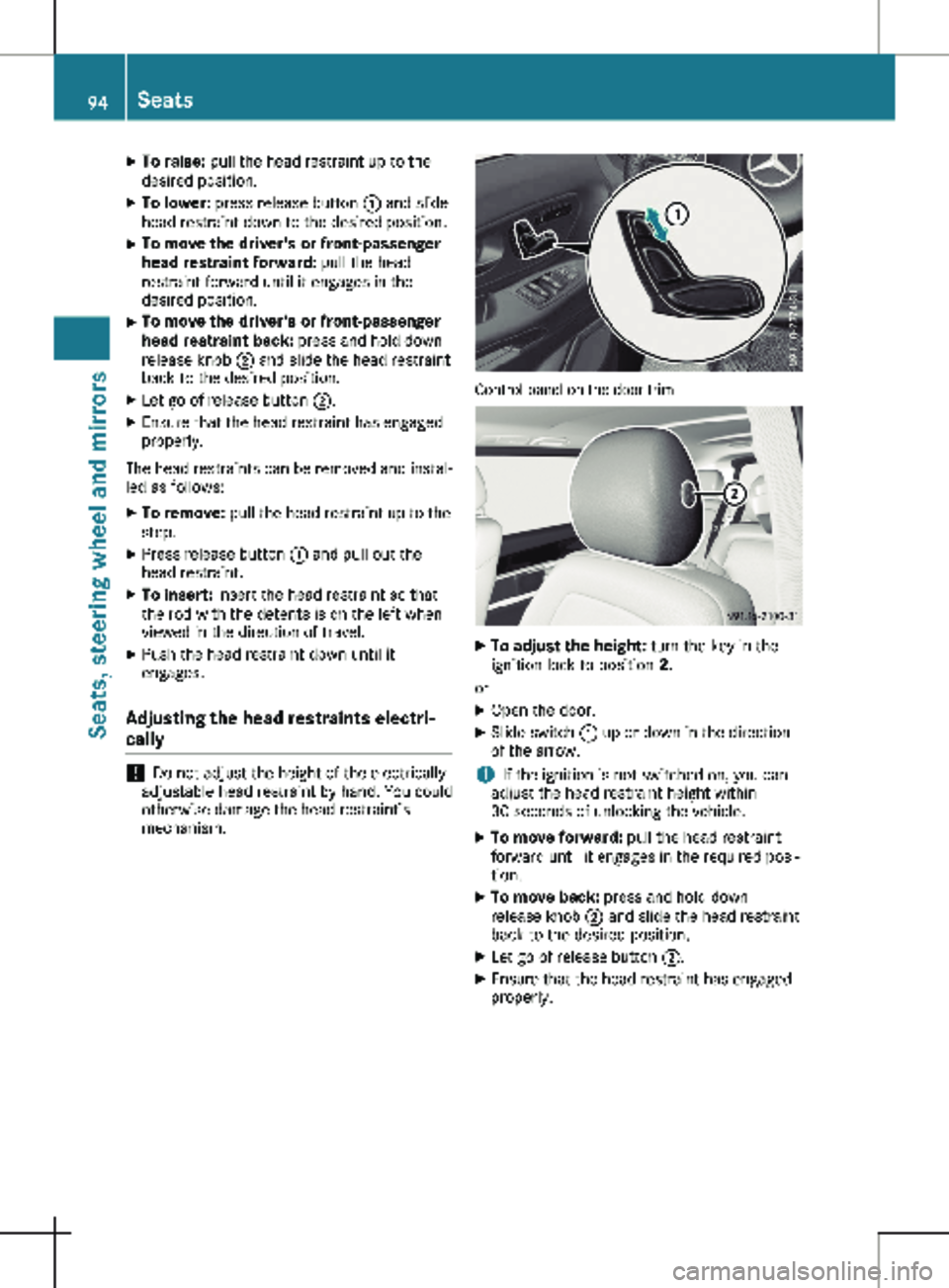
To raise: pull the head restraint up to the
desired position.
X To lower: press release button : and slide
head restraint down to the desired position.
X To move the driver's or front-passenger
head restraint forward: pull the head
restraint forward until it engages in the
desired position.
X To move the driver's or front-passenger
head restraint back: press and hold down
release knob ; and slide the head restraint
back to the desired position.
X Let go of release button ;.
X Ensure that the head restraint has engaged
properly.
The head restraints can be removed and instal-
led as follows:
X To remove: pull the head restraint up to the
stop.
X Press release button : and pull out the
head restraint.
X To insert: insert the head restraint so that
the rod with the detents is on the left when
viewed in the direction of travel.
X Push the head restraint down until it
engages.
Adjusting the head restraints electri-
cally !
Do not adjust the height of the electrically
adjustable head restraint by hand. You could
otherwise damage the head restraint’s
mechanism. Control panel on the door trim
X
To adjust the height: turn the key in the
ignition lock to position 2.
or X Open the door.
X Slide switch : up or down in the direction
of the arrow.
i If the ignition is not switched on, you can
adjust the head restraint height within
30 seconds of unlocking the vehicle.
X To move forward: pull the head restraint
forward until it engages in the required posi-
tion.
X To move back: press and hold down
release knob ; and slide the head restraint
back to the desired position.
X Let go of release button ;.
X Ensure that the head restraint has engaged
properly.94
SeatsSeats, steering wheel and mirrors
Page 97 of 320

Armrests
X
To adjust the armrest angle: fold the arm-
rest up by more than 45° to position 2.
The armrest is released.
X Fold armrest 3 forward to the stop.
X Slowly fold the armrest up to the desired
position.
X To fold the armrest up: if necessary, fold
the armrest up by more than 90° to position
1. Seat heating
G
WARNING
Repeatedly switching on the seat heating
can cause the seat cushion and backrest
pads to become very hot. The health of per-
sons with limited temperature sensitivity or
a limited ability to react to high tempera-
tures may be affected or they may even suf-
fer burn-like injuries. There is a risk of injury.
Therefore, do not switch the seat heating on
repeatedly.
! When you leave your seat, do not place
anything on the seat and switch off the seat
heating. Do not switch the seat heating on
when the seat is not occupied, e.g. when
driving without a front passenger. The seat
heating may otherwise overheat, causing
damage to the seat. The three red indicator lamps in the
Í but-
ton show the activated heating level 1 to 3.
The seat heating automatically switches down
from level 3 to level 2 after approximately
seven minutes.
The system automatically switches down from
level 2 to level 1 after approximately ten
minutes.
At level 1 the seat heating switches off auto-
matically after approximately
20 minutes.
X Make sure that the key is in position 1 or 2
in the ignition lock.
X To switch on: press the Í button
repeatedly until the desired heating level
has been set.
X To switch off: press the Í button
repeatedly until all indicator lamps go out.
If the on-board voltage is too low, the seat
heating will either switch itself off prematurely
or not come on at all. In this case, too many
electrical consumers are switched on or the
battery charge is not sufficient. The seat heat-
ing will automatically switch back to the cur-
rent heating level when enough on-board volt-
age is available again. Steering wheel
G
WARNING
You could lose control of your vehicle if you
do the following while driving:
R adjust the driver's seat, head restraint,
steering wheel or mirrors
R fasten the seat belt
There is a risk of an accident. Steering wheel
95
Seats, steering wheel and mirrors
Z
Page 98 of 320

Adjust the driver's seat, head restraint,
steering wheel and mirror and fasten your
seat belt before starting the engine.
G
WARNING
If the steering wheel is unlocked while the
vehicle is in motion, it could change position
unexpectedly. This could cause you to lose
control of the vehicle. There is a risk of an
accident.
Before starting off, make sure the steering
wheel is locked. Never unlock the steering
wheel while the vehicle is in motion. G
WARNING
Children could injure themselves if they
adjust the steering wheel. There is a risk of
injury.
When leaving the vehicle, always take the
SmartKey with you and lock the vehicle.
Never leave children unsupervised in the
vehicle.
The steering wheel can still be adjusted if the
key has been removed. Adjusts the steering wheel
:
Steering column height
; Lever
X To adjust the steering wheel: pull lever ;
up and hold it.
The steering wheel is unlocked.
X Move the steering wheel to the desired posi-
tion.
X Let go of lever ;.
The steering wheel engages and is locked
again. Mirrors
Important safety notes
G
WARNING
You could lose control of your vehicle if you
do the following while driving:
R adjust the driver's seat, head restraint,
steering wheel or mirrors
R fasten the seat belt
There is a risk of an accident.
Adjust the driver's seat, head restraint,
steering wheel and mirror and fasten your
seat belt before starting the engine. G
WARNING
The exterior mirror on the front-passenger
side reduces the size of the image. Visible
objects are actually closer than they appear.
This means that you could misjudge the dis-
tance from road users traveling behind, e.g.
when changing lane. There is a risk of an
accident.
For this reason, always make sure of the
actual distance from the road users traveling
behind by glancing over your shoulder. Inside rearview mirror
X
Anti-glare mode: push anti-glare lever :
forwards or back. 96
MirrorsSeats, steering wheel and mirrors
Page 99 of 320

Exterior mirrors
Adjusting manually X
Before starting off, manually adjust the exte-
rior mirrors in such a way that you can get a
good overview of road and traffic conditions.
Adjusting electrically X
Before pulling away, turn the key to position
1 or 2 in the ignition lock.
X Press the Z button for the left exterior
mirror or the \ button for the right exte-
rior mirror.
The indicator lamp for the button switches
on and the selected exterior mirror can be
adjusted.
The indicator lamp goes out again after
some time.
X If the indicator lamp for the Z or \
button lights up, press button 7 up or
down, to the right or left.
Adjust the exterior mirrors in such a way
that you have a good overview of traffic con-
ditions.
After the engine has been started, the exterior
mirrors are automatically heated if the rear
window defroster is switched on and the out-
side temperature is low.
Disengaged exterior mirrors If an exterior mirror has been pushed out of
position, proceed as follows:
X
Move the exterior mirror into the correct
position manually.
The mirror housing engages again and the
exterior mirrors can be adjusted again as
usual. Exterior mirror heating
i Vehicles without rear window
defroster: when the temperature is below
15 °C the mirror heating switches on auto-
matically after engine start and remains on.
i Vehicles with rear window heater: at
temperatures below
15 °C the mirror heater
switches on automatically for ten minutes
after engine start. In addition, mirror heating
can be switched on together with the rear
window defroster.
X To switch the mirror heating on man-
ually:
turn the key to position 2 in the igni-
tion lock.
X Press the ¤ button on the control panel.
If the indicator lamp in the ¤ button
lights up, both the mirror heating and the
rear window defroster are switched on.
The rear window defroster switches off auto-
matically after a few minutes. Memory function
General notes
With the memory function, you can store up to
three different seat settings, e.g. for three dif-
ferent people. The position of the seat, seat
backrest and head restraint are stored as a
single memory preset. Important safety notes
G
WARNING
If you use the memory function on the driv-
er's side while driving, you could lose con-
trol of the vehicle as a result of the adjust-
ments being made. There is a risk of an acci-
dent.
Only use the memory function on the driv-
er's side when the vehicle is stationary. G
WARNING
When the memory function adjusts the seat,
you and other vehicle occupants – particu-
larly children – could become trapped. There
is a risk of injury. Memory function
97
Seats, steering wheel and mirrors
Z
Page 100 of 320
While the memory function is making adjust-
ments, make sure that no one has any body
parts in the sweep of the seat. If somebody
becomes trapped, immediately release the
memory function position button. The
adjustment process is stopped. G
WARNING
Children could become trapped if they acti-
vate the memory function, particularly when
unattended. There is a risk of injury.
When leaving the vehicle, always take the
SmartKey with you and lock the vehicle.
Never leave children unsupervised in the
vehicle.
The memory function can be used at any time,
for example even when the key has been
removed from the ignition lock. Storing settings
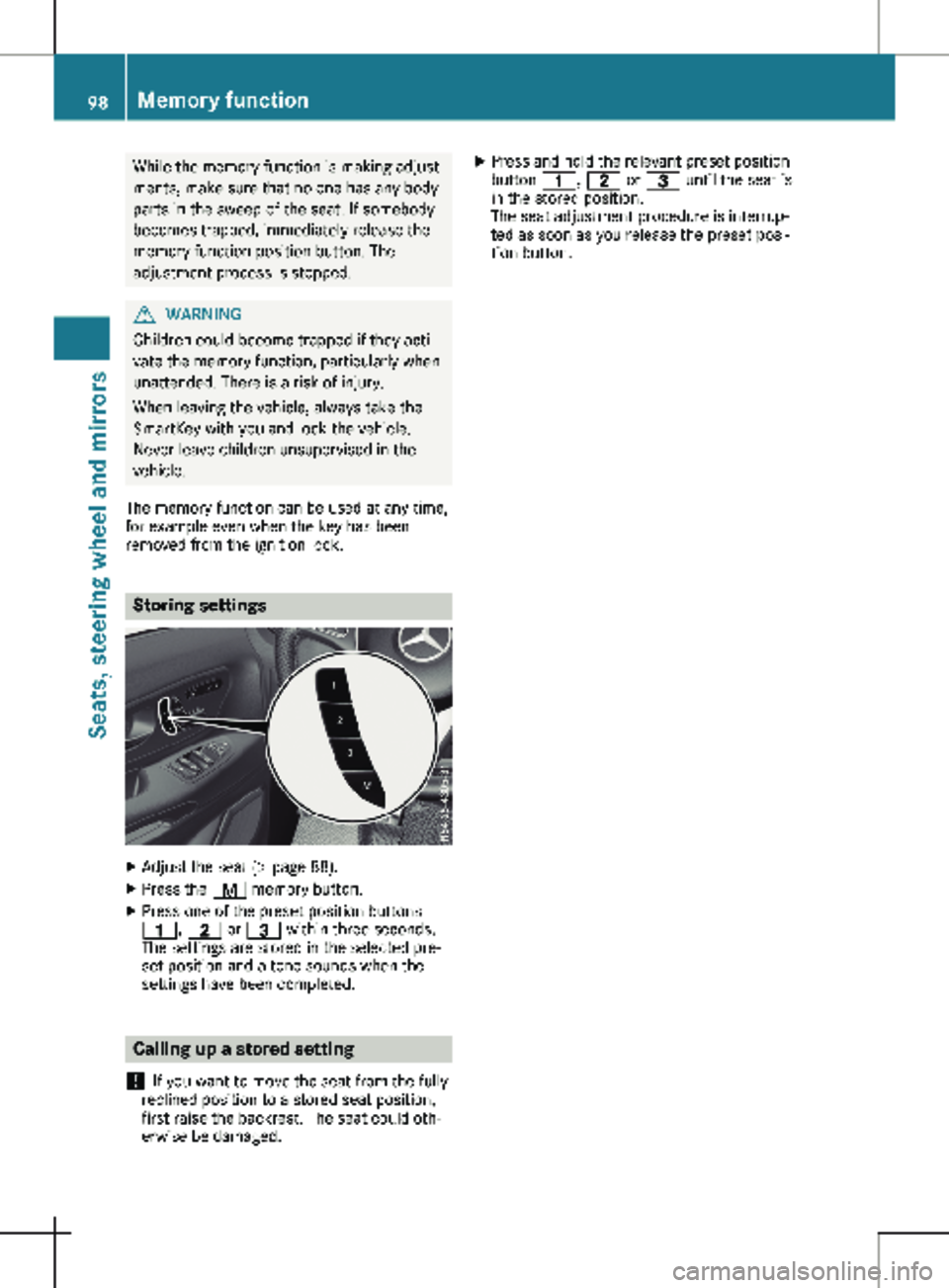
X
Adjust the seat (Y page 88).
X Press the r memory button.
X Press one of the preset position buttons
4, 5 or = within three seconds.
The settings are stored in the selected pre-
set position and a tone sounds when the
settings have been completed. Calling up a stored setting
! If you want to move the seat from the fully
reclined position to a stored seat position,
first raise the backrest. The seat could oth-
erwise be damaged. X
Press and hold the relevant preset position
button 4, 5 or = until the seat is
in the stored position.
The seat adjustment procedure is interrup-
ted as soon as you release the preset posi-
tion button. 98
Memory function
Seats, steering wheel and mirrors
Page 244 of 320

Useful information
This Operator's Manual describes all models
as well as standard and optional equipment of
your vehicle that were available at the time of
going to print. Country-specific variations are
possible. Note that your vehicle may not be
equipped with all of the described functions.
This also applies to systems and functions rel-
evant to safety.
Read the information on qualified specialist
workshops (Y page
32).Loading guidelines
Important safety notes
G
WARNING
When objects are unsecured or inadequately
secured, they can slip, turn over or be
thrown about, striking vehicle occupants.
This also applies to:
R luggage or loads
R seats which have been removed and are
being transported in the vehicle in an
exceptional case.
There is a risk of injury, particularly in the
event of a braking maneuver or abrupt
change in direction.
Always stow objects in such a way that they
cannot be tossed about. Before traveling,
secure objects, luggage or loads to prevent
them slipping or tipping over. If you remove
a seat, store it preferably outside the vehi-
cle. G
WARNING
As a result of improperly placed or unevenly
distributed loads, the center of gravity of the
load being transported may be too high or
too far back. This can significantly impair
handling as well as steering and braking
characteristics. There is a risk of an acci-
dent. Always make sure that the center of gravity
of the load is:
R between the axles
and
R as low as possible, near the rear axle. G
WARNING
When the permissible wheel loads, axle
loads and/or the maximum permissible
gross vehicle weight are exceeded, driving
safety is compromised. The handling as well
as steering and braking characteristics may
be significantly impaired. Overloaded tires
may overheat, causing them to burst. There
is a risk of an accident.
When transporting a load, always observe
the permissible wheel loads, axle loads and
the maximum permissible gross vehicle
weight for the vehicle (including occupants).
! If you are using a roof carrier, observe the
maximum roof load and maximum roof car-
rier load.
R Do not stack luggage or loads higher than
the backrests.
R Objects to be transported should preferably
be stowed in the cargo compartment.
R When transporting luggage, always use the
cargo tie-down rings for securing loads and
a cargo net, if installed.
R Use cargo tie-down rings and fasteners
which are suitable for the weight and size of
the load.
When using suitable load securing aids and tie
downs, always follow the manufacturer's oper-
ating instructions, in particular the notes on
discard criteria contained therein.
Load securing aids or tie downs must not be
used if:
R identification marks are missing or illegible
R there are yarn breakages, damage to bear-
ing seams or other signs of tearing
R there are signs of shearing, deformation,
pinching or other damage
R there is damage to clamping or connecting
elements
Load securing aids and tie downs in this condi-
tion are ready for discard and must be 242
Loading guidelines
Transporting loads