2020 MERCEDES-BENZ E-CLASS CABRIOLET wheel
[x] Cancel search: wheelPage 159 of 546
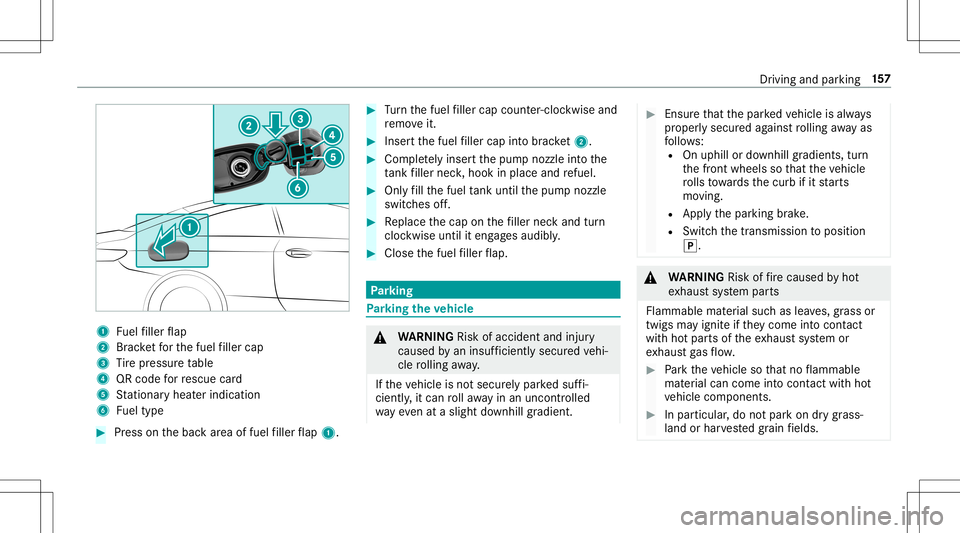
1
Fuelfiller flap
2 Brac ketfo rth efuel filler cap
3 Tire pressur eta ble
4 QRcode forre scue card
5 Statio naryheat erind icat ion
6 Fueltype #
Press onthebac kar ea offuel filler flap 1. #
Turn thefuel filler cap coun ter-cloc kwiseand
re mo veit. #
Insertth efuel filler cap intobr ac ket2. #
Comp lete ly inse rtthepum pnoz zleintoth e
ta nk filler neck,hook inplace andrefuel . #
Onlyfill th efuel tank unti lth epum pnoz zle
switc hesoff. #
Replace thecap onthefiller neckand turn
cloc kwise untilit eng ages audibl y. #
Close thefuel filler flap. Pa
rking Pa
rking theve hicl e &
WARNIN GRisk ofacci dent andinjury
cau sed byan insufficie ntlysecu redve hi‐
cle rolling away.
If th eve hicle isno tsecur elyparkedsuf fi‐
cie ntly ,it can rollaw ay inan unc ontrolled
wa yev en ataslight downhill gradient. #
Ensur eth at thepar kedve hicle isalw ays
pr oper lysecur edagains tro lling away as
fo llo ws :
R Onuphil lor downhill gradients, turn
th efront wheels sothat theve hicle
ro lls towa rdsth ecurb ifit star ts
mo ving.
R App lythepar king brak e.
R Switc hth etra nsmiss iontoposition
005D. &
WARNIN GRisk offire cau sed byhot
ex haus tsy stem parts
Flammable material suc has lea ves, grass or
twigs mayignit eif th ey come intocont act
wi th hotpar tsof theex haus tsy stem or
ex haus tga sflow . #
Park theve hicle sothat no flammab le
mat erial can com eint ocon tact with hot
ve hicle component s. #
Inpar ticular ,do notpar kon drygr ass‐
land orhar vested grain fields. Dr
iving andparking 15
7
Page 160 of 546
&
WARNIN GRisk ofacci dent andinjury
due tochildr enleftunat tende din the
ve hicle
If ch ildr enarelef tunat tende din theve hicle,
th ey cou ld:
R Ope ndoo rs,th er eb yendang ering other
per sons orroad user s.
R Getout and bestru ck byoncom ingtraf‐
fi c.
R Ope rate vehicle equipment andbecome
tr apped, forex am ple.
In addit ion,th ech ildr encould alsosetth e
ve hicle inmo tion, forex am ple by:
R Releasing thepar king brak e.
R Changing thetra nsmiss ionposition .
R Startin gth eve hicle. #
Neverlea vechildr enunat tende din the
ve hicle. #
When leaving theve hicle, alwaysta ke
th eke ywit hyo uand lockth eve hicle. #
Keep theve hicle keyout ofreac hof
ch ildr en. *
NO
TEDama getotheve hicle duetoit
ro lling away #
Alw ayssecur eth eve hicle agains tro ll‐
ing away. #
Bring theve hicle toast ands tillby appl ying
th ebr ak epedal. #
Onuphill ordownhill gradients, turnth efront
wheels sothat theve hicle rolls towa rdsth e
curb ifit star ts mo ving. #
App lytheelectr icpar king brak e. #
Engage trans missi on positio n005D inast atio n‐
ar yve hicle withth ebr ak epedal applied
(/ page15 2). #
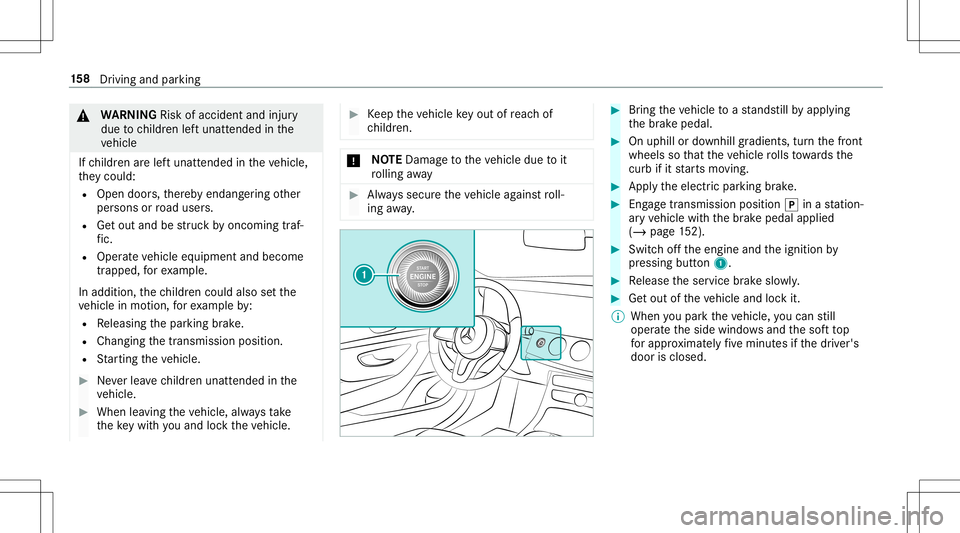
Swi tchof fth eengine andtheignition by
pr essing button1. #
Release theser vice brak eslo wly. #
Getout oftheve hicle andlockit.
% When youpar kth eve hicle, youcan still
opera tetheside windo wsand thesof tto p
fo rapp roxima tely five minut esifth edr iver's
door isclosed. 15
8
Driving and parking
Page 169 of 546
R
Rear vie wcam era(/ page20 0)
R ActiveLa ne Chang eAssi st(/ pag e18 7)
R Cruis econtr ol(/ page 176)
R Blind SpotAssis tand ActiveBli nd Spo tAssi st
( / pag e21 6)
R Traf fic Sign Assist(/ pag e21 4) Fu
nction ofABS (Anti-loc kBr aking System) AB
Sre gulat esthebr ak epr essur ein critical driv‐
ing situation s:
R Dur ing braking, e.g.atfull brak eapplication
or insuf ficie nttiretracti on, thewheels are
pr eve nted from lock ing.
R Vehicle steer ability whilebraking isensur ed.
If ABS interve nes when braki ng, youwill feel a
pulsing inthebr ak epedal. Thepulsating brak e
pedal canbeanindicat ionofhazar dous road
con dition sand canserveas are minder totake
ex tra car ewh ile dr ivi ng.
Sy stem limita tions
R ABSis act ive from speeds ofappr ox.5 mp h
(8 km/ h). R
ABSma ybe impair edorma yno tfunc tion ifa
malfunc tionhasoccurredand theye l‐
lo w 0025 ABSwa rning lam plight sup con tin‐
uousl yin theins trument clusteraf te rth e
engine isstar ted. Fu
nction ofBA S(Br akeAssis tSy stem) &
WARNIN GRisk ofan acci dent caused by
a malf unctionin BA S(Br akeAssi stSys‐
te m)
If BA Sis mal functi oning,th ebr aking distance
in an eme rgency braking situation is
incr eased. #
Depr essthebr ak epedal withfull forc e
in emer gency braki ng situa tions. ABS
pr eve nts thewheels from locking . BA
Ssu ppo rts yo ur eme rgency braking situation
wit hadditional brak efo rc e.
If yo udepr essthebr ak epedal quickl y, BA Sis
acti vated:
R BASau tomatical lyboos tsthebr ak epr es‐
sur e. R
BAScan shorten thebr aking distance.
R ABS preve nts thewheels from locking .
The brak es will func tion asusual onceyo u
re lease thebr ak epedal. BASis dea ctivated. Fu
nction ofESP ®
(Electr onicStabil ityPro‐
gr am) &
WARNIN GRisk ofskid ding ifESP ®
is
mal functi oning
If ESP ®
is mal functi oning,ESP ®
canno tcar ry
out vehicle stabiliz ation.Inaddit ion,ot her
dr iving safetysy stems areswitc hedoff. #
Drive on car efull y. #
Have ESP ®
ch eckedat aqu alif ied spe‐
cialis two rkshop. &
WARNIN GRisk ofskid ding ifESP ®
is
dea ctivated
If yo udeac tivateES P®
,ES P®
can notcar ry
out vehicle stabiliz ation. Dr
ivin gand parking 16
7
Page 170 of 546

#
ESP ®
sho uld only bedeacti vatedin the
fo llo wing situat ions. Mer
cedes‑AM Gve hicl es:besur eto obser ve
th eno tesin theSupplement .Ot her wise, you
ma yfa ilto recogni zedangers.
ESP ®
can moni torand improve driving stabilit y
and tract ion inthefo llo wing situat ions,wit hin
ph ysical limit s:
R When pulling away on awe tor slip pe ry road‐
wa y.
R When braking.
R Instro ng side winds when youar edr ivin g
fa ster than 47 mp h(7 5 km/h).
If th eve hicle deviat esfrom thedir ect ion desir ed
by thedr iver ,ES P®
can stabiliz eth eve hicle by
int erve ning inthefo llo wing ways:
R One ormor ewheels arebr ak ed.
R The engine outputisadap tedaccor dingto
th esituation . ES
P®
is deactiv ated ifth e00BB ESP®
OFF warn‐
ing lam plight sup con tinuousl yin theins trument
clus ter:
R Driving stabilit ywill nolongerbe improv ed.
R Crosswind Assistis no long eractiv e.
R The drive wheels couldspin.
R ETS/4 ETStraction control isstill act ive.
% When ESP®
is deact ivat ed, youar est ill assis‐
te dby ESP ®
wh en braki ng.
If th e00E5 ESP®
wa rning lam pflashes inthe
ins trumen tclus ter,one orseveralve hicle wheels
has reac hed itsgrip limit :
R Adaptyo ur drivin gst yle to suit thecur rent
ro ad and weather condition s.
R Donotdeac tivateES P®
.
R Onlydepr esstheaccelera torpeda las faras
is necessar ywhen pulling away.
Dea ctivateESP ®
in thefo llo wing situat ionsto
im prov etraction :
R When usingsnowch ains .
R Indeep snow . R
Onsand orgrav el.
% Spinn ingthewheels results inacutting
action, whichenhances traction.
If th e00E5 ESP®
wa rning lam plight sup con tinu‐
ousl y,ESP ®
is no tav ailable duetoamalf unction.
Obse rveth efo llo wing informatio n:
R Warning and indic ator lam ps(/ page489 )
R Disp lay mess ages
ET S/4ET S(Electr onicTractio nSy stem)
ET S/ 4ETS tracti oncontr olispa rtof ESP ®
and
mak esitpossible topull away and accelerat eon
a slippe ryroadw ay.
ET S/4ET Scan impr ovetheve hicle's traction by
int erve ning inthefo llo wing ways:
R The drive wheels arebr ak ed individually if
th ey spin.
R Mor edr ive to rq ue istrans ferred tothewheel
or wheels withtra ction.
Inf luence ofdrive pr og rams onESP®
The drive pr og rams enabl eESP ®
to adap tto dif‐
fe re nt we ather and road con dition sas wellas 16
8
Driving and parking
Page 173 of 546
Ac
tiv atin g/deac tivatin gES P®
(E lectr onicSta‐
bil ity Prog ram) Mu
ltimed iasystem:
4 Vehicle 5
k Assist ance 5
ESP
Mer cedes‑AMG vehicl es:obse rveth eno tesin
th eSupplement .Ot her wise, youma yno tre cog‐
nize dangers. #
Activate0073 ordeacti vate 0053 thefunc tion.
ES P®
is deactiv ated ifth e00BB ESP®
OFF warn‐
ing lam plight sup con tinuousl yin theins trument
clus ter.
Obser vetheinf ormation onwarning lam psand
displa ymess ages whic hma ybe sho wninthe
ins trumen tclus ter. Fu
nction ofESP ®
Cr osswind Assist ES
P®
Cr osswind Assistde tects sudde ngu stsof
side wind andhelps thedr iver tokeep theve hi‐
cle inthelane:
R ESP®
Cr osswind Assistis activ eat vehicle
speeds between appr ox.47 mp h(7 5 km/h) and
125mp h(2 00 km/h) whendr iving
st ra ight ahead orcor ner ing slight ly.
R The vehicle isstabiliz edbymeans ofindivi d‐
ua lbr ak eapp lication onone side. Fu
nction ofEBD (electr onicbrak efo rc edis‐
tr ibut ion) EB
Dis ch aract erize dby thefo llo wing:
R Mon itor ing and regulating thebr ak epr essur e
on there ar wheels .
R Improv ed driving stabilit ywhen brakin g,
espe ciallyon ben ds. Fu
nction ofSTEER CONT ROL ST
EER CONTR OLhelpsyo uby trans mitting a
no tice ablesteer ing forc eto thesteer ing wheel in
th edir ect ion requ ired forve hicle stabiliz ation.
This steer ing recomme ndation isgiv en particu‐
lar lyin thefo llo wing situat ions:
R Both right wheels orboth leftwheels areon
a we tor slip pe ry road sur face whe nyo u
br ak e R
The vehicle star ts to skid
Sy stem limit s
ST EER CONTR OLmaybe impa ired orma yno t
fu nctio nin thefo llo wing situat ions:
R ESP®
is deact ivat ed.
R ESP®
is malfun ctionin g.
R The steer ing ismalfunct ioning.
If ES P®
is malfunct ioning,youwill beassis ted
fur ther by theelectr icpo we rst eer ing. Fu
nction ofActiv eBr ak eAs sist Ac
tiveBr ak eAssi stconsi stsof thefo llo wing
func tions:
R Distance warning func tion
R Autonomo usbraki ng func tion
R Situ ation-d epend ent braki ng assist anc e
R Vehicl eswith Drivin gAss istanc ePa ck‐
ag e:Evasi ve Steer ing Assis t Dr
iving andparking 17
1
Page 179 of 546

cr
uise contr olwillre sume speed regulation back
to thestor ed speed.
Cr uise controlis oper ated using thecor respond‐
ing steer ing wheel buttons. Youcan stor ean y
speed above15 mp h(2 0km/h) uptothemaxi‐
mum speed.
If yo ufa ilto adap tyo ur drivin gst yle, cruise con‐
tr ol can neither reduce therisk ofan accident
nor override thelaws ofphysics. Itcan nottak e
int oacc ount road, weather ortraf fic condi tions.
Cr uise contr olisonly anaid. The driver is
re sponsible forth edis tance totheve hicle in
fr ont, forve hicle speed, forbr aking ingood time
and forst ay ing inlane.
Displa yson themu ltifunct iondisp lay
The status ofcruise control and thestor ed
speed aresho wninthemultifunc tiondispla y. 1
Cruise contro lis selec ted
2 Spee dis save d, cruise control isdeactiv ated
3 Speed issave d, cruise control isactiv ated
% The segmen tsbetween thestor ed speed and
th eend ofthesegment displaylight upin
th espeedome ter.
Sy stem limit s
Cr uise control ma ybe unable tomaint ainthe
st or ed speed onuphill gradients. Thestor ed
speed isresumed whenthegr adient evensout.
Ch ang eint oalowe rge ar ingood timeon long
and steep downhill gradients. Take par ticular
no te ofthis when drivin galaden vehicle. By doing
so,youwill mak euse oftheengine' sbr ak‐
ing effect. Thisre lie vesth eload onthebr ak e
sy stem and preve nts thebr ak es from overheat‐
ing and wearing tooqu ickl y.
Do notus ecr uise contr olinthefo llo wing situa‐
tion s:
R Intraf fic situ ations whichrequ ire freq uent
ch ang esofspee d,e.g .in hea vytraf fic, on
wi nding roads.
R Onslippe ryroads. Accel erati ng can cause
th edr ive wheels tolose tract ion and the
ve hicle could then skid.
R Ifyo uar edr ivin gwhen visibilit yis poor .
Ope ratin gcr uis eco ntr ol &
WARNIN GRisk ofacci dent dueto stor ed
speed
If yo ucall upthestor ed speed andthis is
lo we rth an your cur rent spe ed,th eve hicle
deceler ates. #
Take intoacc ount thetra ffic situat ion
bef orecallin gup thestor ed speed. Dr
iving andparking 17
7
Page 181 of 546
Ac
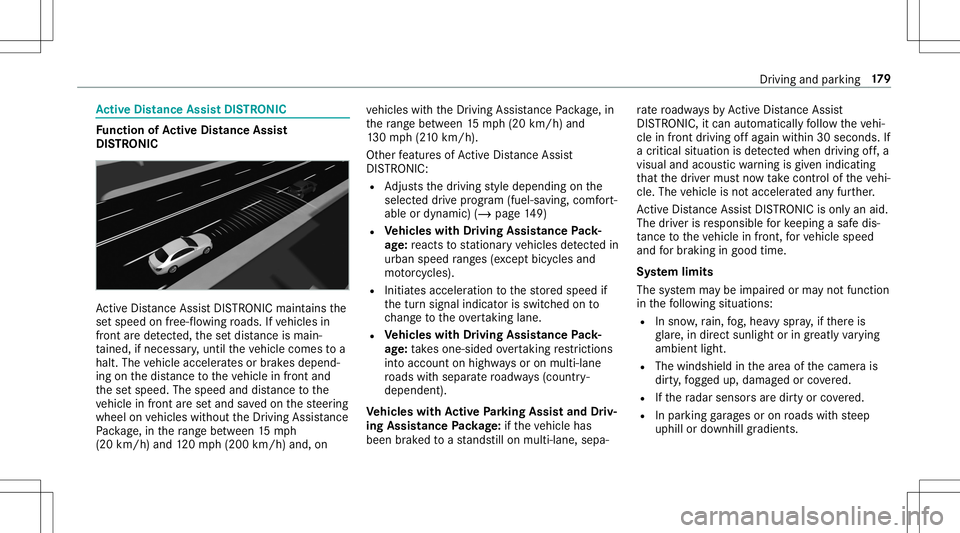
tiv eDi stance AssistDI ST RO NIC Fu
nction ofActiv eDi stance Assist
DI ST RO NIC Ac
tiveDis tance AssistDIS TRONI Cma intains the
se tspeed onfree-f lowing roads. Ifve hicles in
fr ont arede tected, these tdis tance ismai n‐
ta ined, ifnec essar y,unt ilth eve hicle comes toa
halt. Thevehicle acceler ates orbrak es depend‐
ing onthedis tance totheve hicle infront and
th ese tspeed. Thespeed anddistance tothe
ve hicle infront arese tand save don thesteer ing
wheel onvehicles without theDr iving Assistance
Pa ckag e, inthera ng ebe twee n15 mp h
(20 km/ h)and 120mp h(200 km/h) and,on ve
hicles withth eDr iving Assistance Packag e, in
th era ng ebe twee n15 mp h(20 km/h) and
13 0mp h(210 km/h) .
Ot her featur esofActiveDis tance Assist
DIS TRONI C:
R Adjus tsthedr iving style depending onthe
select eddrive pr ogr am (fuel-sa ving,comfort‐
able ordynamic) (/page14 9)
R Vehicl eswith Drivin gAss istanc ePa ck‐
ag e:react sto statio naryve hicles detected in
urb anspe edrang es (exc ep tbicy cles and
mo torcyc les).
R Initiates acc eler ation tothestor ed speed if
th etur nsignal indicat orisswitc hedonto
ch ang eto theove rtakin glane .
R Vehicl eswith Drivin gAss istanc ePa ck‐
ag e:take sone-sided overtakin gre strictions
int oacco untonhighwaysor on multi-lane
ro ads withseparat ero adw ays(countr y-
dependen t).
Ve hicl eswith Activ ePa rking Assis tand Driv‐
ing Assis tance Packag e:ifth eve hicle has
been brak ed toast ands tillon mult i-lane,sepa‐ ra
te roadw aysby ActiveDis tance Assist
DIS TRONI C,itcan automatical lyfollo wtheve hi‐
cle infront driving offag ain within 30seconds. If
a cr itical situation isde tected whe ndr ivi ng off,a
vis ualand acoustic warning isgiv en indic ating
th at thedr iver mus tno wtake contr olof theve hi‐
cle. The vehicle isno tacceler ated anyfur ther.
Ac tiveDis tance AssistDIS TRONI Cis only anaid.
The driver isresponsible forke eping asaf edis‐
ta nce totheve hicle infront, forve hicle speed
and forbr aking ingood time.
Sy stem limit s
The system maybe impair edorma yno tfunc tion
in thefo llo wing situat ions:
R Insno w,rain, fog, hea vyspr ay,if th er eis
gl ar e, indir ect sunlight oringreat lyvarying
ambien tlight .
R The windsh ieldinthear ea ofthecamer ais
dir ty,fo gg ed up, damag edorcovered.
R Ifth era dar sensor sar edir tyor covered.
R Inpar kingga rage sor on roads withsteep
uphill ordownhill gradients. Dr
iving andparking 17
9
Page 182 of 546
R
Ifth er ear enar row vehicles infront, suchas
bicy cles ormo torcyc les.
In addition ,on slipper yro ads, brakin gor acc el‐
er atin gcan caus eon eor severalwheels tolose
tr act ion and theve hicle could then skid.
Do notuse ActiveDis tance AssistDIS TRONI Cin
th ese situation s. &
WARNIN GRisk ofacci dent from acce ler‐
ati on orbraki ng byActiveDis tance
Assi stDIS TRONI C
Ac tiveDis tance AssistDIS TRONI Cma yacc el‐
er ateor brak ein thefo llo wing cases ,fo r
ex am ple:
R Ifth eve hicle pullsaway usin gAc tiveDis ‐
ta nce AssistDIS TRONI C.
R Ifth estor ed speed iscalled upand is
considera blyfaster or slo werth an the
cur rently driven spe ed.
R IfAc tiveDis tance AssistDIS TRONI Cno
lo ng er detects ave hicle infront ordoes
no tre act toreleva nt objects. #
Alw ayscar efully observethetraf fic con‐
di tions andbeready tobrak eat all
times. #
Take intoacc ount thetra ffic situat ion
bef orecallin gup thestor ed speed. &
WARNIN GRisk ofacci dent dueto insuf ‐
fi cie ntdece lera tio nby ActiveDis tance
Assi stDIS TRONI C
Ac tiveDis tance AssistDIS TRONI Cbrak es
yo ur vehicle withup to50% ofthemaximum
possible deceleration.Ifth is decele ratio nis
no tsu fficien t,Ac tiveDis tance Assist
DIS TRONI Caler ts youwit havis ual and
aco ustic warning. #
Inthese cases, adjustyo ur spee dand
ke ep asuf ficie ntdist anc e. #
Brak eth eve hicle yourself and/or take
ev asiv eact ion. &
WARNIN GRisk ofacci dent ifde tection
functi onofActiveDis tance Assist
DIS TRONI Cis impai red
Ac tiveDis tance AssistDIS TRONI Cdo es not
re act orhas alimit edreact ion:
R when drivin gon adif fere nt lane orwh en
ch ang inglane s
R topedes trians, animals, bicycles orsta‐
tio nar yve hicles, orune xpect edobs tacle s
R tocom plex traf fic condi tions
R tooncom ingvehicles andcrossing traf fic
As are sult, ActiveDis tance Assist
DIS TRONI Cma ynei ther giv ewa rnings nor
int erve ne insuch situations. #
Alw aysobser vethetra ffic con dition s
car efull yand react accordin gly. Oper
ating Activ eDi stance AssistDI ST RO NIC
Re quirement s:
R The vehicle hasbeen star ted.
R The elect ric pa rking brak eis released.
R ESP®
is act ivat ed and isno tint erve ning . 18
0
Driving and parking