2020 Lexus ES300h fuel
[x] Cancel search: fuelPage 347 of 462

3456-3. Do-it-yourself maintenance
6
Maintenance and care
8Using a Phillips screwdriver, install
the clip.
■Scheduled maintenance of the air
intake vent is necessary when
In some situations such as when the vehicle
is used frequently or in heavy traffic or dusty
areas, the air intake vent may need to be
cleaned more regularly.
For details, refer to “Owner’s Manual Sup-
plement” or “Scheduled Maintenance”.
■Cleaning the air intake vent
●Dust in the air intake vent may interfere
with the cooling of the hybrid battery
(traction battery). If charging/discharging
of the hybrid battery (traction battery)
becomes limited, the distance that the
vehicle can be driven using the electric
motor (traction motor) may be reduced
and the fuel economy may be reduced.
Inspect and clean the air intake vent peri-
odically.
●Improper handling of the air intake vent
cover and filter may result in damage to
them. If you have any concerns about
cleaning the filter, contact your Lexus
dealer.
■If “Maintenance required for Traction
battery cooling parts See owner’s man-
ual” is displayed on the multi-informa-
tion display
●If this warning message is displayed on
the multi-information display, remove the
air intake vent cover and clean the filter.
( P.343)
●After cleaning the air intake vent, start
the hybrid system and check that the
warning message is no longer displayed.
After the hybrid system is started, it may be necessary to drive the vehicle up to
approximately 20 minutes before the
warning message disappears. If the warn-
ing message does not disappear after
driving for appropriately 20 minutes,
have the vehicle inspected by your Lexus
dealer.
WARNING
■When cleaning the air intake vent
●Do not use water or other liquids to
clean the air intake vent. If water is
applied to the hybrid battery (traction
battery) or other components, a mal-
function or fire may occur.
●Before cleaning the air intake vent,
make sure to turn the power switch off
to stop the hybrid system.
■When removing the air intake vent
cover
Do not touch the service plug located
near the air intake vent. ( P.64)
NOTICE
■When cleaning the air intake vent
When cleaning the air intake vent, make
sure to only use a vacuum to suck out
dust and clogs. If a compressed air blow
gun, etc. is used to blow out dust and
clogs, the dust or clogs may be pushed
into the air intake ve nt, which may affect
the performance of the hybrid battery
(traction battery) and cause a malfunc-
tion.
Page 357 of 462

355
7
7
When trouble arises
When trouble arises
7-1. Essential informationEmergency flashers.................. 356
If your vehicle has to be stopped in an emergency .......................... 356
If the vehicle is trapped in rising water............................................ 357
7-2. Steps to take in an emergency If your vehicle needs to be towed........................................................ 359
If you think something is wrong ........................................................ 362
If a warning light turns on or a warning buzzer sounds ....... 364
If a warning message is displayed ........................................................ 374
If you have a flat tire.................. 378
If the hybrid system will not start ........................................................ 385
If you lose your keys ................. 387
If the fuel filler door cannot be opened........................................ 387
If the electronic key does not operate properly .................... 388
If the 12-volt battery is discharged ........................................................ 390
If your vehicle overheats ........ 395
If the vehicle becomes stuck 398
Page 369 of 462

3677-2. Steps to take in an emergency
7
When trouble arises
■Low fuel level warning light
■Driver’s and front passenger’s seat belt reminder light (warning buzzer)*
*: Driver’s seat belt warning buzzer:
The driver’s seat belt warning buzzer sounds to al ert the driver that his or her seat belt is not
fastened. Once the power switch is turned to ON, the buzzer sounds. If the seat belt is still
unfastened, the buzzer sounds intermittently for a certain period of time after the vehicle
reaches a certain speed.
Front passenger’s seat belt warning buzzer:
The front passenger’s seat belt warning buzzer sounds to alert the front passenger that his
or her seat belt is not fastened. If the seat belt is unfastened, the buzzer sounds intermit-
tently for a certain period of time af ter the vehicle reaches a certain speed.
■Rear passengers’ seat belt reminder lights (warning buzzer)*
*: Rear passengers’ seat belt warning buzzer:
The rear passengers’ seat belt warning buzzer sounds to al ert the rear passenger that his or
her seat belt is not fastened. If the seat belt is unfastened, the buzzer sounds intermittently
for a certain period of time af ter the seat belt is fastened and unfastened and the vehicle
reaches a certain speed.
Warning lightDetails/Actions
Indicates that remaining fuel is approximately 1.8 gal. (7 L, 1.5 Imp.gal.)
or less
Refuel the vehicle.
Warning lightDetails/Actions
Warns the driver and/or front passe nger to fasten their seat belts
Fasten the seat belt.
If the front passenger’s seat is occupied, the front passenger’s seat
belt also needs to be fastened to make the warning light (warning
buzzer) turn off.
Warning lightDetails/Actions
Warns the rear passengers to fasten their seat belts
Fasten the seat belt.
Page 375 of 462

3737-2. Steps to take in an emergency
7
When trouble arises
WARNING
■If a blowout or sudden air leakage
should occur
The tire pressure warning system may
not activate immediately.
■Maintenance of the tires
Each tire, including the spare (if pro-
vided), should be checked monthly when
cold and inflated to the inflation pressure
recommended by the vehicle manufac-
turer on the vehicle placard or tire infla-
tion pressure label (tire and load
information label). (If your vehicle has
tires of a different size than the size indi-
cated on the vehicle placard or tire infla-
tion pressure label [tire and load
information label], yo u should determine
the proper tire infl ation pressure for
those tires.)
As an added safety feature, your vehicle
has been equipped with a tire pressure
monitoring system (TPMS-tire pressure
warning system) that illuminates a low
tire pressure telltale (tire pressure warn-
ing light) when one or more of your tires
is significantly under-inflated. Accord-
ingly, when the low tire pressure telltale
(tire pressure warnin g light) illuminates,
you should stop and check your tires as
soon as possible, and inflate them to the
proper pressure. Driving on a signifi-
cantly under-inflated tire causes the tire
to overheat and can lead to tire failure.
Under-inflation also reduces fuel effi-
ciency and tire tread life, and may affect
the vehicle’s handling and stopping abil-
ity.
Please note that the TPMS (tire pressure
warning system) is not a substitute for
proper tire maintenance, and it is the
driver’s responsibility to maintain correct
tire pressure, even if under-inflation has
not reached the level to trigger illumina-
tion of the TPMS low tire pressure telltale
(tire pressure warning light).
Your vehicle has also been equipped with
a TPMS (tire pressure warning system)
malfunction indicator to indicate when
the system is not operating properly. The
TPMS (tire pressure warning system)
malfunction indicator is combined with
the low tire pressure telltale (tire pres-
sure warning light) . When the system
detects a malfunction, the telltale will
flash for approximately one minute and
then remain continuously illuminated.
This sequence will continue upon subse-
quent vehicle start-ups as long as the
malfunction exists. When the malfunction
indicator is illuminated, the system may
not be able to detect or signal low tire
pressure as intended.
TPMS (tire pressure warning system)
malfunctions may occur for a variety of
reasons, including the installation of
replacement or alternate tires or wheels
on the vehicle that prevent the TPMS
(tire pressure warning system) from func-
tioning properly. Always check the
TPMS (tire pressure warning system)
malfunction telltale after replacing one
or more tires or wheels on your vehicle to
ensure that the replacement or alternate
tires and wheels allow the TPMS (tire
pressure warning system) to continue to
function properly.
NOTICE
■To ensure the tire pressure warning
system operates properly
Do not install tires with different specifi-
cations or makers, as the tire pressure
warning system may not operate prop-
erly.
Page 387 of 462

3857-2. Steps to take in an emergency
7
When trouble arises
One of the following may be the cause
of the problem:
The electronic key may not be func-
tioning properly. ( P.389)
There may not be sufficient fuel in
the vehicle’s tank.
Refuel the vehicle. ( P.170)
There may be a malfunction in the
immobilizer system. ( P.67)
There may be a malfunction in the
steering lock system.
The hybrid system may be malfunc-
tioning due to an electrical problem
such as electronic key battery
depletion or a blown fuse. However,
depending on the type of malfunc-
tion, an interim measure is available
to start the hybrid system.
One of the following may be the cause
WARNING
■Speed limit when using the compact
spare tire
Do not drive at speeds in excess of 50
mph (80 km/h) when a compact spare
tire is installed on the vehicle.
The compact spare tire is not designed
for driving at high speeds. Failure to
observe this precaution may lead to an
accident causing deat h or serious injury.
■After using the tools and jack
Before driving, make sure all the tools
and jack are securely in place in their
storage location to reduce the possibility
of personal injury during a collision or
sudden braking.
NOTICE
■Be careful when driving over bumps
with the compact spare tire installed
on the vehicle
The vehicle becomes lower when driving
with the compact spare tire compared to
when driving with standard tires. Be
careful when driving over uneven road
surfaces.
■Driving with tire chains and the com-
pact spare tire
Do not fit tire chains to the compact
spare tire.
Tire chains may damage the vehicle body
and adversely affect driving perfor-
mance.
■When replacing the tires
When removing or fitting the wheels,
tires or the tire pressure warning valve
and transmitter, contact your Lexus
dealer as the tire pr essure warning valve
and transmitter may be damaged if not
handled correctly.
If the hybrid system will not
s
tart
Reasons for the hybrid system not
starting vary depending on the situ-
ation. Check the following and per-
form the appropriate procedure:
The hybrid system will not start
even though the correct starting
procedure is being followed.
( P.143)
The interior lights and head-
lights are dim, or the horn does
not sound or sounds at a low vol-
ume.
Page 389 of 462
3877-2. Steps to take in an emergency
7
When trouble arises
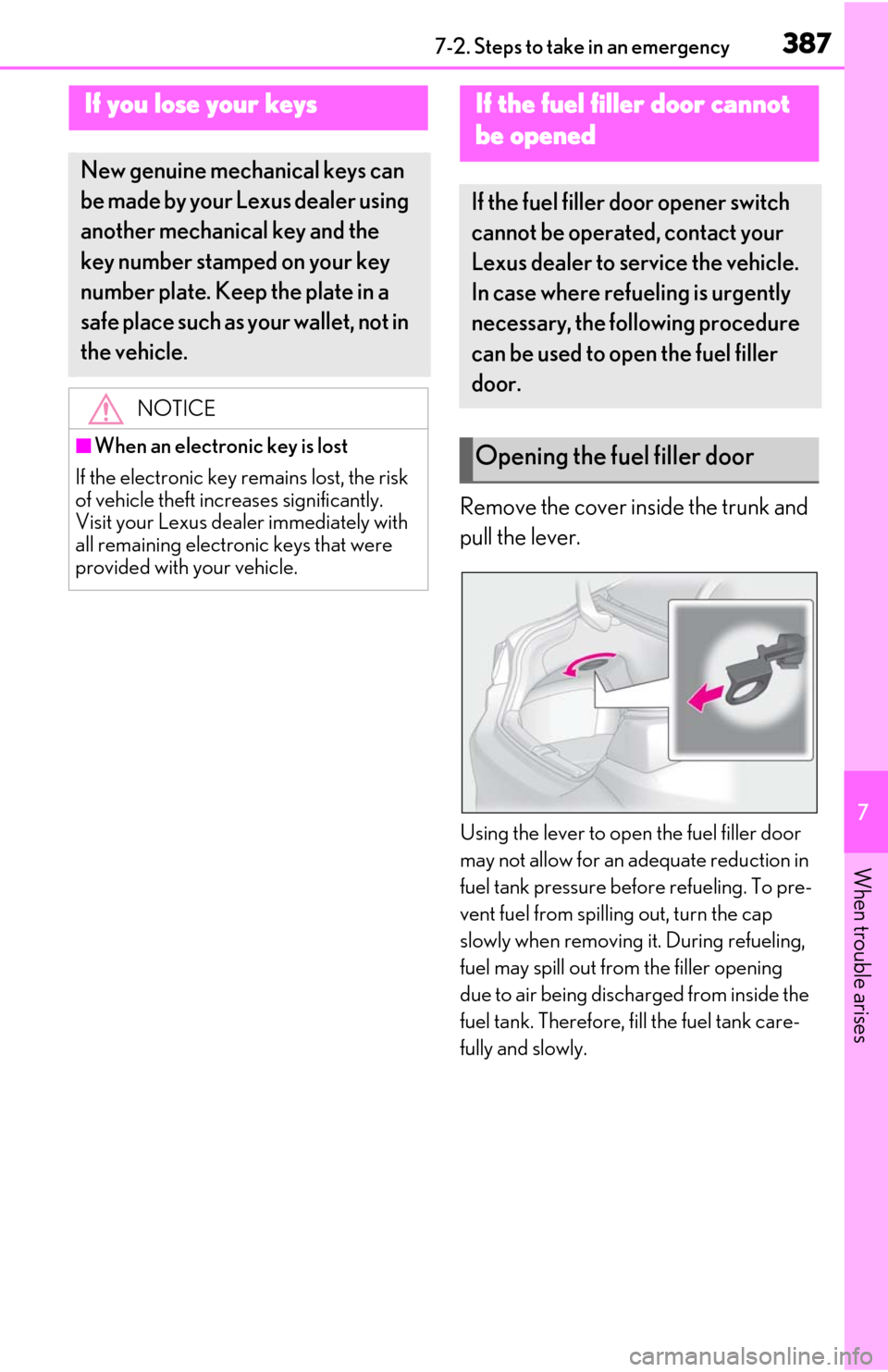
Remove the cover inside the trunk and
pull the lever.
Using the lever to open the fuel filler door
may not allow for an adequate reduction in
fuel tank pressure before refueling. To pre-
vent fuel from spilling out, turn the cap
slowly when removing it. During refueling,
fuel may spill out from the filler opening
due to air being discharged from inside the
fuel tank. Therefore, fill the fuel tank care-
fully and slowly.
If you lose your keys
New genuine mechanical keys can
be made by your Lexus dealer using
another mechanical key and the
key number stamped on your key
number plate. Keep the plate in a
safe place such as your wallet, not in
the vehicle.
NOTICE
■When an electronic key is lost
If the electronic key remains lost, the risk
of vehicle theft increases significantly.
Visit your Lexus deal er immediately with
all remaining electronic keys that were
provided with your vehicle.
If the fuel filler door cannot
b
e opened
If the fuel filler door opener switch
cannot be operated, contact your
Lexus dealer to service the vehicle.
In case where refueling is urgently
necessary, the following procedure
can be used to open the fuel filler
door.
Opening the fuel filler door
Page 401 of 462

399
8
8
Vehicle specifications
Vehicle specifications
8-1. SpecificationsMaintenance data (fuel, oil level, etc.) .............................................. 400
Fuel information ......................... 407
Tire information.......................... 409
8-2. Customization Customizable features............. 418
8-3. Items to initialize Items to initialize ........................ 429
Page 402 of 462

4008-1. Specifications
8-1.Specifications
*1:Unladen vehicle
*2: Vehicles with 215/55R17 tires
*3: Vehicles with 235/45R18 tires
■Vehicle identification number
The vehicle identification number
(VIN) is the legal identifier for your
vehicle. This is the primary identifica-
tion number for your Lexus. It is used in
registering the ownership of your vehi-
cle.
This number is stamped on the top left
of the instrument panel. This number is also stamped under the
right-hand front seat.
Maintenance data (fuel, oil level, etc.)
Dimensions and weight
Overall length195.9 in. (4975 mm)
Overall width73.4 in. (1865 mm)
Overall height*156.9 in. (1445 mm)
Wheelbase113.0 in. (2870 mm)
Tread*1
Front63.0 in. (1599 mm)*2
62.6 in. (1589 mm)*3
Rear63.3 in. (1609 mm)*2
63.0 in. (1600 mm)*3
Vehicle capacity weight
(Occupants + luggage)905 lb. (410 kg)
Vehicle identification