Page 479 of 611
633
What to do in an emergency
TOWING
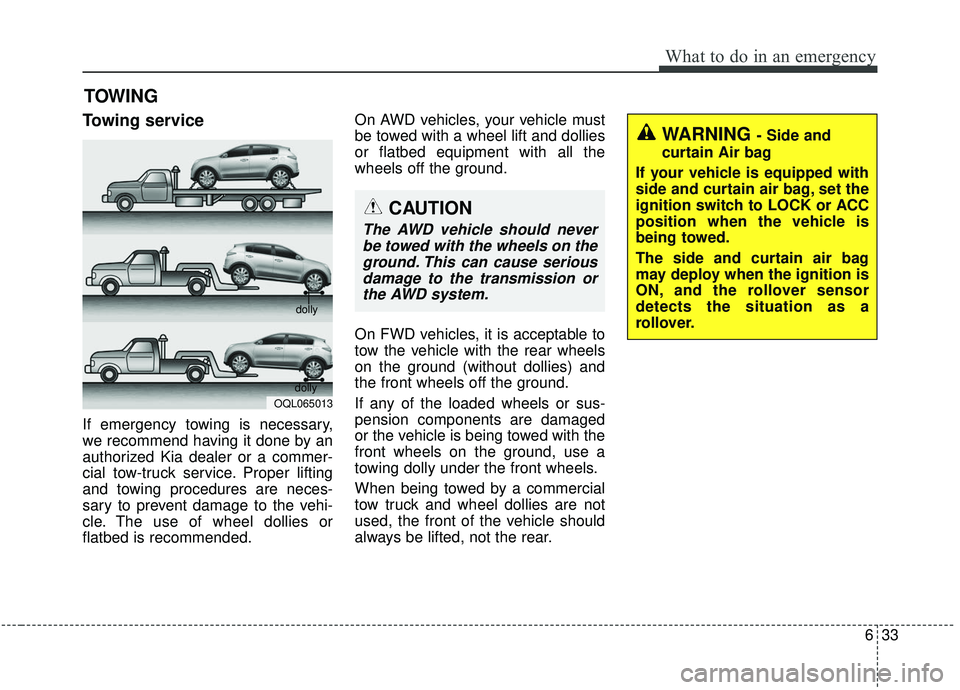
Towing service
If emergency towing is necessary,
we recommend having it done by an
authorized Kia dealer or a commer-
cial tow-truck service. Proper lifting
and towing procedures are neces-
sary to prevent damage to the vehi-
cle. The use of wheel dollies or
flatbed is recommended.On AWD vehicles, your vehicle must
be towed with a wheel lift and dollies
or flatbed equipment with all the
wheels off the ground.
On FWD vehicles, it is acceptable to
tow the vehicle with the rear wheels
on the ground (without dollies) and
the front wheels off the ground.
If any of the loaded wheels or sus-
pension components are damaged
or the vehicle is being towed with the
front wheels on the ground, use a
towing dolly under the front wheels.
When being towed by a commercial
tow truck and wheel dollies are not
used, the front of the vehicle should
always be lifted, not the rear.
OQL065013
dolly
dolly
WARNING - Side and
curtain Air bag
If your vehicle is equipped with
side and curtain air bag, set the
ignition switch to LOCK or ACC
position when the vehicle is
being towed.
The side and curtain air bag
may deploy when the ignition is
ON, and the rollover sensor
detects the situation as a
rollover.
CAUTION
The AWD vehicle should never be towed with the wheels on theground. This can cause seriousdamage to the transmission orthe AWD system.
Page 481 of 611
635
What to do in an emergency
3. Install the towing hook by turning itclockwise into the hole until it is
fully secured.
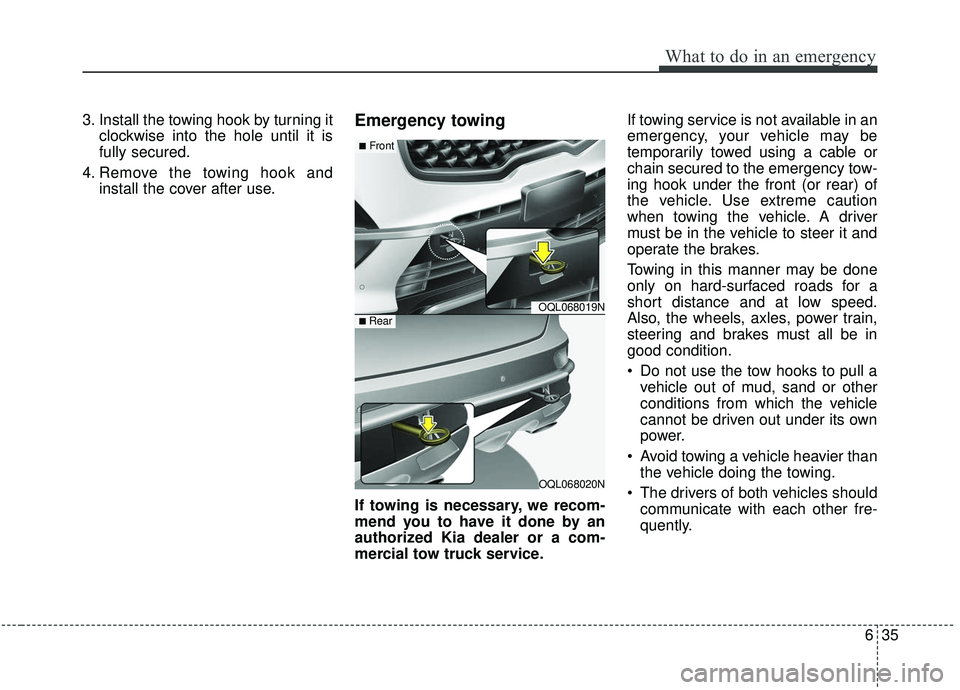
4. Remove the towing hook and install the cover after use.Emergency towing
If towing is necessary, we recom-
mend you to have it done by an
authorized Kia dealer or a com-
mercial tow truck service. If towing service is not available in an
emergency, your vehicle may be
temporarily towed using a cable or
chain secured to the emergency tow-
ing hook under the front (or rear) of
the vehicle. Use extreme caution
when towing the vehicle. A driver
must be in the vehicle to steer it and
operate the brakes.
Towing in this manner may be done
only on hard-surfaced roads for a
short distance and at low speed.
Also, the wheels, axles, power train,
steering and brakes must all be in
good condition.
Do not use the tow hooks to pull a
vehicle out of mud, sand or other
conditions from which the vehicle
cannot be driven out under its own
power.
Avoid towing a vehicle heavier than the vehicle doing the towing.
The drivers of both vehicles should communicate with each other fre-
quently.
OQL068019N
OQL068020N
■Front
■ Rear
Page 482 of 611
What to do in an emergency
36
6
• Attach a towing strap to the tow
hook.
Use only a cable or chain specifical- ly intended for use in towing vehi-
cles. Securely fasten the cable or
chain to the towing hook provided.
Accelerate or decelerate the vehi- cle in a slow and gradual manner
while maintaining tension on the
tow rope or chain to start or drive
the vehicle, otherwise tow hooks
and the vehicle may be damaged.
Before emergency towing, check if the hook is not broken or damaged. Fasten the towing cable or chain
securely to the hook.
Do not jerk the hook. Apply it steadily and with even force.
To avoid damaging the hook, do not pull from the side or at a vertical
angle. Always pull straight ahead.
CAUTION
Using a portion of the vehicleother than the tow hooks fortowing may damage the body ofyour vehicle.
WARNING- Emergency
Towing Precautions
Use extreme caution when tow-
ing the vehicle.
• Avoid sudden starts or erratic driving maneuvers which
would place excessive stress
on the emergency towing hook
and towing cable or chain. The
hook and towing cable or
chain may break and cause
serious injury or damage.
If the disabled vehicle is unable to be moved, do not
forcibly continue the towing.
We recommend that you con-
tact an authorized Kia dealer
or a commercial tow truck
service for assistance.
Tow the vehicle as straight ahead as possible.
Keep away from the vehicle during towing.
Page 487 of 611
Maintenance
47
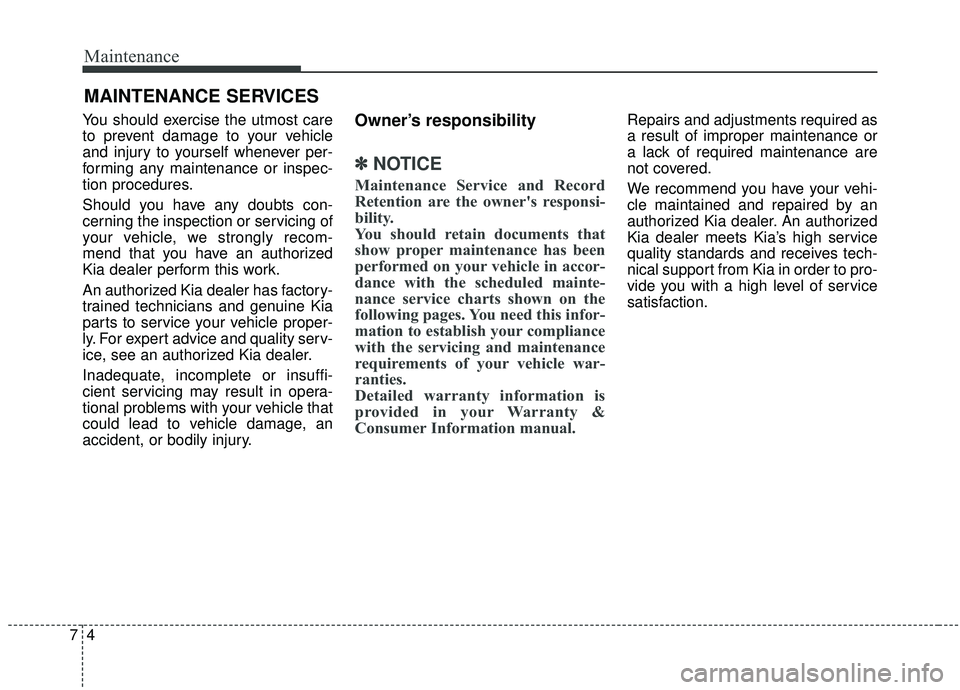
MAINTENANCE SERVICES
You should exercise the utmost care
to prevent damage to your vehicle
and injury to yourself whenever per-
forming any maintenance or inspec-
tion procedures.
Should you have any doubts con-
cerning the inspection or servicing of
your vehicle, we strongly recom-
mend that you have an authorized
Kia dealer perform this work.
An authorized Kia dealer has factory-
trained technicians and genuine Kia
parts to service your vehicle proper-
ly. For expert advice and quality serv-
ice, see an authorized Kia dealer.
Inadequate, incomplete or insuffi-
cient servicing may result in opera-
tional problems with your vehicle that
could lead to vehicle damage, an
accident, or bodily injury.Owner’s responsibility
✽ ✽NOTICE
Maintenance Service and Record
Retention are the owner's responsi-
bility.
You should retain documents that
show proper maintenance has been
performed on your vehicle in accor-
dance with the scheduled mainte-
nance service charts shown on the
following pages. You need this infor-
mation to establish your compliance
with the servicing and maintenance
requirements of your vehicle war-
ranties.
Detailed warranty information is
provided in your Warranty &
Consumer Information manual.
Repairs and adjustments required as
a result of improper maintenance or
a lack of required maintenance are
not covered.
We recommend you have your vehi-
cle maintained and repaired by an
authorized Kia dealer. An authorized
Kia dealer meets Kia’s high service
quality standards and receives tech-
nical support from Kia in order to pro-
vide you with a high level of service
satisfaction.
Page 493 of 611
Maintenance
10
7
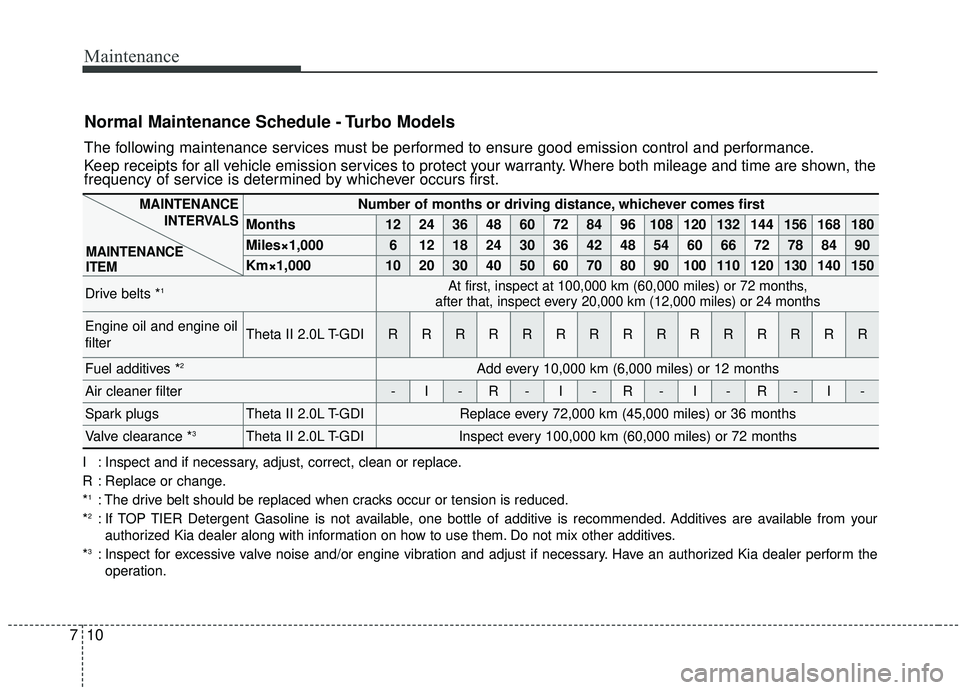
Normal Maintenance Schedule - Turbo Models
The following maintenance services must be performed to ensure good emission control and performance.
Keep receipts for all vehicle emission services to protect your warranty. Where both mileage and time are shown, the
frequency of service is determined by whichever occurs first.
Number of months or driving distance, whichever comes first
Months1224364860728496108120132144156168180
Miles×1,00061218243036424854606672788490
Km×1,000102030405060708090100110120130140150
Drive belts *1At first, inspect at 100,000 km (60,000 miles) or 72 months,
after that, inspect every 20,000 km (12,000 miles) or 24 months
Engine oil and engine oil
filterTheta II 2.0L T-GDIRRRRRRRRRRRRRRR
Fuel additives *2Add every 10,000 km (6,000 miles) or 12 months
Air cleaner filter-I-R-I-R-I-R-I-
Spark plugsTheta II 2.0L T-GDIReplace every 72,000 km (45,000 miles) or 36 months
Valve clearance *3Theta II 2.0L T-GDIInspect every 100,000 km (60,000 miles) or 72 months
I : Inspect and if necessary, adjust, correct, clean or replace.
R : Replace or change.
*
1: The drive belt should be replaced when cracks occur or tension is reduced.
*2: If TOP TIER Detergent Gasoline is not available, one bottle of additive is recommended. Additives are available from your authorized Kia dealer along with information on how to use them. Do not mix other additives.
*
3: Inspect for excessive valve noise and/or engine vibration and adjust if necessary. Have an authorized Kia dealer perform the operation.
MAINTENANCE INTERVALS
MAINTENANCE
ITEM
Page 494 of 611
711
Maintenance
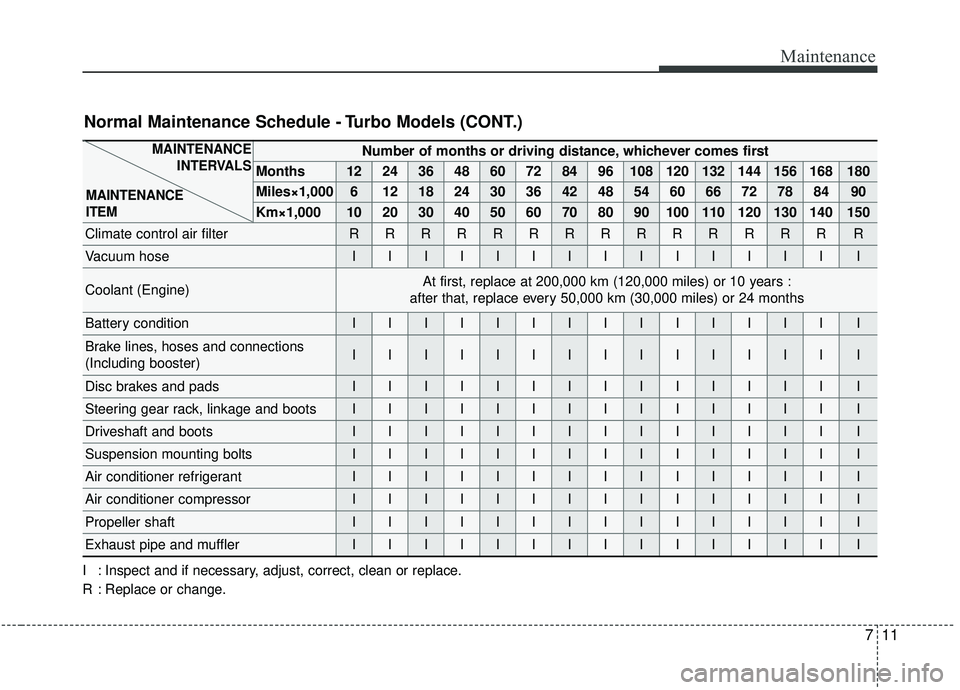
Number of months or driving distance, whichever comes first
Months1224364860728496108120132144156168180
Miles×1,00061218243036424854606672788490
Km×1,000102030405060708090100110120130140150
Climate control air filterRRRRRRRRRRRRRRR
Vacuum hoseIIIIIIIIIIIIIII
Coolant (Engine)At first, replace at 200,000 km (120,000 miles) or 10 years :
after that, replace every 50,000 km (30,000 miles) or 24 months
Battery conditionIIIIIIIIIIIIIII
Brake lines, hoses and connections
(Including booster)IIIIIIIIIIIIIII
Disc brakes and padsIIIIIIIIIIIIIII
Steering gear rack, linkage and bootsIIIIIIIIIIIIIII
Driveshaft and bootsIIIIIIIIIIIIIII
Suspension mounting boltsIIIIIIIIIIIIIII
Air conditioner refrigerantIIIIIIIIIIIIIII
Air conditioner compressorIIIIIIIIIIIIIII
Propeller shaftIIIIIIIIIIIIIII
Exhaust pipe and mufflerIIIIIIIIIIIIIII
Normal Maintenance Schedule - Turbo Models (CONT.)
I : Inspect and if necessary, adjust, correct, clean or replace.
R : Replace or change.
MAINTENANCE INTERVALS
MAINTENANCE
ITEM
Page 495 of 611
Maintenance
12
7
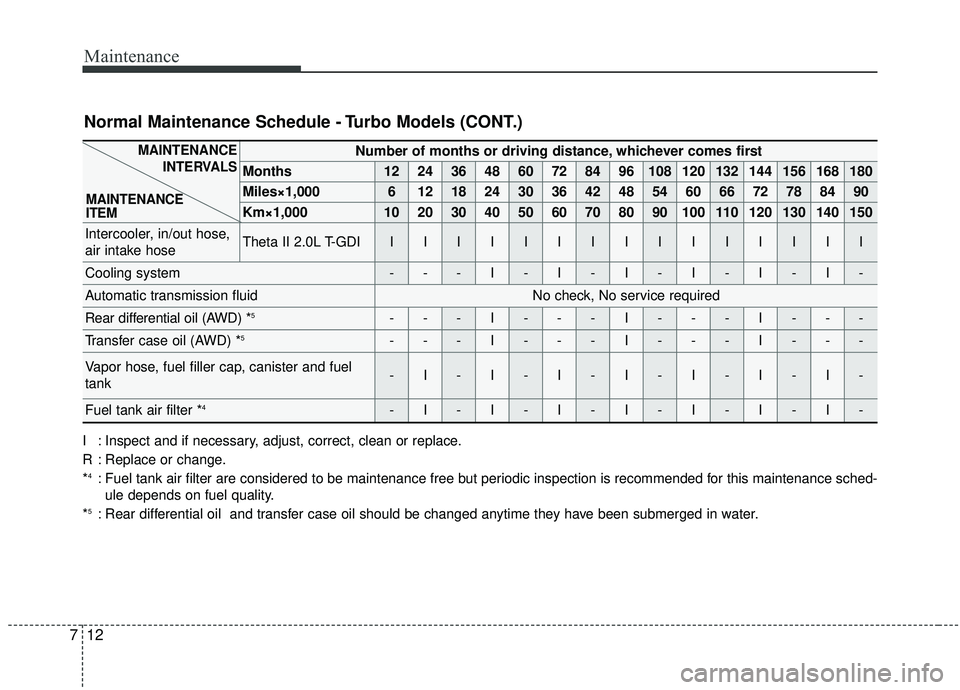
Number of months or driving distance, whichever comes first
Months1224364860728496108120132144156168180
Miles×1,00061218243036424854606672788490
Km×1,000102030405060708090100110120130140150
Intercooler, in/out hose,
air intake hoseTheta II 2.0L T-GDIIIIIIIIIIIIIIII
Cooling system---I-I-I-I-I-I-
Automatic transmission fluidNo check, No service required
Rear differential oil (AWD) *5---I---I---I---
Transfer case oil (AWD) *5---I---I---I---
Vapor hose, fuel filler cap, canister and fuel
tank-I-I-I-I-I-I-I-
Fuel tank air filter *4-I-I-I-I-I-I-I-
Normal Maintenance Schedule - Turbo Models (CONT.)
I : Inspect and if necessary, adjust, correct, clean or replace.
R : Replace or change.
*
4: Fuel tank air filter are considered to be maintenance free but periodic inspection is recommended for this maintenance sched-
ule depends on fuel quality.
*
5: Rear differential oil and transfer case oil should be changed anytime they have been submerged in water.
MAINTENANCE INTERVALS
MAINTENANCE
ITEM
Page 496 of 611
713
Maintenance
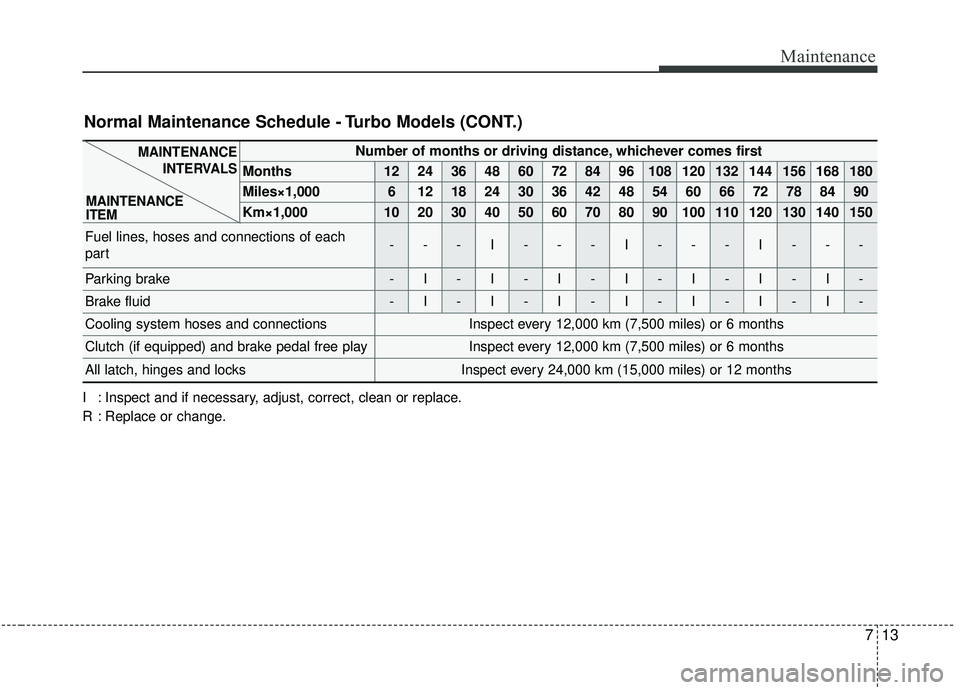
Number of months or driving distance, whichever comes first
Months1224364860728496108120132144156168180
Miles×1,00061218243036424854606672788490
Km×1,000102030405060708090100110120130140150
Fuel lines, hoses and connections of each
part---I---I---I---
Parking brake-I-I-I-I-I-I-I-
Brake fluid-I-I-I-I-I-I-I-
Cooling system hoses and connectionsInspect every 12,000 km (7,500 miles) or 6 months
Clutch (if equipped) and brake pedal free playInspect every 12,000 km (7,500 miles) or 6 months
All latch, hinges and locksInspect every 24,000 km (15,000 miles) or 12 months
Normal Maintenance Schedule - Turbo Models (CONT.)
I : Inspect and if necessary, adjust, correct, clean or replace.
R : Replace or change.
MAINTENANCEINTERVALS
MAINTENANCE
ITEM