2020 KIA SPORTAGE fuel
[x] Cancel search: fuelPage 586 of 611
7103
Maintenance
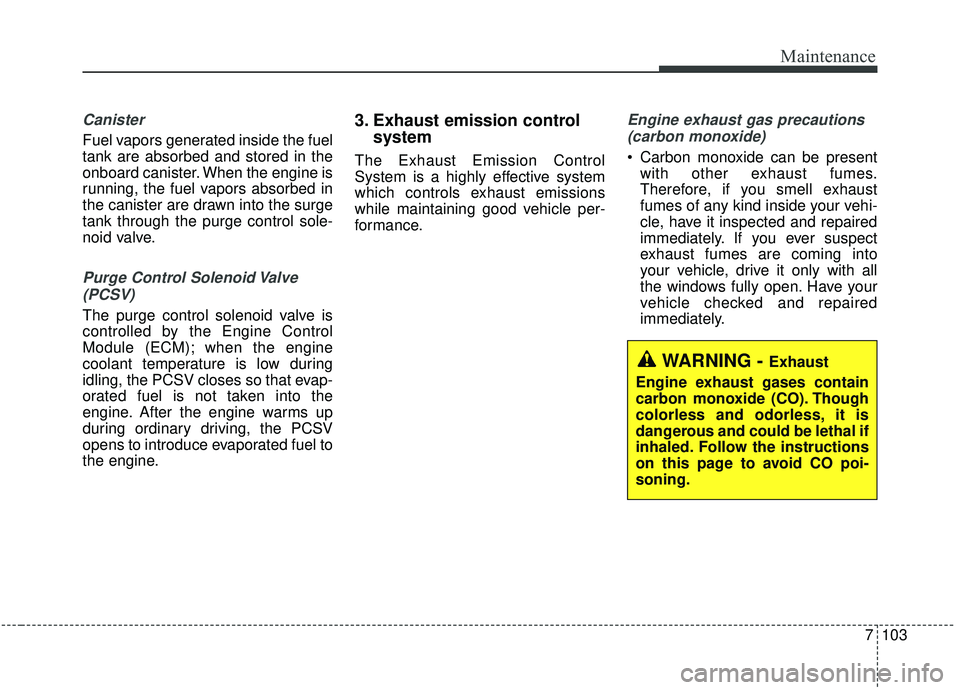
Canister
Fuel vapors generated inside the fuel
tank are absorbed and stored in the
onboard canister. When the engine is
running, the fuel vapors absorbed in
the canister are drawn into the surge
tank through the purge control sole-
noid valve.
Purge Control Solenoid Valve(PCSV)
The purge control solenoid valve is
controlled by the Engine Control
Module (ECM); when the engine
coolant temperature is low during
idling, the PCSV closes so that evap-
orated fuel is not taken into the
engine. After the engine warms up
during ordinary driving, the PCSV
opens to introduce evaporated fuel to
the engine.
3. Exhaust emission control system
The Exhaust Emission Control
System is a highly effective system
which controls exhaust emissions
while maintaining good vehicle per-
formance.
Engine exhaust gas precautions
(carbon monoxide)
Carbon monoxide can be present with other exhaust fumes.
Therefore, if you smell exhaust
fumes of any kind inside your vehi-
cle, have it inspected and repaired
immediately. If you ever suspect
exhaust fumes are coming into
your vehicle, drive it only with all
the windows fully open. Have your
vehicle checked and repaired
immediately.
WARNING - Exhaust
Engine exhaust gases contain
carbon monoxide (CO). Though
colorless and odorless, it is
dangerous and could be lethal if
inhaled. Follow the instructions
on this page to avoid CO poi-
soning.
Page 588 of 611
7105
Maintenance
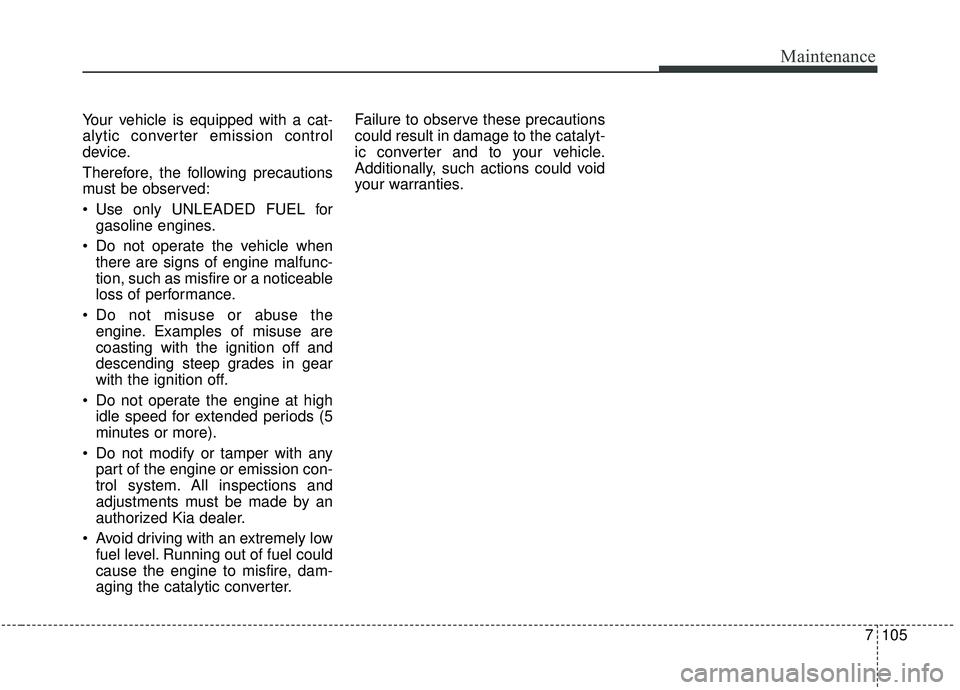
Your vehicle is equipped with a cat-
alytic converter emission control
device.
Therefore, the following precautions
must be observed:
Use only UNLEADED FUEL forgasoline engines.
Do not operate the vehicle when there are signs of engine malfunc-
tion, such as misfire or a noticeable
loss of performance.
Do not misuse or abuse the engine. Examples of misuse are
coasting with the ignition off and
descending steep grades in gear
with the ignition off.
Do not operate the engine at high idle speed for extended periods (5
minutes or more).
Do not modify or tamper with any part of the engine or emission con-
trol system. All inspections and
adjustments must be made by an
authorized Kia dealer.
Avoid driving with an extremely low fuel level. Running out of fuel could
cause the engine to misfire, dam-
aging the catalytic converter. Failure to observe these precautions
could result in damage to the catalyt-
ic converter and to your vehicle.
Additionally, such actions could void
your warranties.
Page 596 of 611
88
Specification & Consumer information
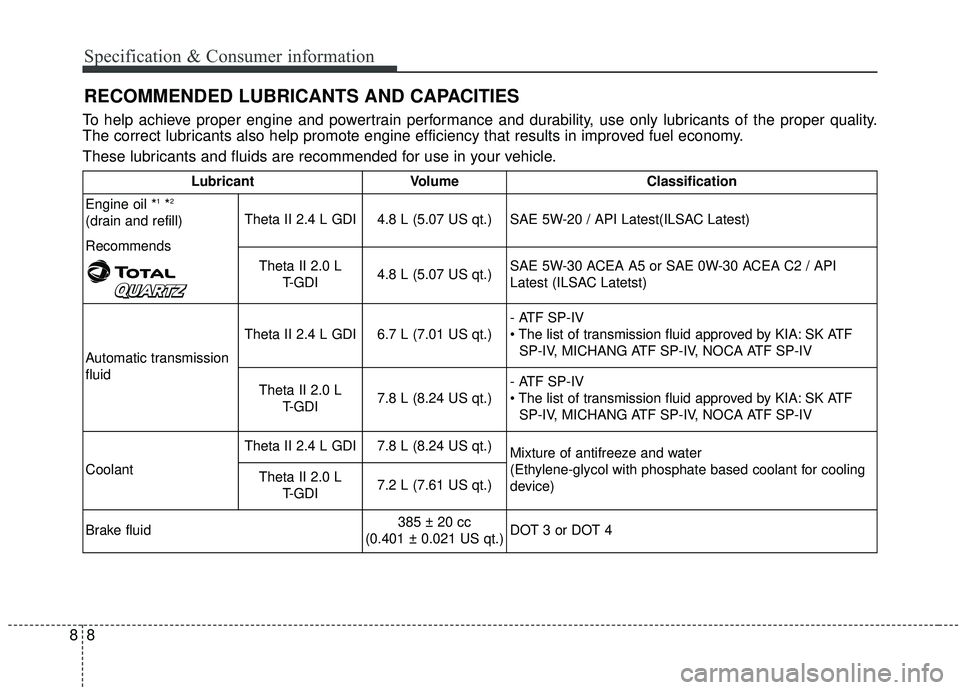
RECOMMENDED LUBRICANTS AND CAPACITIES
To help achieve proper engine and powertrain performance and durability, use only lubricants of the proper quality.
The correct lubricants also help promote engine efficiency that results in improved fuel economy.
These lubricants and fluids are recommended for use in your vehicle.
LubricantVolumeClassification
Engine oil *
1*2
(drain and refill)
Recommends Theta II 2.4 L GDI4.8 L (5.07 US qt.) SAE 5W-20 / API Latest(ILSAC Latest)
Theta II 2.0 L T-GDI
4.8 L (5.07 US qt.) SAE 5W-30 ACEA A5 or SAE 0W-30 ACEA C2 / API
Latest (ILSAC Latetst)
Automatic transmission
fluid Theta II 2.4 L GDI
6.7 L (7.01 US qt.)
- ATF SP-IV
• The list of transmission fluid approved by KIA: SK ATF
SP-IV, MICHANG ATF SP-IV, NOCA ATF SP-IV
Theta II 2.0 L T-GDI
7.8 L (8.24 US qt.) - ATF SP-IV
SK ATF
SP-IV, MICHANG ATF SP-IV, NOCA ATF SP-IV
Coolant Theta II 2.4 L GDI
7.8 L (8.24 US qt.)
Mixture of antifreeze and water
(Ethylene-glycol with phosphate based coolant for cooling
device)
Theta II 2.0 L
T-GDI
7.2 L (7.61 US qt.)
Brake fluid
385 ± 20 cc
(0.401 ± 0.021 US qt.) DOT 3 or DOT 4
Page 597 of 611
89
Specification & Consumer information
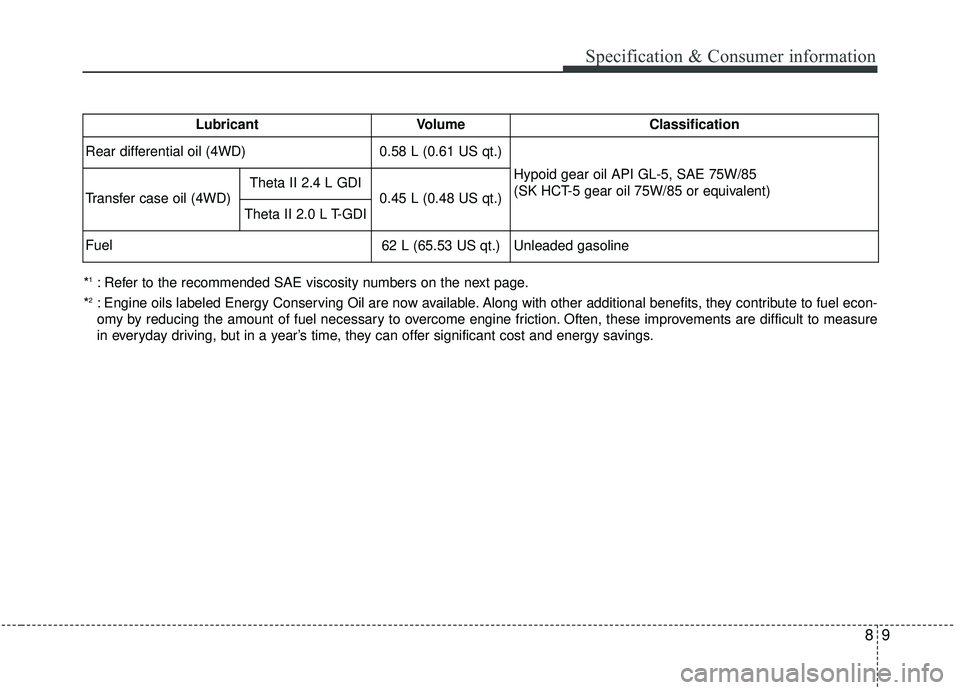
*1: Refer to the recommended SAE viscosity numbers on the next page.
*
2: Engine oils labeled Energy Conserving Oil are now available. Along with other additional benefits, they contribute to fuel econ-
omy by reducing the amount of fuel necessary to overcome engine friction. Often, these improvements are difficult to measure
in everyday driving, but in a year’s time, they can offer significant cost and energy savings. Lubricant
Volume
Classification
Rear differential oil (4WD)
0.58 L (0.61 US qt.) Hypoid gear oil API GL-5, SAE 75W/85
(SK HCT-5 gear oil 75W/85 or equivalent)
Transfer case oil (4WD) Theta II 2.4 L GDI
0.45 L (0.48 US qt.)
Theta II 2.0 L T-GDI
Fuel
62 L (65.53 US qt.) Unleaded gasoline
Page 598 of 611
10
8
Specification & Consumer information
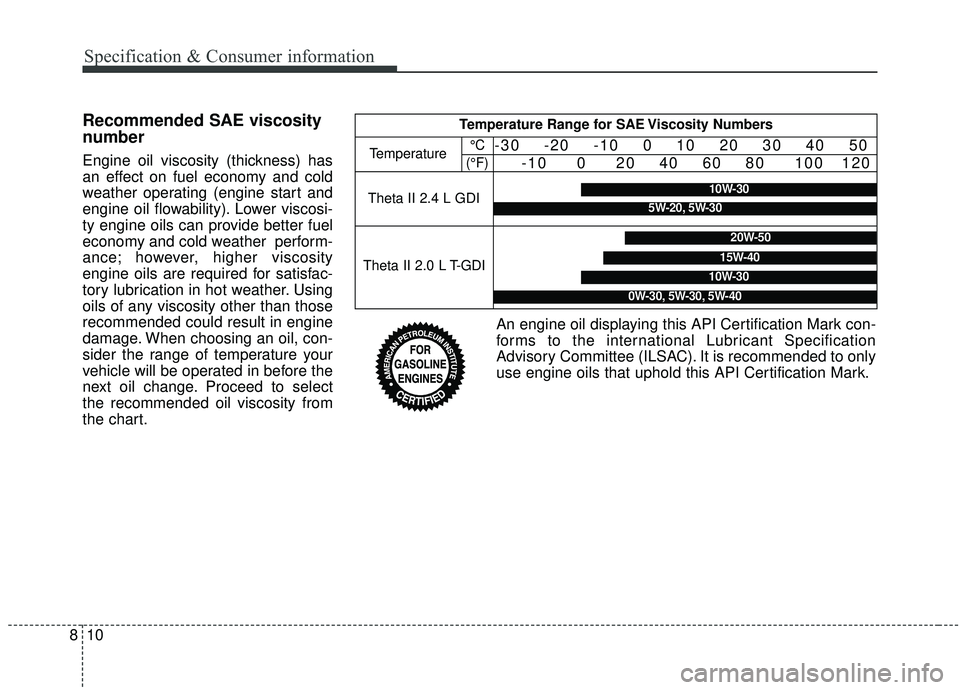
Recommended SAE viscosity
number
Engine oil viscosity (thickness) has
an effect on fuel economy and cold
weather operating (engine start and
engine oil flowability). Lower viscosi-
ty engine oils can provide better fuel
economy and cold weather perform-
ance; however, higher viscosity
engine oils are required for satisfac-
tory lubrication in hot weather. Using
oils of any viscosity other than those
recommended could result in engine
damage. When choosing an oil, con-
sider the range of temperature your
vehicle will be operated in before the
next oil change. Proceed to select
the recommended oil viscosity from
the chart.
Temperature Range for SAE Viscosity Numbers
Temperature°C
(°F)-30 -20 -10 0 10 20 30 40 50 -10 0 20 40 60 80 100 120
Theta II 2.0 L T-GDI
20W-50
10W-30
15W-40
0W-30, 5W-30, 5W-40
Theta II 2.4 L GDI10W-30
5W-20, 5W-30
An engine oil displaying this API Certification Mark con-
forms to the international Lubricant Specification
Advisory Committee (ILSAC). It is recommended to only
use engine oils that uphold this API Certification Mark.
Page 604 of 611
Index
4I
System setting and activation ..................................5-136
System standby ........................................................5-138
Economical operation ..................................................5-141 Driving at night ........................................................5-146
Driving in flooded areas ..........................................5-147
Driving in the rain ....................................................5-146
Driving off-road ........................................................5-147
Hazardous driving conditions ..................................5-143
Highway driving ......................................................5-147
Reducing the risk of a rollover ................................5-143
Rocking the vehicle ..................................................5-145
Smooth cornering ......................................................5-145
Special driving conditions ........................................5-143
Emergency starting ..........................................................6-5 Jump starting ................................................................6-5
Push-starting ................................................................6-6
Emission control system ..............................................7-102 Crankcase emission control system ..........................7-102
Evaporative emission control (including ORVR: Onboard Refueling Vapor Recovery) system ........7-102
Exhaust emission control system ..............................7-103
Engine ........................................................................\
......8-2
Engine compartment ................................................2-6, 7-3 Engine coolant ..............................................................7-29
Changing the coolant ..................................................7-32
Checking the coolant level..........................................7-29
Engine number ..............................................................8-12
Engine oil ......................................................................7-\
27 Changing the engine oil and filter ..............................7-28
Checking the engine oil level ....................................7-27
Engine start/stop button ................................................5-11 Engine start/stop button position ................................5-11
Illuminated engine start/stop button ..........................5-11
Starting the engine with a smart key ..........................5-13
Explanation of scheduled maintenance items ..............7-21
Exterior features ..........................................................4-186 Roof rack ..................................................................4-186
Exterior overview ....................................................2-2, 2-3
Folding key ......................................................................4-\
5 Battery replacement ......................................................4-8
Immobilizer system ......................................................4-9
Key operations ..............................................................4-5
Record your key number ..............................................4-5
Transmitter precautions ................................................4-7
Forward Collision-avoidance Assist (FCA) system camera type..................................................................5-54Brake operation ..........................................................5-58
FCA sensor (Front view camera)................................5-58
E
F
Page 605 of 611
I5
Index
FCA warning message and system control ................5-56
Limitation of the system ............................................5-61
System malfunction ....................................................5-60
System setting and activation ....................................5-54
Forward Collision-avoidance Assist (FCA) system sensor fusion type (front radar+front view camera) ..............5-67Brake operation ..........................................................5-71
Downhill Brake Control (DBC)..................................5-81
FCA sensor (front radar + front view Ccamera) ........5-71
FCA warning message and system control ................5-69
Good braking practices ..............................................5-83
Limitation of the system ............................................5-75
System malfunction ....................................................5-74
System setting and activation ....................................5-67
Fuel filler lid ..................................................................4-48 Closing the fuel filler lid ............................................4-49
Opening the fuel filler lid ..........................................4-48
Fuel requirements ............................................................1-2 Do not use methanol ....................................................1-4
Fuel Additives ..............................................................1-5
Gasoline containing alcohol and methanol ..................1-3
Operation in foreign countries ......................................1-5
Fuses ........................................................................\
......7-61 Engine compartment fuse replacement ......................7-65
Fuse/relay panel description ......................................7-67
Inner panel fuse replacement ......................................7-63 Gross vehicle weight........................................................8-7\
Hood ........................................................................\
......4-46
Closing the hood ........................................................4-47
Opening the hood ........................................................4-46
How to use this manual ..................................................1-2
If the engine overheats ....................................................6-7
If the engine will not start ..............................................6-4 If engine doesn't turn over or turns over slowly ..........6-4
If engine turns over normally but does not start ..........6-4
If you have a flat tire (with spare tire) ..........................6-15 Changing tires ............................................................6-17
Jack and tools ..............................................................6-15
Removing and storing the spare tire ..........................6-16
If you have a flat tire (with Tire Mobility Kit)..............6-24 Checking the tire inflation pressure ............................6-31
Components of the Tire Mobility Kit (TMK) ............6-27
Distributing the sealant ..............................................6-31
Introduction ................................................................6-25
Notes on the safe use of the Tire Mobility Kit ..........6-25
H
G
I
Page 610 of 611
Index
10I
Tire maintenance ........................................................7-51
Tire pressure................................................................7-47
Tire replacement ........................................................7-50
Tire rotation ..............................................................7-48
Tire sidewall labeling ..................................................7-51
Tire traction ................................................................7-51
Wheel alignment and tire balance ..............................7-49
Wheel replacement ....................................................7-51
Towing ........................................................................\
..6-33 Emergency towing ......................................................6-35
Removable towing hook ............................................6-34
Towing service ............................................................6-33
Trailer Towing..............................................................5-152 Driving with a trailer ................................................5-154
Hitches ......................................................................5-\
153
If you do decide to pull a trailer ..............................5-158
Maintenance when trailer towing ............................5-157
Safety chains ............................................................5-153
Trailer brakes ............................................................5-153
Trip modes (Trip computer) ..........................................4-94 Fuel economy ..............................................................4-94
Trip modes ..................................................................4-94
Warning messages ......................................................4-97
Vehicle break-in process ..................................................1-6
Vehicle certification label ..............................................8-11 Vehicle data collection and event data recorders ............1-7
Vehicle handling instructions ..........................................1-5
Vehicle Identification Number (VIN) ............................8-11
Vehicle load limit ........................................................5-160
Certification label......................................................5-164
Tire and loading information label ..........................5-160
Vehicle modifications ......................................................1-5
Vehicle weight ............................................................5-165
Warning and indicator lights........................................4-104 Indicator lights ..........................................................4-112
Warning lights ..........................................................4-104
Washer fluid ..................................................................7-34 Checking the washer fluid level..................................7-34
Welcome system ..........................................................4-142 Headlight (Headlamp) escort function......................4-142
Interior light ..............................................................4-142
Pocket lamp ..............................................................4-142
Windows ........................................................................\
4-41 Power windows ..........................................................4-42
Windshield defrosting and defogging..........................4-166 Automatic climate control system ............................4-167
Defogging logic ........................................................4-168
Manual climate control system ................................4-166
Winter driving ..............................................................5-149 Carry emergency equipment ....................................5-151
V
W