Page 472 of 589

Maintenance
67
OWNER MAINTENANCE
The following lists are vehicle checks
and inspections that should be per-
formed by the owner or an author-
ized Kia dealer at the frequencies
indicated to help ensure safe,
dependable operation of your vehi-
cle.
Any adverse conditions should be
brought to the attention of your deal-
er as soon as possible.
These Owner Maintenance Checks
are generally not covered by war-
ranties and you may be charged for
labor, parts and lubricants used.Owner maintenance schedule
When you stop for fuel:
Check the engine oil level.
Check the coolant level in coolantreservoir.
Check the windshield washer fluid level.
Look for low or under-inflated tires.
While operating your vehicle:
Note any changes in the sound of the exhaust or any smell of
exhaust fumes in the vehicle.
Check for vibrations in the steering wheel. Notice any increased steer-
ing effort or looseness in the steer-
ing wheel, or change in its straight-
ahead position.
Notice if your vehicle constantly turns slightly or “pulls” to one side
when traveling on smooth, level
roads.
When stopping, listen and check for unusual sounds, pulling to one
side, increased brake pedal travel
or “hard-to-push” brake pedal.
If any slipping or changes in the operation of your transmission
occurs, check the transmission
fluid level.
Check the automatic transmission P (Park) function.
Check the parking brake.
Check for fluid leaks under your vehicle (water dripping from the air
conditioning system during or after
use is normal).
WARNING- Hot coolant
Be careful when checking your
engine coolant level when the
engine is hot. Scalding hot
coolant and steam may blow
out under pressure.
WARNING
When you open the engine
hood, turn the Hybrid system
off. If not, it may result in death
or serious injury because of the
high voltage flow.
Page 478 of 589

Maintenance
12
7
Maintenance Under Severe Usage Conditions - Non Turbo Model
The following items must be serviced more frequently on cars normally used under severe driving conditions. Refer
to the chart below for the appropriate maintenance intervals.
R : Replace I : Inspect and, after inspection, clean, adjust, repair or replace if neces\
sary
MAINTENANCE ITEMMAINTENANCE
OPERATIONMAINTENANCE INTERVALSDRIVING
CONDITION
Engine oil and engine oil filterNu 2.0L GDIREvery 6,000 km (3,750 miles) or 6 monthsA, B, C, D, E,
F, G, H, I, J, K
Air cleaner filterRMore frequentlyC, E
Spark plugs RMore frequentlyA, B, F, G, H, I, K
Automatic transmission fluidREvery 96,000 km (60,000 miles)A, C, D, E,
F, G, H, I, J
HSG (Hybrid Starter & Generator) belt
REvery 48,000 km (30,000 miles) or 24 monthsC, D, E, K
IEvery 6,000 km (3,750 miles) or 6 monthsC, D, E, K
Brake discs and pads, calipers and rotorsIMore frequentlyC, D, E, G, H
Parking brake (Foot Type)IMore frequentlyC, D, G, H
Steering gear rack, linkage and bootsIMore frequentlyC, D, E, F, G
Suspension ball jointsIMore frequentlyC, D, E, F, G
Page 480 of 589

Maintenance
14
7
EXPLANATION OF SCHEDULED MAINTENANCE ITEMS
Engine oil and filter
The engine oil and filter should be
changed at the intervals specified in
the maintenance schedule. If the
vehicle is being driven in severe con-
ditions, more frequent oil and filter
changes are required.
HSG (Hybrid starter & genera-
tor) belt
The HSG belt should be changed at
the intervals specified in the mainte-
nance schedule.
Fuel filter (for gasoline)
Kia gasoline vehicles are equipped a
lifetime fuel filter that is integrated
with the fuel tank. Regular mainte-
nance or replacement is generally
not needed but depends on fuel
quality. If there are some important
fuel related problems like fuel flow
restriction, surging, loss of power,
hard starting problem etc, fuel filter
inspection or replace is needed.
The fuel filter should be inspected or
replaced by an authorized Kia dealer.
Fuel lines, fuel hoses and con-
nections
Check the fuel lines, fuel hoses and
connections for leakage and dam-
age. Have an authorized Kia dealer
replace any damaged or leaking
parts immediately.
Vapor hose and fuel filler cap
The vapor hose and fuel filler cap
should be inspected at those inter-
vals specified in the maintenance
schedule. Make sure that a new
vapor hose or fuel filler cap is cor-
rectly replaced.
Page 486 of 589
Maintenance
20
7
ENGINE MAINTENANCE MODE (FOR PLUG-IN HYBRID)
Starting Engine Maintenance
Mode
To prevent damage of the engine
lubrication system when the engine
has not been started for a long time:
- When the engine is started after 5
weeks of being turned off, the
engine maintenance mode will
operate.
- When the engine maintenance mode is operated, HEV mode will
be kept on after the engine is ON
and the above message will be dis-
played on the cluster. If you press the HEV switch to shift
EV mode during engine mainte-
nance mode, the above message will
appear due to priority of the engine
maintenance mode.
Stopping Engine Maintenance
Mode
The engine will automatically stop
after sufficient heating. If the engine
is turned OFF without sufficient heat-
ing, the engine maintenance mode
will be operated once more.
OJFHP078230LOJFHP078229L
Page 487 of 589
721
Maintenance
COOLANT
The high-pressure cooling system
has a reservoir filled with year round
antifreeze coolant. The reservoir is
filled at the factory.
Check the antifreeze protection and
coolant level at least once a year: at
the beginning of the winter season,
and before traveling to a colder cli-
mate.Checking the coolant level Turn the engine off and wait until itcools down. Use extreme care
when removing the radiator cap.
Wrap a thick towel around it, and
turn it counterclockwise slowly to
the first stop. Step back while the
pressure is released from the cool-
ing system.
When you are sure all the pressure
has been released, press down on
the cap, using a thick towel, and
continue turning counterclockwise
to remove it.
Even if the engine is not operating, do not remove the radiator cap or
the drain plug while the engine and
radiator are hot. Hot coolant and
steam may still blow out under
pressure, causing serious injury.
The engine coolant and/or inverter
coolant level is influenced by the
hybrid system temperature. Before
checking or refilling the engine
coolant and/or inverter coolant,
turn the hybrid vehicle off.
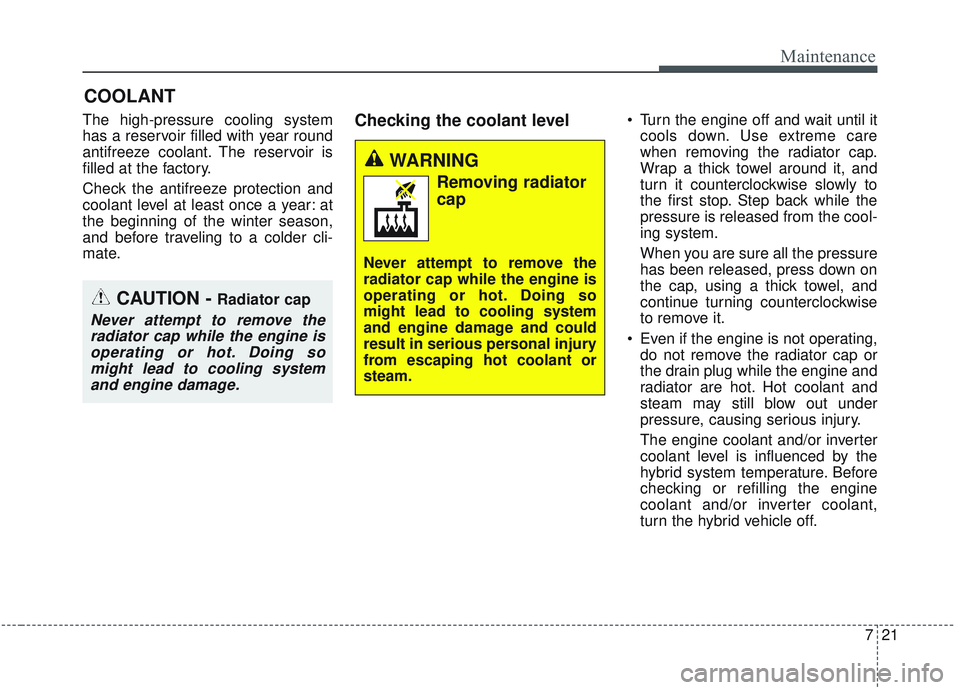
WARNING
Removing radiator
cap
Never attempt to remove the
radiator cap while the engine is
operating or hot. Doing so
might lead to cooling system
and engine damage and could
result in serious personal injury
from escaping hot coolant or
steam.
CAUTION - Radiator cap
Never attempt to remove theradiator cap while the engine isoperating or hot. Doing somight lead to cooling systemand engine damage.
Page 530 of 589
Maintenance
64
7
Engine compartment fuse panel
(For Hybrid)
OJFH076170N
OJFH075029
Page 531 of 589
765
Maintenance
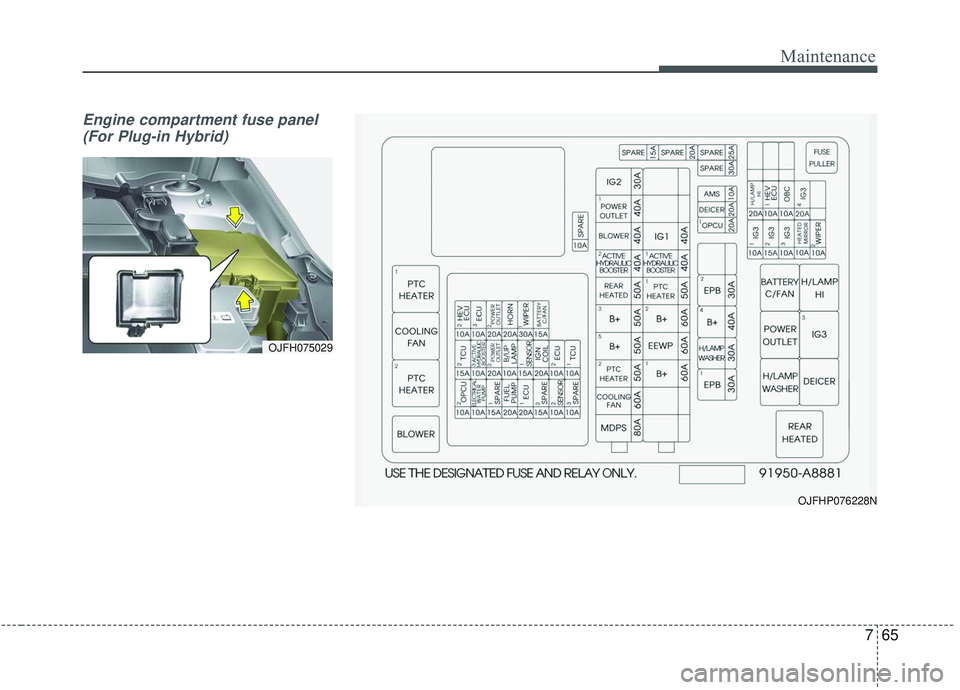
Engine compartment fuse panel(For Plug-in Hybrid)
OJFHP076228N
OJFH075029
Page 570 of 589
28
DIMENSIONS Specification & Consumer information
ENGINE
ItemUnit : mm (in)
Overall length4,855 (191.1)
Overall width1,860 (73.2)
Overall height1,460 (57.7)
Tread
Front205/65 R16 *1,614 (63.5)
215/55 R171,602 (63)
Rear205/65 R16 *1,621 (63.8)
215/55 R171,609 (63.3)
Wheelbase2,805 (110.4)
Item
Gasoline
2.0L GDI HEV
Displacement [cc (cu. in)]
1,999 (121.99)
Bore x Stroke [mm (in.)]
81.0 X 97.0 (3.19 X 3.81)
Firing order
1-3-4-2
No. of cylinders
4. In-line
* : Only for Hybrid vehicle. Not for Plug-in hybrid vehicle