Page 37 of 568
321
Safety features of your vehicle
If the passenger seat belt is unfas-
tened during driving, the warning
light will illuminate if the speed is
under 20 km/h (12 mph). When the
speed is 20 km/h (12 mph) and
faster, the warning light will blink and
the warning chime will sound for
approximately 100 seconds.
✽ ✽NOTICE
• Even if the front passenger seat is
not occupied, the seat belt warning
light will illuminate for 6 seconds.
• The front passenger's seat belt warning may operate when lug-
gage is placed on the front passen-
ger seat.
Seat belt - Driver's 3-point system
with emergency locking retractor
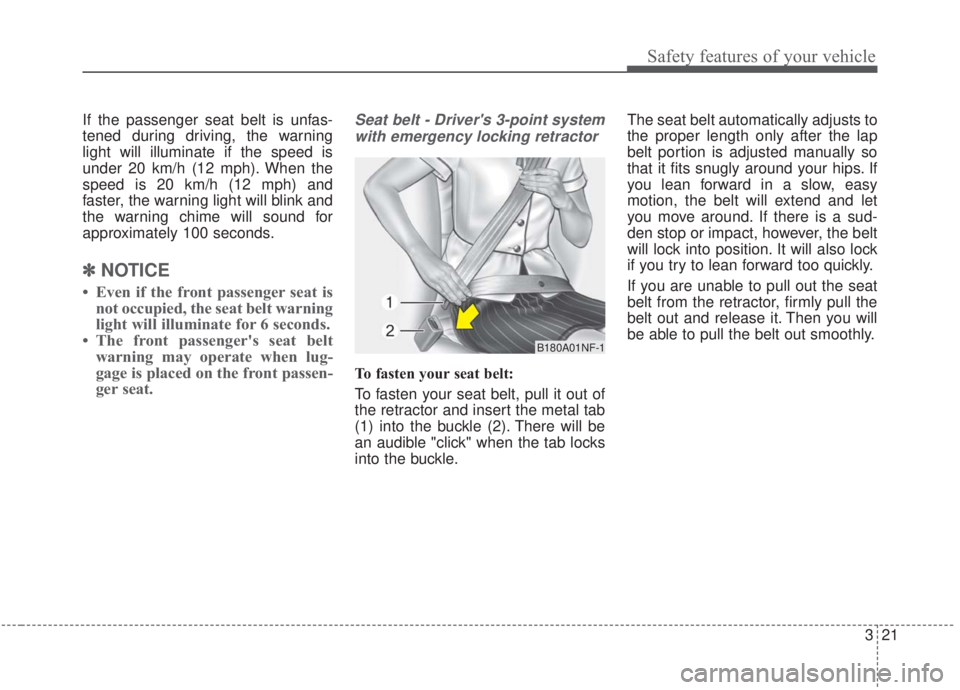
To fasten your seat belt:
To fasten your seat belt, pull it out of
the retractor and insert the metal tab
(1) into the buckle (2). There will be
an audible "click" when the tab locks
into the buckle. The seat belt automatically adjusts to
the proper length only after the lap
belt portion is adjusted manually so
that it fits snugly around your hips. If
you lean forward in a slow, easy
motion, the belt will extend and let
you move around. If there is a sud-
den stop or impact, however, the belt
will lock into position. It will also lock
if you try to lean forward too quickly.
If you are unable to pull out the seat
belt from the retractor, firmly pull the
belt out and release it. Then you will
be able to pull the belt out smoothly.
B180A01NF-1
Page 38 of 568
Safety features of your vehicle
22
3
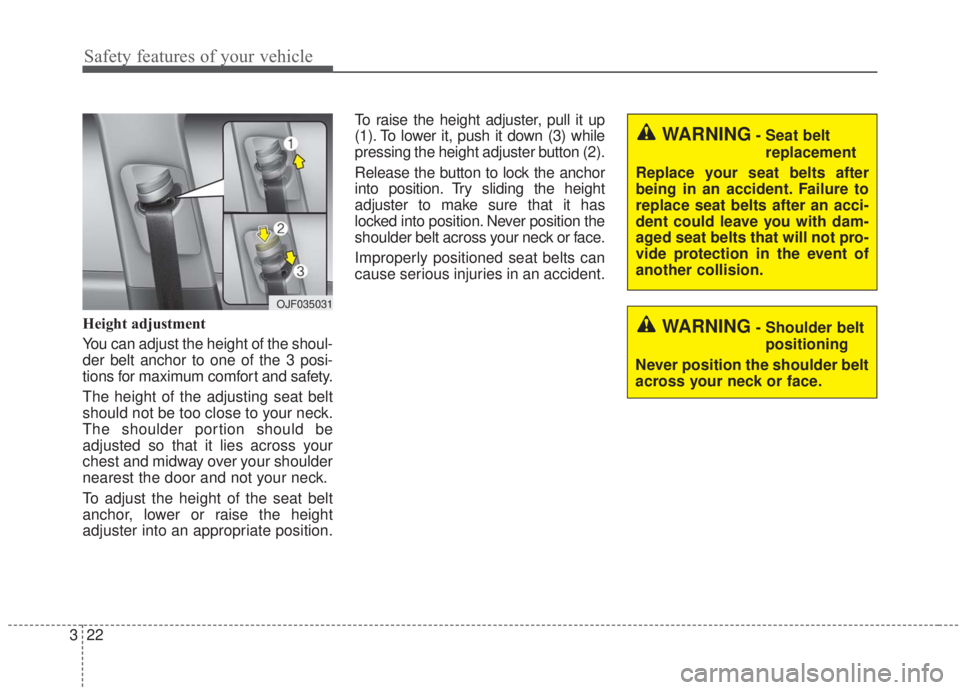
Height adjustment
You can adjust the height of the shoul-
der belt anchor to one of the 3 posi-
tions for maximum comfort and safety.
The height of the adjusting seat belt
should not be too close to your neck.
The shoulder portion should be
adjusted so that it lies across your
chest and midway over your shoulder
nearest the door and not your neck.
To adjust the height of the seat belt
anchor, lower or raise the height
adjuster into an appropriate position. To raise the height adjuster, pull it up
(1). To lower it, push it down (3) while
pressing the height adjuster button (2).
Release the button to lock the anchor
into position. Try sliding the height
adjuster to make sure that it has
locked into position. Never position the
shoulder belt across your neck or face.
Improperly positioned seat belts can
cause serious injuries in an accident.
WARNING- Seat belt
replacement
Replace your seat belts after
being in an accident. Failure to
replace seat belts after an acci-
dent could leave you with dam-
aged seat belts that will not pro-
vide protection in the event of
another collision.
WARNING- Shoulder belt positioning
Never position the shoulder belt
across your neck or face.
OJF035031
Page 39 of 568

323
Safety features of your vehicle
Seat belts - Front passenger andrear seat 3-point system withcombination locking retractor
To fasten your seat belt
Combination retractor type seat belts
are installed in the rear seat posi-
tions to help accommodate the
installation of child restraint systems.
Although a combination retractor is
also installed in the front passenger
seat position, it is strongly recom-
mended that children always be
seated in the rear seat. NEVER
place an infant restraint system in
the front seat of the vehicle.
This type of seat belt combines the
features of both an emergency lock-
ing retractor seat belt and an auto-
matic locking retractor seat belt. To
fasten your seat belt, pull it out of the
retractor and insert the metal tab into
the buckle. There will be an audible
"click" when the tab locks into the
buckle. When not securing a child
restraint, the seat belt operates in the
same way as the driver's seat belt
(Emergency Locking Retractor Type). It automatically adjusts to the proper
length only after the lap belt portion
of the seat belt is adjusted manually
so that it fits snugly around your hips.
When the seat belt is fully extended
from the retractor to allow the instal-
lation of a child restraint system, the
seat belt operation changes to allow
the belt to retract, but not to extend
(Automatic Locking Retractor Type).
Refer to “Using a child restraint sys-
tem” in this section.
To convert from the automatic lock-
ing feature to the emergency locking
operation mode, allow the unbuckled
seat belt to fully retract.
B200A01NF
WARNING
You should place the lap belt
portion as low as possible and
snugly across your hips. If the
lap belt is located too high on
your waist, it may increase the
chance of injury in the event of
a collision.
The arm closest to the seat belt
buckle should be over the belt
while the other arm should be
under the belt as shown in the
illustration. Never wear the seat
belt under the arm closest to
the door.
Page 40 of 568
Safety features of your vehicle
24
3
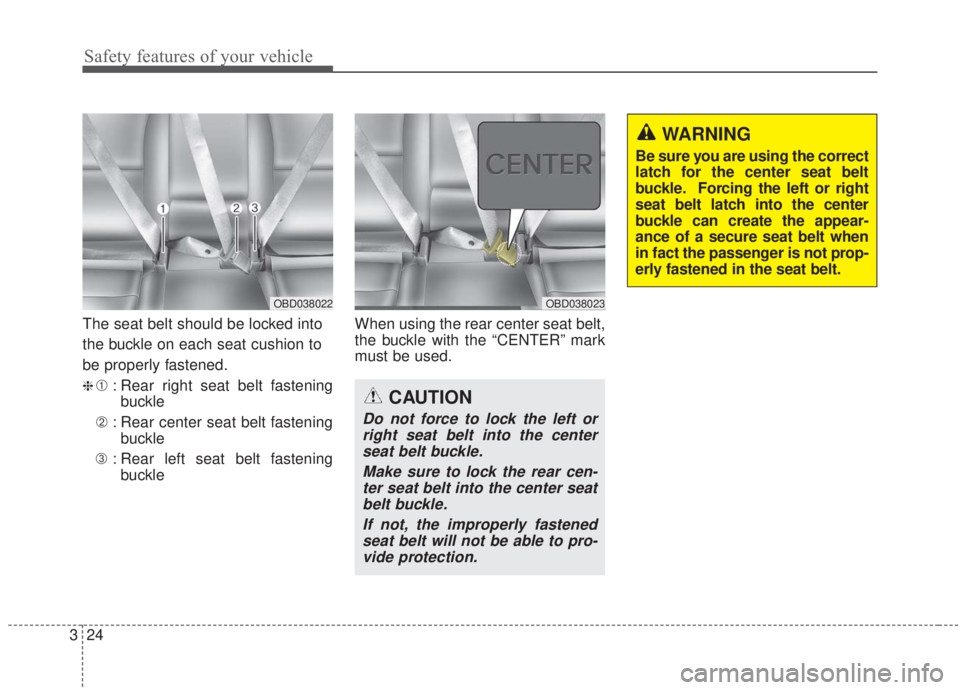
The seat belt should be locked into
the buckle on each seat cushion to
be properly fastened.
❈➀ : Rear right seat belt fastening
buckle
➁ : Rear center seat belt fastening
buckle
➂ : Rear left seat belt fastening
buckle When using the rear center seat belt,
the buckle with the “CENTER” mark
must be used.
OBD038023OBD038022
CAUTION
Do not force to lock the left or
right seat belt into the centerseat belt buckle.
Make sure to lock the rear cen-ter seat belt into the center seatbelt buckle.
If not, the improperly fastenedseat belt will not be able to pro-vide protection.
WARNING
Be sure you are using the correct
latch for the center seat belt
buckle. Forcing the left or right
seat belt latch into the center
buckle can create the appear-
ance of a secure seat belt when
in fact the passenger is not prop-
erly fastened in the seat belt.
Page 41 of 568
325
Safety features of your vehicle
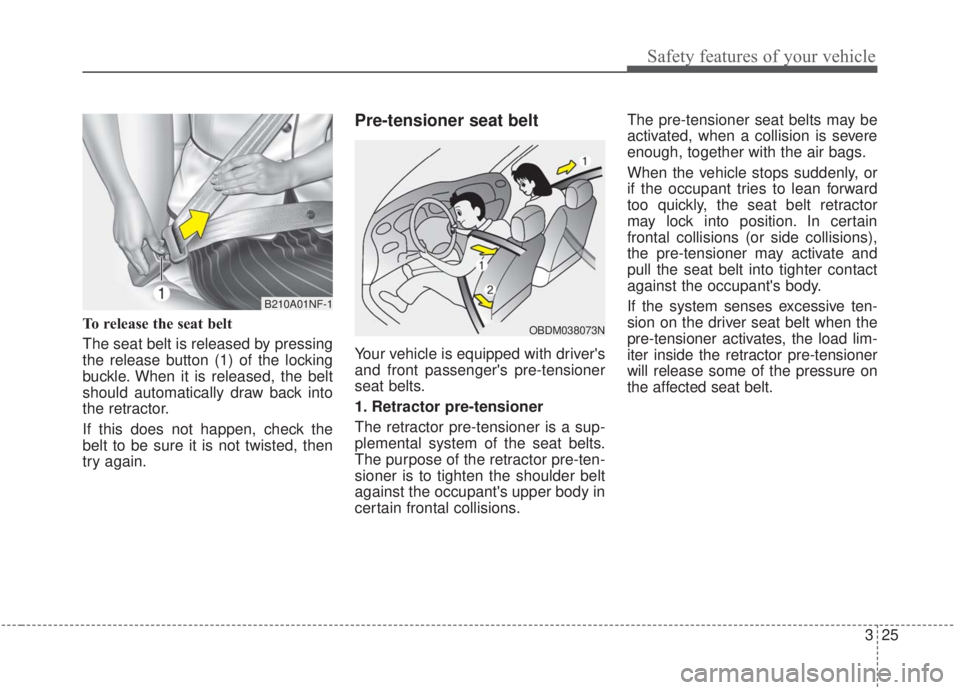
To release the seat belt
The seat belt is released by pressing
the release button (1) of the locking
buckle. When it is released, the belt
should automatically draw back into
the retractor.
If this does not happen, check the
belt to be sure it is not twisted, then
try again.
Pre-tensioner seat belt
Your vehicle is equipped with driver's
and front passenger's pre-tensioner
seat belts.
1. Retractor pre-tensioner
The retractor pre-tensioner is a sup-
plemental system of the seat belts.
The purpose of the retractor pre-ten-
sioner is to tighten the shoulder belt
against the occupant's upper body in
certain frontal collisions.The pre-tensioner seat belts may be
activated, when a collision is severe
enough, together with the air bags.
When the vehicle stops suddenly, or
if the occupant tries to lean forward
too quickly, the seat belt retractor
may lock into position. In certain
frontal collisions (or side collisions),
the pre-tensioner may activate and
pull the seat belt into tighter contact
against the occupant's body.
If the system senses excessive ten-
sion on the driver seat belt when the
pre-tensioner activates, the load lim-
iter inside the retractor pre-tensioner
will release some of the pressure on
the affected seat belt.
OBDM038073N
B210A01NF-1
Page 54 of 568

Safety features of your vehicle
38
3
The lower anchor position indicator
symbols are located on the left and
right rear seat backs to identify the
position of the lower anchors in your
vehicle (see arrows in illustration).
The LATCH anchors are located
between the seatback and the seat
cushion of the rear seat left and right
outboard seating positions.
To use the lower anchor, push the
upper portion of the lower anchor
cover.
❈ (1) : Lower Anchor position indicator
(2) : Lower Anchor
Securing a child restraint with
the LATCH anchors system
To install a LATCH-compatible child
restraint in either of the rear outboard
seating positions:
1. Move the seat belt buckle away from the lower anchors.
2. Move any other objects away from the anchors that could prevent a
secure connection between the
child restraint and the lower
anchors.
3. Place the child restraint on the vehicle seat, then attach the seat
to the lower anchors according to
the instructions provided by the
child restraint manufacturer.
4. Follow the child restraint instruc- tions for properly adjusting and
tightening the lower attachments
on the child restraint to the lower
anchors.
OBD038027L
WARNING
Take the following precautions
when using the LATCH system:
Read and follow all installationinstructions provided with
your child restraint system.
To prevent the child from reaching and taking hold of the
unused seat belts, buckle all
unused rear seat belts before
the child is placed into the
vehicle. Lock each unused
seatbelt following the instruc-
tions in the “Automatic locking
mode” subsection, and place
the webbing behind the child
seat or against an unused seat-
back. Children can be stran-
gled if a shoulder belt becomes
wrapped around their neck and
the seat belt tightens.
(Continued)
Page 56 of 568
Safety features of your vehicle
40
3
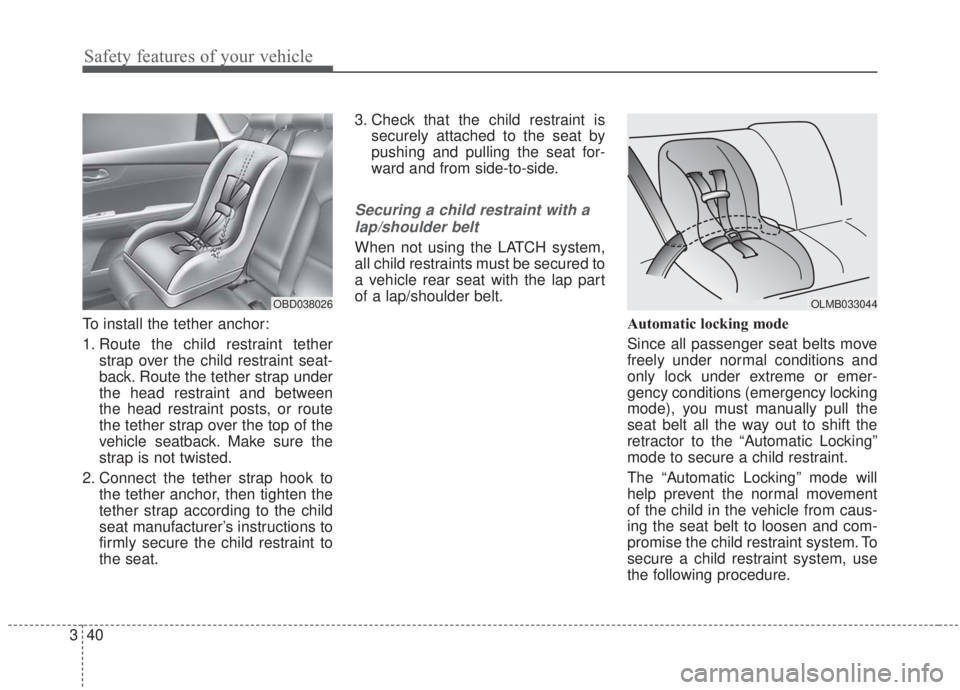
To install the tether anchor:
1. Route the child restraint tether
strap over the child restraint seat-
back. Route the tether strap under
the head restraint and between
the head restraint posts, or route
the tether strap over the top of the
vehicle seatback. Make sure the
strap is not twisted.
2. Connect the tether strap hook to the tether anchor, then tighten the
tether strap according to the child
seat manufacturer’s instructions to
firmly secure the child restraint to
the seat. 3. Check that the child restraint is
securely attached to the seat by
pushing and pulling the seat for-
ward and from side-to-side.
Securing a child restraint with a
lap/shoulder belt
When not using the LATCH system,
all child restraints must be secured to
a vehicle rear seat with the lap part
of a lap/shoulder belt.
Automatic locking mode
Since all passenger seat belts move
freely under normal conditions and
only lock under extreme or emer-
gency conditions (emergency locking
mode), you must manually pull the
seat belt all the way out to shift the
retractor to the “Automatic Locking”
mode to secure a child restraint.
The “Automatic Locking” mode will
help prevent the normal movement
of the child in the vehicle from caus-
ing the seat belt to loosen and com-
promise the child restraint system. To
secure a child restraint system, use
the following procedure.
OBD038026OLMB033044
Page 57 of 568
341
Safety features of your vehicle
To install a child restraint system on
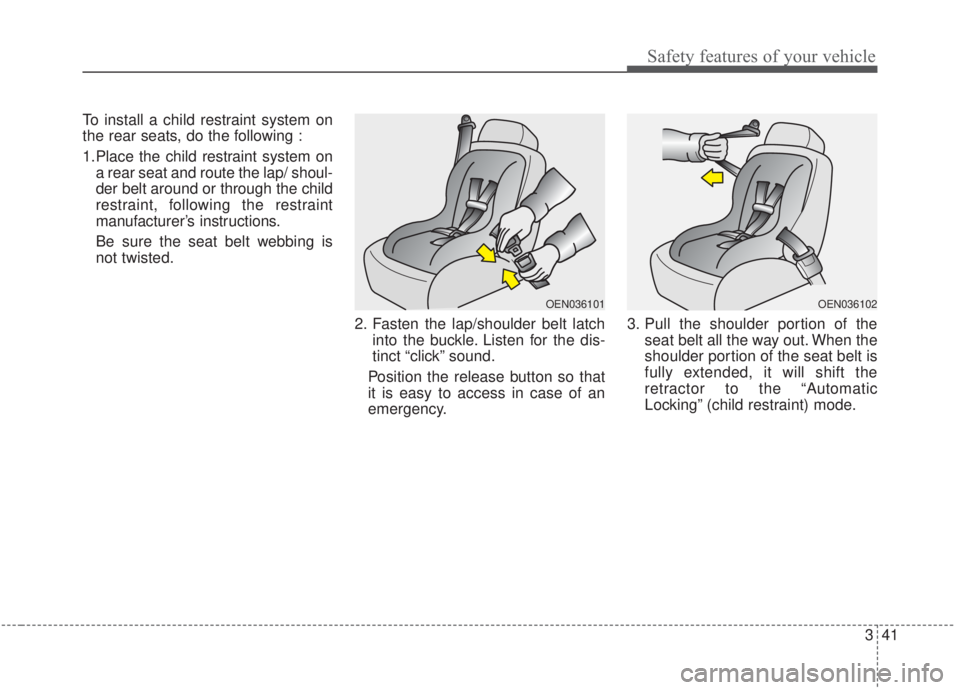
the rear seats, do the following :
1.Place the child restraint system ona rear seat and route the lap/ shoul-
der belt around or through the child
restraint, following the restraint
manufacturer’s instructions.
Be sure the seat belt webbing is
not twisted.
2. Fasten the lap/shoulder belt latchinto the buckle. Listen for the dis-
tinct “click” sound.
Position the release button so that
it is easy to access in case of an
emergency. 3. Pull the shoulder portion of the
seat belt all the way out. When the
shoulder portion of the seat belt is
fully extended, it will shift the
retractor to the “Automatic
Locking” (child restraint) mode.
OEN036101OEN036102