2020 INFINITI Q50 emergency
[x] Cancel search: emergencyPage 364 of 468

6-8In case of emergency
at a fast idle (approximately 1,500 rpm)
until the temperature gauge indication
returns to normal.
4. Get out of the vehicle. Look and listen for steam or coolant escaping from the
radiator before opening the hood. (If
steam or coolant is escaping, turn off the
engine.) Do not open the hood further
until no steam or coolant can be seen.
5. Open the engine hood.
WARNING
If steam or water is coming from the
engine, stand clear to prevent getting
burned.
6. Visually check drive belts for damage or looseness. Also check if the cooling fan is
running. The radiator hoses and radiator
should not leak water. If coolant is
leaking or the cooling fan does not run,
stop the engine.
WARNING
Be careful not to allow your hands, hair,
jewelry or clothing to come into contact
with, or get caught in, engine belts or the
engine cooling fan. The engine cooling fan can start at any time.
7. After the engine cools down, check the coolant level in the reservoir tank with
the engine running. Add coolant to the
reservoir tank if necessary. Have your
vehicle repaired. It is recommended you
visit an INFINITI retailer for this service. When towing your vehicle, all State (Pro-
vincial in Canada) and local regulations for
towing must be followed. Incorrect towing
equipment could damage your vehicle. Tow-
ing instructions are available from an
INFINITI retailer. Local service operators
are familiar with the applicable laws and
procedures for towing. To assure proper
towing and to prevent accidental damage to
your vehicle, INFINITI recommends that you
have a service operator tow your vehicle. It is
advisable to have the service operator care-
fully read the following precautions.
WARNING
.
Never ride in a vehicle that is being
towed.
. Never get under your vehicle after it
has been lifted by a tow truck.
CAUTION
.When towing, make sure that the
transmission, axles, steering system
and powertrain are in working con-
dition. If any unit is damaged, dollies
must be used.
TOWING YOUR VEHICLE
Page 365 of 468
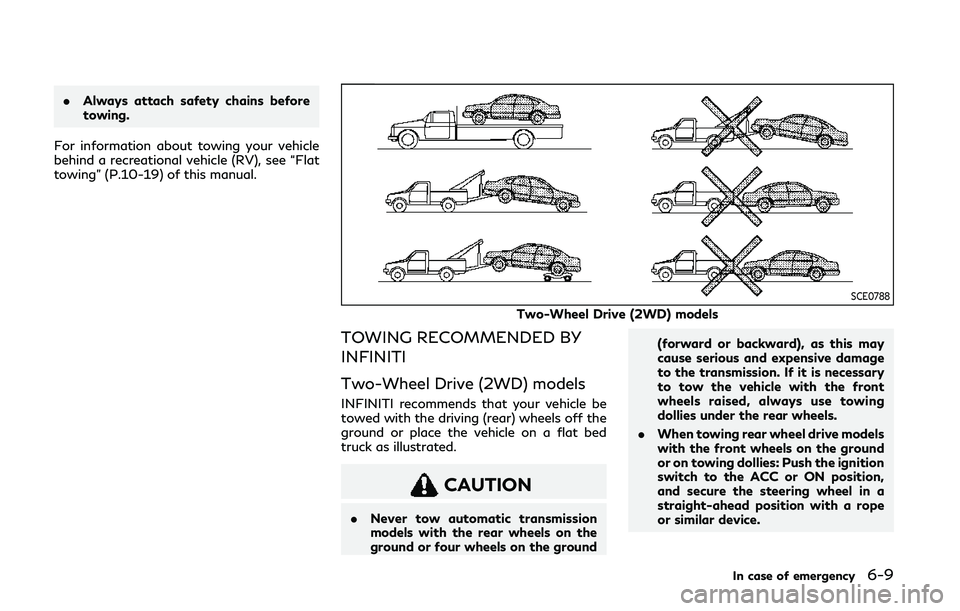
.Always attach safety chains before
towing.
For information about towing your vehicle
behind a recreational vehicle (RV), see “Flat
towing” (P.10-19) of this manual.
SCE0788
Two-Wheel Drive (2WD) models
TOWING RECOMMENDED BY
INFINITI
Two-Wheel Drive (2WD) models
INFINITI recommends that your vehicle be
towed with the driving (rear) wheels off the
ground or place the vehicle on a flat bed
truck as illustrated.
CAUTION
. Never tow automatic transmission
models with the rear wheels on the
ground or four wheels on the ground (forward or backward), as this may
cause serious and expensive damage
to the transmission. If it is necessary
to tow the vehicle with the front
wheels raised, always use towing
dollies under the rear wheels.
. When towing rear wheel drive models
with the front wheels on the ground
or on towing dollies: Push the ignition
switch to the ACC or ON position,
and secure the steering wheel in a
straight-ahead position with a rope
or similar device.
In case of emergency6-9
Page 366 of 468

6-10In case of emergency
SCE0488
All-Wheel Drive (AWD) models
Intelligent All-Wheel Drive (AWD)
models
INFINITI recommends that towing dollies be
used when towing your vehicle or the vehicle
be placed on a flat bed truck as illustrated.
CAUTION
Never tow Intelligent AWD models with
any of the wheels on the ground as this
may cause serious and expensive da-
mage to the powertrain.
VEHICLE RECOVERY (freeing a
stuck vehicle)
WARNING
To avoid vehicle damage, serious perso-
nal injury or death when recovering a
stuck vehicle:
.Contact a professional towing ser-
vice to recover the vehicle if you have
any questions regarding the recovery
procedure.
. Tow chains or cables must be at-
tached only to main structural mem-
bers of the vehicle.
. Do not use the vehicle tie-downs to
tow or free a stuck vehicle.
. Only use devices specifically designed
for vehicle recovery and follow the
manufacturer’s instructions.
. Always pull the recovery device
straight out from the front of the
vehicle. Never pull at an angle.
. Route recovery devices so they do
not touch any part of the vehicle
except the attachment point.
Page 367 of 468

If your vehicle is stuck in sand, snow, mud,
etc., use a tow strap or other device
designed specifically for vehicle recovery.
Always follow the manufacturer’s instruc-
tions for the recovery device.
Rocking a stuck vehicle
If your vehicle is stuck in sand, snow, mud,
etc., use the following procedure:
1. Turn off the Vehicle Dynamic Control(VDC) system.
2. Make sure the area in front and behind the vehicle is clear of obstructions.
3. Turn the steering wheel right and left to clear an area around the front tires.
4. Slowly rock the vehicle forward and backward.
.Shift back and forth between R (Re-verse) and D (Drive).
.Apply the accelerator as little aspossible to maintain the rocking mo-
tion.
.Release the accelerator pedal before shifting between R and D.
.Do not spin the tires above 35 MPH
(55 km/h).
5. If the vehicle cannot be freed after a few tries, contact a professional towing
service to remove the vehicle.
WARNING
.Stand clear of a stuck vehicle.
. Do not spin your tires at high speed.
This could cause them to explode and
result in serious injury. Parts of your
vehicle could also overheat and be
damaged.
In case of emergency6-11
Page 368 of 468

6-12In case of emergency
MEMO
Page 448 of 468

10-16Technical and consumer information
WARNING
.It is extremely dangerous to
ride in a cargo area inside the
vehicle. In a collision, people
riding in these areas are more
likely to be seriously injured or
killed.
.Do not allow people to ride in
any area of vehicle that is not
equipped with seats and seat
belts.
.Be sure everyone in your vehicle
is in a seat and using a seat belt
properly.
TERMS
It is important to familiarize yourself
with the following terms before load-
ing your vehicle:
.Curb Weight (actual weight ofyour vehicle) - vehicle weight in-
cluding: standard and optional
equipment, fluids, emergency
tools, and spare tire assembly. This
weight does not include passen- gers and cargo.
.GVW (Gross Vehicle Weight) -
curb weight plus the combined
weight of passengers and cargo.
.GVWR (Gross Vehicle Weight Rat-ing) - maximum total combined
weight of the unloaded vehicle,
passengers, luggage, hitch, trailer
tongue load and any other op-
tional equipment. This information
is located on the F.M.V.S.S./C.M.
V.S.S. label.
.GAWR (Gross Axle Weight Rating)- maximum weight (load) limit
specified for the front or rear axle.
This information is located on the
F.M.V.S.S./C.M.V.S.S. label.
.GCWR (Gross Combined Weight
Rating) - The maximum total
weight rating of the vehicle, pas-
sengers, cargo, and trailer.
.Vehicle Capacity Weight, Loadlimit, Total load capacity - max-
imum total weight limit specified
of the load (passengers and cargo)
for the vehicle. This is the max-
imum combined weight of occu- pants and cargo that can be
loaded into the vehicle. If the
vehicle is used to tow a trailer,
the trailer tongue weight must be
included as part of the cargo load.
This information is located on the
Tire and Loading Information la-
bel.
.Cargo capacity - permissible
weight of cargo, the weight of
total occupants weight subtracted
from the load limit.
VEHICLE LOADING INFORMATION
Page 451 of 468

Do not tow a trailer with your
vehicle.
FLAT TOWING
Towing your vehicle with all four wheels on
the ground is sometimes called flat towing.
This method is sometimes used when towing
a vehicle behind a recreational vehicle, such
as a motor home.
CAUTION
.Failure to follow these guidelines can
result in severe transmission damage.
. Whenever flat towing your vehicle,
always tow forward, never back-
ward.
. DO NOT tow any Automatic Trans-
mission (AT) vehicle with all four
wheels on the ground (flat towing).
Doing so WILL DAMAGE internal
transmission parts due to lack of
transmission lubrication.
. DO NOT tow any All-Wheel Drive
(AWD) vehicle with any of the wheels
on the ground. Doing so may cause
serious and expensive damage to the
powertrain.
. For emergency towing procedures
refer to “Towing recommended by INFINITI” (P.6-9).
Automatic Transmission
All-Wheel Drive (AWD) models:
Do not tow an AWD vehicle with any of the
wheels on the ground.
Two-Wheel Drive (2WD) models:
To tow a vehicle equipped with an automatic
transmission, an appropriate vehicle dolly
MUST
be placed under the towed vehicle’s
drive wheels. Alwaysfollow the dolly man-
ufacturer’s recommendations when using
their product. DOT (Department Of Transportation) Qual-
ity Grades: All passenger car tires must
conform to federal safety requirements in
addition to these grades.
Quality grades can be found where applic-
able on the tire sidewall between tread
shoulder and maximum section width. For
example:
Treadwear 200 Traction AA Temperature A
TREADWEAR
The treadwear grade is a comparative rating
based on the wear rate of the tire when
tested under controlled conditions on a
specified government test course. For ex-
ample, a tire graded 150 would wear one
and one-half (1 1/2) times as well on the
government course as a tire graded 100.
The relative performance of tires depends
upon actual conditions of their use, however,
and may depart significantly from the norm
due to variations in driving habits, service
practices and differences in road character-
istics and climate.
Technical and consumer information10-19
TOWING A TRAILERUNIFORM TIRE QUALITY GRADING
Page 458 of 468

11-2
ChimesAudible reminders .......................................... 2-17
Seat belt warning light and chime ............ 2-14
Circuit breaker
Fusible link ....................................................... 8-18
Cleaning exterior and interior .................... 7-2, 7-5
Climate control
Automatic air conditioner ........................... 4-37
Clock ...................................................................... 2-28
Coat hooks ............................................................ 2-48
Cockpit ...................................................................... 2-3
Cold weather driving ........................................ 5-135
Console box ........................................................... 2-47
Coolant Capacities and
recommended fluids/lubricants ................. 10-2
Changing engine coolant ............................... 8-5
Checking engine coolant level ...................... 8-4
Corrosion protection ............................................. 7-7
Courtesy light ....................................................... 2-56
Cruise control ....................................................... 5-69 Fixed speed cruise control (on
ICC system) .................................................... 5-88
Intelligent Cruise Control (ICC) ................. 5-71
Cruise indicator .................................................... 2-22
Cup holders ........................................................... 2-45
Current fuel consumption ................................. 2-26
D
Daytime running light system .......................... 2-38 Defroster switch
Rear window and outside mirror
defroster switch ............................................. 2-34
Dimensions ......................................................... 10-10
Direct Adaptive Steering ................................. 5-124
Distance Control Assist (DCA) ........................ 5-92
Distance to empty ............................................... 2-26
Drive belts .............................................................. 8-13
Drive positioner .................................................... 3-32
Driver assist system indicator .......................... 2-23
Driving Cold weather driving .................................. 5-135
Driving with automatic transmission ....... 5-16
Precautions when starting and driving ..... 5-4
E
ECO drive indicator light ................................... 2-15
ECO mode ............................................................. 5-22
ECO pedal system ............................................... 5-22
Economy
Fuel ................................................................. 5-120
Elapsed time ......................................................... 2-26
Elapsed time and trip odometer ..................... 2-26
Emission control information label ............... 10-12
Emission control system warranty .............. 10-20
Engine Before starting the engine .......................... 5-14
Break-in schedule ........................................ 5-119
Capacities and
recommended fluids/lubricants ................. 10-2
Changing engine coolant ............................... 8-5 Changing engine oil and filter ...................... 8-7
Checking engine coolant level ...................... 8-4
Checking engine oil level ............................... 8-7
Coolant temperature gauge ......................... 2-8
Emergency engine shut off ......................... 5-13
Engine block heater ................................... 5-136
Engine compartment check locations ........ 8-3
Engine cooling system ................................... 8-3
Engine oil ........................................................... 8-7
Engine oil and filter
replacement indicator ................................... 2-24
Engine oil and oil
filter recommendation .................................. 10-6
Engine oil viscosity ........................................ 10-7
Engine serial number ................................. 10-12
Engine specifications ................................... 10-8
Engine start operation indicator ............... 2-20
If your vehicle overheats ................................ 6-7
Remote engine start ..................................... 3-19
Remote engine start
operation indicator ........................................ 2-20
Starting the engine ....................................... 5-15
Engine coolant temperature gauge .................. 2-8
Entry/exit function Automatic drive positioner ......................... 3-32
Event Data Recorders (EDR) ........................ 10-23
Exhaust gas (carbon monoxide) ........................ 5-4
Explanation of scheduled
maintenance items ................................................. 9-5