2020 Hyundai Sonata Seat
[x] Cancel search: SeatPage 5 of 537

I
8 7
6 5
4 32 1Index Maintenance Emergency Situations
While Driving Convenient Features
Instrument Cluster
Seats & Safety System Vehicle Information Foreword
Table of Contents
Page 12 of 537
01
1 -7
Detergent Fuel Additives
HYUNDAI recommends that you use
good quality gasolines treated with
detergent additives such as TOP TIER
Detergent Gasoline, which help prevent
deposit formation in the engine. These
gasolines will help the engine run
cleaner and enhance performance of
the Emission Control System. For more
information on TOP TIER Detergent
Gasoline, please go to the website (www.
toptiergas.com ).
For customers who do not use TOP Tier
Detergent Gasoline regularly, and have
problems starting or the engine does
not run smoothly, detergent-based
fuel additives that you can purchase
separately may be added to the gasoline.
If TOP TIER Detergent Gasoline is
not available, one bottle of additive
added to the fuel tank according to the
maintenance schedule is recommended
(refer to the Maintenance Schedule in
chapter 8).
Additives are available from your
authorized HYUNDAI dealer along with
information on how to use them. Do not
mix other additives.
Operation in foreign countries
If you are going to drive your vehicle in
another country, be sure to:
• Observe all regulations regarding
registration and insurance.
• Determine that acceptable fuel is
available. •
This vehicle should not be modified.
Modification of your vehicle could
affect its performance, safety or
durability and may even violate
governmental safety and emissions
regulations.
In addition, damage or performance
problems resulting from any
modification may not be covered
under warranty.
• If you use unauthorized electronic
devices, it may cause the vehicle to
operate abnormally, wire damage,
battery discharge and fire. For your
safety, do not use unauthorized
electronic devices.
VEHICLE BREAK-IN
PROCESS
By following a few simple precautions for
the first 600 miles (1,000 km) you may
add to the performance, economy and
life of your vehicle.
• Do not race the engine.
• While driving, keep your engine speed
(rpm, or revolutions per minute)
between 2,000 rpm and 4,000 rpm.
• Do not maintain a single speed for
long periods of time, either fast or
slow. Varying engine speed is needed
to properly break-in the engine.
• Avoid hard stops, except in
emergencies, to allow the brakes to
seat properly.
VEHICLE MODIFICATIONS
Page 17 of 537

2-4
Vehicle Information
The actual shape may differ from the illustration.ODN8A019003
1. Inside door handle ................................ 5-32
2. Seat position memory system .............5-39
3. Side view mirror control switch ...........5-54
4. Central door lock switch .......................5-33
5. Power window switches ......................5-56
6. Power window lock button ..................5-59
7. Steering wheel tilt/telescopic lever ....5-43
8. Steering wheel ......................................5-42
9. Instrument panel illumination control
switch
......................................................4-3
10. Idle Stop and Go (ISG) OFF button ......6-33
11. Lane Keeping Assist system button ....6-58
12. Trunk release button ............................5-65
13. ESC OFF button ....................................6-29
14. EPB (Electronic Parking Brake) .............6-21
15. Hood release lever ...............................5-64
INTERIOR OVERVIEW
Page 26 of 537
02
2-13
VEHICLE IDENTIFICATION
NUMBER (VIN)
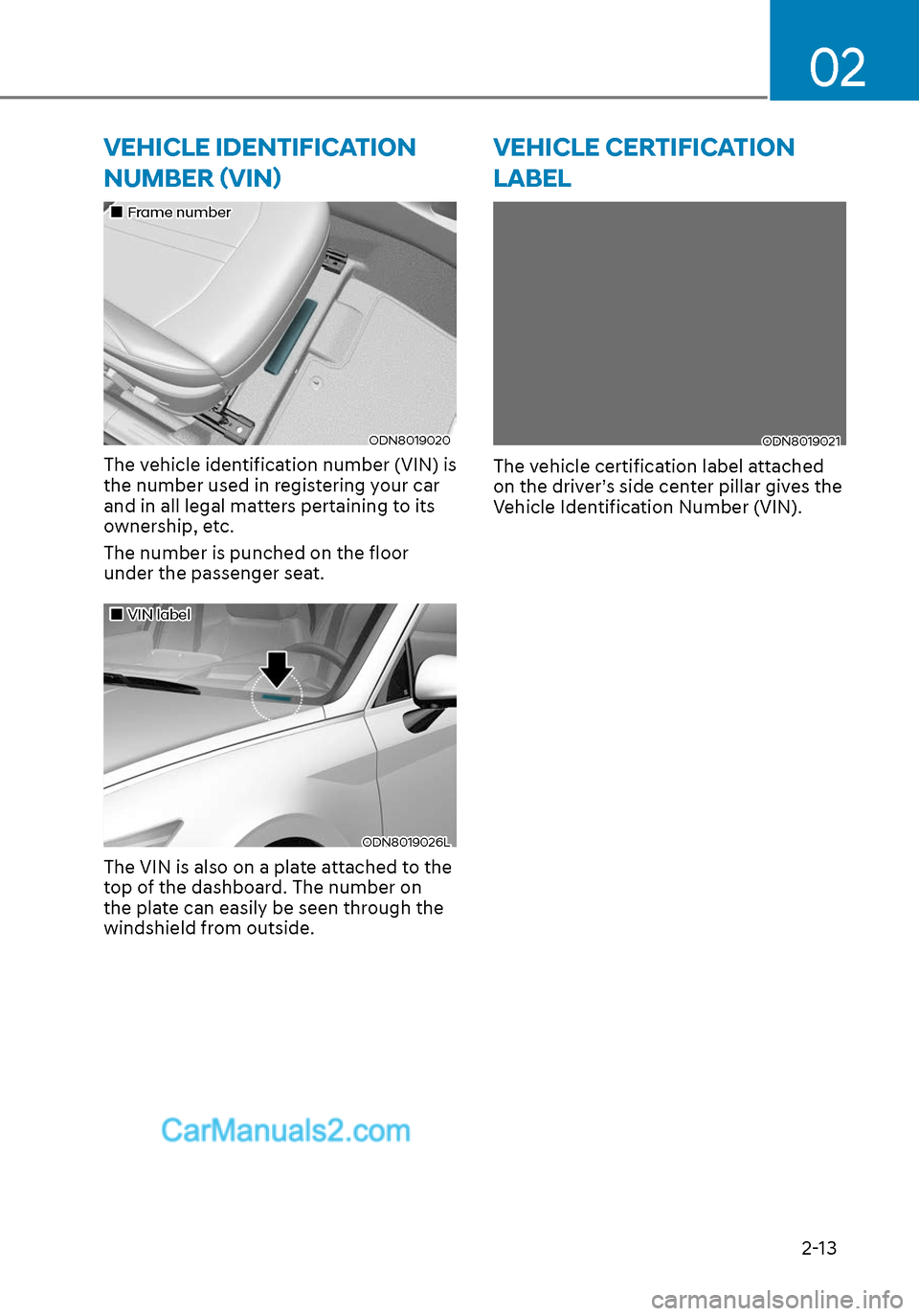
Frame number
ODN8019020
The vehicle identification number (VIN) is
the number used in registering your car
and in all legal matters pertaining to its
ownership, etc.
The number is punched on the floor
under the passenger seat.
VIN label
ODN8019026L
The VIN is also on a plate attached to the
top of the dashboard. The number on
the plate can easily be seen through the
windshield from outside.
VEHICLE CERTIFICATION
LABEL
ODN8019021
The vehicle certification label attached
on the driver’s side center pillar gives the
Vehicle Identification Number (VIN).
Page 29 of 537

3. Seats & Safety System
3
Important Safety Precautions ....................................................................... 3-2
Always Wear Your Seat Belt ........................................................................\
............. 3-2
Restrain All Children ........................................................................\
......................... 3-2
Air Bag Hazards ........................................................................\
................................ 3-2
Driver Distraction ........................................................................\
............................. 3-2
Control Your Speed ........................................................................\
.......................... 3-2
Keep Your Vehicle in Safe Condition ....................................................................... 3-2
Seats .....................................................................\
.......................................... 3-3
Safety Precautions ........................................................................\
........................... 3-4
Front Seats ........................................................................\
........................................ 3-5
Rear Seats ........................................................................\
........................................3-10
Head Restraints ........................................................................\
................................3-11
Seat Warmers and Air Ventilation Seats ................................................................ 3-15
Seat Belts ........................................................................\
...............................3-19Seat Belt Safety Precautions ........................................................................\
..........3-19
Seat Belt Warning Light ........................................................................\
................. 3-20
Seat Belt Restraint System .....................................................................\
................ 3-21
Additional Seat Belt Safety Precautions ............................................................... 3-26
Care of Seat Belts ........................................................................\
........................... 3-28
Child Restraint System (CRS) ...................................................................... 3-29Children Always in the Rear ........................................................................\
........... 3-29
Selecting a Child Restraint System (CRS) ............................................................. 3-30
Installing a Child Restraint System (CRS) .............................................................. 3-31
Air Bag - Advanced Supplemental Restraint System ................................ 3-37Where Are the Air Bags? ........................................................................\
................ 3-39
How Does the Air Bag System Operate? ............................................................... 3-42
What to Expect After an Air Bag Inflates .............................................................. 3-46
Occupant Classification System (OCS) ................................................................. 3-47
Why Didn’t My Air Bag Go Off in a Collision? ....................................................... 3-52
SRS Care ........................................................................\
......................................... 3-56
Additional Safety Precautions ........................................................................\
....... 3-57
Air Bag Warning Labels ........................................................................\
.................. 3-57
This chapter provides you with important information about how to protect yourself and your
passengers. It explains how to properly use your seats and seat belts, and how your air bags work.
Additionally, this chapter explains how to properly restrain infants and children in your vehicle.
Page 30 of 537

Seats & Safety System3-2
You will find many safety precautions
and recommendations throughout this
section, and throughout this manual.
The safety precautions in this section are
among the most important.
Always Wear Your Seat Belt
A seat belt is your best protection in all
types of accidents. Air bags are designed
to supplement seat belts, not replace
them. So even though your vehicle is
equipped with air bags, ALWAYS make
sure you and your passengers wear your
seat belts, and wear them properly.
Restrain All Children
All children under age 13 should ride
in your vehicle properly restrained in a
rear seat, not the front seat. Infants and
small children should be restrained in
an appropriate child restraint. Larger
children should use a booster seat with
the lap/shoulder belt until they can use
the seat belt properly without a booster
seat.
Air Bag Hazards
While air bags can save lives, they can
also cause serious or fatal injuries to
occupants who sit too close to them, or
who are not properly restrained. Infants,
young children, and shorter adults are at
the greatest risk of being injured by an
inflating air bag. Follow all instructions
and warnings in this manual.
Driver Distraction
Driver distraction presents a serious and
potentially deadly danger, especially for
inexperienced drivers. Safety should be
the first concern when behind the wheel,
and drivers need to be aware of the wide
array of potential distractions, such as
drowsiness, reaching for objects, eating,
personal grooming, other passengers,
and using cellular phones. Drivers can become distracted when
they take their eyes and attention off
the road or their hands off the wheel to
focus on activities other than driving. To
reduce your risk of distraction or getting
into an accident:
• ALWAYS set up your mobile devices
(i.e., MP3 players, phones, navigation
units, etc.) when your vehicle is
parked or safely stopped.
• ONLY use your mobile device when allowed by laws and when conditions
permit safe use. NEVER text or email
while driving. Most states have laws
prohibiting drivers from texting. Some
states and cities also prohibit drivers
from using handheld phones.
• NEVER let the use of a mobile device distract you from driving. You have a
responsibility to your passengers and
others on the road to always drive
safely, with your hands on the wheel
as well as your eyes and attention on
the road.
Control Your Speed
Excessive speed is a major factor in crash
injuries and deaths. Generally, the higher
the speed, the greater the risk, but
serious injuries can also occur at lower
speeds. Never drive faster than is safe
for current conditions, regardless of the
maximum speed posted.
Keep Your Vehicle in Safe
Condition
Having a tire blowout or a mechanical
failure can be extremely hazardous. To
reduce the possibility of such problems,
check your tire pressures and condition
frequently, and perform all regularly
scheduled maintenance.
IMPORTANT SAFETY PRECAUTIONS
Page 31 of 537
3-3
03
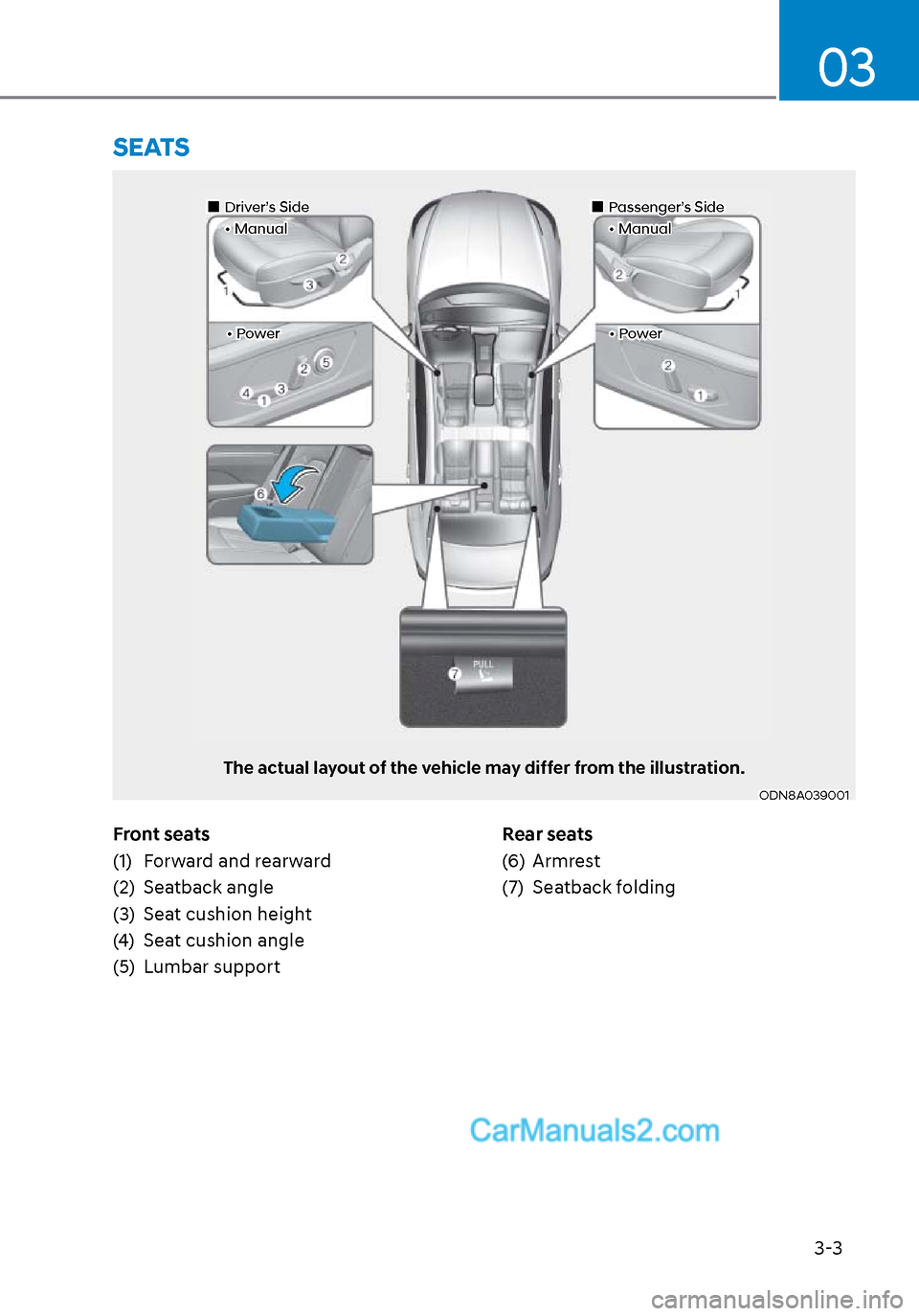
Front seats
(1) Forward and rearward
(2) Seatback angle
(3) Seat cushion height
(4) Seat cushion angle
(5) Lumbar supportRear seats
(6) Armrest
(7) Seatback folding
SEATS
ODN8A039001ODN8A039001
The actual layout of the vehicle may differ from the illustration.
Driver’s SideDriver’s Side
• Manual• Manual
Passenger’s SidePassenger’s Side
• Manual• Manual
• Power• Power• Power• Power
Page 32 of 537

Seats & Safety System3-4
Safety Precautions
Adjusting the seats so that you are sitting
in a safe, comfortable position plays an
important role in driver and passenger
safety together with the seat belts and
air bags in an accident.
WARNING
Do not use a cushion that reduces
friction between the seat and the
passenger. The passenger’s hips may
slide under the lap portion of the seat
belt during an accident or a sudden
stop. Serious or fatal internal injuries
could result because the seat belt
cannot operate properly.
Air bags
You can take steps to reduce the risk
of being injured by an inflating air bag.
Sitting too close to an air bag greatly
increases the risk of injury in the event
the air bag inflates.
The National Highway Traffic Safety
Administration (NHTSA) recommends
that drivers allow at least 10 inches (25
cm) between the center of the steering
wheel and their chest.
WARNING
To reduce the risk of serious injury or
death from an inflating air bag, take the
following precautions:
• Adjust the driver’s seat as far to the
rear as possible while maintaining
the ability to maintain full control of
the vehicle.
• Adjust the front passenger seat as far
to the rear as possible.
• Hold the steering wheel by the rim
with hands at the 9 o’clock and 3
o’clock positions to minimize the risk
of injuries to your hands and arms. •
NEVER place anything or anyone
between the steering wheel and the
air bag.
• Do not allow the front passenger to
place feet or legs on the dashboard
to minimize the risk of leg injuries.
Seat belts
Always fasten your seat belt before
starting any trip.
At all times, passengers should sit
upright and be properly restrained.
Infants and small children must be
restrained in appropriate child restraint
systems. Adults and children who
have outgrown a booster seat must be
restrained using the seat belts.
WARNING
Take the following precautions when
adjusting your seat belt:
• NEVER use one seat belt for more
than one occupant.
• Always position the seatback upright
with the lap portion of the seat belt
snug and low across the hips.
• NEVER allow children or small infants
to ride on a passenger’s lap.
• Do not route the seat belt across your
neck, across sharp edges, or reroute
the shoulder strap away from your
body.
• Do not allow the seat belt to become
caught or jammed.