2020 Hyundai Sonata Led
[x] Cancel search: LedPage 56 of 537
Seats & Safety System3-28
Care of Seat Belts
Seat belt systems should never be
disassembled or modified. In addition,
care should be taken to assure that seat
belts and belt hardware are not damaged
by seat hinges, doors or other abuse.
Periodic inspection
All seat belts should be inspected
periodically for wear or damage of
any kind. Any damaged parts should
be replaced as soon as possible by an
authorized HYUNDAI dealer.
Keep belts clean and dry
Seat belts should be kept clean and
dry. If belts become dirty, they can be
cleaned by using a mild soap solution
and warm water. Bleach, dye, strong
detergents or abrasives should not be
used because they may damage and
weaken the fabric.
When to replace seat belts
The entire seat belt assembly or
assemblies should be replaced if the
vehicle has been involved in an accident.
This should be done even if no damage is
visible. Additional questions concerning
seat belt operation should be directed to
an authorized HYUNDAI dealer.
Page 57 of 537
03
3-29
Children Always in the Rear
WARNING
Always properly restrain children in the
rear seats of the vehicle.
Children of all ages are safer when
restrained in the rear seat. A child riding
in the front passenger seat can be
forcefully struck by an inflating air bag
resulting in SERIOUS INJURY or DEATH.
Children under age 13 must always
ride in the rear seats and must always
be properly restrained to minimize the
risk of injury in an accident, sudden
stop or sudden maneuver. According
to accident statistics, children are safer
when properly restrained in the rear
seats than in the front seat. Even with
air bags, children can be seriously
injured or killed. Children too large for
a child restraint must use the seat belts
provided.
All 50 states have child restraint laws
which require children to travel in
approved child restraint devices. The
laws governing the age or height/weight
restrictions at which seat belts can be
used instead of child restraints differs
among states, so you should be aware of
the specific requirements in your state,
and where you are travelling.
Child restraint systems must be properly
placed and installed in the rear seat.
You must use a commercially available
child restraint system that meets the
requirements of the Federal Motor
Vehicle Safety Standards (FMVSS 213).
Child restraint systems are generally
designed to be secured in a vehicle seat
by lap belt portion of a lap/shoulder belt,
or by a LATCH system in the rear seats of
the vehicle.
Child restraint system (CRS)
Infants and younger children must be
restrained in an appropriate rear-facing
or forward-facing CRS that has first
been properly secured to the rear seat
of the vehicle. Read and comply with
the instructions for installation and use
provided by the manufacturer of the
child restraint.
WARNING
An improperly secured child restraint
can increase the risk of SERIOUS
INJURY or DEATH in an accident. Always
take the following precautions when
using a child restraint system:
• NEVER install a child or infant
restraint in the front passenger’s
seat.
• Always properly secure the child
restraint to a rear seat of the vehicle.
• Always follow the child restraint
system manufacturer’s instructions
for installation and use.
• Always properly restrain your child in
the child restraint.
• If the vehicle head restraint prevents
proper installation of a child seat
(as described in the child restraint
system manual), the head restraint of
the respective seating position shall
be readjusted or entirely removed.
• Do not use an infant carrier or a
child safety seat that “hooks” over
a seatback, it may not provide
adequate protection in an accident.
• After an accident, have a HYUNDAI
dealer check the child restraint
system, seat belts, tether anchors
and lower anchors.
CHILD RESTRAINT SYSTEM (CRS)
Page 60 of 537

Seats & Safety System3-32
After selecting a proper child seat
for your child, check to make sure it
fits properly in your vehicle. Follow
the instructions provided by the
manufacturer when installing the child
seat. Note these general steps when
installing the seat to your vehicle:
• Properly secure the child restraint to
the vehicle. All child restraints must
be secured to the vehicle with the lap
part of a lap/shoulder belt or with the
LATCH system.
• Make sure the child restraint is
firmly secured. After installing a
child restraint to the vehicle, push
and pull the seat forward-and-back
and side-to-side to verify that it
is securely attached to the seat. A
child restraint secured with a seat
belt should be installed as firmly as
possible. However, some side-to-side
movement can be expected.
• Secure the child in the child
restraint. Make sure the child is
properly strapped in the child restraint
according to the manufacturer
instructions.
CAUTION
A child restraint in a closed vehicle can
become very hot. To prevent burns,
check the seating surface and buckles
before placing your child in the child
restraint.
Lower Anchors and Tether for
Children (LATCH System)
The LATCH system holds a child restraint
during driving and in an accident. This
system is designed to make installation
of the child restraint easier and reduce
the possibility of improperly installing
your child restraint. The LATCH system
uses anchors in the vehicle and
attachments on the child restraint. The
LATCH system eliminates the need to use
seat belts to secure the child restraint to
the rear seats.
Lower anchors are metal bars built into
the vehicle. There are two lower anchors
for each LATCH seating position that
will accommodate a child restraint with
lower attachments.
To use the LATCH system in your vehicle,
you must have a child restraint with
LATCH attachments.
The child seat manufacturer will provide
you with instructions on how to use the
child seat with its attachments for the
LATCH lower anchors.
ODN8039075LODN8039075L
LATCH anchors have been provided in
the left and right outboard rear seating
positions. Their locations are shown
in the illustration. There are no LATCH
anchors provided for the center rear
seating position.
Page 61 of 537
03
3-33
WARNING
Do not attempt to install a child
restraint system using LATCH anchors in
the rear center seating position. There
are no LATCH anchors provided for this
seat. Using the outboard seat anchors
can damage the anchors which may
break or fail in a collision resulting in
serious injury or death.
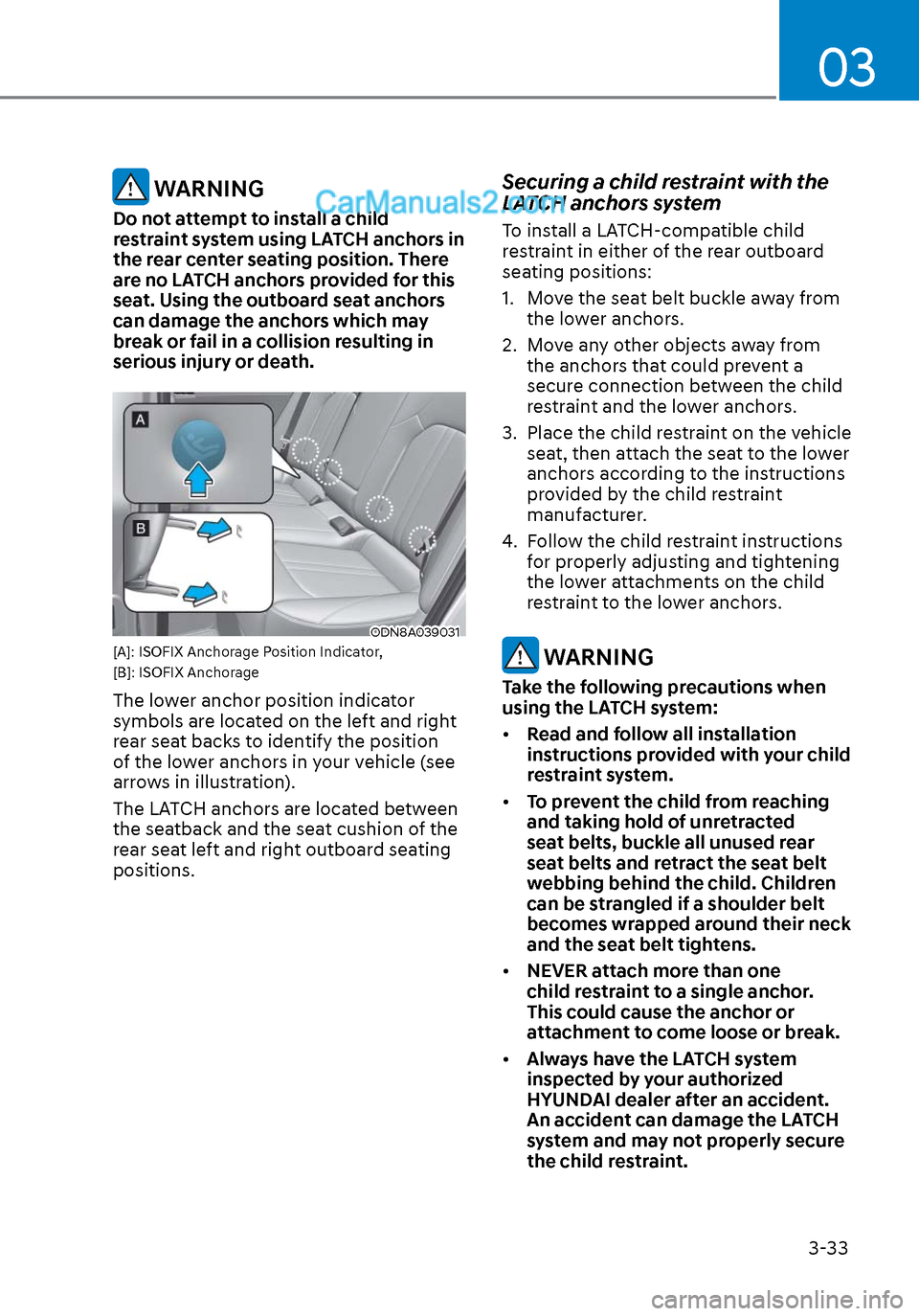
ODN8A039031ODN8A039031[A]: ISOFIX Anchorage Position Indicator,
[B]: ISOFIX Anchorage
The lower anchor position indicator
symbols are located on the left and right
rear seat backs to identify the position
of the lower anchors in your vehicle (see
arrows in illustration).
The LATCH anchors are located between
the seatback and the seat cushion of the
rear seat left and right outboard seating
positions.
Securing a child restraint with the
LATCH anchors system
To install a LATCH-compatible child
restraint in either of the rear outboard
seating positions:
1. Move the seat belt buckle away from the lower anchors.
2. Move any other objects away from the anchors that could prevent a
secure connection between the child
restraint and the lower anchors.
3. Place the child restraint on the vehicle seat, then attach the seat to the lower
anchors according to the instructions
provided by the child restraint
manufacturer.
4. Follow the child restraint instructions for properly adjusting and tightening
the lower attachments on the child
restraint to the lower anchors.
WARNING
Take the following precautions when
using the LATCH system:
• Read and follow all installation
instructions provided with your child
restraint system.
• To prevent the child from reaching
and taking hold of unretracted
seat belts, buckle all unused rear
seat belts and retract the seat belt
webbing behind the child. Children
can be strangled if a shoulder belt
becomes wrapped around their neck
and the seat belt tightens.
• NEVER attach more than one
child restraint to a single anchor.
This could cause the anchor or
attachment to come loose or break.
• Always have the LATCH system
inspected by your authorized
HYUNDAI dealer after an accident.
An accident can damage the LATCH
system and may not properly secure
the child restraint.
Page 64 of 537

Seats & Safety System3-36
Information
Position the release button so that it is easy
to access in case of an emergency.
OLF034076OLF034076
3. Pull the shoulder portion of the seat belt all the way out. When the
shoulder portion of the seat belt
is fully extended, it will shift the
retractor to the “Automatic Locking”
(child restraint) mode.
OLF034075OLF034075
4. Slowly allow the shoulder portion of the seat belt to retract and listen for
an audible “clicking” or “ratcheting”
sound. This indicates that the retractor
is in the “Automatic Locking” mode.
If no distinct sound is heard, repeat
steps 3 and 4. 5. Remove as much slack from the belt
as possible by pushing down on the
child restraint system while feeding
the shoulder belt back into the
retractor.
6. Push and pull on the child restraint system to confirm that the seat belt
is holding it firmly in place. If it is not,
release the seat belt and repeat steps
2 through 6.
7. Double check that the retractor is in the “Automatic Locking” mode by
attempting to pull more of the seat
belt out of the retractor. If you cannot,
the retractor is in the “Automatic
Locking” mode.
If your CRS (child restraint system)
manufacturer instructs or recommends
you to use a tether anchor with the lap/
shoulder belt, refer to the previous pages
for more information.
Information
When the seat belt is allowed to retract to
its fully stowed position, the retractor will
automatically switch from the “Automatic
Locking” mode to the emergency lock
mode for normal adult usage.
WARNING
If the retractor is not in the “Automatic
Locking” mode, the child restraint
can move when your vehicle turns or
stops suddenly. A child can be seriously
injured or killed if the child restraint
is not properly anchored in the car,
including manually pulling the seat belt
all the way out to shift the rectractor to
the “Automatic Locking” mode.
To remove the child restraint, press the
release button on the buckle and then
pull the lap/shoulder belt out of the
restraint and allow the seat belt to retract
fully.
Page 66 of 537

Seats & Safety System3-38
This vehicle is equipped with an Advanced Supplemental Air Bag System for the
driver’s seat and front passenger’s seats.
The front air bags are designed to supplement the three-point seat belts. For these air
bags to provide protection, the seat belts must be worn at all times when driving.
You can be severely injured or killed in an accident if you are not wearing a seat belt.
Air bags are designed to supplement seat belts, but do not replace them. Also, air bags
are not designed to deploy in every collision. In some accidents, the seat belts are the
only restraint protecting you.
WARNING
AIR BAG SAFETY PRECAUTIONS
ALWAYS use seat belts and child restraints - every trip, every time, everyone! Even
with air bags, you can be seriously injured or killed in a collision if you are improperly
belted or not wearing your seat belt when the air bag inflates.
NEVER place a child in any child restraint or booster seat in the front passenger seat.
An inflating air bag could forcefully strike the infant or child causing serious or fatal
injuries.
ABC - Always Buckle Children under age 13 in the back seat. It is the safest place
for children of any age to ride. If a child age 13 or older must be seated in the front
seat, he or she must be properly belted and the seat should be moved as far back as
possible.
All occupants should sit upright with the seatback in an upright position, centered
on the seat cushion with their seat belt on, legs comfortably extended and their
feet on the floor until the vehicle is parked and is turned off. If an occupant is out of
position during an accident, the rapidly deploying air bag may forcefully contact the
occupant causing serious or fatal injuries.
You and your passengers should never sit or lean unnecessarily close to the air bags
or lean against the door or center console.
Move your seat as far back as possible from front air bags, while still maintaining
control of the vehicle. The U.S. National Highway Traffic Safety Administration
(NHTSA) recommends that drivers allow at least 10 inches (25 cm) between the
center of the steering wheel and the chest.
Page 67 of 537

03
3-39
Where Are the Air Bags?
Driver’s and passenger’s front air
bags
Your vehicle is equipped with an
Advanced Supplemental Restraint
System (SRS) and lap/shoulder belts at
both the driver and passenger seating
positions.
The SRS consists of air bags which are
located in the center of the steering
wheel, in the driver’s side lower crash
pad below the steering wheel column
and the passenger’s side front panel pad
above the glove box.
The air bags are labeled with the letters
“AIR BAG” embossed on the pad covers.
Driver’s front air bagDriver’s front air bag
ODN8039034ODN8039034
Driver’s knee air bagDriver’s knee air bag
ODN8039035ODN8039035
Passenger’s front air bagPassenger’s front air bag
ODN8039036ODN8039036
The purpose of the SRS is to provide the
vehicle’s driver and front passengers with
additional protection than that offered
by the seat belt system alone. The SRS
uses sensors to gather information about
the driver’s and front passenger’s seat
belt usage and impact severity. The seat
belt buckle sensors determine if the
driver and front passenger’s seat belts
are fastened. These sensors provide the
ability to control the SRS deployment
based on whether or not the seat belts
are fastened, and how severe the impact
is. The advanced SRS offers the ability to
control the air bag inflation within two
levels. A first stage level is provided for
moderate-severity impacts. A second
stage level is provided for more severe
impacts. According to the impact
severity, and seat belt usage, the SRS
Control Module (SRSCM) controls the
air bag inflation. Failure to properly
wear seat belts can increase the risk or
severity of injury in an accident.
Page 75 of 537

03
3-47
Occupant Classification System
(OCS)
ODN8A039038ODN8A039038
Your vehicle is equipped with an
Occupant Classification System (OCS) in
the front passenger’s seat.
Main components of the Occupant
Classification System
• A detection device located within the front passenger seat cushion.
• Electronic system to determine whether the passenger air bag
systems should be activated or
deactivated.
• An indicator light located on the instrument panel which illuminates
the words “PASSENGER AIR BAG OFF”
indicating the front passenger air bag
system is deactivated.
• The instrument panel air bag indicator light is interconnected with the OCS.
The OCS is designed to help detect
the presence of a properly-seated
front passenger and determine if the
passenger’s front air bag should be
enabled (may inflate) or not.
The purpose is to help reduce the risk
of injury or death from an inflating air
bag to certain front passenger seat
occupants, such as children, by requiring
the air bag to be automatically turned
OFF. For example, if a child restraint of the
type specified in the regulations is on the
seat, the occupant classification sensor
can detect it and cause the air bag to
turn OFF.
Front passenger seat adult occupants
who are properly seated and wearing the
seat belt properly, should not cause the
passenger air bag to be automatically
turned OFF. For small adults it may be
turned OFF, however, if the occupant
does not sit in the seat properly (for
example, by not sitting upright, by sitting
on the edge of the seat, or by otherwise
being out of position), this could cause
the sensor to turn the air bag OFF.
You will find the “PASSENGER AIR BAG
OFF” indicator on the center fascia
panel. This system detects the conditions
1-4 in the following table and activates or
deactivates the front passenger air bag
based on these conditions.
Always be sure that you and all vehicle
occupants are seated properly and
wearing the seat belt properly for the
most effective protection by the air bag
and the seat belt.
The OCS may not function properly if the
passenger takes actions which can affect
the classification system. These include:
• Failing to sit in an upright position.
• Leaning against the door or center
console.
• Sitting towards the sides of the front of the seat.
• Putting their legs on the dashboard or resting them on other locations which
reduce the passenger weight on the
front seat.
• Wearing the seat belt improperly.
• Reclining the seatback.
• Wearing a thick cloth like ski wear or hip protection wear.
• Putting an additional thick cushion on the seat.
• Putting electrical devices (e.g. notebook, satellite radio) on the seat
with inverter charging.