2020 Hyundai Sonata Led
[x] Cancel search: LedPage 443 of 537
07
7-15
If you have a tire gauge, check the tire
pressure (see “Tires and Wheels” in
chapter 2 for tire pressure instructions.).
If the pressure is lower or higher than
recommended, drive slowly to the
nearest service station and adjust it to
the recommended pressure. Always
reinstall the valve cap after checking
or adjusting tire pressure. If the cap
is not replaced, air may leak from the
tire. If you lose a valve cap, buy another
and install it as soon as possible. After
changing tires, secure the flat tire and
return the jack and tools to their proper
storage locations. If it is hard to secure
the flat tire, put the flat tire in the
luggage compartment.
NOTICE
• Check the tire pressure as soon
as possible after installing a spare
tire. Adjust it to the recommended
pressure.
• Check and tighten the wheel lug
nuts after driving over 30 miles (50
km), after the spare tire is installed.
Recheck the tire wheel lug nuts after
driving over 620 miles (1,000 km)
after the replaced tire is reinstalled.
CAUTION
Your vehicle has metric threads on the
studs and lug nuts. Make certain during
tire changing that the same nuts that
were removed are reinstalled. If you
have to replace your lug nuts make
sure they have metric threads to avoid
damaging the studs and ensure the
wheel is properly secured to the hub.
Consult an authorized HYUNDAI dealer
for assistance.
If any of the equipment such as the jack,
lug nuts, studs, or other equipment is
damaged or in poor condition, do not
attempt to change the tire and call for
assistance.
Use of compact spare tires (if equipped)
Compact spare tires are designed for
emer
gency use only. Drive carefully on
the compact spare tire and always follow
the safety precautions.
WARNING
To prevent compact spare tire failure
and loss of control possibly resulting in
an accident:
• Use the compact spare tire only in an
emergency.
• NEVER operate your vehicle over 50
mph (80 km/h).
• Do not exceed the vehicle’s
maximum load rating or the load
carrying capacity shown on the
sidewall of the compact spare tire.
• Do not use the compact spare tire
continuously. Repair or replace the
original tire as soon as possible to
avoid failure of the compact spare
tire.
Page 444 of 537
Emergency Situations7-16
When driving with the compact spare tire
mounted to your vehicle:
• Check the tire pressure after installing the compact spare tire. The compact
spare tire should be inflated to 60 psi
(420 kPa).
• Do not take this vehicle through an automatic car wash while the
compact spare tire is installed.
• Do not use the compact spare tire on any other vehicle because this tire
has been designed especially for your
vehicle.
• The compact spare tire’s tread life is shorter than a regular tire. Inspect
your compact spare tire regularly and
replace worn compact spare tires with
the same size and design, mounted on
the same wheel.
• Do not use more than one compact spare tire at a time.
NOTICE
When the original tire and wheel are
repaired and reinstalled on the vehicle,
the lug nut torque must be set correctly.
The correct lug nut tightening torque is
79~94 lbf·ft (11~13 kgf·m).
CAUTION
To prevent damaging the compact
spare tire and your vehicle:
• Drive slowly enough for the road
conditions to avoid all hazards, such
as a potholes or debris.
• Avoid driving over obstacles. The
compact spare tire diameter is
smaller than the diameter of a
conventional tire and reduces the
ground clearance approximately 1
inch (25 mm).
• Do not use tire chains on the
compact spare tire. Because of the
smaller size, a tire chain will not fit
properly.
• Do not use the compact spare tire
on any other wheels, nor should
standard tires, snow tires, wheel
covers or trim rings be used with the
compact spare wheel.
Page 445 of 537
07
7-17
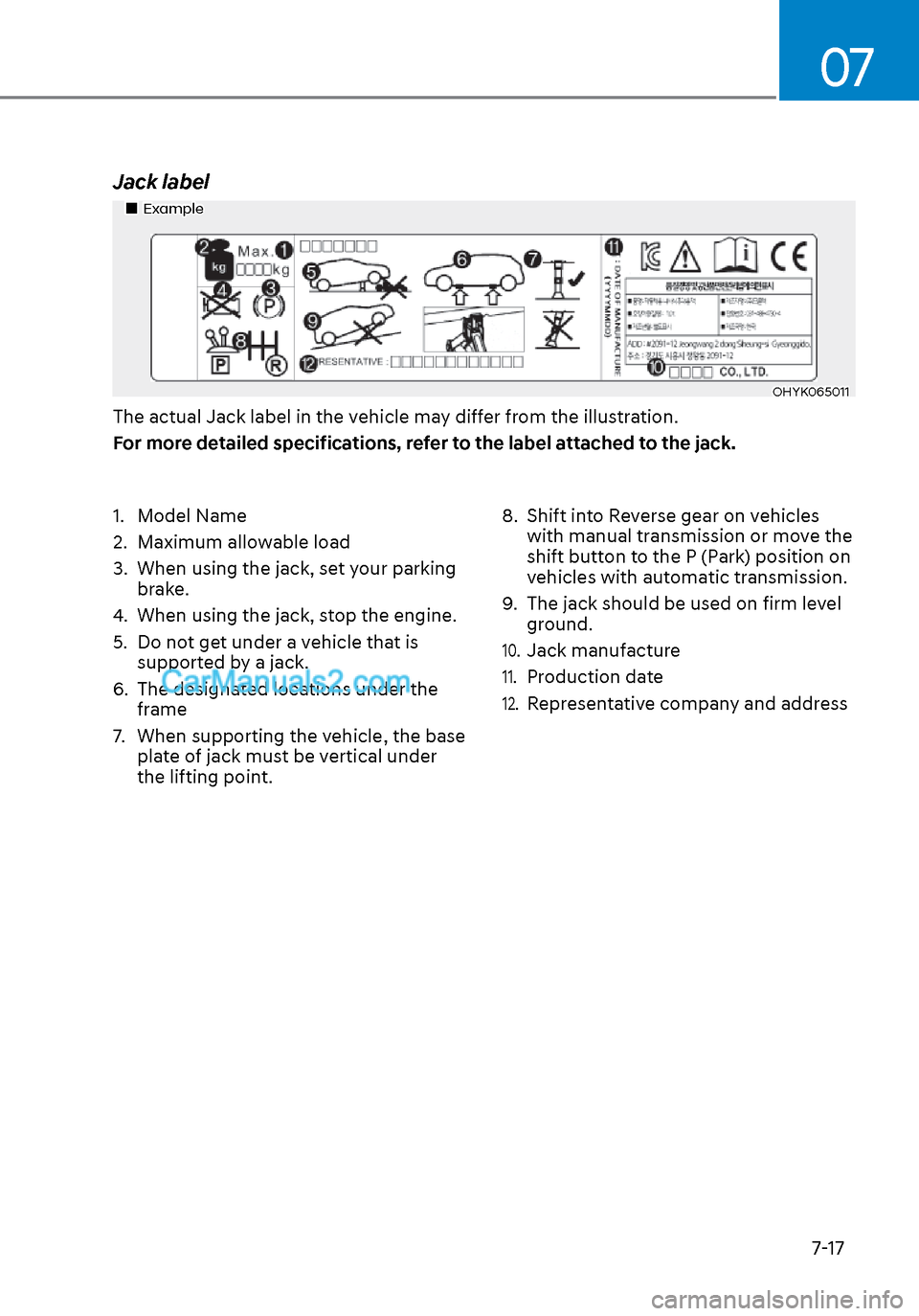
Jack label
ExampleExample
OHYK065011OHYK065011
The actual Jack label in the vehicle may differ from the illustration.
For more detailed specifications, refer to the label attached to the jack.
1. Model Name
2. Maximum allowable load
3. When using the jack, set your parking brake.
4. When using the jack, stop the engine.
5. Do not get under a vehicle that is supported by a jack.
6. The designated locations under the frame
7. When supporting the vehicle, the base plate of jack must be vertical under
the lifting point. 8. Shift into Reverse gear on vehicles
with manual transmission or move the
shift button to the P (Park) position on
vehicles with automatic transmission.
9. The jack should be used on firm level ground.
10. Jack manufacture
11. Production date
12. Representative company and address
Page 448 of 537

Engine Compartment ........................................................................\
............ 8-3
Maintenance Services ........................................................................\
...........8-4
Owner’s Responsibility ........................................................................\
.................... 8-4
Owner Maintenance Precautions ........................................................................\
.... 8-4
Owner Maintenance ........................................................................\
.............. 8-5Owner Maintenance Schedule ........................................................................\
........ 8-5
Scheduled Maintenance Services ................................................................ 8-7Normal Maintenance Schedule (Smartstream G1.6 T-GDi) ...................................8-8
Maintenance Under Severe Usage Conditions (Smartstream G1.6 T-GDi) ......... 8-11
Severe Driving Conditions ........................................................................\
.............. 8-11
Normal Maintenance Schedule (Smartstream G2.5 GDi) ..................................... 8-12
Maintenance Under Severe Usage Conditions (Smartstream G2.5 GDi) ................8-15
Severe Driving Conditions ........................................................................\
..............8-15
Explanation of Scheduled Maintenance Items .......................................... 8-16
Engine Oil ........................................................................\
............................. 8-19
Checking the Engine Oil Level ........................................................................\
........8-19
Checking the Engine Oil and Filter ....................................................................... 8-20
Engine Coolant ........................................................................\
......................8-21Checking the Engine Coolant Level ....................................................................... 8-21
Engine Coolant ........................................................................\
................................ 8-21
Changing Engine Coolant ........................................................................\
.............. 8-23
Brake fluid ........................................................................\
............................ 8-24Checking the Brake Fluid Level ........................................................................\
..... 8-24
Washer Fluid ........................................................................\
......................... 8-25Checking the Washer Fluid Level ........................................................................\
.. 8-25
Air Cleaner ........................................................................\
............................ 8-26Filter Replacement ........................................................................\
......................... 8-26
Climate Control Air Filter ........................................................................\
..... 8-28
Filter Inspection........................................................................\
.............................. 8-28
Filter Replacement ........................................................................\
......................... 8-28
Wiper Blades ........................................................................\
........................ 8-29Blade Inspection ........................................................................\
............................ 8-29
Blade Replacement ........................................................................\
........................ 8-29
Battery ....................................................................\
.......................................8-31For Best Battery Service ........................................................................\
................ 8-32
Battery Recharging ........................................................................\
........................ 8-32
Reset Features ........................................................................\
................................ 8-33
8. Maintenance
8
Page 451 of 537
Maintenance8-4
You should exercise the utmost care
to prevent damage to your vehicle and
injury to yourself whenever performing
any maintenance or inspection
procedures.
We recommend you have your
vehicle maintained and repaired by
an authorized HYUNDAI dealer. An
authorized HYUNDAI dealer meets
HYUNDAI’s high service quality
standards and receives technical support
from HYUNDAI in order to provide you
with a high level of service satisfaction.
Owner’s Responsibility
Maintenance service and record
retention are the owner’s responsibility.
You should retain documents that show
proper maintenance has been performed
on your vehicle in accordance with
the scheduled maintenance service
charts shown on the following pages.
You need this information to establish
your compliance with the servicing
and maintenance requirements of your
vehicle warranties.
Detailed warranty information is
provided in your Owner’s Handbook &
Warranty Information booklet.
Repairs and adjustments required as a
result of improper maintenance or a lack
of required maintenance are not covered.
Owner Maintenance Precautions
Inadequate, incomplete or insufficient
servicing may result in operational
problems with your vehicle that could
lead to vehicle damage, an accident, or
personal injury. This chapter provides
instructions only for the maintenance
items that are easy to perform. Several
procedures can be done only by an
authorized HYUNDAI dealer with special
tools.
Your vehicle should not be modified
in any way. Such modifications may
adversely affect the performance, safety
or durability of your vehicle and may, in
addition, violate conditions of the limited
warranties covering the vehicle.
Certain modifications may also be in
violation of regulations established by
the U.S. Department of Transportation
and other federal or state agencies.
NOTICE
Improper owner maintenance during
the warranty period may affect
warranty coverage. For details, read
the separate Owner’s Handbook &
Warranty Information booklet provided
with the vehicle. If you’re unsure about
any service or maintenance procedure,
have it done by an authorized HYUNDAI
dealer.
MAINTENANCE SERVICES
Page 452 of 537
08
8-5
WARNING
Performing maintenance work on a
vehicle can be dangerous. If you lack
sufficient knowledge and experience or
the proper tools and equipment to do
the work, have it done by an authorized
HYUNDAI dealer.
ALWAYS follow these precautions for
performing maintenance work:
• Park your vehicle on level ground,
move the shift button into the P
(Park) position, place the ignition
switch in the LOCK/OFF position.
• Block the tires (front and back) to
prevent the vehicle from moving.
Remove loose clothing or jewelry
that can become entangled in
moving parts.
• If you must run the engine during
maintenance, do so out doors or in
an area with plenty of ventilation.
• Keep flames, sparks, or smoking
materials away from the battery and
fuel-related parts. The following lists are vehicle checks and
inspections that should be performed
by the owner or an authorized HYUNDAI
dealer at the frequencies indicated to
help ensure safe, dependable operation
of your vehicle.
Any adverse conditions should be
brought to the attention of your dealer as
soon as possible.
These Owner Maintenance vehicle
checks are generally not covered by
warranties and you may be charged for
labor, parts and lubricants used.
Owner Maintenance Schedule
When you stop for fuel:
• Check the engine oil level.
• Check the coolant level in the engine
coolant reservoir.
• Check the windshield washer fluid level.
• Check the for low or under-inflated tires.
WARNING
Be careful when checking your engine
coolant level when the engine is hot.
This may result in coolant being blown
out of the opening and cause serious
burns and other injuries.
OWNER MAINTENANCE
Page 454 of 537
08
8-7
Follow Normal Maintenance Schedule if the vehicle is usually operated where none of
the following conditions apply. If any of the following conditions apply, you must follow
the Maintenance Under Severe Usage Conditions.
• Repeated short distance driving.
• Driving in dusty conditions or sandy areas.
• Extensive use of brakes.
• Driving in areas where salt or other corrosive materials are used.
• Driving on rough or muddy roads.
• Driving in mountainous areas.
• Extended periods of idling or low speed operation.
• Driving for a prolonged period in cold temperatures and/or extremely humid climates.
• More than 50% driving in heavy city traffic during hot weather above 90°F (32°C).
For additional information or assistance see your authorized HYUNDAI dealer.
SCHEDULED MAINTENANCE SERVICES
Page 458 of 537

08
8-11
Maintenance Under Severe Usage Conditions (Smartstream G1.6 T-GDi)
The following items must be serviced more frequently on cars normally used under
severe driving conditions. Refer to the chart below for the appropriate maintenance
intervals.
R: Replace or change.
I : Inspect and if necessary, adjust, correct, clean or replace.
MAINTENANCE ITEMMAINTENANCE
OPERATION MAINTENANCE
INTERVALS DRIVING
CONDITION
Engine oil and filter RE
very 3,000 miles or
6 months A, B, C, D, E,
F, G, H, I, J, K
Air cleaner filter RMore frequently C, E
Spark plugs RMore frequently A, B, H, I, K
Automatic transmission fluid
(if equipped) R Every 60,000 miles A, C, E, F, G, I
Front brake disc/pads, calipers IMore frequently C, D, G, H
Rear brake shoes or disc/pads IMore frequently C, D, G, F
Parking brake IMore frequently C, D, G, H
Steering gear box, linkage &
boots/ lower arm ball joint,
upper arm ball joint I
More frequently C, D, E, F, G,
H, I
Suspension mounting bolts IMore frequently C, D, E, F, G,
H, I
Drive shafts and boots IEvery 3,000 miles or
6 months C, D, E, F, G,
H, I
Climate control air filter
(for evaporator and blower unit) R
More frequently C, E
Severe Driving Conditions
A. Repeatedly driving short distances
of less than 5 miles (8 km) in normal
temperature or less than 10 miles (16
km) in freezing temperature
B. Extensive engine idling or low speed driving for long distances
C. Driving on rough, dusty, muddy, unpaved, graveled or salt- spread
roads
D. Driving in areas using salt or other corrosive materials or in very cold
weather E. Driving in sandy areas
F. Driving in heavy traffic area over 90°F
(32°C)
G. Driving on uphill, downhill, or mountain road
H. Towing a Trailer, or using a camper, or roof rack
I. Driving as a patrol car, taxi, other commercial use or vehicle towing
J. Driving over 106 mph (170 km/h)
K. Frequently driving in stop-and-go conditions