2020 FORD TRANSIT power steering
[x] Cancel search: power steeringPage 288 of 529

Pre-fuse Box
Protected Component
Fuse Rating
Item
Body control module.
125 A
1
Electronic power assist steering.
80 A
2
Positive temperature coefficient heater.
150 A
3
Not used.
-
4
Not used.
-
5
Passenger compartment fuse box.
150 A
6
Camper.
60 A
7
Not used.
-
8
Starter motor.
500 A
9
Alternator.
Engine compartment fuse box.
300 A
10
Dual generators.
250 A
11
285
2020 Transit (TTH) Canada/United States of America, LK3J 19A321 HA enUSA, Edition date: 201911, First-Printing Fuses8
14
15
13
9
10
11
12
1
2
3
4
5
6
7E296043
Page 304 of 529

Continued operation increases the engine
temperature, causing the engine to
completely shut down. Your steering and
braking effort increases in this situation.
When the engine temperature cools, you
can re-start the engine. Have your vehicle
checked as soon as possible to minimize
engine damage.
When Fail-Safe Mode Is Activated
WARNING: Fail-safe mode is for
use during emergencies only. Operate
your vehicle in fail-safe mode only as
long as necessary to bring your vehicle
to rest in a safe location and seek
immediate repairs. When in fail-safe
mode, your vehicle will have limited
power, will not be able to maintain
high-speed operation, and may
completely shut down without warning,
potentially losing engine power, power
steering assist, and power brake assist,
which may increase the possibility of a
crash resulting in serious injury. WARNING:
Do not remove the
coolant reservoir cap when the engine is
on or the cooling system is hot. Wait 10
minutes for the cooling system to cool
down. Cover the coolant reservoir cap
with a thick cloth to prevent the
possibility of scalding and slowly remove
the cap. Failure to follow this instruction
could result in personal injury.
Your vehicle has limited engine power
when in the fail-safe mode, drive your
vehicle with caution. Your vehicle does not
maintain high-speed operation and the
engine may operate poorly.
Remember that the engine is capable of
automatically shutting down to prevent
engine damage. In this situation:
1. Pull off the road as soon as safely possible and switch the engine off. 2. If you are a member of a roadside
assistance program, we recommend
that you contact your roadside
assistance service provider.
3. If this is not possible, wait for a short period of time for the engine to cool.
4. Check the coolant level. If the coolant level is at or below the minimum mark,
add prediluted coolant immediately.
5. When the engine temperature cools, you can re-start the engine. Have your
vehicle checked as soon as possible to
minimize engine damage.
Note: Driving your vehicle without repair
increases the chance of engine damage.
Engine Coolant Temperature
Management
(If Equipped) WARNING:
To reduce the risk of
crash and injury, be prepared that the
vehicle speed may reduce and the
vehicle may not be able to accelerate
with full power until the coolant
temperature reduces.
If you tow a trailer with your vehicle, the
engine may temporarily reach a higher
temperature during severe operating
conditions, for example ascending a long
or steep grade in high ambient
temperatures.
At this time, you may notice the coolant
temperature gauge moves toward the red
zone and a message may appear in the
information display.
301
2020 Transit (TTH) Canada/United States of America, LK3J 19A321 HA enUSA, Edition date: 201911, First-Printing Maintenance
Page 345 of 529
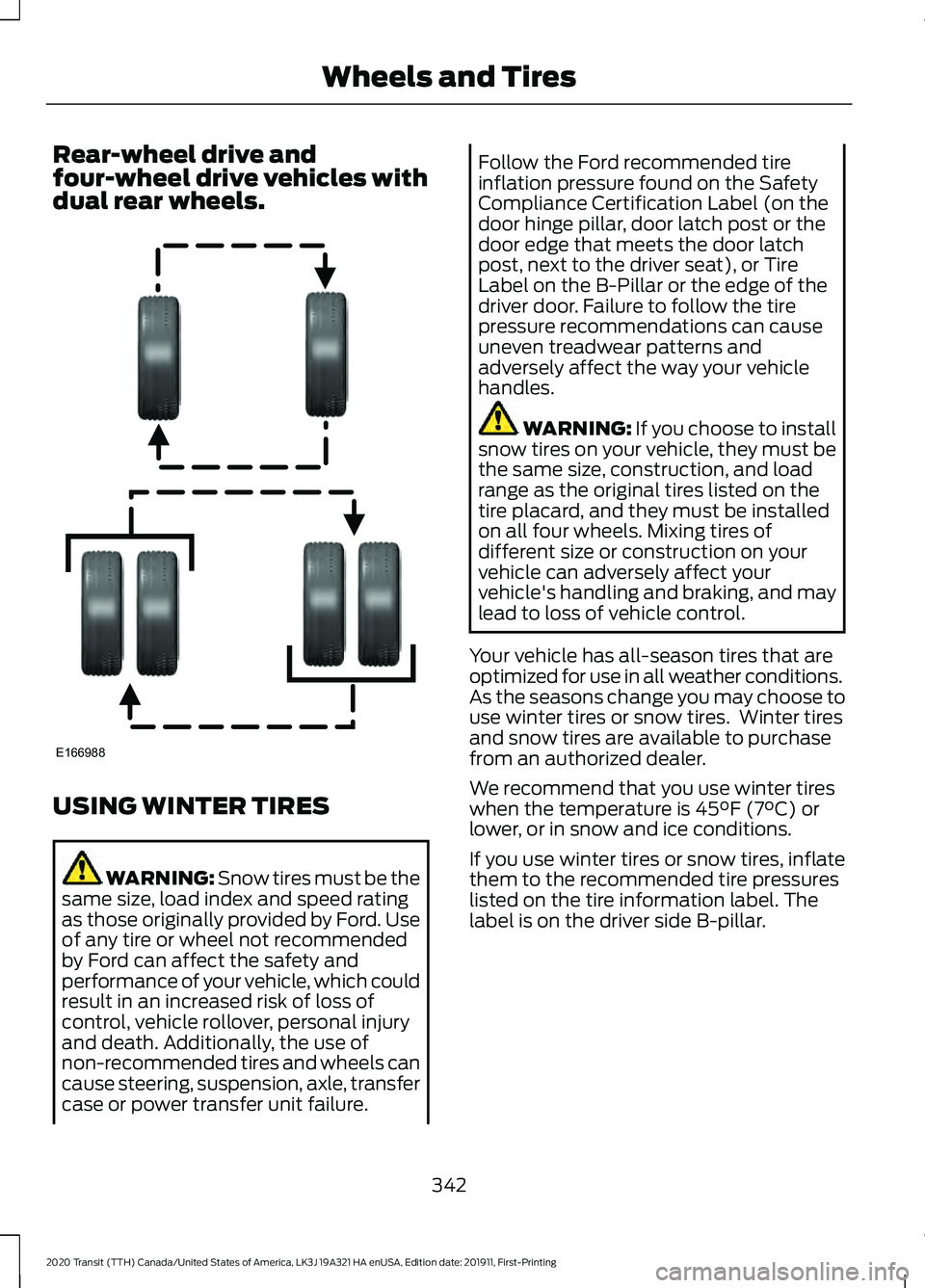
Rear-wheel drive and
four-wheel drive vehicles with
dual rear wheels.
USING WINTER TIRES
WARNING: Snow tires must be the
same size, load index and speed rating
as those originally provided by Ford. Use
of any tire or wheel not recommended
by Ford can affect the safety and
performance of your vehicle, which could
result in an increased risk of loss of
control, vehicle rollover, personal injury
and death. Additionally, the use of
non-recommended tires and wheels can
cause steering, suspension, axle, transfer
case or power transfer unit failure. Follow the Ford recommended tire
inflation pressure found on the Safety
Compliance Certification Label (on the
door hinge pillar, door latch post or the
door edge that meets the door latch
post, next to the driver seat), or Tire
Label on the B-Pillar or the edge of the
driver door. Failure to follow the tire
pressure recommendations can cause
uneven treadwear patterns and
adversely affect the way your vehicle
handles.
WARNING: If you choose to install
snow tires on your vehicle, they must be
the same size, construction, and load
range as the original tires listed on the
tire placard, and they must be installed
on all four wheels. Mixing tires of
different size or construction on your
vehicle can adversely affect your
vehicle's handling and braking, and may
lead to loss of vehicle control.
Your vehicle has all-season tires that are
optimized for use in all weather conditions.
As the seasons change you may choose to
use winter tires or snow tires. Winter tires
and snow tires are available to purchase
from an authorized dealer.
We recommend that you use winter tires
when the temperature is
45°F (7°C) or
lower, or in snow and ice conditions.
If you use winter tires or snow tires, inflate
them to the recommended tire pressures
listed on the tire information label. The
label is on the driver side B-pillar.
342
2020 Transit (TTH) Canada/United States of America, LK3J 19A321 HA enUSA, Edition date: 201911, First-Printing Wheels and TiresE166988
Page 407 of 529
![FORD TRANSIT 2020 Owners Manual If a crash deploys an airbag (excluding
knee airbags and rear inflatable safety
belts [if equipped]) or activates the fuel
pump shut-off, your SYNC-equipped
vehicle may be able to contact emergency
se](/manual-img/11/40676/w960_40676-406.png "FORD TRANSIT 2020 Owners Manual If a crash deploys an airbag (excluding
knee airbags and rear inflatable safety
belts [if equipped]) or activates the fuel
pump shut-off, your SYNC-equipped
vehicle may be able to contact emergency
se")
If a crash deploys an airbag (excluding
knee airbags and rear inflatable safety
belts [if equipped]) or activates the fuel
pump shut-off, your SYNC-equipped
vehicle may be able to contact emergency
services by dialing 911 through a paired and
connected Bluetooth-enabled phone.
See Supplementary Restraints System
(page 51). Important information about
airbag deployment is in this chapter.
See
Roadside Emergencies (page 257).
Important information about the fuel pump
shut-off is in this chapter.
Setting 911 Assist On or Off
Press the Settings button then select: Action and Description
Menu
Item
Select the desired option, on
or off.
911 Assist
To make sure that 911 Assist works
properly:
• SYNC must be powered and working
properly at the time of the incident and
throughout feature activation and use.
• The 911 Assist feature must be set on
before the incident.
• You must pair and connect a Bluetooth
enabled and compatible cell phone to
SYNC.
• A connected Bluetooth enabled phone
must have the ability to make and
maintain an outgoing call at the time
of the incident.
• A connected Bluetooth enabled phone
must have adequate network coverage,
battery power and signal strength.
• The vehicle must have battery power
and be located in the U.S., Canada or
in a territory in which 911 is the
emergency number. In the Event of a Crash
Not all crashes deploy an airbag or activate
the fuel pump shut-off (the triggers for 911
Assist). If a connected cell phone sustains
damage or loses its connection to SYNC
during a crash, SYNC searches for and tries
to connect to a previously paired cell
phone; SYNC then attempts to call the
emergency services.
Before making the call:
•
SYNC provides a short window of time
(about 10 seconds) to cancel the call.
If you fail to cancel the call, SYNC
attempts to dial 911.
• SYNC says the following, or a similar
message: "SYNC will attempt to call
911, to cancel the call, press Cancel on
your screen or press and hold the
phone button on your steering wheel".
If you do not cancel the call, and SYNC
makes a successful call, a pre-recorded
message plays for the 911 operator, and
then the occupant(s) in your vehicle are
able to talk with the operator. Be prepared
to provide your name, phone number and
location immediately, because not all 911
systems are capable of receiving this
information electronically.
911 Assist May Not Work If
• Your cellular phone or 911 Assist
hardware sustains damage in a crash.
• The vehicle's battery or the SYNC
system has no power.
• The phone(s) thrown from your vehicle
are the ones paired and connected to
the system.
404
2020 Transit (TTH) Canada/United States of America, LK3J 19A321 HA enUSA, Edition date: 201911, First-Printing SYNC™
Page 467 of 529

Check every six months
Battery connections. Clean if necessary.
Body and door drain holes for obstruc-
tions. Clean if necessary.
Cooling system fluid level and coolant
strength.
Door weatherstrips for wear. Lubricate if
necessary.
Front door check arms for correct opera-
tion.
Hinges, latches and outside locks for
correct operation. Lubricate if necessary.
Parking brake for correct operation.
Seatbelts and seat latches for wear and
function.
Safety warning lamps (brake, ABS, airbag
and seatbelt) for operation.
Washer spray and wiper operation. Clean
or replace blades as necessary.
Multi-point Inspection
In order to keep your vehicle running
correctly, it is important to have the
systems on your vehicle checked regularly.
This can help identify potential issues and
prevent major problems. We recommend
having the following multi-point inspection
performed at every scheduled
maintenance interval to help make sure
your vehicle keeps running correctly. Multi-point inspection
Accessory drive belt(s).
Battery performance.
Engine air filter. Multi-point inspection
Exhaust system.
Exterior lamps and hazard warning
system operation.
Fluid levels *
; fill if necessary.
For oil and fluid leaks.
Horn operation.
Radiator, cooler, heater and A/C hoses.
Suspension component for leaks or
damage.
Steering and linkage.
Tires (including spare) for wear and
correct pressure **
.
Windshield for cracks, chips or pits.
Washer spray and wiper operation.
* Brake, coolant recovery reservoir,
automatic transmission, power steering (if
equipped with hydraulic power assist
steering) and window washer.
** If your vehicle is equipped with a
temporary mobility kit, check the tire
sealant expiration Use By date on the
canister. Replace as needed.
Be sure to ask your dealership service
advisor or technician about the multi-point
vehicle inspection. It is a comprehensive
way to perform a thorough inspection of
your vehicle. Your checklist gives you
immediate feedback on the overall
condition of your vehicle.
464
2020 Transit (TTH) Canada/United States of America, LK3J 19A321 HA enUSA, Edition date: 201911, First-Printing Scheduled Maintenance
Page 523 of 529

Seatbelt Warning Lamp and Indicator
Chime...............................................................47
Conditions of operation..................................... 48
Seats.................................................................128
Security.............................................................90
Selective Catalytic Reductant System - 2.0L EcoBlue
...............................................164
Diesel Exhaust Fluid Guidelines.................... 164
Filling the Diesel Exhaust Fluid Tank..........164
Filling the Diesel Exhaust Fluid Tank Using a Container...................................................... 166
Filling the Diesel Exhaust Fluid Tank Using a Fuel Station Pump..................................... 165
Selective Catalytic Reductant System Warning Lamp................................................. 167
Settings...........................................................443 911 Assist............................................................... 444
Ambient Lighting............................................... 444
Audio...................................................................... 443
Automatic Updates.......................................... 444
Bluetooth.............................................................. 443
Charge Settings................................................. 444
Clock....................................................................... 443
Display................................................................... 444
Driver Assist......................................................... 444
FordPass............................................................... 444
General.................................................................. 444
Message Center................................................. 444
Mobile Apps........................................................ 444
Multi Contour Seats......................................... 444
Navigation............................................................ 444
Personal Profiles............................................... 444
Phone..................................................................... 443
Seats...................................................................... 444
Sound..................................................................... 443
Valet Mode........................................................... 444
Vehicle................................................................... 444
Voice Control...................................................... 444
Side Airbags
.....................................................58
Side Sensing System..................................196
Object Distance Indicator................................ 197
Sitting in the Correct Position..................128
Sliding Door Precautions.............................81
Sliding Door
.......................................................81
Closing the Sliding Door..................................... 81
Opening the Sliding Door................................... 81
Sliding Door – Troubleshooting..................... 86Sliding Door – Troubleshooting...............86
Sliding Door – Frequently Asked
Questions........................................................... 87
Sliding Door – Information Messages.........86
Snow Chains See: Using Snow Chains................................. 343
Spare Wheel See: Changing a Road Wheel....................... 349
Special Notices
................................................16
New Vehicle Limited Warranty........................ 16
Special Operating Conditions Scheduled Maintenance...............................................467
Exceptions........................................................... 469
Speed Control See: Cruise Control........................................... 206
Speed Limiter
.................................................214
Principle of Operation....................................... 214
Using Speed Limiter.......................................... 214
Stability Control
............................................189
Principle of Operation...................................... 189
Starter Switch See: Ignition Switch........................................... 143
Starting a Diesel Engine.............................145 Engine Warning Lamps.................................... 146
Failure to Start..................................................... 145
Glow Plug Indicator........................................... 146
Guarding Against Exhaust Fumes...............146
Important Ventilating Information..............146
Starting the Engine............................................ 145
Stopping the Engine When Your Vehicle is Moving............................................................... 146
Stopping the Engine When Your Vehicle is Stationary......................................................... 146
Starting a Gasoline Engine........................143 Engine Warning Lamps.................................... 145
Failure to Start..................................................... 144
Guarding Against Exhaust Fumes................144
Important Ventilating Information...............145
Starting the Engine............................................ 144
Stopping the Engine When Your Vehicle is Moving............................................................... 144
Stopping the Engine When Your Vehicle is Stationary......................................................... 144
Starting and Stopping the Engine..........143 General Information.......................................... 143
Steering...........................................................228 Adaptive Learning............................................. 229
Electric Power Steering................................... 228
520
2020 Transit (TTH) Canada/United States of America, LK3J 19A321 HA enUSA, Edition date: 201911, First-Printing Index