2020 FORD EXPEDITION roof
[x] Cancel search: roofPage 5 of 542

Steering Wheel
Adjusting the Steering Wheel - Vehicles
With: Manual Adjustable Steering
Column ..........................................................87
Adjusting the Steering Wheel - Vehicles With: Power Adjustable Steering
Column ..........................................................
87
Audio Control .................................................
88
Voice Control ..................................................
89
Cruise Control - Vehicles With: Adaptive Cruise Control ............................................
89
Cruise Control - Vehicles With: Cruise Control ..........................................................
89
Information Display Control .....................
89
Heated Steering Wheel ..............................
89
Horn ...................................................................
90
Adjustable Pedals
Adjusting the Pedals .....................................
91
Wipers and Washers
Windshield Wipers ........................................
92
Autowipers ......................................................
92
Windshield Washers ....................................
93
Rear Window Wiper and Washers ..........
93
Lighting
General Information ....................................
94
Lighting Control .............................................
94
Autolamps .......................................................
95
Instrument Lighting Dimmer ....................
95
Headlamp Exit Delay ...................................
95
Daytime Running Lamps - Vehicles With: Configurable Daytime Running Lamps
........................................................................\
..
96
Daytime Running Lamps - Vehicles With: Daytime Running Lamps (DRL) .........
96
Front Fog Lamps ...........................................
96
Direction Indicators .......................................
97
Interior Lamps ................................................
97
Ambient Lighting ..........................................
98Automatic High Beam Control
What Is Automatic High Beam Control
........................................................................\
..
99
Switching Automatic High Beam Control On and Off ..................................................
99
Automatic High Beam Control Indicators ........................................................................\
..
99
Overriding Automatic High Beam Control ........................................................................\
..
99
Windows and Mirrors
Power Windows ............................................
101
Global Opening and Closing ....................
101
Exterior Mirrors .............................................
102
Interior Mirror .................................................
103
Childminder Mirror ......................................
104
Sun Visors ......................................................
104
Moonroof ........................................................
105
Liftgate Window ..........................................
106
Instrument Cluster
Gauges .............................................................
107
Warning Lamps and Indicators ...............
110
Audible Warnings and Indicators ............
113
Information Displays
General Information ....................................
114
Information Messages ...............................
123
Climate Control
Manual Climate Control ............................
139
Automatic Climate Control .......................
141
Hints on Controlling the Interior Climate - Vehicles With: Automatic
Temperature Control ..............................
143
Hints on Controlling the Interior Climate - Vehicles With: Manual Temperature
Control .........................................................
144
Rear Passenger Climate Controls - Vehicles With: Automatic
Temperature Control .............................
145
2
Expedition (TB8) Canada/United States of America, enUSA, Edition date: 201907, Third-Printing- Table of Contents
Page 7 of 542

Parking Aids
Principle of Operation
................................218
Rear Parking Aid ...........................................
219
Front Parking Aid ........................................
220
Side Sensing System .................................
222
Active Park Assist ........................................
223
Rear View Camera .....................................
230
360 Degree Camera ..................................
233
Cruise Control
What Is Cruise Control ..............................
236
Switching Cruise Control On and Off ........................................................................\
236
Setting the Cruise Control Speed .........
236
Canceling the Set Speed ..........................
237
Resuming the Set Speed ..........................
237
Cruise Control Indicators ..........................
237
Using Adaptive Cruise Control ...............
237
Driving Aids
Driver Alert ....................................................
244
Lane Keeping System ...............................
245
Blind Spot Information System ............
249
Cross Traffic Alert .......................................
253
Steering ..........................................................
256
Pre-Collision Assist ....................................
257
Drive Control ..................................................
261
Load Carrying
Rear Under Floor Storage ........................
265
Cargo Nets .....................................................
267
Roof Racks and Load Carriers ...............
268
Load Limit .....................................................
269
Towing
Towing a Trailer ............................................
275
Trailer Reversing Aids ................................
276
Trailer Sway Control ..................................
285
Recommended Towing Weights ..........
286Essential Towing Checks
.........................
289
Towing the Vehicle on Four Wheels .....
296
Driving Hints
Reduced Engine Performance ..............
299
Economical Driving ....................................
299
Breaking-In ...................................................
300
Driving Through Water .............................
300
Floor Mats .....................................................
300
Roadside Emergencies
Roadside Assistance .................................
302
Hazard Flashers ..........................................
303
Fuel Shutoff ..................................................
303
Jump Starting the Vehicle .......................
304
Post-Crash Alert System .........................
306
Transporting the Vehicle .........................
306
Towing Points ...............................................
307
Customer Assistance
Getting the Services You Need .............
308
In California (U.S. Only) ...........................
309
The Better Business Bureau (BBB) Auto Line Program (U.S. Only) .....................
310
Utilizing the Mediation/Arbitration Program (Canada Only) ........................
311
Getting Assistance Outside the U.S. and Canada .........................................................
311
Ordering Additional Owner's Literature ........................................................................\
.
313
Reporting Safety Defects (U.S. Only) ........................................................................\
.
313
Reporting Safety Defects (Canada Only) ........................................................................\
.
313
Fuses
Fuse Box Locations .....................................
315
Fuse Specification Chart ..........................
315
Changing a Fuse ..........................................
323
4
Expedition (TB8) Canada/United States of America, enUSA, Edition date: 201907, Third-Printing- Table of Contents
Page 42 of 542
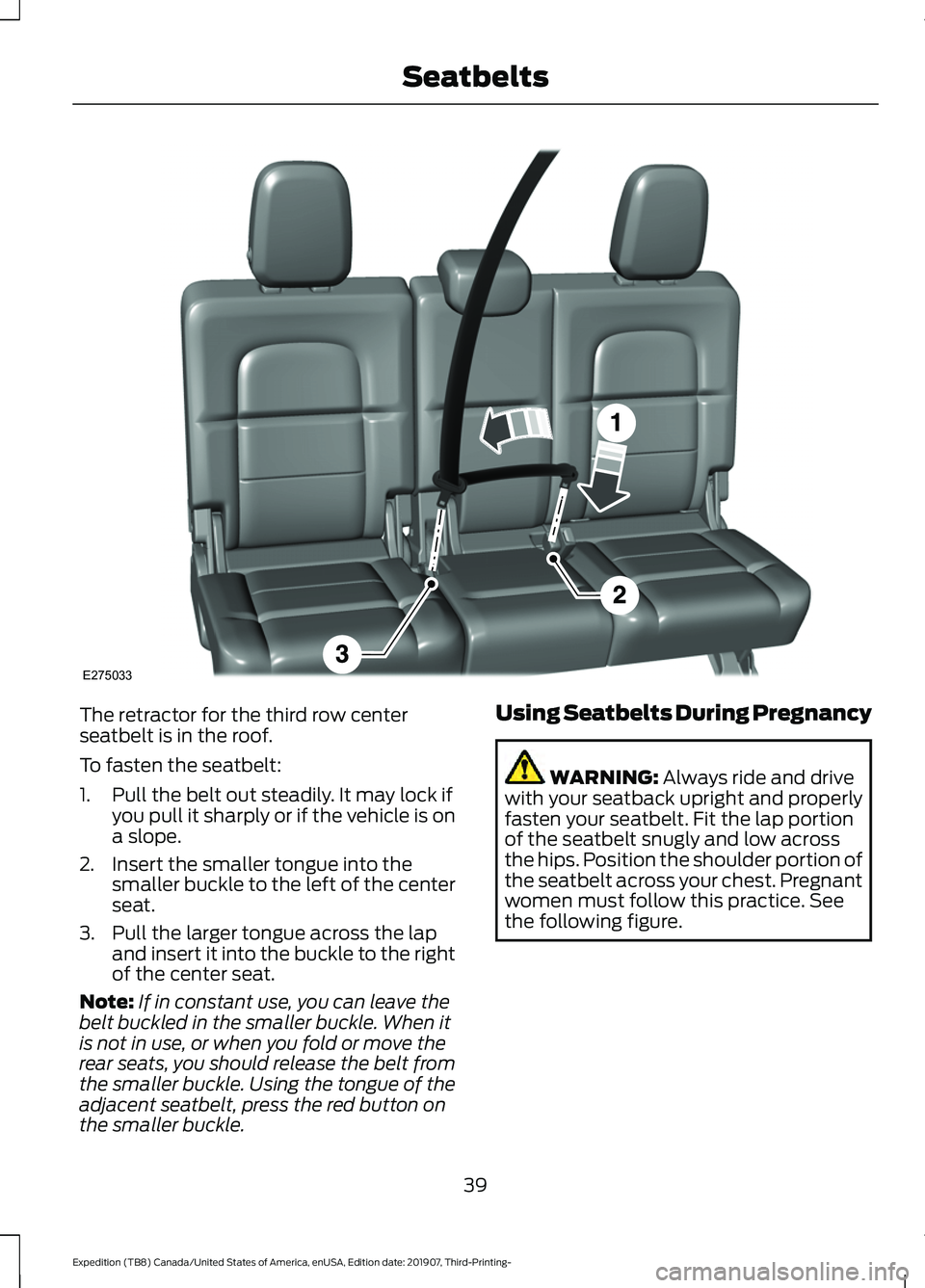
The retractor for the third row center
seatbelt is in the roof.
To fasten the seatbelt:
1. Pull the belt out steadily. It may lock if
you pull it sharply or if the vehicle is on
a slope.
2. Insert the smaller tongue into the smaller buckle to the left of the center
seat.
3. Pull the larger tongue across the lap and insert it into the buckle to the right
of the center seat.
Note: If in constant use, you can leave the
belt buckled in the smaller buckle. When it
is not in use, or when you fold or move the
rear seats, you should release the belt from
the smaller buckle. Using the tongue of the
adjacent seatbelt, press the red button on
the smaller buckle. Using Seatbelts During Pregnancy WARNING: Always ride and drive
with your seatback upright and properly
fasten your seatbelt. Fit the lap portion
of the seatbelt snugly and low across
the hips. Position the shoulder portion of
the seatbelt across your chest. Pregnant
women must follow this practice. See
the following figure.
39
Expedition (TB8) Canada/United States of America, enUSA, Edition date: 201907, Third-Printing- SeatbeltsE275033
Page 57 of 542

The Safety Canopy deploys during
significant side crashes or when a certain
likelihood of a rollover event is detected
by the rollover sensor. The Safety Canopy
is mounted to the roof side rail sheet metal,
behind the headliner, above each row of
seats. In certain sideways crashes or
rollover events, the Safety Canopy will be
activated, regardless of which seats are
occupied. The Safety Canopy is designed
to inflate between the side window area
and occupants to further enhance
protection provided in side impact crashes
and rollover events.
The system consists of the following:
•
Safety Canopy curtain airbags above
the trim panels over the front and rear
side windows identified by a label or
wording on the headliner or roof-pillar
trim.
• A flexible headliner which opens above
the side doors to allow air curtain
deployment · Crash sensors and monitoring
system with a readiness
indicator. See Crash Sensors
and Airbag Indicator (page 54). Properly restrain children 12 years old and
under in the rear seats. The Safety Canopy
will not interfere with children restrained
using a properly installed child or booster
seat because it is designed to inflate
downward from the headliner above the
doors along the side window opening.
The design and development of the Safety
Canopy included recommended testing
procedures that were developed by a
group of automotive safety experts known
as the Side Airbag Technical Working
Group. These recommended testing
procedures help reduce the risk of injuries
related to the deployment of side airbags
(including the Safety Canopy).
CRASH SENSORS AND
AIRBAG INDICATOR
WARNING:
Modifying or adding
equipment to the front end of your
vehicle (including hood, bumper system,
frame, front end body structure, tow
hooks and hood pins) may affect the
performance of the airbag system,
increasing the risk of injury. Do not
modify or add equipment to the front
end of your vehicle.
Your vehicle has a collection of crash and
occupant sensors which provide
information to the restraints control
module which deploys (activates) the
front seatbelt pretensioners, the adaptive
steering column, driver airbag, passenger
airbag, rear inflatable belts, seat mounted
side airbags, and the Safety Canopy. Based
on the type of crash, the restraints control
module will deploy the appropriate safety
devices.
54
Expedition (TB8) Canada/United States of America, enUSA, Edition date: 201907, Third-Printing- Supplementary Restraints System E75004 E67017
Page 88 of 542

USING POWER RUNNING
BOARDS
WARNING: In extreme climates,
excessive ice buildup may occur, causing
the running boards not to deploy. Make
sure that the running boards have
deployed, and have finished moving
before attempting to step on them. The
running boards will resume normal
function once the blockage is cleared. WARNING:
Turn off the running
boards before jacking or placing any
object under your vehicle. Never place
your hand between the extended running
board and your vehicle. A moving running
board may cause injury.
Note: Do not use the running boards, front
and rear hinge assemblies, running board
motors, or the running board underbody
mounts to lift your vehicle when jacking.
Always use proper jacking points.
Note: The running boards may operate
more slowly in cool temperatures.
Note: The running board mechanism may
trap debris such as mud, dirt, snow, ice and
salt. This may cause unwanted noise. If this
happens, manually set the running boards
to the deployed position. Then, wash the
system, in particular the front and rear hinge
arms, with a high-pressure car wash wand. Automatic Power Deploy The running boards automatically extend
down and out when you open the door.
This can help you enter and exit your
vehicle.
Automatic Power Stow
When you close the doors, the running
boards return to the stowed position after
a two-second delay.
Manual Power Deploy
You can manually operate the running
boards in the information display. See
General Information
(page 114).
Set the running boards in the deployed
position to access the roof.
The running boards return to the stowed
position and enter automatic mode when
the vehicle speed exceeds 5 mph (8 km/h).
Enabling and Disabling
You can enable and disable the power
running board feature in the information
display. See
General Information (page
114).
85
Expedition (TB8) Canada/United States of America, enUSA, Edition date: 201907, Third-Printing- Power Running Boards
(If Equipped)E166682
Page 108 of 542
Illuminated Vanity Mirror
Lift the cover to switch the lamp on.
MOONROOF (IF EQUIPPED)
WARNING:
Do not let children play
with the moonroof or leave them
unattended in the vehicle. They may
seriously hurt themselves. WARNING:
When closing the
moonroof, you should verify that it is free
of obstructions and make sure that
children and pets are not in the proximity
of the roof opening.
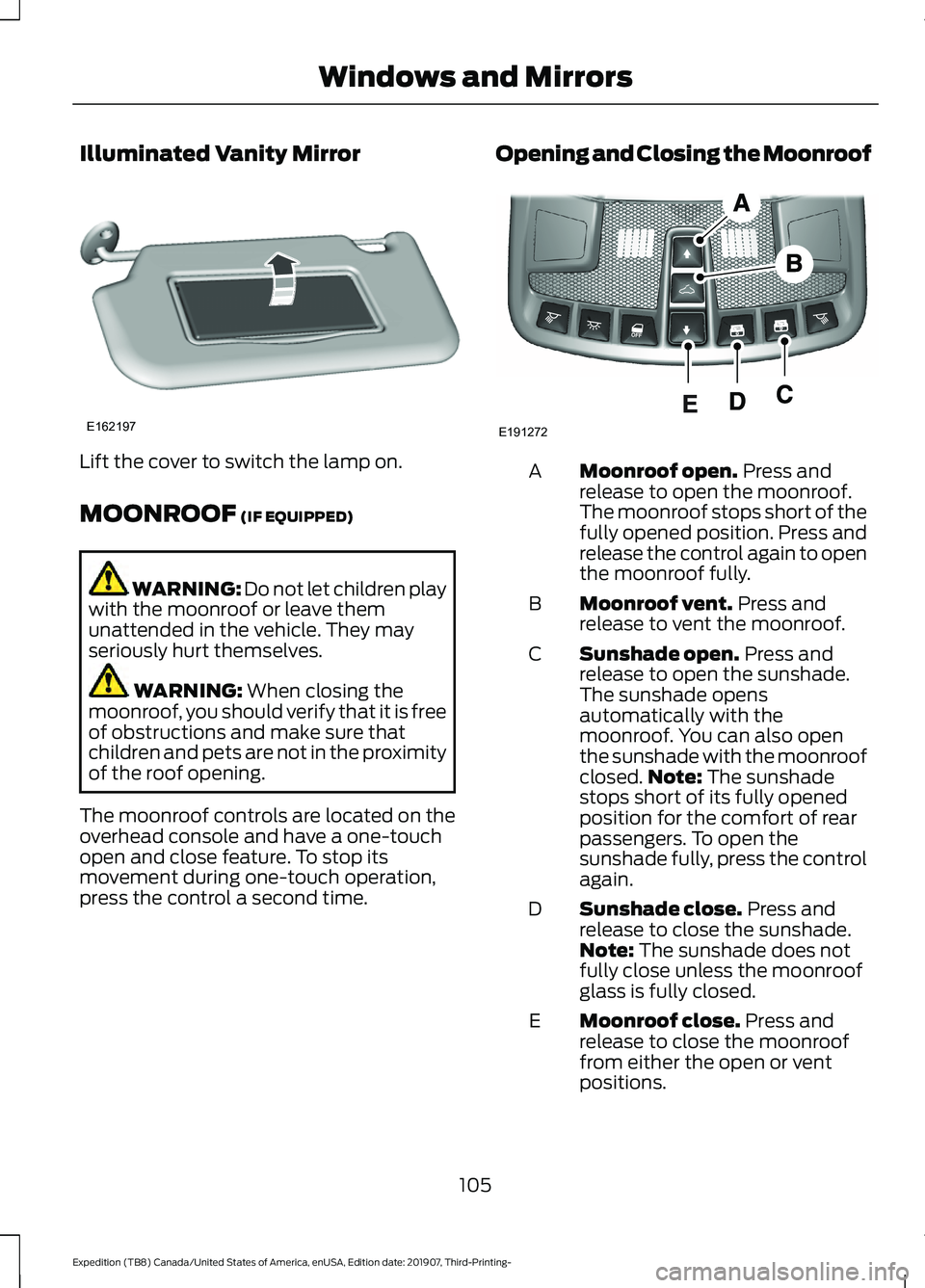
The moonroof controls are located on the
overhead console and have a one-touch
open and close feature. To stop its
movement during one-touch operation,
press the control a second time. Opening and Closing the Moonroof Moonroof open.
Press and
release to open the moonroof.
The moonroof stops short of the
fully opened position. Press and
release the control again to open
the moonroof fully.
A
Moonroof vent.
Press and
release to vent the moonroof.
B
Sunshade open.
Press and
release to open the sunshade.
The sunshade opens
automatically with the
moonroof. You can also open
the sunshade with the moonroof
C
closed. Note:
The sunshade
stops short of its fully opened
position for the comfort of rear
passengers. To open the
sunshade fully, press the control
again.
Sunshade close.
Press and
release to close the sunshade.
Note:
The sunshade does not
fully close unless the moonroof
glass is fully closed.
D
Moonroof close.
Press and
release to close the moonroof
from either the open or vent
positions.
E
105
Expedition (TB8) Canada/United States of America, enUSA, Edition date: 201907, Third-Printing- Windows and MirrorsE162197 E191272
Page 109 of 542
Bounce-Back
The moonroof automatically reverses
some distance if an obstacle is detected
while closing.
To override this feature, press and hold the
moonroof close control within two
seconds after the roof comes to a stop
following a bounce-back reversal.
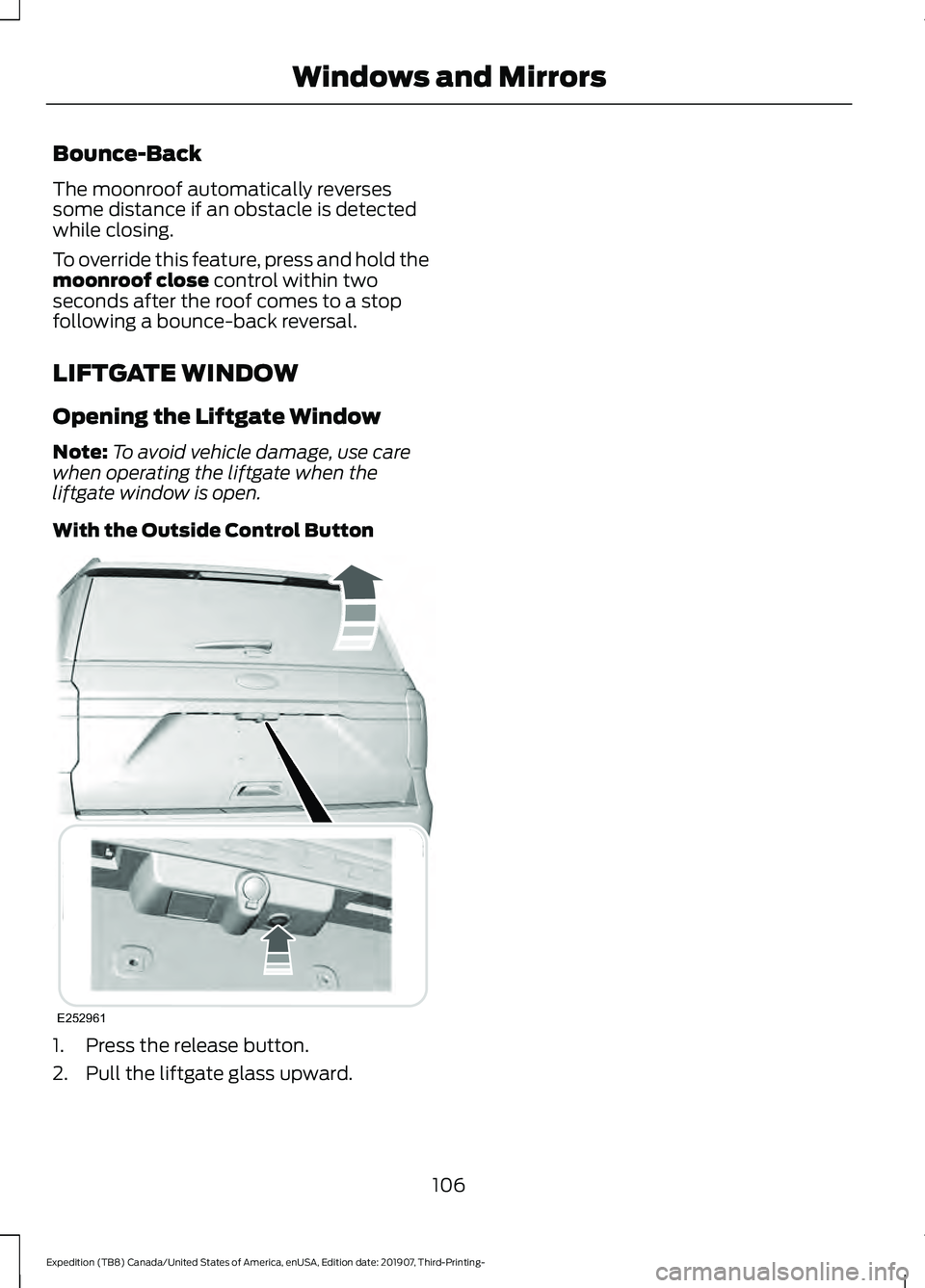
LIFTGATE WINDOW
Opening the Liftgate Window
Note: To avoid vehicle damage, use care
when operating the liftgate when the
liftgate window is open.
With the Outside Control Button 1. Press the release button.
2. Pull the liftgate glass upward.
106
Expedition (TB8) Canada/United States of America, enUSA, Edition date: 201907, Third-Printing- Windows and MirrorsE252961
Page 217 of 542
PRINCIPLE OF OPERATION
WARNING: Vehicle modifications
involving braking system, aftermarket
roof racks, suspension, steering system,
tire construction and wheel and tire size
may change the handling characteristics
of your vehicle and may adversely affect
the performance of the electronic
stability control system. In addition,
installing any stereo loudspeakers may
interfere with and adversely affect the
electronic stability control system. Install
any aftermarket stereo loudspeaker as
far as possible from the front center
console, the tunnel, and the front seats
in order to minimize the risk of interfering
with the electronic stability control
sensors. Reducing the effectiveness of
the electronic stability control system
could lead to an increased risk of loss of
vehicle control, vehicle rollover, personal
injury and death. WARNING:
Remember that even
advanced technology cannot defy the
laws of physics. It’ s always possible to
lose control of a vehicle due to
inappropriate driver input for the
conditions. Aggressive driving on any
road condition can cause you to lose
control of your vehicle increasing the risk
of personal injury or property damage.
Activation of the electronic stability
control system is an indication that at
least some of the tires have exceeded
their ability to grip the road; this could
reduce the operator ’s ability to control
the vehicle potentially resulting in a loss
of vehicle control, vehicle rollover,
personal injury and death. If your
electronic stability control system
activates, SLOW DOWN.
The system automatically turns on each
time you switch the ignition on. If a fault occurs in either the stability
control or the traction control system, you
may experience the following conditions:
•
The stability and traction control light
illuminates steadily.
• The stability control and traction
control systems do not enhance your
vehicle's ability to maintain traction of
the wheels.
If a driving condition activates either the
stability control or the traction control
system you may experience the following
conditions:
• The stability and traction control light
flashes.
• Your vehicle slows down.
• Reduced engine power.
• A vibration in the brake pedal.
• The brake pedal is stiffer than usual.
• If the driving condition is severe and
your foot is not on the brake, the brake
pedal may move as the system applies
higher brake force.
The stability control system has several
features built into it to help you maintain
control of your vehicle:
Electronic Stability Control
The system enhances your vehicle ’s ability
to prevent skids or lateral slides by
applying brakes to one or more of the
wheels individually and, if necessary,
reducing engine power.
Roll Stability Control
The system enhances your vehicle ’s ability
to prevent rollovers by detecting your
vehicle ’s roll motion and the rate at which
it changes by applying the brakes to one
or more wheels individually.
214
Expedition (TB8) Canada/United States of America, enUSA, Edition date: 201907, Third-Printing- Stability Control