2020 CITROEN C1 start
[x] Cancel search: startPage 80 of 269

78
C1_en_Chap04_conduite_ed01-2016
F With the parking brake applied, press the b
rake pedal then select position N.
F
S
tart the engine.
Moving off
if you do not press the brake pedal or if the gear selector is not in position N,
engine
starting is not possible. Never
leave a child unsupervised inside
t
he vehicle with the engine running.F
Sel
ect position E using the gear selector.
The gearbox then operates in auto-active
m
ode, without any intervention required by
t
he driver.
It continuously selects the most suitable g
ear for:
- o ptimised fuel consumption,
-
t
he driving style,
-
t
he profile of the road,
-
t
he load in the vehicle.
To
obtain optimum acceleration, when
ov
ertaking another vehicle for example, press
f
irmly on the accelerator pedal going beyond
t
he point of resistance.
Automatic (EASY) mode
It is possible to change mode at any time, by moving the gear selector from position E to
position M
and the other way round.
F
W
ith
your
foot
on
the
brake
pedal,
select
p
osition R
, E or M.
F
R
elease
the
parking
brake.
F
P
rogressively
release
the
brake
pedal.
A
ccelerate
away.
The
creep
function
may
be
temporarily
u
navailable
if
the
clutch
temperature
is
t
oo
high
or
the
gradient
too
steep.
An
a
udible
signal
gives
a
warning
if
the
c
lutch
temperature
is
too
high.
Never select neutral N when the vehicle
is
moving.
This
function
makes
manoeuvring
the
vehicle
a
t
low
speed
easier
(parking,
traffic
jams…).
After
first
placing
the
gear
selector
in
p
osition
E
, M or R , the vehicle moves off as
soon as you take your foot off the brake
pedal ,
at
low
speed,
with
the
engine
at
idle.
Creep function
Driving
Page 82 of 269

80
C1_en_Chap04_conduite_ed01-2016
The vehicle can be stopped whatever the position of the gear selector (N , E or R ).
However,
there is an audible signal on opening
t
he driver's door if the gear selector is not at
p
osition N .
Switching off
When the vehicle is stopped with the e
ngine running, always put the gear
s
elector to neutral N .
There
is a continuous audible signal
i
f you turn the ignition switch to "OFF "
with
the vehicle in 2
nd, 3rd, 4th or 5th ge a r.
In
this
case
return
the
ignition
switch
t
o " ON ",
move
the
gear
selector
to
p
osition
N , then to position E , M or R,
then
turn
the
ignition
switch
to
" OFF ".
On
a
slope,
use
the
brakes
to
i
mmobilise
the
vehicle
and
place
the
g
ear
selector
in
position
N , E or R . With
the ignition on, illumination
o
f this warning lamp indicates a
g
earbox fault.
Contact a CITROËN dealer or a
q
ualified
w
orkshop.
Operating faults
In all cases, it is essential
that you
apply the parking brake to immobilise
t
he vehicle.
Before
doing anything under the
b
onnet, check that the gear selector is
i
n neutral N and the parking brake is
a
pplied.
Limits of operation
On a gradient, or when hill start assist is activated, n ever hold the vehicle using the
accelerator :
you could damage the clutch.
In
these situations there is an audible signal.
F
M
ove the gear selector to position N.
F
W
ait 15 minutes to allow the clutch to cool
d
own before setting off. -
c
heck that the ignition switch is at the
"
O
N
"
position,
-
p
lace the gear selector at N
, then move it
t
o E
, M or R .
If 1 is flashing in the instrument panel:
- p lace the gear selector at E or M
, then
move it to N.
If R
is flashing in the instrument panel:
-
p
lace the gear selector at R,
then move it
t
o N.
If
N is flashing in the instrument panel
a
ccompanied by an audible signal for a long time:
Driving
Page 84 of 269
82
C1_en_Chap04_conduite_ed01-2016
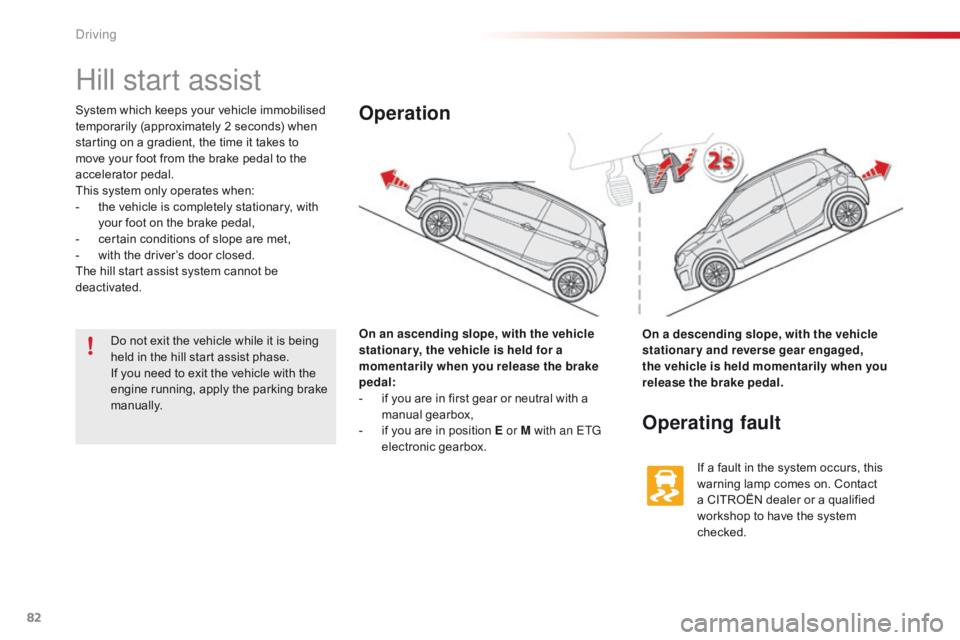
Hill start assist
System which keeps your vehicle immobilised temporarily (approximately 2 seconds) when
s
tarting on a gradient, the time it takes to
m
ove your foot from the brake pedal to the
a
ccelerator
ped
al.
This
system only operates when:
-
t
he vehicle is completely stationary, with
y
our foot on the brake pedal,
-
c
ertain conditions of slope are met,
-
w
ith the driver’s door closed.
The
hill start assist system cannot be
d
eactivated. On an ascending slope, with the vehicle
stationar y, the vehicle is held for a
momentarily when you release the brake
pedal:
-
i
f you are in first gear or neutral with a
m
anual
g
earbox,
-
i
f you are in position E or M with an ETG
electronic
ge
arbox.Operation
On a descending slope, with the vehicle
stationary and reverse gear engaged,
the vehicle is held momentarily when you
release the brake pedal.
Operating fault
If a fault in the system occurs, this warning lamp comes on. Contact
a
CITROËN dealer or a qualified
w
orkshop to have the system
c
hecked.
Do
not
exit
the
vehicle
while
it
is
being
h
eld
in
the
hill
start
assist
phase.
If
you
need
to
exit
the
vehicle
with
the
e
ngine
running,
apply
the
parking
brake
m
anually.
Driving
Page 85 of 269

83
C1_en_Chap04_conduite_ed01-2016
Stop & Start (VTi 68 S&S engine)
Operation
Going into engine STOP
mode
This indicator lamp comes on in the instrument panel and the engine
g
oes into standby automatically:
-
w
hen
stationary, in neutral, and you
r
elease the clutch pedal.
Never
refuel with the engine in
S
TOP mode; you must switch off the
i
gnition with the button.
For
smoother operation, during p
arking manoeuvres STOP mode is n
ot available for a few seconds after
c
oming out of reverse gear.
The
Stop & Start does not affect the
v
ehicle's systems, such as for example,
b
raking, power steering...
The
Stop
&
Start system
puts
the
engine
t
emporarily
into
standby
-
STOP
mode
-
during
s
tops
in
the
traffic
(red
lights,
traffic
jams,
or
o
ther...).
The
engine
restarts
automatically
-
S
TART
mode
-
as
soon
as
you
want
to
move
o
ff.
The
restart
takes
place
instantly,
quickly
a
nd
silently.
Per fect
for
urban
use,
the
Stop
&
Start
system
r
educes
fuel
consumption
and
exhaust
e
missions
as
well
as
the
noise
level
when
s
tationary.
Stop & Start time counters
A partial time counter counts the periods in S TOP mode during a journey.
It
is displayed in the trip computer once the
S
top & Start is operating.
Press one of the " DISP" buttons to return to the
previous
d
isplay.
A
global time counter counts the periods in
S
TOP mode since the last reset.
When
it is displayed, press one of the
"D
ISP " buttons
to reset the counter.
4
Driving
Page 86 of 269

84
C1_en_Chap04_conduite_ed01-2016
Going into engine START
mode
This indicator lamp goes off and the engine s tarts a utomatically:
-
w
hen
you fully
depress the clutch pedal.
START
mode is invoked automatically when:
-
y
ou
open the driver's door,
-
y
ou
open the bonnet,
-
y
ou
unfasten the driver's seat belt,
-
s
ome
special conditions (battery charge,
e
ngine temperature, braking assistance,
d
escending a steep gradient, adjustment of
t
he
air conditioning...) where the engine is
n
eeded for control of a system.
Special cases: START invoked
automatically
In the event o f a f ault w ith t he s ystem, t
his warning lamp flashes in the
in
strument
pan
el.
Operating fault
Have it checked by a CITROËN dealer or a qualified w orkshop.
Special cases: STOP mode not
available
STOP mode is not invoked principally when:
- t he driver's door is open,
-
t
he driver's seat belt is not fastened,
-
t
he engine is needed to maintain a
c
omfortable temperature in the passenger
c
ompartment,
-
d
emisting is active,
-
s
ome special conditions (battery charge,
e
ngine temperature, braking assistance,
v
ehicle stopped on a steep gradient, high
a
ltitude...) where the engine is needed to
a
ssure control of a system.
Driving
Page 87 of 269

85
C1_en_Chap04_conduite_ed01-2016
At any time, press this button to deactivate the system.
Manual deactivation /
reactivation
If the system has been deactivated in S TOP mode, the engine restarts immediately.
The
system is reactivated automatically at
e
very new engine start by the driver.
Press
this button again.
The
system is active again; this is confirmed by the
i
ndicator lamp going off in the instrument panel.
Deactivation
is confirmed by the
i
llumination of this indicator lamp in
t
he instrument panel.
Before
doing
anything
under
the
b
onnet,
deactivate
the
Stop
&
Start
s
ystem
to
avoid
any
risk
of
injury
r
esulting
from
automatic
operation
of
S
TART
mode.
Maintenance
The Stop & Start system requires a 12 V b
attery of a special specification and
t
echnology.
All
work on this type of battery must be
d
one only by a CITROËN dealer or a
q
ualified
w
orkshop.
For
more information on the 12 V
b
attery, refer to the corresponding
s
ection.
4
Driving
Page 110 of 269

108
C1_en_Chap06_securite_ed01-2016
Illumination of this warning lamp, accompanied by an audible signal,
i
ndicates that there is a fault with the
e
lectronic brake force distribution
(
EBFD), which could cause loss of
c
ontrol of the vehicle when braking.
Operation
Illumination of this warning lamp, accompanied by an audible signal,
i
ndicates that there is a fault with
t
he ABS system, which could cause
l
oss of control of the vehicle when
braking.
Anti-lock braking system (ABS)
and electronic brake force
distribution (EBFD)When changing w heels ( tyres a nd r ims), m
ake sure that these are approved for
y
our vehicle.
Normal
operation of the ABS may make
i
tself felt by slight vibration of the brake
ped
al.
In emergency braking, press
very firmly without releasing
the
pressure.
Yo u must
stop
as
soon
as
it
is
safe
to
do
so.
Contact
a
CITROËN
dealer
or
a
qualified
w
orkshop
as
soon
as
possible.
Dynamic stability control (DSC)
and traction control (TRC)
Activation
These systems are activated automatically e ach time the vehicle is started.
As
soon as they detect a problem of grip or
t
rajectory, these systems act on the operation if
t
he engine and brakes.
Activation
of the DSC system is
s
ignalled by the flashing of this
i
ndicator lamp in the instrument panel,
a
ccompanied by an audible signal.
Activation
of the TRC system is
s
ignalled by the flashing of this
i
ndicator lamp in the instrument panel.
Drive
carefully
at
reduced
speed,
and
contact
a
C
ITROËN
dealer
or
a
qualified
workshop.
Safety
Page 111 of 269

109
C1_en_Chap06_securite_ed01-2016
The TRC and DSC systems offer increased safety in normal driving, but
s
hould not encourage the driver to take
e
xtra risks or drive at high speed.
The correct operation of these
systems
depends on observation of
t
he
ma
nufacturer's
r
ecommendations
r
egarding the wheels (tyres and rims),
t
he braking components, the electronic
c
omponents and the assembly and
r
epair procedures used by CITROËN
d
ealers.
After
an impact, have the system
c
hecked by a CITROËN dealer or a
q
ualified
w
orkshop.
Deactivation
In exceptional conditions (starting a vehicle which is bogged down, stuck in snow, on soft
g
round...), it may be advisable to deactivate the
D
SC and TRC systems, so that the wheels can
s
pin freely and regain grip.
Operating fault
However, it is recommended that these systems be reactivated as soon as possible.
F
P
ress this button briefly.
This
warning lamp comes on: the
T
RC system no longer acts on the
o
peration of the engine.
Reactivation
The TRC and DSC control systems are reactivated automatically every time the engine
i
s started. F
P
ress the button again to
r
eactivate it manually. Illumination
of this warning lamp, a
ccompanied by an audible signal,
i
ndicates a fault with the system.
Drive
carefully at reduced speed and contact
a
CITROËN dealer or a qualified workshop to
h
ave the system checked.
Deactivation of the TRC system only
Deactivation of the TRC and DSC systems F
V
ehicle stationary , press this
button
for
at
least
than
3
seconds.
These
warning
lamps
come
o
n:
the
TRC
and
DSC
s
ystems
no
longer
act
on
t
he
operation
of
the
engine. When
the TRC system only is deactivated, it is
r
eactivated as the vehicle's speed increases.
When
both the TRC and DSC systems are
d
eactivated, they do not reactivate themselves
e
ven if the speed of the vehicle increases.
6
Safety