2019 YAMAHA XT1200Z Cover b
[x] Cancel search: Cover bPage 8 of 118

Safety information
1-2
1
Many accidents involve inexperi-
enced operators. In fact, many op-
erators who have been involved in
accidents do not even have a cur-
rent motorcycle license.
• Make sure that you are qualified and that you only lend your mo-
torcycle to other qualified oper-
ators.
• Know your skills and limits. Staying within your limits may
help you to avoid an accident.
• We recommend that you prac- tice riding your motorcycle
where there is no traffic until you
have become thoroughly famil-
iar with the motorcycle and all of
its controls.
Many accidents have been
caused by error of the motorcycle
operator. A typical error made by
the operator is veering wide on a
turn due to excessive speed or un-
dercornering (insufficient lean an-
gle for the speed).
• Always obey the speed limit and never travel faster than warrant-
ed by road and traffic condi-
tions.
• Always signal before turning or changing lanes. Make sure that
other motorists can see you.
The posture of the operator and
passenger is important for proper
control.
• The operator should keep both hands on the handlebar and
both feet on the operator foot-
rests during operation to main-
tain control of the motorcycle. • The passenger should always
hold onto the operator, the seat
strap or grab bar, if equipped,
with both hands and keep both
feet on the passenger footrests.
Never carry a passenger unless
he or she can firmly place both
feet on the passenger footrests.
Never ride under the influence of
alcohol or other drugs.
Protective Apparel
The majority of fatalities from motorcy-
cle accidents are the result of head in-
juries. The use of a safety helmet is the
single most critical factor in the pre-
vention or reduction of head injuries. Always wear an approved helmet.
Wear a face shield or goggles.
Wind in your unprotected eyes
could contribute to an impairment
of vision that could delay seeing a
hazard.
The use of a jacket, heavy boots,
trousers, gloves, etc., is effective
in preventing or reducing abra-
sions or lacerations.
Never wear loose-fitting clothes,
otherwise they could catch on the
control levers, footrests, or wheels
and cause injury or an accident.
Always wear protective clothing
that covers your legs, ankles, and
feet. The engine or exhaust sys-
tem become very hot during or af-
ter operation and can cause
burns.
A passenger should also observe
the above precautions.
UBP8E1E0.book Page 2 Friday, September 14, 2018 11:35 AM
Page 41 of 118

Instrument and control functions
3-27
3
4. Have a Yamaha dealer check the
vehicle and turn off the engine
trouble warning light.
EAU13076
Fuel tank cap
To open the fuel tank cap
Open the fuel tank cap lock cover, in-
sert the key into the lock, and then turn
it 1/4 turn clockwise. The lock will be
released and the fuel tank cap can be
opened.
To close the fuel tank cap
With the key still inserted in the lock,
push down the fuel tank cap. Turn the
key 1/4 turn counterclockwise, remove
it, and then close the lock cover.
TIP
The fuel tank cap cannot be closed un-
less the key is in the lock. In addition,
the key cannot be removed if the cap is
not properly closed and locked.
WARNING
EWA11092
Make sure that the fuel tank cap is
properly close d after fillin g fuel.
Leakin g fuel is a fire hazar d.
1. Fuel tank cap lock cover
2. Unlock.
1
2
UBP8E1E0.book Page 27 Friday, September 14, 2018 11:35 AM
Page 89 of 118

Periodic maintenance an d a djustment
6-26
6
EAU22754
Chan gin g the brake an d
clutch flui ds
Have a Yamaha dealer change the
brake and clutch fluids at the intervals
specified in the periodic maintenance
and lubrication chart. In addition, have
the oil seals of the brake and clutch
master cylinders and calipers as well
as the brake and clutch hoses replaced
at the intervals listed below or whenev-
er they are damaged or leaking.
Oil seals: Replace every two
years.
Brake and clutch hoses: Replace
every four years.
EAU23115
Checkin g an d lu bricatin g the
throttle grip an d ca ble
The operation of the throttle grip
should be checked before each ride. In
addition, the cable should be lubricat-
ed by a Yamaha dealer at the intervals
specified in the periodic maintenance
chart.
The throttle cable is equipped with a
rubber cover. Make sure that the cover
is securely installed. Even though the
cover is installed correctly, it does not
completely protect the cable from wa-
ter entry. Therefore, use care not to
pour water directly onto the cover or
cable when washing the vehicle. If the
cable or cover becomes dirty, wipe
clean with a moist cloth.
UBP8E1E0.book Page 26 Friday, September 14, 2018 11:35 AM
Page 96 of 118

Periodic maintenance an d a djustment
6-33
6
3. Turn the key to “ON” and turn onthe electrical circuit in question to
check if the device operates.
4. If the fuse immediately blows again, have a Yamaha dealer
check the electrical system.
EAU39014
Replacin g a hea dlig ht bul b
This model is equipped with halogen
bulb headlights. If a headlight bulb
burns out, replace it as follows.
NOTICE
ECA10651
Take care not to damag e the follow-
in g parts:
Hea dlig ht bul b
Do not touch the glass part of
the hea dlig ht bul b to keep it free
from oil, otherwise the transpar-
ency of the glass, the luminosity
of the b ulb, an d the bul b life will
b e ad versely affected . Thor-
ou ghly clean off any d irt and fin-
g erprints on the hea dlig ht bul b
usin g a cloth moistene d with al-
cohol or thinner.
Hea dlig ht lens
Do not affix any type of tinted
film or stickers to the head light
lens.
Do not use a hea dlig ht bul b of a
watta ge hi gher than specifie d.
1. Remove the headlight bulb cover
by turning it counterclockwise.
Specifie d fuses:
Main fuse: 50.0 A
Te r m i n a l f u s e 1 :
3.0 A
Headlight fuse: 20.0 A
Brake light fuse: 1.0 A
Parking lighting fuse:
7.5 A
Signaling system fuse: 7.5 A
Ignition fuse: 20.0 A
Radiator fan motor fuse:
20.0 A
Backup fuse: 7.5 A
Electronic throttle valve fuse: 7.5 A
Fuel injection system fuse:
20.0 A
ABS solenoid fuse: 20.0 A
ABS control unit fuse: 7.5 A
ABS motor fuse:
30.0 A
Cruise control fuse: 1.0 A
O/P (option) fuse: 20.0 A
1. Do not touch the glass part of the bulb.
UBP8E1E0.book Page 33 Friday, September 14, 2018 11:35 AM
Page 97 of 118
Periodic maintenance an d a djustment
6-34
6
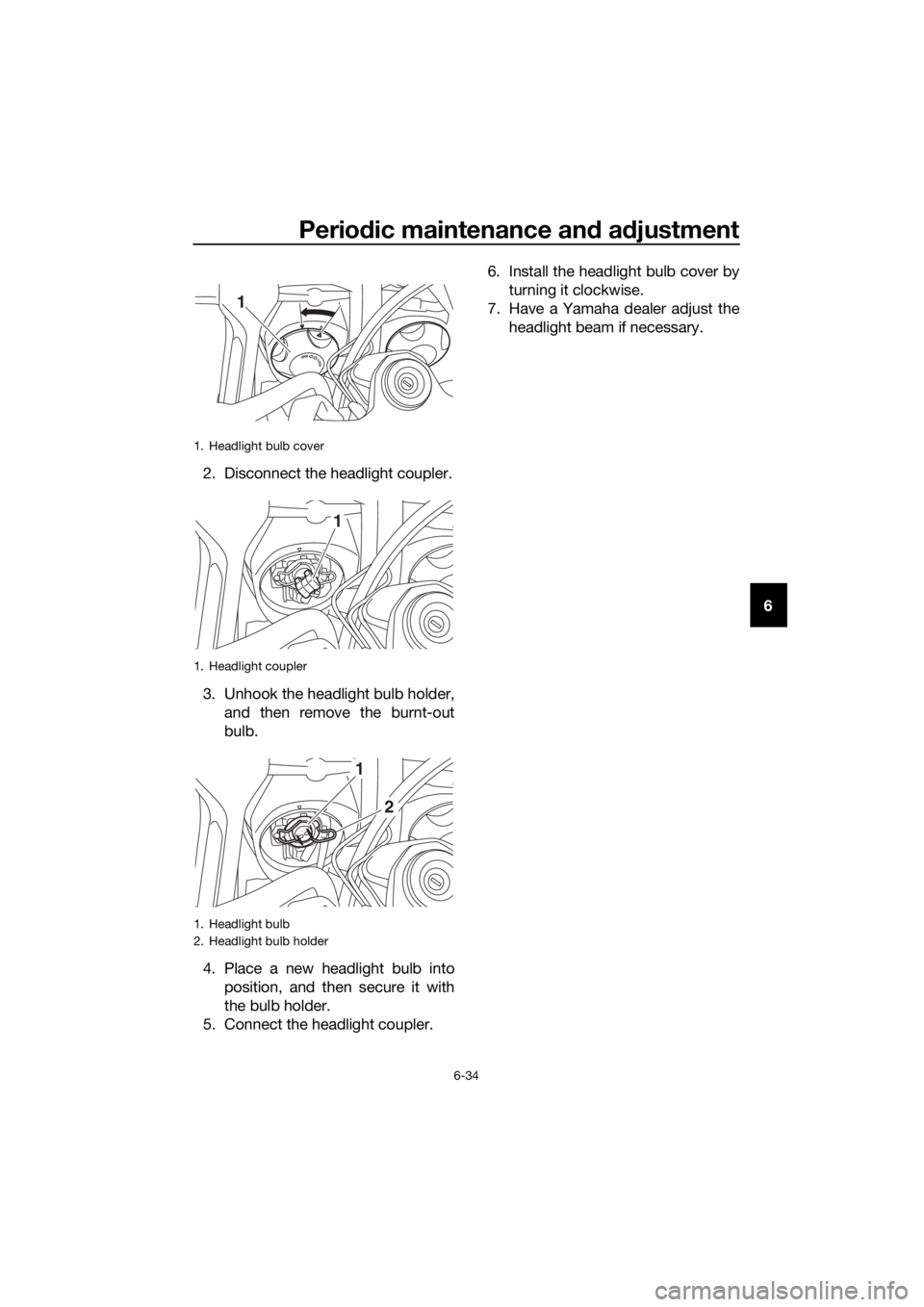
2. Disconnect the headlight coupler.
3. Unhook the headlight bulb holder,
and then remove the burnt-out
bulb.
4. Place a new headlight bulb into position, and then secure it with
the bulb holder.
5. Connect the headlight coupler. 6. Install the headlight bulb cover by
turning it clockwise.
7. Have a Yamaha dealer adjust the headlight beam if necessary.
1. Headlight bulb cover
1. Headlight coupler
1. Headlight bulb
2. Headlight bulb holder
1
1
1
2
UBP8E1E0.book Page 34 Friday, September 14, 2018 11:35 AM
Page 98 of 118
Periodic maintenance an d a djustment
6-35
6
EAU58971
Replacin g an auxiliary lig ht
b ul b
This model is equipped with two auxil-
iary lights. If an auxiliary light bulb
burns out, replace it as follows.
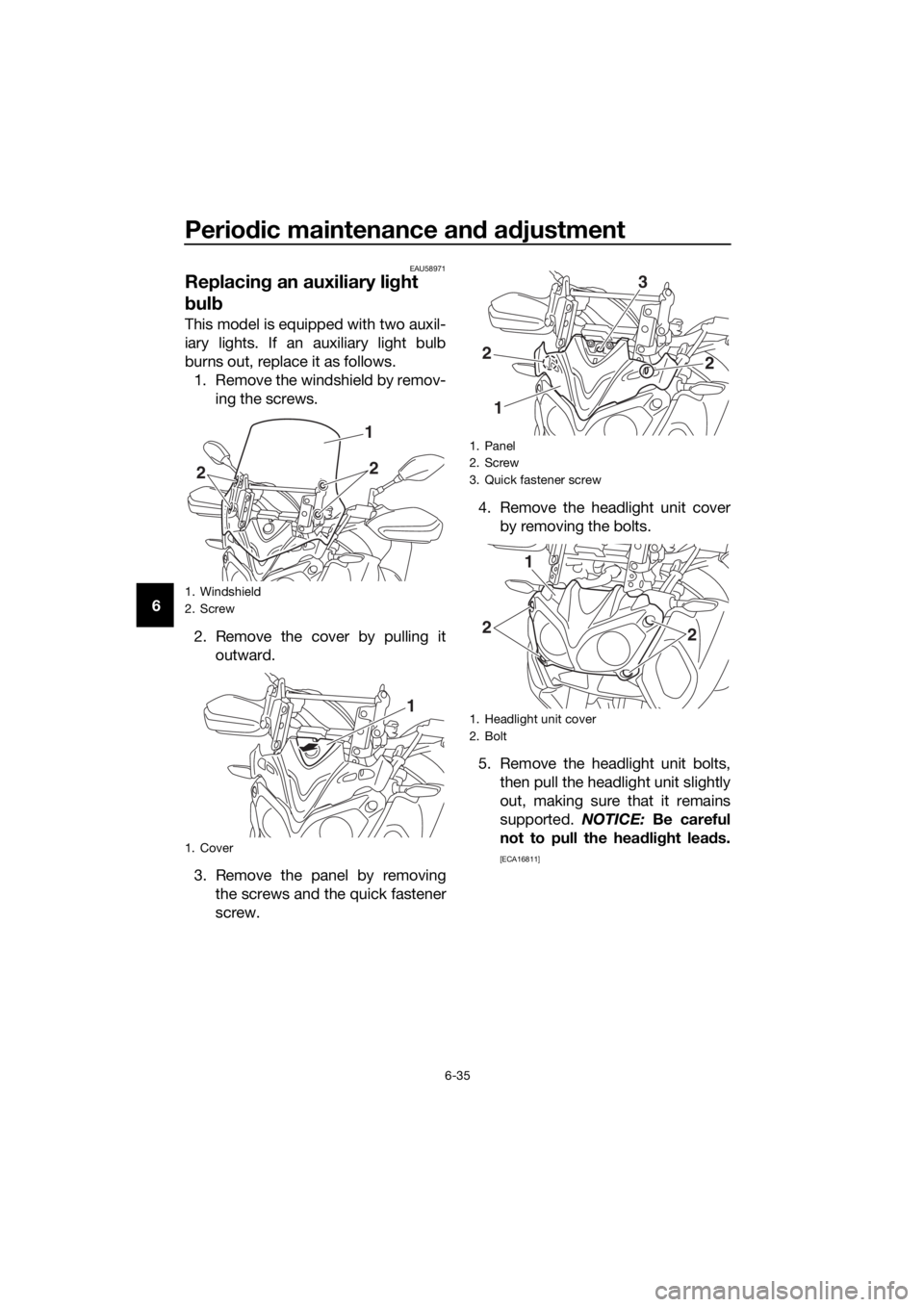
1. Remove the windshield by remov- ing the screws.
2. Remove the cover by pulling it outward.
3. Remove the panel by removing the screws and the quick fastener
screw. 4. Remove the headlight unit cover
by removing the bolts.
5. Remove the headlight unit bolts, then pull the headlight unit slightly
out, making sure that it remains
supported. NOTICE: Be careful
not to pull the hea dlig ht lea ds.
[ECA16811]
1. Windshield
2. Screw
1. Cover
1
22
1
1. Panel
2. Screw
3. Quick fastener screw
1. Headlight unit cover
2. Bolt
3
22
1
1
22
UBP8E1E0.book Page 35 Friday, September 14, 2018 11:35 AM
Page 99 of 118
Periodic maintenance an d a djustment
6-36
6
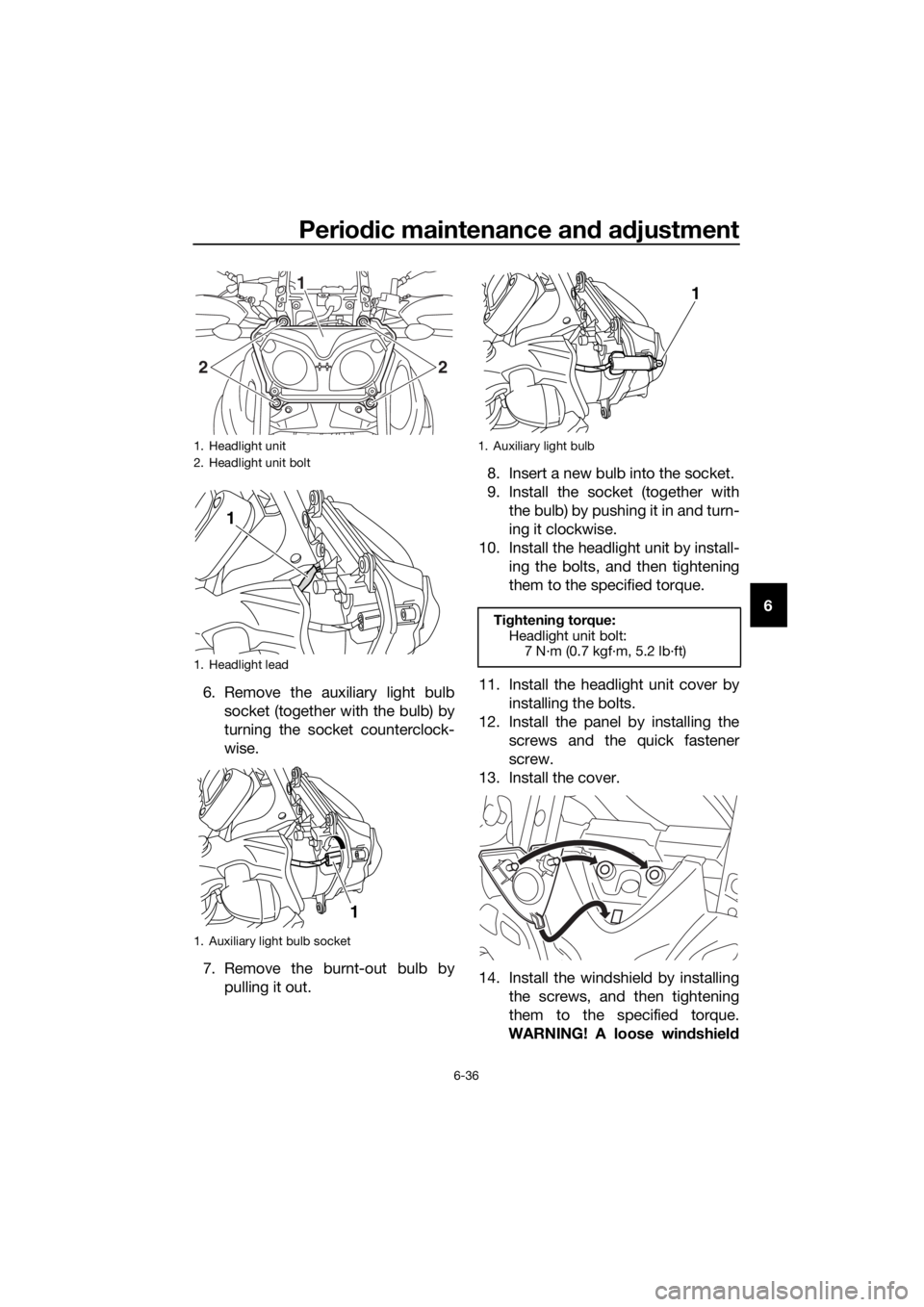
6. Remove the auxiliary light bulb socket (together with the bulb) by
turning the socket counterclock-
wise.
7. Remove the burnt-out bulb by pulling it out. 8. Insert a new bulb into the socket.
9. Install the socket (together with
the bulb) by pushing it in and turn-
ing it clockwise.
10. Install the headlight unit by install- ing the bolts, and then tightening
them to the specified torque.
11. Install the headlight unit cover by installing the bolts.
12. Install the panel by installing the screws and the quick fastener
screw.
13. Install the cover.
14. Install the windshield by installing the screws, and then tightening
them to the specified torque.
WARNING! A loose win dshield
1. Headlight unit
2. Headlight unit bolt
1. Headlight lead
1. Auxiliary light bulb socket
1
2
2
1
1
1. Auxiliary light bulb
Tightenin g torque:
Headlight unit bolt: 7 N·m (0.7 kgf·m, 5.2 lb·ft)
1
UBP8E1E0.book Page 36 Friday, September 14, 2018 11:35 AM
Page 106 of 118

Motorcycle care and stora ge
7-2
7
harsh chemicals, inclu din g
stron g aci dic wheel cleaners,
especially on spoke or mag ne-
sium wheels.
harsh chemicals, a brasive
cleanin g compoun ds, or wax on
matte-finishe d parts. Brushes
can scratch an d damag e the
matte-finish, use soft spon ge or
towel only.
towels, spon ges, or brushes
contaminated with abrasive
cleanin g pro ducts or stron g
chemicals such as, solvents,
g asoline, rust removers, brake
flui d, or antifreeze, etc.
Before washin g
1. Park the vehicle out of direct sun- light and allow it to cool. This will
help avoid water spots.
2. Make sure all caps, covers, elec- trical couplers and connectors are
tightly installed.
3. Cover the muffler end with a plas- tic bag and a strong rubber band.
4. Pre-soak stubborn stains like in- sects or bird droppings with a wet
towel for a few minutes.
5. Remove road grime and oil stains with a quality degreasing agent
and a plastic-bristle brush or
sponge. NOTICE: Do not use
d eg reasin g a gent on areas re-
quirin g lu brication such as
seals, gaskets, an d wheel axles.
Follow prod uct instructions.
[ECA26290]
Washing
1. Rinse off any degreaser and spray down the vehicle with a garden
hose. Use only enough pressure
to do the job. Avoid spraying wa-
ter directly into the muffler, instru-
ment panel, air inlet, or other inner
areas such as underseat storage
compartments.
2. Wash the vehicle with a quality au- tomotive-type detergent mixed
with cool water and a soft, clean
towel or sponge. Use an old tooth-
brush or plastic-bristle brush for
hard-to-reach places. NOTICE:
Use col d water if the vehicle has
b een exposed to salt. Warm wa-
ter will increase salt’s corrosive
properties.
[ECA26301]
3. For windshield-equipped vehicles: Clean the windshield with a soft
towel or sponge dampened with
water and a pH neutral detergent.
If necessary, use a high-quality
windshield cleaner or polish for
motorcycles. NOTICE: Never use
any stron g chemicals to clean
the win dshield . Additionally,
some cleanin g compoun ds for
plastic may scratch the win d-
shield , so be sure to test all
cleanin g prod ucts before gen-
eral application.
[ECA26310]
4. Rinse off thoroughly with clean water. Be sure to remove all deter-
gent residues, as they can be
harmful to plastic parts.
After washin g
1. Dry the vehicle with a chamois or absorbent towel, preferably mi-
crofiber terrycloth.
UBP8E1E0.book Page 2 Friday, September 14, 2018 11:35 AM