2019 VOLVO XC90 TWIN ENGINE warning
[x] Cancel search: warningPage 620 of 697

MAINTENANCE AND SERVICE
* Option/accessory.
618 Hoisting the vehicle
When hoisting the vehicle, it is important to
ensure the jack/vehicle hoist is correctly
engaged in the designated attachment points
under the vehicle.
For vehicles with self-leveling*, pneumatic sus-
pension (if installed) must be turned off before
the vehicle is lifted. Turning off the function in the
center display.
WARNING If the vehicle is lifted on a garage jack, the
jack must be placed under one of the four lift-
ing points. Make sure that the vehicle is cor-
rectly positioned on the jack and that it can-
not slide off. Make sure the jack plate has a
rubber pad to help keep the vehicle stable
and prevent damage. Always use axle stands
or similar.
NOTE Volvo recommends only using the jack
intended for your specific vehicle model. If a
jack other than that recommended by Volvo is
used, follow the instructions included with the
equipment.
The vehicle's ordinary jack is only intended to
be used in temporary situations for short peri-
ods of time, such as when changing wheels in
the event of a flat tire. If the vehicle needs to
be lifted more frequently, or for a longer
period of time than for a wheel change, a
garage jack or hoist is recommended. Always
follow the instructions for use provided with
the equipment.
Page 622 of 697

MAINTENANCE AND SERVICE
620Opening and closing the hood
To open the hood, pull the lever in the passen-
ger compartment and then turn the handle under
the hood.
Opening the hood
Pull the lever near the pedals to release the
hood from its fully closed position. Turn the handle under the front edge of the
hood counterclockwise to release the catch
and lift the hood.
Warning - hood not closedWhen the hood is released, a warning
symbol and graphic will be displayed in
the instrument panel and an audible
signal will sound. If the vehicle begins
to roll, the audible signal will be repeated several
times.
NOTE If the warning symbol is illuminated or an
audible warning signal sounds even though
the hood is securely closed, consult a work-
shop - an authorized Volvo workshop is rec-
ommended.
Closing the hood1. Press down the hood until it begins to close
under its own weight.
2. When the hood reaches the catch at the handle in the front edge of the vehicle, press
down on the hood to close it completely.
WARNING Risk of injury! When closing, make sure that
the hood is completely unobstructed and that
no one can be injured.
WARNING
Make sure the hood locks securely after clos-
ing. It must audibly lock on both sides.
Hood not completely closed. The illustration is generic -
details may vary according to vehicle model.
Page 623 of 697

MAINTENANCE AND SERVICE
* Option/accessory.621Hood completely closed. The illustration is generic -
details may vary according to vehicle model.
WARNING
Never drive with the hood open!
If there are any indications while driving that
the hood is not completely closed, stop imme-
diately and close it securely.
Related information
Engine compartment overview (p. 622)
Door and seat belt reminders (p. 51) Climate control system service
Service and repairs on the air conditioning sys-
tem should only be done by an authorized work-
shop.
Troubleshooting and repairsThe air conditioning system contains a fluores-
cent tracer substance. Ultraviolet light is used to
search for leaks in the system.
Volvo recommends contacting an authorized
Volvo workshop.
Vehicles with R134a refrigerant
WARNING
The air conditioning system contains the
refrigerant R134a under pressure. Service
and repairs to the system should only be done
by an authorized workshop.
Related information
Volvo's service program (p. 610) Replacing a windshield with head-
up display*
Vehicles with a head-up display have a special
type of windshield that meets the requirements
for displaying projected information.
Volvo recommends contacting an authorized
Volvo workshop for assistance replacing the
windshield. The correct type of replacement
windshield must be used in order for the head-up
display to function properly.
Related information
Head-up display* (p. 142)
Cleaning the head-up display* (p. 646)
Page 624 of 697

MAINTENANCE AND SERVICE
622Engine compartment overview
This overview shows some service-related com-
ponents.
Some of the components included in the vehi-
cle's electric drive system are located in the
engine compartment. Exercise caution when
accessing the engine compartment and only
touch what is required for normal maintenance.
WARNING Orange wiring may only be handled by quali-
fied personnel.
WARNING
Several components in the vehicle work with
high voltage that can be hazardous in case of
an incorrect procedure.
Do not touch anything that is not clearly
described in this Owner's Manual.
Be careful when checking/filling fluids in
the engine compartment. The layout of the engine compartment may vary depend-
ing on model and engine variant.
Coolant expansion tank
Brake fluid reservoir (located on the driver's
side)
Washer fluid filler pipe
12 Fusebox
Air filter
Engine oil filler pipe
WARNING Bear in mind that the cooling fan (located at
the front of the engine compartment behind
the radiator) may start or continue running
automatically up to about 6 minutes after the
engine is turned off.
Always entrust engine washing to a workshop
– an authorized Volvo workshop is recom-
mended. If the engine is hot, there is a risk of
fire.
WARNING
The ignition system works with extremely high
and dangerous voltages. The vehicle electrical
system should always be in ignition mode 0
when work in being performed in the engine
compartment.
Do not touch any spark plugs or ignition coils
when the vehicle electrical system is in igni-
tion mode II or when the engine is warm.
Related information
Opening and closing the hood (p. 620)
Filling washer fluid (p. 662)
Refilling coolant (p. 625)
Fuses in the engine compartment (p. 634)
Checking and filling engine oil (p. 624)
Ignition modes (p. 437) 12
Fill the washer fluid at regular intervals, e.g. when refueling.
Page 625 of 697

MAINTENANCE AND SERVICE
623
Engine oil
For the recommended service intervals and war-
ranties to be applied, an approved engine oil
must be used. Volvo recommends: If the engine oil is not checked regularly and the
level becomes low, this could cause serious
engine damage.
CAUTION
To satisfy the requirements for the engine's
service intervals, all engines are factory-filled
with a specially adapted synthetic engine oil.
Great care has been put into the choice of oil,
with consideration given to service life, starta-
bility, fuel consumption and environmental
impact.
For the recommended service intervals to
apply, an approved engine oil must be used.
Only use the prescribed oil grade to top off or
change the oil. Otherwise, there is a risk of
the vehicle's service life, startability, fuel con-
sumption and environmental impact being
affected.
Failure to use engine oil of the prescribed
grade and viscosity could cause damage to
engine-related components. Volvo Car Corpo-
ration disclaims warranty liability for such type
of damage.
Volvo recommends entrusting oil changes to
an authorized Volvo workshop.
Volvo uses different systems to warn if the oil
level is too low/high or the oil pressure is low. On
engine variants with an oil pressure sensor, awarning symbol is displayed in the instrument
panel when oil pressure is low . On engine
variants with an oil level sensor, the warn-
ing symbol in the instrument panel and display
messages are used to alert the driver. Some
engine variants have both systems. Contact a
Volvo retailer for more information.
Change the engine oil and oil filter according to
the schedule specified in the Warranty and Main-
tenance Records Information booklet. Oils of a
higher grade than that specified may be used. If
the vehicle is driven in adverse conditions, Volvo
recommends using an oil with a higher grade
than that specified.
Related information
Checking and filling engine oil (p. 624)
Engine oil specifications (p. 672)
Page 626 of 697

MAINTENANCE AND SERVICE
624Checking and filling engine oil
The engine oil level is monitored by an electronic
oil level sensor. Filler pipe
13
.
It may be necessary to top up engine oil between
regularly scheduled services.
No action is necessary with regard to engine oil
level until a message appears in the instrument
panel.
WARNING If this symbol is shown together
with the message
Engine oil level
Service required, visit a workshop – an authorized Volvo workshop is
recommended. The oil level may be too high.
CAUTION If this symbol is shown together
with a message about low oil level,
for example
Engine oil level low
Refill 1 liter, fill only with the indi-
cated volume, e.g. 1 liter (1 quart).
WARNING Do not spill oil on the hot exhaust pipes as
this could cause a fire.
Viewing oil level in the center displayThe oil level can be viewed using the electronic
oil level gauge in the center display once the
vehicle has been started. The oil level should be
checked regularly.
1.
Open the Car Status app from App view in
the center display.
2. Tap Status to display the oil level. Oil level graphic in the center display.NOTE
The system cannot directly detect changes
when the oil is filled or drained. The vehicle
must have been driven approximately 30 km
(20 miles) and have been stationary
5 minutes on a level surface and with the
engine off before the correct oil level will be
displayed.
13
Engines with an electronic oil level sensor do not have a dipstick.
Page 627 of 697

MAINTENANCE AND SERVICE
}}
625
NOTE If the conditions for measuring oil level are
not properly fulfilled (time after engine shut-
down, vehicle inclination, ambient tempera-
ture, etc.) the message
No value available
will be shown in the center display. This does
not mean that anything is wrong in the vehi-
cle systems.
Related information
Engine oil (p. 623)
Engine oil specifications (p. 672)
Ignition modes (p. 437)
Vehicle status (p. 614) Refilling coolant
Coolant helps keep the combustion engine at
the right operating temperature. The heat trans-
ferred from the engine to the coolant can be
used to warm the passenger compartment.
When refilling coolant, follow the instructions on
the package. Never fill the cooling system with
only water. The risk of freezing is increased with
too low or too high amounts of coolant.
If there is coolant under the vehicle, smoke from
the cooling system, or if more than 2 liters (about
2 quarts) of coolant has been added to the sys-
tem, there could be something wrong with the
cooling system and starting the vehicle could
damage the engine. Call a tow truck and do not
attempt to start the engine.
WARNING The coolant may be very hot. Never unscrew
the cap when the coolant is hot. If coolant
must be filled, unscrew the expansion tank
cap slowly to relieve overpressure. Coolant expansion tank.
Page 629 of 697
MAINTENANCE AND SERVICE
}}
627
Start battery
The vehicle has a single-pole electrical system
that uses the chassis and engine mount as con-
ductors.
The start battery is used to start the electrical
system and power electrical equipment in the
vehicle. The hybrid battery is used to start the
combustion engine.
The start battery should only be replaced by a
workshop 15
.
The start battery is a 12 V AGM (Absorbed Glass
Mat) battery, dimensioned for regenerative charg-
ing and to support the function of the vehicle's
various systems.
The service life and performance of the start bat-
tery are affected by factors such as driving style,
driving conditions, climate, battery discharges,
number of starts, etc.
Never disconnect the start battery while the
engine is running.
Make sure the cables to the start battery are
correctly connected and the clamps are
securely tightened.
WARNING
Batteries generate hydrogen gas, which
is flammable and explosive.
Do not connect the jumper cable to any
part of the fuel system or to any moving
parts. Avoid touching hot manifolds.
Battery fluid contains sulfuric acid. Do not
allow battery fluid to contact eyes, skin,
fabrics or painted surfaces.
If contact occurs, flush the affected area
immediately with water. Obtain medical
help immediately if eyes are affected.
Never expose the battery to open flame
or electric spark. Do not smoke near the
battery. Failure to follow the instructions
for jump starting can lead to injury.
Connection points
WARNING PROPOSITION 65 WARNING
Battery posts, terminals, and related accesso-
ries contain lead and lead compounds, chemi-
cals known to the state of California to cause
cancer and reproductive harm. Wash hands
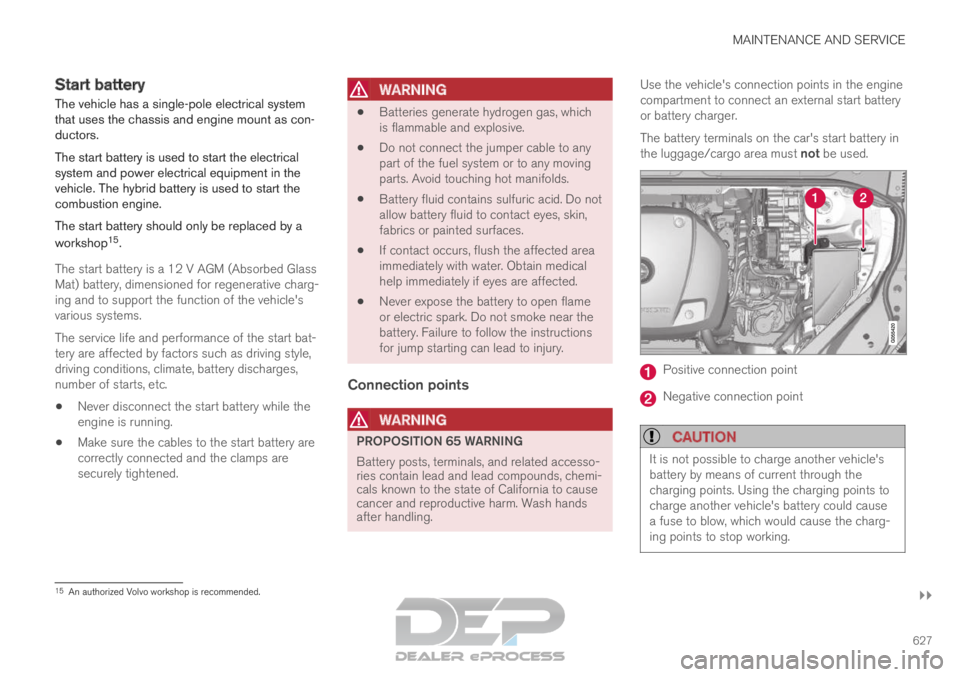
after handling.Use the vehicle's connection points in the engine
compartment to connect an external start battery
or battery charger.
The battery terminals on the car's start battery in
the luggage/cargo area must not be used.
Positive connection point
Negative connection point
CAUTION
It is not possible to charge another vehicle's
battery by means of current through the
charging points. Using the charging points to
charge another vehicle's battery could cause
a fuse to blow, which would cause the charg-
ing points to stop working.
15
An authorized Volvo workshop is recommended.