2019 VOLVO XC90 TWIN ENGINE fog light
[x] Cancel search: fog lightPage 162 of 697

||LIGHTING
160
The rear fog light turns off automatically when
the ignition is switched off or when the steering
wheel lever lighting ring is in position
or
.
NOTE
Regulations concerning rear fog light use vary
from country to country.
Related information
Lighting panel and controls (p. 152)
Ignition modes (p. 437) Brake lights
The brake lights are automatically illuminated
when braking.
The brake lights illuminate when the brake pedal
is depressed. They also illuminate when the
brakes are automatically applied by one of the
driver support systems.
Related information
Emergency brake lights (p. 160)
Brake functions (p. 438) Emergency brake lights
The emergency brake lights are activated to
warn following vehicles of hard braking.
This function causes an additional taillight on
each side of the vehicle to illuminate.
The emergency brake lights are activated in the
event of hard braking or if the ABS system is
activated and the vehicle is traveling at a high
speed.
After the driver decelerates to a low speed and
then releases the brake, the brake lights resume
their normal brightness.
Related information
Brake lights (p. 160)
Brakes (p. 439)
Hazard warning flashers (p. 161)
Page 223 of 697

CLIMATE CONTROL
221
2.
Tap or press and hold AUTO.
Tap - air recirculation, air conditioning and
air distribution are controlled automati-
cally.
Press and hold - air recirculation, air con-
ditioning and air distribution are controlled
automatically. Temperature and blower
speed are changed to standard settings:
22 °C (72 °F) and speed
3 (speed 2 in
the rear seat).
>
Auto climate mode is activated and the
button lights up.
NOTE It is possible to change the temperature and
blower speed without deactivating automatic
climate control. Automatic climate control is
deactivated when the air distribution is
changed manually or when the max defroster
is activated.
Related information
Climate system controls (p. 215) Activating and deactivating
recirculation
The climate system's recirculation function helps
shut out smog, smoke, exhaust fumes, etc. by
reusing the air in the passenger compartment. Air recirculation button in Climate view.
1. Open Climate view in the center display.
2.
Tap Recirc.
>
Air recirculation is activated/deactivated
and the button lights up/goes out.
CAUTION If the air in the vehicle is recirculated too long,
there is a risk of fogging on the inside of the
windows.
NOTE Recirculation cannot be activated when the
max defroster is on.
Related information
Climate system controls (p. 215)
Activating and deactivating the recirculation
timer setting (p. 222)
Page 228 of 697

CLIMATE CONTROL
226Setting the blower speed for the
front seats
The blower can be set to several different auto-
matically controlled speeds for the front seat.
Blower control buttons in Climate view.
1. Open Climate view in the center display.
2.
Tap the desired blower speed: Off,
1-5 or
Max.
>
The blower speed will be changed and the
buttons for the set speed will light up.
CAUTION The air conditioning will not engage if the
blower is turned off completely, which may
cause fogging on the inside of the windows.
NOTE The climate system automatically adapts air-
flow as needed within the set blower speed,
which means that airflow speed may vary
slightly within the same blower speed.
Related information
Climate system controls (p. 215) Setting the blower speed for the
rear seats
The blower can be set to several different auto-
matically controlled speeds for the rear seat.
Setting blower speed for the rear seats
from the front seats Blower control buttons in the Rear climate tab in Cli-
mate view.
1. Open Climate view in the center display and
select the Rear climate tab.
Page 331 of 697

DRIVER SUPPORT
}}
* Option/accessory. 329
Pilot Assist limitations
Pilot Assist functionality may be reduced in cer-
tain situations.
Pilot Assist is a driver support function designed
to simplify driving and assist the driver in many
situations. However, the driver is always responsi-
ble for maintaining a suitable distance to vehicles
or objects around it and ensuring that the vehicle
is correctly positioned in the traffic lane.
WARNING In some situations, Pilot Assist may have trou-
ble helping the driver properly or may be
deactivated automatically – we advise against
using Pilot Assist in such cases. Examples of
such situations include:
the lane markings are worn, missing or
cross each other.
lane division is unclear, for example, when
the lanes divide or merge or at exits or
when there are multiple sets of markings.
edges or other lines than lane markings
are present on or near the road, e.g.
curbs, joints or repairs to the road sur-
face, edges of barriers, roadside edges or
strong shadows.
the lane is narrow or winding.
the lane contains ridges or holes.
weather conditions are poor, e.g. rain,
snow or fog or slush or reduced visibility
with poor light conditions, backlighting,
wet road surface, etc.
The driver should also note that Pilot Assist
has the following limitations:
High curbs, roadside barriers, temporary
obstacles (traffic cones, safety barriers,
etc.) are not detected. Alternatively, they
may be detected incorrectly as lane mark-
ings, with a subsequent risk of contact
between the vehicle and such obstacles. The driver is responsible for ensuring that
the vehicle maintains a suitable distance
from such obstacles.
The camera and radar sensors do not
have the capacity to detect all oncoming
objects and obstacles in traffic environ-
ments, e.g. potholes, stationary obstacles
or objects that completely or partially
block the route.
Pilot Assist does not "see" pedestrians,
animals, etc.
The recommended steering input is lim-
ited in force, which means that it cannot
always help the driver to steer and keep
the vehicle within the lane.
In vehicles equipped with Sensus
Navigation*, the function is able to use
information from map data, which could
cause variations in performance.
Pilot Assist is switched off if the power
steering is working with reduced power -
e.g. during cooling due to overheating
(see section "Speed-dependent steering
force").
The driver can always correct or adjust steering
assistance provided by Pilot Assist by turning the
steering wheel to the desired position.
Page 340 of 697
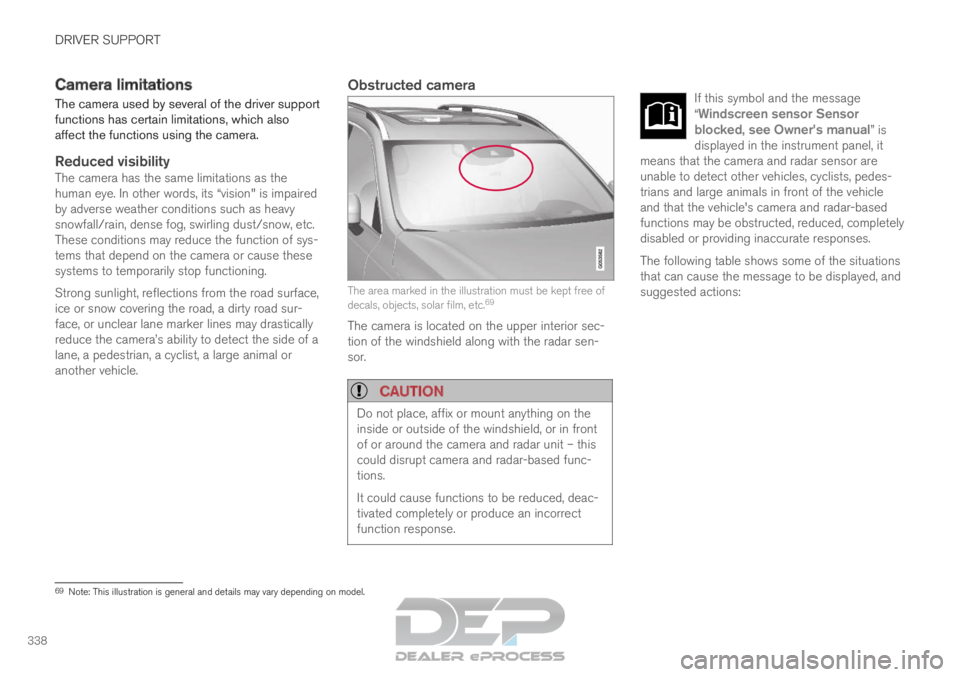
DRIVER SUPPORT
338Camera limitations
The camera used by several of the driver support
functions has certain limitations, which also
affect the functions using the camera.
Reduced visibilityThe camera has the same limitations as the
human eye. In other words, its “vision" is impaired
by adverse weather conditions such as heavy
snowfall/rain, dense fog, swirling dust/snow, etc.
These conditions may reduce the function of sys-
tems that depend on the camera or cause these
systems to temporarily stop functioning.
Strong sunlight, reflections from the road surface,
ice or snow covering the road, a dirty road sur-
face, or unclear lane marker lines may drastically
reduce the camera
Page 341 of 697

DRIVER SUPPORT
}}}}
339 Cause
Action
The area of the windshield in front of the camera/radar sensor is
dirty or covered by ice or snow. Clean the windshield in front of the camera/radar sensor and remove dirt\
, ice and
snow.
Thick fog, heavy rain or snow is blocking the radar signals or the
camera's range of visibility. No action. Heavy precipitation may sometimes prevent the camera/radar se\
nsor from
functioning.
Water or snow is spraying/swirling up and blocking the radar signals
or the camera's range of visibility. No action. Very wet or snow-covered roads may sometimes prevent the came\
ra/
radar sensor from functioning.
There is dirt between the inside of the windshield and the camera/
radar sensor. Consult a workshop to have the area of the windshield on the inside of t\
he camera's
casing cleaned. An authorized Volvo workshop is recommended.
Bright sunlight. No action. The camera/radar sensor will reset automatically when lightin\
g conditions
improve.
NOTEKeep the windshield in front of the camera
and radar unit clean.
High temperaturesIf the temperature in the passenger compartment
is very high, the camera/radar sensor will switch
off temporarily for approx. 15 minutes after the
engine is started to protect its electronic compo-
nents. When the temperature has cooled suffi-
ciently, the camera/radar sensor will automati-
cally restart.
Damaged windshield
CAUTION
If there are cracks, scratches or stone chips
on the windshield in front of any of the cam-
era and radar unit "windows" and this covers
an area of about 0.5 × 3.0 mm
(0.02 × 0.12 in.) or more, contact a workshop
to have the windshield replaced – an author-
ized Volvo workshop is recommended.
Failure to take action could result in reduced
performance for the driver support systems
that use the camera and radar unit. It could cause functions to be reduced, deac-
tivated completely or produce an incorrect
function response.
To avoid the risk of loss of function, malfunc-
tion or reduced function of the driver support
systems that use the radar unit, the following
also apply:
Volvo advises against repairing cracks,
scratches or stone chips in the area in
front of the camera and radar unit – the
entire windshield should instead be
replaced.
Before replacing the windshield, contact
an authorized Volvo workshop to verify
Page 488 of 697

||STARTING AND DRIVING
* Option/accessory.
486 When Trailer Stability Assist is
activated, the ESC symbol is
displayed in the instrument
panel.
Related information
Driving with a trailer (p. 483)
Electronic Stability Control (p. 279) Checking trailer lights
When connecting a trailer, make sure that all of
the lights on the trailer are functioning before
starting to drive.
Trailer turn signals and brake lightsIf one or more of the turn signals or brake lights
on the trailer is not working, a symbol and mes-
sage will be displayed in the instrument panel.
The other lights on the trailer must be checked
manually by the driver before the vehicle is driven. Symbol
Message
Trailer turn indicator Right
turn indicator malfunction
Trailer turn indicator Left
turn indicator malfunction
Trailer brake light Malfunc-
tion If any of the trailer's turn signal lights is not work-
ing, the turn signal symbol in the instrument
panel will also flash more quickly than normal.
Trailer rear fog lightWhen a trailer is connected, the vehicle's rear fog
light may not illuminate and rear fog light func-
tionality is instead transferred to the trailer. If this
is the case, check to see if the trailer is equipped
with a rear fog light before activating the vehicle'sfog lights when driving with a trailer to help
ensure safe operation.
Checking trailer lights*
Automatic check
When the trailer has been connected to the vehi-
cle's electrical system, its lights can be checked
by automatically activating them. This function
helps the driver check that the trailer's lights are
functioning correctly before starting to drive.
In order to perform this check, the engine must
be turned off.
1. When a trailer is connected to the towbar, the message Automatic Trailer Lamp
Check will appear in the instrument panel.
2.
Acknowledge the message by pressing the
O button on the right-side steering wheel
keypad.
> The light check will begin.
3. Get out of the vehicle to perform the check. > All of the lights on the trailer will beginflashing, and then illuminate separately
one at a time.
4. Visually check that all of the trailer's lights are functioning correctly.
5. After a short time, all of the trailer's lights will start flashing again.
> The light check is completed.
Page 683 of 697

INDEX
681
Electric parking brake 442
Electronic immobilizer 257
emergency brake lights 160
Emission inspection readiness 610
Energy distribution
using map data 460
Engine automatic start and stop of combustion
engine 454
overheating 479
start 434
turn off 436
Engine braking 439, 449, 466
Engine compartment coolant 625
engine oil 623
overview 622
Engine drag control 279
Engine oil 623 filling 624
filter 623
grade and volume 672
Engine shutdown 436
Engine specifications 671
Engine temperature high 479
Environment 27 Error messages
Adaptive Cruise Control
314
see Messages and symbols 314, 330
Error messages in BLIS 359
Ethanol content max. 10% by volume 476
Exterior dimensions 667
Extra heater (Auxiliary heater) 239
F Federal Clean Air Act
610
Ferry transport
461
Flat tire 582
Flooded road 473
Fluids, volumes 662, 674
Fluids and oils 673, 674
Fog lights rear 159
Four-C 461
Front seat blower 226
climate 215
heating 217, 218
temperature 228
ventilation 219 Front seat manual
184
Front seats, power
185
adjusting passenger seat from driver's
seat 192
adjusting seat 185
Lumbar support 191
massage 188, 189
multifunction control 188, 189, 190, 191
Side bolsters 190
store position 186, 187
FSC, environmental labeling 24
Fuel 476
Travel Link service 516
Fuel filling 475
Fuel gauge 87
Fuel requirements 476, 477
Fuel tank volume 674
Fuse box 633
Fuses below the glove compartment 638
general 632
in engine compartment 634
in the cargo compartment 641
replacing 633