2019 VOLVO XC90 TWIN ENGINE brakes
[x] Cancel search: brakesPage 280 of 697
DRIVER SUPPORT
* Option/accessory.
278 Driver support systems
The vehicle is equipped with a number of driver
support systems that can provide the driver with
active or passive assistance in various situations.
The systems can, for example, help the driver:
maintain a set speed
maintain a set time interval to the vehicle
ahead
help prevent a collision by warning the driver
and applying the brakes
park the vehicle.
Some of the systems are standard and others are
options. This also varies from market to market.
Related information
Speed-dependent steering wheel resistance
(p. 278)
Electronic Stability Control (p. 279)
Stability system Roll Stability Control
(p. 279)
Speed limiter (p. 283)
Automatic Speed Limiter (p. 287)
Cruise control (p. 291)
Distance Alert* (p. 296)
Adaptive Cruise Control* (p. 300)
Pilot Assist (p. 316)
Radar sensor (p. 332)
Camera (p. 337)
City Safety™ (p. 341)
Rear Collision Warning (p. 354)
BLIS* (p. 355)
Cross Traffic Alert* (p. 360)
Road Sign Information* (p. 364)
Driver Alert Control (p. 370)
Lane Keeping Aid (p. 372)
Steering assistance at risk of collision
(p. 380)
Park Assist* (p. 390)
Park Assist Camera* (p. 396)
Park Assist Pilot* (p. 406) Speed-dependent steering wheel
resistance
Speed-dependent power steering increases the
steering wheel resistance in pace with the vehi-
cle's speed to give the driver an enhanced feel-
ing of control and stability.
Steering may feel stiffer on highways. When
parking and at low speeds, it will be easier to
move the steering wheel.
NOTE In some situations, the power steering may
become too hot and require temporary cool-
ing – during such time the power steering will
work at reduced output and the steering
wheel may feel more difficult to move.
In parallel with the temporarily reduced steer-
ing assistance, the driver display shows a
message as well as a STEERING WHEEL
symbol.
WARNING
While the power steering is working at
reduced power, the driver support functions
and systems with steering assistance are not
available.
In such a situation, the driver display shows
the
Power steering failure message, com-
bined with a STEERING WHEEL symbol.
Page 281 of 697

DRIVER SUPPORT
}}
* Option/accessory. 279
Changing the level of steering wheel
resistance*
To change the level of steering wheel resistance,
see the description of the INDIVIDUAL option
under "Available drive modes" in the "Drive
modes" section.
On models not equipped with drive mode con-
trols and the INDIVIDUAL option, steering wheel
resistance can instead be set in the center dis-
play's Top view under:
Settings My Car Drive Modes
Steering Force
Steering wheel resistance settings cannot be
accessed when turning at speeds above
10 km/h (6 mph).
Related information
Drive modes (p. 454)
Pilot Assist (p. 316)
Lane Keeping Aid (p. 372)
Steering assistance at risk of collision
(p. 380)
Park Assist Pilot* (p. 406) Stability system Roll Stability
Control
The Roll Stability Control (RSC 1
) system helps
minimize the risk of a rollover in the event of e.g.
a sudden evasive maneuver or if the vehicle
begins to skid.
The RSC system monitors the lateral angle at
which the vehicle is leaning and registers any
changes. Using this information, the system cal-
culates the likelihood of a rollover. If there is an
imminent risk of a rollover, Electronic Stability
Control is activated, engine torque is reduced and
brakes are applied to one or more of the wheels
until the vehicle has regained stability.
WARNING The vehicle
Page 282 of 697

||DRIVER SUPPORT
* Option/accessory.
280
WARNING
The Electronic Stability Control system
ESC is supplementary driver support
intended to facilitate driving and make it
safer – it cannot handle all situations in
all traffic, weather and road conditions.
ESC is not a substitute for the driver's
attention and judgment. The driver is
always responsible for ensuring the vehi-
cle is driven in a safe manner, at the
appropriate speed, with an appropriate
distance to other vehicles, and in accord-
ance with current traffic rules and regula-
tions.
Stability control 3This function helps control the driving and brak-
ing force of each individual wheel in an attempt
to stabilize the vehicle.
Spin control and active yaw controlThis function is active at low speeds and brakes
the wheels that are spinning to transfer additional
power from wheels that are not spinning.
This function also helps prevent the wheels from
spinning while the vehicle is accelerating.
Engine drag control
Engine drag control (EDC
4
) helps prevent inad-
vertent wheel lock, e.g. after downshifting or
using engine braking when driving at low speeds
on a slippery surface.
Inadvertent wheel lock while driving could impair
the driver's ability to steer the vehicle.
Trailer Stability Assist* 5
Trailer Stability Assist (TSA
6
) is designed to help
stabilize a vehicle that is towing a trailer if the
vehicle and trailer have begun to sway. For more
information, see "Trailer Stability Assist".
NOTE The TSA function is deactivated if
ESC Sport
Mode is activated.
Related information
Electronic Stability Control Sport mode
(p. 281)
Activating/deactivating Sport mode in Elec-
tronic Stability Control (p. 281)
Electronic Stability Control Sport mode limi-
tations (p. 281)
Electronic Stability Control symbols and mes-
sages (p. 282)
Trailer Stability Assist* (p. 485)
3
Also called traction control.4 Engine Drag Control5Trailer Stability Assist is included if the vehicle is equipped with a V\
olvo original towbar.6 Trailer Stability Assist
Page 284 of 697
DRIVER SUPPORT
282Electronic Stability Control symbols
and messages
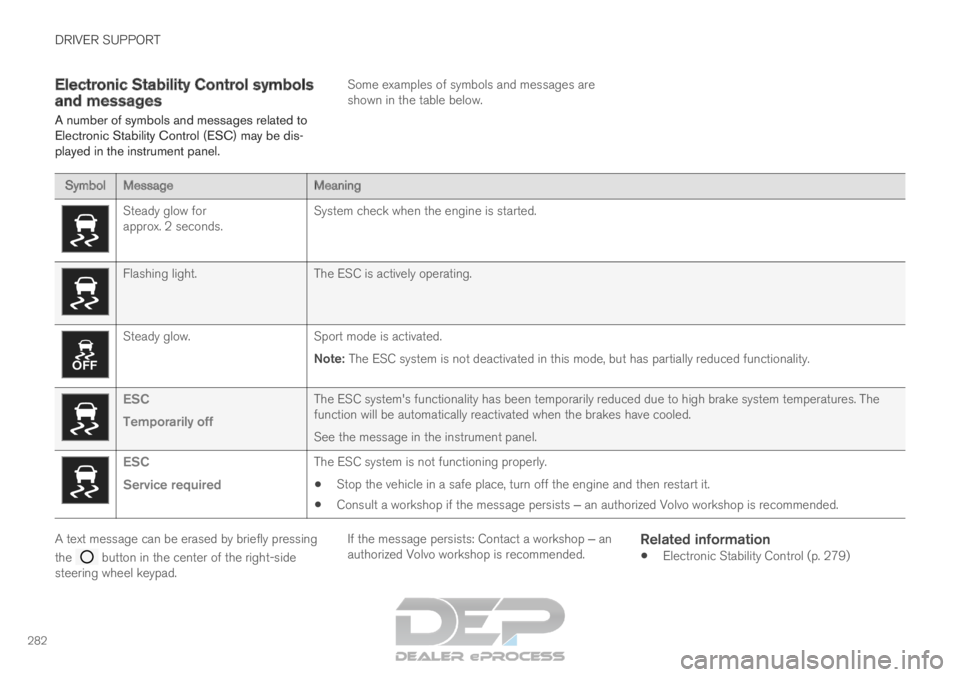
A number of symbols and messages related to
Electronic Stability Control (ESC) may be dis-
played in the instrument panel. Some examples of symbols and messages are
shown in the table below.Symbol
Message MeaningSteady glow for
approx. 2 seconds.
System check when the engine is started.Flashing light.
The ESC is actively operating.Steady glow.
Sport mode is activated.
Note: The ESC system is not deactivated in this mode, but has partially reduc\
ed functionality. ESC
Temporarily off
The ESC system's functionality has been temporarily reduced due to hi\
gh brake system temperatures. The
function will be automatically reactivated when the brakes have cooled.
See the message in the instrument panel.ESC
Service required
The ESC system is not functioning properly.
Stop the vehicle in a safe place, turn off the engine and then restart i\
t.
Consult a workshop if the message persists ‒ an authorized Volvo workshop is recommended. A text message can be erased by briefly pressing
the
button in the center of the right-side
steering wheel keypad. If the message persists: Contact a workshop ‒ an
authorized Volvo workshop is recommended.
Related information
Electronic Stability Control (p. 279)
Page 296 of 697

||DRIVER SUPPORT
294
For vehicles with both CC and ACC
–
Change a set speed by pressing the (1)
or (3) buttons briefly or by pressing and
holding them:
Press briefly: Press briefly: each press
changes the speed in +/- 5 mph
(+/- 5 km/h) increments.
Press and hold: release the button when
the set speed indicator (4) has moved to
the desired speed.
The most recently set speed will be stored.
If speed is increased by depressing the accelera-
tor pedal while pressing the (1) button on
the steering wheel, the vehicle's speed when the
button is pressed will be stored as the set speed.
Temporarily increasing speed using the accelera-
tor pedal, e.g. when passing another vehicle, will
not affect the setting. The vehicle will return to
the set speed when the accelerator pedal is
released.
Using engine braking instead of
applying the brakes
Cruise Control regulates speed by lightly applying
the brakes. On downgrades, it can sometimes be
desirable to roll a bit faster and let speed be
reduced instead by engine braking alone. The
driver can temporarily disengage the Cruise Con-
trol braking function. To disengage CC:
– Press the accelerator pedal about halfway
down and then release it.
>
Cruise Control will automatically disen-
gage the automatic brake function and
speed will only be reduced using the
engine braking function.
How drive mode affects cruise controlThe way the cruise control maintains the vehicle's
speed can vary depending on the selected drive
mode 26
.
Cruise Control Eco Cruise with ECO drive
mode
In the ECO drive mode, cruise control's accelera-
tion and deceleration will be smoother than in
other drive modes to help provide optimal fuel
efficiency and reduced environmental impact.
Because of this, the vehicle's actual speed may
be slightly above or below the set speed.
Cruise Control Dynamic Cruise
With the Dynamic drive mode, cruise control's
acceleration and deceleration will be faster and
more immediate than in other drive modes.
Related information
Cruise control (p. 291)
Drive modes (p. 454) Deactivating and putting Cruise
Control in standby mode
Cruise Control (CC 27
) can be temporarily put
into standby mode and then reactivated.
Deactivating and putting Cruise Control
in standby mode Note: This illustration is general and details may vary
depending on model.
To put Cruise Control in standby mode:
–
Press the button on the steering wheel
(2).
>
The Cruise Control markings and symbols
will change from WHITE to GRAY, indicat-
ing that Cruise Control is temporarily
deactivated and the driver needs to con-
trol the vehicle's speed. 26
For more information, see "Drive modes".
Page 297 of 697
DRIVER SUPPORT
295
Standby mode due to action by the driver
Cruise Control will be temporarily deactivated and
put in standby mode if: the brakes are applied
the gear selector is moved to N
the vehicle is driven faster than the set
speed for more than 1 minute
The driver must then control the vehicle's speed.
Temporarily increasing speed using the accelera-
tor pedal, e.g. when passing another vehicle, will
not affect the setting. The vehicle will return to
the set speed when the accelerator pedal is
released.
Automatic standby mode
Cruise Control will be temporarily deactivated and
put in standby mode if:
the wheels lose traction
the engine speed (rpm) is too low/high
the temperature in the brake system
becomes too high
the vehicle's speed goes below 30 km/h
(20 mph).
The driver must then control the vehicle's speed.
Related information
Cruise control (p. 291) Reactivating Cruise Control from
standby mode
Cruise Control (CC 28
) can be temporarily put
into standby mode and then reactivated.
Reactivating Cruise Control from
standby mode Note: This illustration is general and details may vary
depending on model.
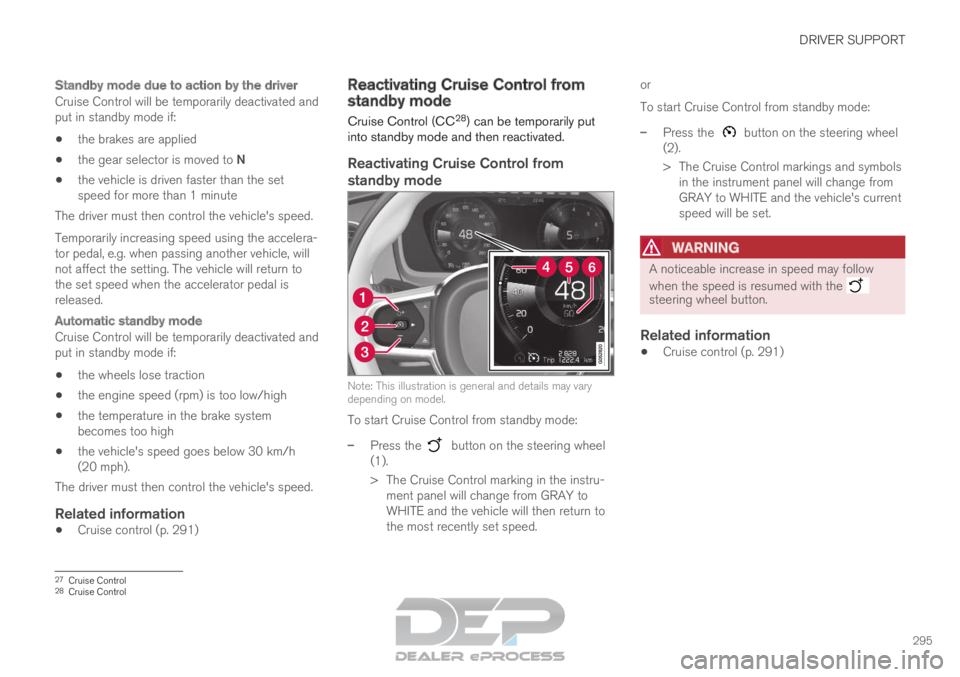
To start Cruise Control from standby mode:
–
Press the button on the steering wheel
(1).
>
The Cruise Control marking in the instru-
ment panel will change from GRAY to
WHITE and the vehicle will then return to
the most recently set speed. or
To start Cruise Control from standby mode:
– Press the button on the steering wheel
(2).
>
The Cruise Control markings and symbols
in the instrument panel will change from
GRAY to WHITE and the vehicle's current
speed will be set.
WARNING A noticeable increase in speed may follow
when the speed is resumed with the
steering wheel button.
Related information
Cruise control (p. 291) 27
Cruise Control
28 Cruise Control
Page 303 of 697

DRIVER SUPPORT
}}
301
WARNING
The Adaptive Cruise Control function is
supplementary driver support intended to
facilitate driving and help make it safer –
it cannot handle all situations in all traffic,
weather and road conditions.
The driver is advised to read all sections
in the Owner's Manual about this function
to learn of its limitations, which the driver
must be aware of before using the func-
tion (see the link list at the end of this
article).
Adaptive Cruise Control is not a substi-
tute for the driver's attention and judg-
ment. The driver is always responsible for
ensuring the vehicle is driven in a safe
manner, at the appropriate speed, with an
appropriate distance to other vehicles,
and in accordance with current traffic
rules and regulations.
NOTE Depending on market, this function may be
either Standard or Optional.
Adaptive Cruise Control regulates speed by
accelerating and braking. It is normal for the brakes to emit a slight sound when they are
being used to adjust speed.
Adaptive Cruise Control always attempts to regu-
late speed smoothly. The driver must apply the
brakes in situations requiring immediate braking.
For example, when there are great differences in
speed between vehicles or if the vehicle ahead
brakes suddenly. Due to limitations in the radar
sensor, braking may occur unexpectedly or not at
all.
Adaptive Cruise Control is designed to follow a
vehicle ahead in the same lane and maintain a
time interval to that vehicle set by the driver. If the
radar sensor does not detect a vehicle ahead, it
will instead maintain the speed set by the driver.
This will also happen if the speed of the vehicle
ahead exceeds the set speed for your vehicle.
Adaptive Cruise Control can follow another
vehicle at speeds from a standstill up to
200 km/h (125 mph).
WARNING
Adaptive Cruise Control is not a collision
avoidance system. The driver is always
responsible and must intervene if the sys-
tem fails to detect a vehicle ahead.
Adaptive Cruise Control does not brake
for people or animals and does not brake
for small vehicles, such as bikes and
motorcycles. Similarly, it does not brake
for low trailers, oncoming, slow-moving or
stationary vehicles and objects.
Do not use Adaptive Cruise Control in
demanding situations, such as in city traf-
fic, at intersections, on slippery surfaces,
with a lot of water or slush on the road, in
heavy rain/snow, in poor visibility, on
winding roads, or on on/off ramps.
CAUTION Maintenance of Adaptive Cruise Control com-
ponents may only be performed by a work-
shop – an authorized Volvo workshop is rec-
ommended.
38
Adaptive Cruise Control
39 Note: This illustration is general and details may vary depending on mod\
el.
Page 305 of 697

DRIVER SUPPORT
* Option/accessory.303
Managing Adaptive Cruise Control speed
(p. 305)
Setting Adaptive Cruise Control time inter-
vals (p. 306)
Deactivating/reactivating Adaptive Cruise
Control (p. 307)
Passing assistance with Adaptive Cruise
Control (p. 309)
Starting passing assistance with Adaptive
Cruise Control (p. 310)
Limitations of passing assistance with Adap-
tive Cruise Control (p. 310)
Switching target vehicles with Adaptive
Cruise Control (p. 310)
Automatic braking with Adaptive Cruise Con-
trol (p. 311)
Adaptive Cruise Control limitations (p. 312)
Switching between Cruise Control and Adap-
tive Cruise Control (p. 313)
Symbols and messages for Adaptive Cruise
Control (p. 314) Adaptive Cruise Control and
collision warning
Adaptive Cruise Control can alert the driver if the
distance to the vehicle ahead suddenly decrea-
ses to an unsafe distance.
Collision warning light on the windshield
40
. Audio-visual collision warning
Camera/radar sensor distance monitoring
Adaptive Cruise Control utilizes approx. 40% of
the vehicle's braking capacity. If a situation
requires more braking force than the Adaptive
Cruise Control can provide, and if the driver does
not apply the brakes, a warning light and audible
warning signal will be activated to alert the driver
that immediate action is required.
NOTE Visual warnings on the windshield may be dif-
ficult to notice in cases of strong sunlight,
reflections, extreme light contrasts, or if the
driver is wearing sunglasses or is not looking
straight ahead.
WARNING
Adaptive Cruise Control only issues a warning
for vehicles detected by its radar unit – thus, a
warning may come after a delay or not at all.
Never wait for a warning. Apply the
brakes when necessary.
Related information
Adaptive Cruise Control* (p. 300) 40
Note: This illustration is general and details may vary depending on mod\
el.