2019 VOLVO XC60 TWIN ENGINE warning
[x] Cancel search: warningPage 293 of 695

DRIVER SUPPORT
* Option/accessory.291
WARNING
Distance Alert only reacts of the time intervalto the vehicle ahead is shorter than the presetvalue – vehicle speed is not affected.
Related information
Head-up display for Distance Alert (p. 291)
Activating/deactivating Distance Alert(p. 292)
Setting a time interval for Distance Alert(p. 292)
Distance Alert limitations (p. 293)
Head-up display for Distance Alert32
In vehicles equipped with a head-up display*, asymbol will be displayed on the windshield aslong as the time interval to the vehicle ahead isshorter than the set time interval.
Distance Alert warning symbol on the windshield33.
For this to be possible, however, the ShowDriver Support function must be activatedunder Settings in the center display's menus (see"Head-up display" for instructions).
NOTE
Visual warnings on the windshield may be dif-ficult to notice in cases of strong sunlight,reflections, extreme light contrasts, or if thedriver is wearing sunglasses or is not lookingstraight ahead.
Related information
Distance Alert* (p. 290)
Head-up display* (p. 142)
32The Distance Alert function is only available in vehicles that can display information on the windshield with a head-up display.33Note: This illustration is general and details may vary depending on model.
Page 295 of 695

DRIVER SUPPORT
}}}}
* Option/accessory.293
NOTE
The greater the vehicles' speed, thegreater the distance between them for aset time interval.
Only use the time intervals permitted bylocal traffic regulations.
The set time interval is also used by theAdaptive Cruise Control and Pilot Assistfunctions.
WARNING
Only use a time interval suitable for thecurrent traffic conditions.
The driver should be aware that shorttime intervals give them limited time toreact and act to any unforeseen trafficsituation.
Related information
Distance Alert* (p. 290)
Distance Alert limitations36
Distance Alert functionality may be reduced incertain situations.
WARNING
The radar sensor has a limited field ofvision. In some situations, it may detect avehicle later than expected or not detectother vehicles at all.
The radar sensor cannot cover all drivingsituations and traffic, weather and roadconditions.
The driver is responsible for maintaining asafe distance and speed and must inter-vene if the various driver support systemsdo not maintain a suitable speed or suita-ble distance to the vehicle ahead.
Maintenance of radar sensor componentsmay only be performed by a trained andqualified Volvo technician.
Strong sunlight, reflections from the roadsurface, strong lighting contrasts or usingsunglasses may make the warning light inthe windshield difficult to see. Poorweather or winding roads can affect theradar sensor's capacity to detect vehiclesahead.
A vehicle's size (e.g., a motorcycle) canalso affect the radar sensor's capacity todetect another vehicle. This may result inthe warning light illuminating at a shorter
36The Distance Alert function is only available in vehicles that can display information on the windshield with a head-up display.
Page 296 of 695
||
DRIVER SUPPORT
* Option/accessory.294
distance than the one that has been setor not illuminating at all.
High speeds may also result in the warn-ing light illuminating at a shorter distancethan the one that has been set due tolimitations in the radar sensor's range.
NOTE
The function uses the vehicle's radar unit,which has some general limitations – see thesection "Radar unit limitations".
Related information
Distance Alert* (p. 290)
Radar sensor limitations (p. 327)
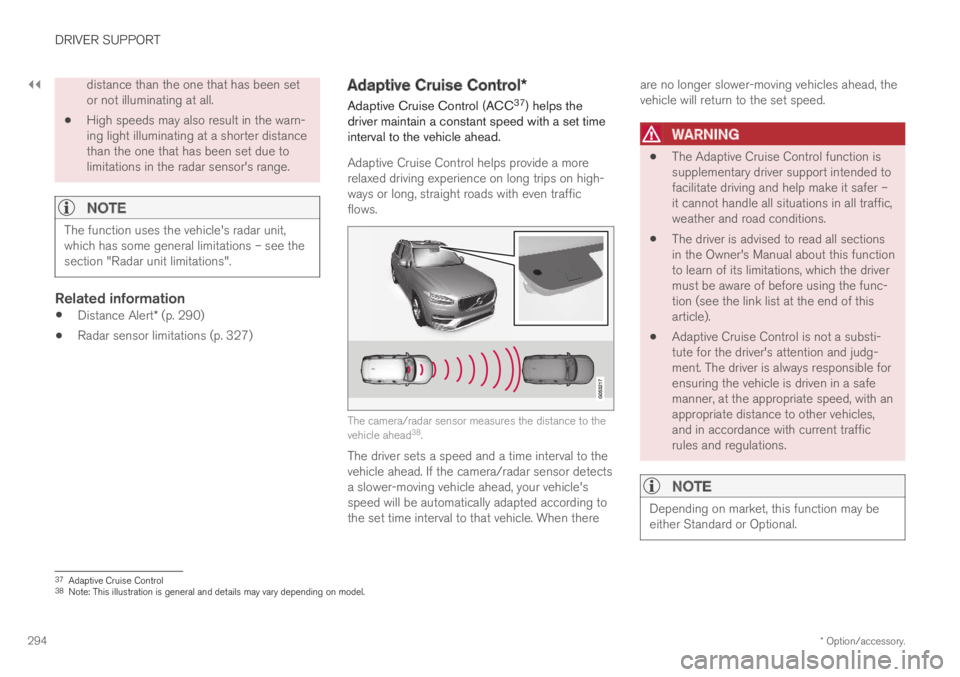
Adaptive Cruise Control*
Adaptive Cruise Control (ACC37) helps thedriver maintain a constant speed with a set timeinterval to the vehicle ahead.
Adaptive Cruise Control helps provide a morerelaxed driving experience on long trips on high-ways or long, straight roads with even trafficflows.
The camera/radar sensor measures the distance to thevehicle ahead38.
The driver sets a speed and a time interval to thevehicle ahead. If the camera/radar sensor detectsa slower-moving vehicle ahead, your vehicle'sspeed will be automatically adapted according tothe set time interval to that vehicle. When there
are no longer slower-moving vehicles ahead, thevehicle will return to the set speed.
WARNING
The Adaptive Cruise Control function issupplementary driver support intended tofacilitate driving and help make it safer –it cannot handle all situations in all traffic,weather and road conditions.
The driver is advised to read all sectionsin the Owner's Manual about this functionto learn of its limitations, which the drivermust be aware of before using the func-tion (see the link list at the end of thisarticle).
Adaptive Cruise Control is not a substi-tute for the driver's attention and judg-ment. The driver is always responsible forensuring the vehicle is driven in a safemanner, at the appropriate speed, with anappropriate distance to other vehicles,and in accordance with current trafficrules and regulations.
NOTE
Depending on market, this function may beeither Standard or Optional.
37Adaptive Cruise Control38Note: This illustration is general and details may vary depending on model.
Page 297 of 695

DRIVER SUPPORT
}}
295
Adaptive Cruise Control regulates speed byaccelerating and braking. It is normal for thebrakes to emit a slight sound when they arebeing used to adjust speed.
Adaptive Cruise Control always attempts to regu-late speed smoothly. The driver must apply thebrakes in situations requiring immediate braking.For example, when there are great differences inspeed between vehicles or if the vehicle aheadbrakes suddenly. Due to limitations in the radarsensor, braking may occur unexpectedly or not atall.
Adaptive Cruise Control is designed to follow avehicle ahead in the same lane and maintain atime interval to that vehicle set by the driver. If theradar sensor does not detect a vehicle ahead, itwill instead maintain the speed set by the driver.This will also happen if the speed of the vehicleahead exceeds the set speed for your vehicle.
Adaptive Cruise Control can follow anothervehicle at speeds from a standstill up to200 km/h (125 mph).
WARNING
Adaptive Cruise Control is not a collisionavoidance system. The driver is alwaysresponsible and must intervene if the sys-tem fails to detect a vehicle ahead.
Adaptive Cruise Control does not brakefor people or animals and does not brakefor small vehicles, such as bikes andmotorcycles. Similarly, it does not brakefor low trailers, oncoming, slow-moving orstationary vehicles and objects.
Do not use Adaptive Cruise Control indemanding situations, such as in city traf-fic, at intersections, on slippery surfaces,with a lot of water or slush on the road, inheavy rain/snow, in poor visibility, onwinding roads, or on on/off ramps.
CAUTION
Maintenance of Adaptive Cruise Control com-ponents may only be performed by a work-shop – an authorized Volvo workshop is rec-ommended.
Overview
Controls
Function buttons and symbols38.
: Activates Adaptive Cruise Control fromstandby mode and resumes the set speed
: Increases the set speed
: From standby mode - activates theAdaptive Cruise Control and stores the cur-rent speed
: From active mode - deactivates/switches the Adaptive Cruise Control tostandby mode
: Reduces the set speed
Increases the time interval to the vehicleahead
38Note: This illustration is general and details may vary depending on model.
Page 298 of 695

||
DRIVER SUPPORT
* Option/accessory.296
Reduces the time interval to the vehicleahead
Target vehicle indicator: ACC has detectedand is following a target vehicle using the settime interval
Symbol for time interval to the vehicle ahead
NOTE
In vehicles equipped with Adaptive CruiseControl*, it is possible to switch betweencruise control and Adaptive Cruise Control –see the heading "Switching between CC andACC".
Instrument panel
Speed indicators38.
Set speed
Speed of the vehicle ahead.
The current speed of your vehicle.
See "Adaptive Cruise Control symbols and mes-sages" for examples of different combinations ofsymbols depending on the traffic situation.
Related information
Adaptive Cruise Control and collision warning(p. 297)
Head-up display for Adaptive Cruise Controlwith collision warning (p. 297)
Activating and starting Adaptive Cruise Con-trol (p. 298)
Managing Adaptive Cruise Control speed(p. 299)
Setting Adaptive Cruise Control time inter-vals (p. 300)
Deactivating/reactivating Adaptive CruiseControl (p. 301)
Passing assistance with Adaptive CruiseControl (p. 303)
Starting passing assistance with AdaptiveCruise Control (p. 304)
Limitations of passing assistance with Adap-tive Cruise Control (p. 304)
Switching target vehicles with AdaptiveCruise Control (p. 304)
Automatic braking with Adaptive Cruise Con-trol (p. 305)
Adaptive Cruise Control limitations (p. 306)
Switching between Cruise Control and Adap-tive Cruise Control (p. 307)
Symbols and messages for Adaptive CruiseControl (p. 308)
38Note: This illustration is general and details may vary depending on model.
Page 299 of 695

DRIVER SUPPORT
}}
* Option/accessory.297
Adaptive Cruise Control andcollision warning
Adaptive Cruise Control can alert the driver if thedistance to the vehicle ahead suddenly decrea-ses to an unsafe distance.
Collision warning audible signal and symbol39.
Acoustic collision warning signal
Collision warning symbol
Camera/radar sensor distance monitoring
Adaptive Cruise Control utilizes approx. 40% ofthe vehicle's braking capacity. If a situationrequires more braking force than the AdaptiveCruise Control can provide, and if the driver doesnot apply the brakes, a warning light and audible
warning signal will be activated to alert the driverthat immediate action is required.
WARNING
Adaptive Cruise Control only issues a warningfor vehicles detected by its radar unit – thus, awarning may come after a delay or not at all.
Never wait for a warning. Apply thebrakes when necessary.
Related information
Adaptive Cruise Control* (p. 294)
Head-up display for Adaptive CruiseControl with collision warning
In vehicles equipped with a head-up display*, aflashing warning symbol will be displayed on thewindshield.
Collision warning symbol on the windshield40.
NOTE
Visual warnings on the windshield may be dif-ficult to notice in cases of strong sunlight,reflections, extreme light contrasts, or if thedriver is wearing sunglasses or is not lookingstraight ahead.
39Note: This illustration is general and details may vary depending on model.40Note: This illustration is general and details may vary depending on model.
Page 303 of 695

DRIVER SUPPORT
}}
* Option/accessory.301
NOTE
The greater the vehicles' speed, thegreater the distance between them for aset time interval.
Only use the time intervals permitted bylocal traffic regulations.
If the Adaptive Cruise Control does notseem to respond with a speed increasewhen activated, it may be because thetime interval to the vehicle ahead isshorter than the set time interval.
WARNING
Only use a time interval suitable for thecurrent traffic conditions.
The driver should be aware that shorttime intervals give them limited time toreact and act to any unforeseen trafficsituation.
Setting how ACC should maintain
distance * to the vehicle ahead
A number of different settings can be made forhow Adaptive Cruise Control should maintain atime interval to the vehicle ahead. Settings aremade using the DRIVE MODE controls.
Select one of the following:
Eco - ACC will focus on providing optimalfuel economy, which will increase the timeinterval to the vehicle ahead.
Comfort - ACC will focus on following theset time interval to the vehicle ahead assmoothly as possible.
Dynamic - ACC will focus on following theset time interval to the vehicle ahead moreexactly, which could mean faster accelerationand heavier braking.
For more information, see "Drive modes".
Related information
Adaptive Cruise Control* (p. 294)
Drive modes (p. 450)
Managing Cruise Control speed (p. 287)
Deactivating/reactivating AdaptiveCruise Control
Adaptive Cruise Control (ACC45) can be tempo-rarily put into standby mode and then reactiva-ted.
Deactivating and putting Adaptive
Cruise Control in standby mode
Note: This illustration is general and details may varydepending on model.
45Adaptive Cruise Control
Page 304 of 695

||
DRIVER SUPPORT
302
To temporarily deactivate Adaptive Cruise Controland put it in standby mode:
–Press the button on the steering wheel(2).
>The symbol in the instrument panelchanges color from WHITE to GRAY andthe set speed in the center of the speed-ometer will change from BEIGE to GRAY.
WARNING
If Adaptive Cruise Control is in standbymode, the driver must intervene and regu-late both speed and distance to the vehicleahead.
If the vehicle comes too close to a vehicleahead when Adaptive Cruise Control is instandby mode, the driver is instead warnedof the short distance by the Distance Alertfunction.
Standby mode due to action by the driver
Adaptive Cruise Control will be temporarily deac-tivated and put in standby mode if:
the brakes are applied
the gear selector is moved to N
the vehicle is driven faster than the setspeed for more than 1 minute
Temporarily increasing speed using the accelera-tor pedal, e.g. when passing another vehicle, willnot affect the setting. The vehicle will return tothe set speed when the accelerator pedal isreleased.
Automatic standby mode
Adaptive Cruise Control is dependent on othersystems, such as Electronic Stability Control
(ESC46). If any of these other systems stopsworking, Adaptive Cruise Control will automati-cally switch off.
WARNING
With automatic standby mode, the driver iswarned by an acoustic signal and a messageon the instrument panel.
The driver must then regulate vehiclespeed, apply the brakes if necessary, andmaintain a safe distance to other vehicles.
Adaptive Cruise Control may go into standbymode if:
your vehicle's speed goes below 5 km/h(3 mph) and ACC cannot determine if thevehicle ahead is stationary or if it is anotherobject, e.g. a speed bump.
your vehicle's speed goes under 5 km/h(3 mph) and the vehicle ahead turns so thatACC no longer has a vehicle to follow.
the driver opens the door.
the driver unbuckles the seat belt.
the engine speed (rpm) is too low/high.
one or more of the wheels lose traction.
the brake temperature is high.
the parking brake is applied.
the camera/radar sensor is covered by snowor heavy rain (the camera lens/radar wavesare blocked)
Reactivating Adaptive Cruise Control
from standby mode
Note: This illustration is general and details may varydepending on model.
46Electronic Stability Control