2019 VOLKSWAGEN E-GOLF lower
[x] Cancel search: lowerPage 241 of 394

The ESC, ABS, BAS, ASR, and EDL braking assistance systems work only when the electric motor is activated. These systems can significantly improve active driving safety.
Electronic Stability Control (ESC)
ESC helps to improve road holding and vehicle dynamics to help reduce the probability of skidding and loss of vehicle control. It works only when the electric motor is activated. ESC detects certain difficult driving situations, including when the vehicle is beginning to spin (yaw) out of control. ESC then helps you to get the vehicle back under control by selectively braking the wheels and/or reducing electric motor power and by providing steering assistance to help hold the vehicle on the driver's intended course.
ESC has limitations. It is important to remember that ESC cannot overcome the laws of physics. It will not always be able to help out under all conditions you may come up against. For example, ESC may not always be able to help you master situations where there is a sudden change in the coefficient of friction of the road surface. When there is a section of dry road that is suddenly covered with water, slush or snow, ESC cannot perform the same way it would on a dry surface. If the vehicle “hydro-planes” (rides on a cushion of water instead of the road surface), ESC will not be able to help you steer the vehicle because contact with the pavement has been interrupted and the vehicle cannot be braked or steered. During fast cornering, particularly on winding roads, ESC cannot always deal as effectively with difficult driving situations as it can at lower speeds. When towing a trailer, ESC is not able to help you regain control as it would if you were not towing a trailer.
Always adjust your speed and driving style to visibility, road, traffic, and weather conditions. ESC cannot override the vehicle's physical limits, increase the available traction, or keep a vehicle on the road if road departure is a result of driver inattention. Instead, ESC improves the possibility of keeping the vehicle under control and on the road during extreme maneuvers by using the driver's steering inputs to help keep the vehicle going in the intended direction. If you are traveling at a speed that causes you to run off the road before ESC can provide any assistance, you may not experience the benefits of ESC.
ESC includes and/or works together with the ABS, BAS, ASR, EDL, and XDL systems (see below). ESC is switched on all the time. In certain situations when you need less traction or additional traction cannot be achieved, you can switch off ASR in the Infotainment system by pressing the #!2 button
followed by the
Page 255 of 394
NOTICE
Failure to heed warning lights or text WARNINGS can result in vehicle damage.
General information on charging the high-voltage battery
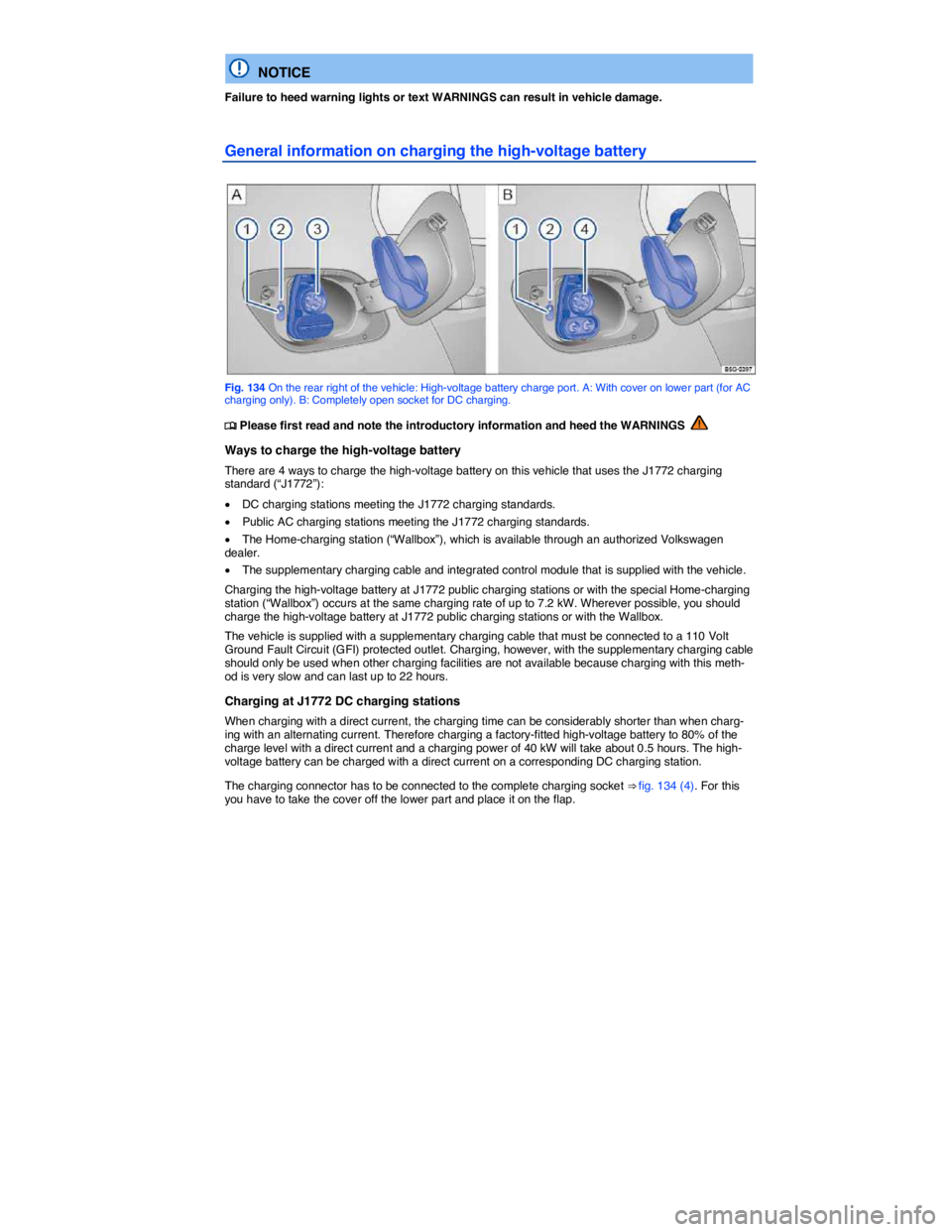
Fig. 134 On the rear right of the vehicle: High-voltage battery charge port. A: With cover on lower part (for AC charging only). B: Completely open socket for DC charging.
Page 256 of 394

Charging at J1772 public AC charging stations or with the Wallbox (AC charging)
Charging the high-voltage battery at an AC charging station or with the Wallbox: The high-voltage battery is charged at a rate of up to 7.2 kW. The charging process for a completely discharged high-voltage battery lasts about 4 hours.
The charging connector has to be connected to the upper part of the charging socket (3). Leave the lower part covered.
The Wallbox is available as an accessory. An authorized Volkswagen dealer can provide you with information on the Wallbox.
Make sure that the Wallbox is installed by a qualified expert and that your house’s electrical system is also checked before installation.
It is not possible to feed energy back into the power grid.
Supplementary charging cable
Connect the charging connector on the supplied charging cable to a properly functioning 110 Volt Ground Fault Circuit (GFI) outlet with a 15 amp fuse. The outlet must be properly protected from
water, moisture, and other fluids ⇒
Charging for the first time and charging after long standing periods
If the high-voltage battery is charged for the first time or charged after the vehicle has been standing for a long period, it is possible that the maximum charging level of the high-voltage battery cannot be reached. This is for technical reasons and does not necessarily mean a vehicle malfunction. If the maximum charge level is not reached even after several charging procedures, have the high-voltage battery checked by an authorized Volkswagen dealer or authorized Volkswagen service facility.
If the vehicle is not used for a long period, the high-voltage battery must be charged after 4 months at
the latest ⇒ .
WARNING
If you are not familiar with the socket or the electrical installation or it has not been checked by qualified experts, never use it for charging. Even very low charging currents can cause serious damage and in particular fires if the socket or electrical installation is in bad condi-tion. If necessary, get expert assistance from a qualified electrical installation specialist.
NOTICE
Frequently charging the vehicle with a high charging power, particularly with a direct current (DC charging), can lead to a permanent reduction of the charging capacity of the high-voltage battery. If possible, charge the vehicle with low charging power, like with a home-charging station or with the supplementary charging cable.
NOTICE
Not using the vehicle for long periods can cause damage to the high-voltage battery. Charge the high-voltage battery after 4 months at the latest.
The vehicle can be charged on charging stations that comply with the J1772 standard.
Page 321 of 394

WARNING
After the vehicle has been washed, the wet brakes or, in winter, brake discs or pads coated with ice, react slower and need longer stopping distances.
x Always dry the brakes and clean off any ice coatings with a few careful applications of the brake. Make sure not to endanger other motorists or cyclists or disobey legal requirements.
CAUTION
Sharp edges under the vehicle can cut exposed skin.
x Always protect your hands and arms from cuts on sharp metal edges when cleaning the underbody, the inside of the wheel housings, etc.
NOTICE
x The water temperature must not be more than +140 °F (+60 °C).
x To help prevent damage to the paint, do not wash the vehicle in direct sunlight.
x Do not use insect sponges, abrasive kitchen sponges or similar things to clean the vehicle. These can damage the paint finish.
x Never clean headlights with a dry cloth or sponge. Always use a wet cloth or sponge. For best results use soapy water.
x When washing or rinsing the vehicle in cold weather, do not let water get into the lock cylinders or point the hose at gaps around the doors, hood, or rear hatch. The water could freeze on the locks and seals and make it difficult to open the vehicle!
x When outside temperatures are low, wipe the rubber seals and their contact surfaces dry to help prevent freezing.
NOTICE
To help prevent vehicle damage in a car wash:
x Compare the vehicle track width with the dimensions of the guide rails in the car wash to help prevent damage to wheel rims and tires!
x Switch off the rain sensor before driving the vehicle through a car wash ⇒ page 127, Rain sensor.
x Make sure there is enough clearance for the height and width of the vehicle.
x To help prevent paint damage to the electric motor hood, place wiper blades against the windshield after they have dried. Do not let them snap back into place.
x Fold the outside mirrors toward the vehicle body.
x Lock the rear hatch to help prevent unintentional opening in the car wash.
Washing with a power washer
Page 322 of 394

Make sure there is enough distance to soft materials such as rubber hoses or insulating material as well as the sensors of the Park Distance Control system (if equipped). The Park Distance Control
system sensors can be found in the rear and, if applicable, front bumper ⇒ .
Make sure there is enough distance to soft materials such as rubber hoses or insulating material.
Never use concentrated jet nozzles or so-called dirt blasters ⇒ .
Never use a power washer to clean the electric motor compartment ⇒ Cleaning the electric motor compartment.
WARNING
Improper use of power washers can cause serious invisible permanent damage leading to tire failure and loss of vehicle control. This can cause accidents and severe personal injury.
x Keep sufficient distance between water jet and tires. Never wash tires with a nozzle that sprays the water out in a direct stream regardless of the distance to the tire and even for a very short time.
x Never use “dirt blasters” to clean tires. Even spraying from a relatively long distance for a very short time can do visible or invisible damage to tires.
WARNING
After the vehicle has been washed, the wet brakes or, in winter, brake discs or pads coated with ice, react slower and need longer stopping distances.
x Always dry the brakes and clean off any ice coatings with a few careful applications of the brake. Make sure not to endanger other motorists or cyclists or disobey legal requirements.
NOTICE
x Water temperature should not be more than +140 °F (+60 °C).
x To help prevent damage to the paint, do not wash the vehicle in direct sunlight.
x In order for Park Distance Control to work correctly, the sensors in the rear bumper must be kept clean and clear of snow and ice.
x When using a power washer or steam cleaner, only spray the sensors directly for a short period of time and always keep the nozzle at least 4 inches (10 cm) from the sensor.
x Do not clean icy or snow-covered windows with a power washer.
x When washing or rinsing the vehicle in cold weather, do not let water get into the lock cylinders or point the hose at gaps around the doors, hood, or rear hatch. The water could freeze on the locks and seals and make it difficult to open the vehicle!
Cleaning windows and outside mirrors
Page 369 of 394

Removing the wheel
x Review the checklist ⇒ Preparations for changing a wheel.
x Loosen the wheel bolts ⇒ Wheel bolts.
x Lift the vehicle ⇒ Lifting the vehicle with the vehicle jack.
x Completely unscrew and remove the previously loosened wheel bolts using the hexagonal socket
in the screwdriver handle ⇒ fig. 176. Place the wheel bolts on a clean surface.
x Remove the wheel.
Mounting a spare or compact spare wheel
If the tire is a unidirectional tire, be sure to install it in the proper rolling direction ⇒ Tires and wheels.
x Place the spare wheel or compact spare wheel on the axle.
x Screw in the wheel bolts clockwise and tighten them slightly using the hexagonal socket in the screwdriver handle.
x Lower the vehicle with the jack.
x Use the lug wrench to firmly tighten all wheel bolts (turn clockwise) ⇒ . Do not tighten them in sequence! Tighten any wheel bolt to begin, then tighten the wheel bolt diagonally opposite the first bolt, and so forth.
x Install the wheel bolt caps, center wheel hubcap, or wheel cover, if any ⇒ Wheel trim.
WARNING
Wheel bolts that are tightened or installed improperly can come loose, causing loss of vehi-cle control, a crash, and serious personal injury.
x Always keep wheel bolts and threads in the wheel hub clean and free of oil and grease. The wheel bolts must turn easily and must be tightened with the right torque.
x Use the hexagonal socket in the screwdriver handle only to turn the wheel bolts when they are loose, never to loosen them or tighten them firmly.
WARNING
Improper use of a compact spare wheel can cause loss of vehicle control, a crash or other accident, and serious personal injury.
x Never use a compact spare wheel if it is damaged or worn down to the wear indicators.
x Never drive faster than 50 mph (80 km/h) with a compact spare wheel. Avoid full-throttle acceleration, heavy braking, and fast cornering!
x Never drive more than 125 miles (200 km) with a compact spare wheel that is installed on the front axle (drive axle).
x Replace the compact spare with a normal wheel and tire as soon as possible. Compact spare tires are designed for brief use only.
After changing a wheel
Page 379 of 394

Color Current strength in
amps
(ATO® /MINI®)
Current strength in
amps
(JCASE®)
Light
brown
5 —
Brown 7.5 —
Red 10 50
Blue 15 20
Yellow 20 60
White or
clear
25 —
Green 30 40
Orange 40 —
Pink 30 30
Opening the fuse box in the instrument panel
x Pull the lower part of the cover toward the steering wheel (in the direction of the arrow ⇒ fig. 178) and remove the cover from the bottom. This action may require moderate force.
x To install, guide the cover from the bottom into the instrument panel and push in the direction
opposite to the arrow ⇒ fig. 178 until you can hear it latch into place.
Opening the fuse box in the electric motor compartment
x Open the electric motor hood