Page 233 of 348
SERVICING AND MAINTENANCE
CONTENTS
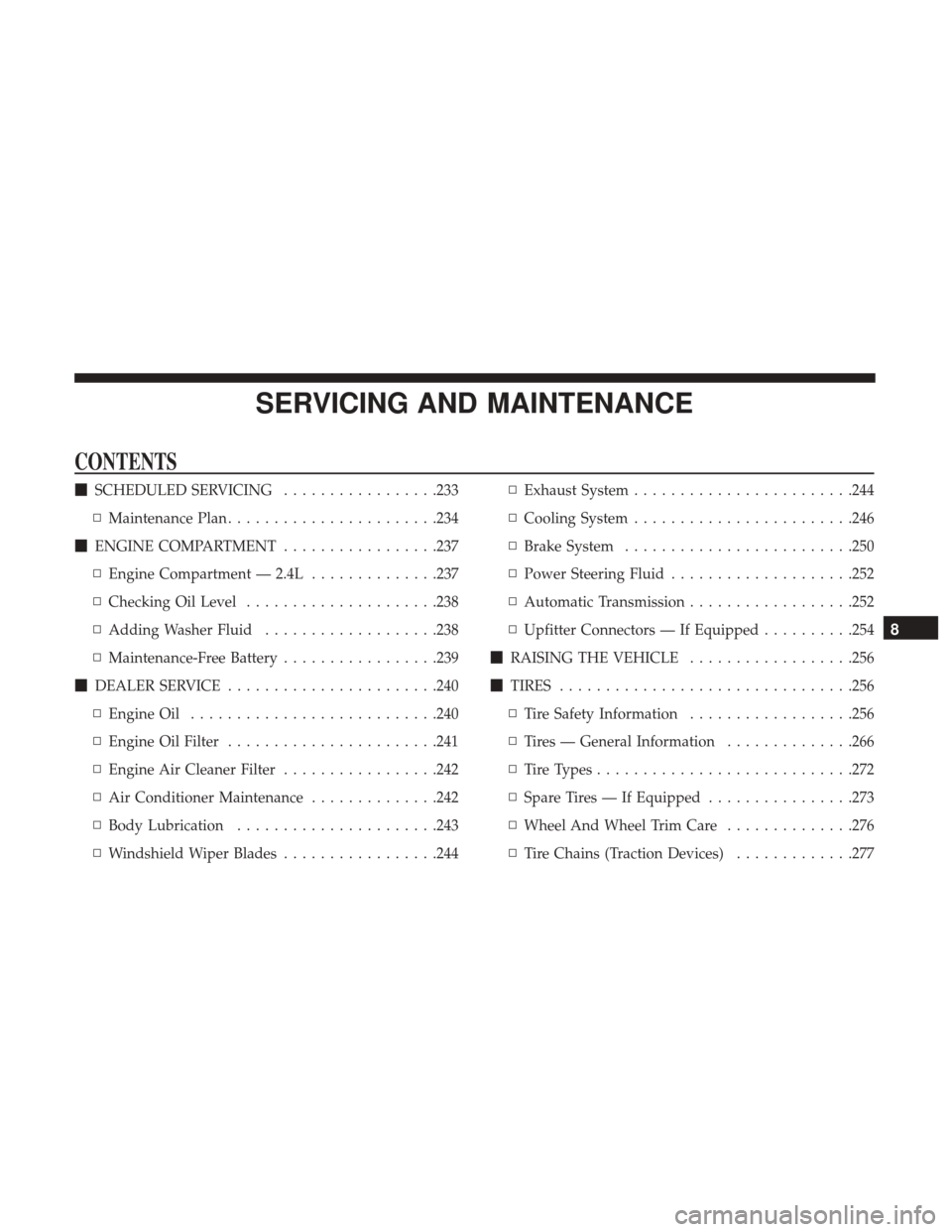
�SCHEDULED SERVICING .................233
▫ Maintenance Plan ...................... .234
� ENGINE COMPARTMENT .................237
▫ Engine Compartment — 2.4L ..............237
▫ Checking Oil Level .....................238
▫ Adding Washer Fluid ...................238
▫ Maintenance-Free Battery .................239
� DEALER SERVICE ...................... .240
▫ Engine Oil .......................... .240
▫ Engine Oil Filter ...................... .241
▫ Engine Air Cleaner Filter .................242
▫ Air Conditioner Maintenance ..............242
▫ Body Lubrication ..................... .243
▫ Windshield Wiper Blades .................244 ▫
Exhaust System ....................... .244
▫ Cooling System ....................... .246
▫ Brake System ........................ .250
▫ Power Steering Fluid ....................252
▫ Automatic Transmission ..................252
▫ Upfitter Connectors — If Equipped ..........254
� RAISING THE VEHICLE ..................256
� TIRES ............................... .256
▫ Tire Safety Information ..................256
▫ Tires — General Information ..............266
▫ Tire Types ........................... .272
▫ Spare Tires — If Equipped ................273
▫ Wheel
And Wheel Trim Care ..............276
▫ Tire Chains (Traction Devices) .............277
8
Page 240 of 348
Checking Oil Level
To assure proper engine lubrication, the engine oil must be
maintained at the correct level. Check the oil level at
regular intervals, such as every fuel stop. The best time to
check the engine oil level is about five minutes after a fully
warmed up engine is shut off.
Checking the oil while the vehicle is on level ground will
improve the accuracy of the oil level readings.
There are three possible dipstick types,
•Crosshatched zone.
• Crosshatched zone marked SAFE.
• Crosshatched zone marked with MIN at the low end of
the range and MAX at the high end of the range.
• Crosshatched zone marked with dimples at the MIN and
the MAX ends of the range.
NOTE: Always maintain the oil level within the crosshatch
markings on the dipstick.
Adding 1 quart (1.0 liters) of oil when the reading is at the
low end of the dipstick range will raise the oil level to the
high end of the range marking.
CAUTION!
Overfilling or underfilling the crankcase will cause
aeration or loss of oil pressure. This could damage your
engine.
Adding Washer Fluid
The windshield and rear window washers share the same
fluid reservoir. The fluid reservoir is located in the front of
the engine compartment. Be sure to check the fluid level in
the reservoir at regular intervals. Fill the reservoir with
windshield washer solvent (not radiator antifreeze) and
operate the system for a few seconds to flush out the
residual water.
When refilling the washer fluid reservoir, take some
washer fluid and apply it to a cloth or towel and wipe clean
the wiper blades, this will help blade performance.
To prevent freeze-up of your windshield washer system in
cold weather, select a solution or mixture that meets or
exceeds the temperature range of your climate. This rating
information can be found on most washer fluid containers.
238 SERVICING AND MAINTENANCE
Page 246 of 348
Windshield Wiper Blades
Clean the rubber edges of the wiper blades and the
windshield periodically with a sponge or soft cloth and a
mild nonabrasive cleaner. This will remove accumulations
of salt or road film.
Operation of the wipers on dry glass for long periods may
cause deterioration of the wiper blades. Always use washer
fluid when using the wipers to remove salt or dirt from a
dry windshield.
Avoid using the wiper blades to remove frost or ice from
the windshield. Keep the blade rubber out of contact with
petroleum products such as engine oil, gasoline, etc.
NOTE:Life expectancy of wiper blades varies depending
on geographical area and frequency of use. Poor perfor-
mance of blades may be present with chattering, marks,
water lines or wet spots. If any of these conditions are
present, clean the wiper blades or replace as necessary.
Wiper Service Position
If it is necessary to lift the blade from the windshield (In the
event of snow or blade replacement) Proceed as directed:
1. Rotate the end of the multifunction lever to the OFF position. 2. Turn the ignition to the MAR-ON position then to STOP.
3. After turning the ignition to the STOP, within two
minutes move the right stalk upward, into the unstable
(“anti-panic”) position, for at least half of a second. The
windshield wiper then executes part of a stroke; at each
command, approximately 1/3 of a normal wiper stroke
is triggered.
NOTE: The previous operation can be repeated up to three
times. In order to move the blades to the most suitable
position.
4. Lift the blade from the windshield and proceed with the required operation.
5. Carefully lower the blade, bringing it back in contact with the windshield.
6. Bring the blade to the initial rest position, turning the ignition to MAR-ON.
NOTE: Do not operate the wiper with the blades lifted
from the windshield.Exhaust System
The best protection against carbon monoxide entry into the
vehicle body is a properly maintained engine exhaust
system.
244 SERVICING AND MAINTENANCE
Page 339 of 348
WaterDriving Through ........................ .186
Wheel And Wheel Tire Care ...................276
Wheel And Wheel Tire Trim ...................276
Wind Buffeting .............................57
Window Fogging ...........................53
Windows .................................54
Power .................................54
Windshield Defroster ....................... .144
Windshield Washers .........................46
Fluid ................................ .238
Windshield Wiper Blades .....................244
Windshield Wipers ...................... .46, 238
Wipers Blade Replacement ....................244
Wrecker Towing .......................... .228
12
INDEX 337