2019 RAM CHASSIS CAB inflation pressure
[x] Cancel search: inflation pressurePage 340 of 607

338 STARTING AND OPERATING
Payload
The payload of a vehicle is defined as the allowable load
weight a truck can carry, including the weight of the driver,
all passengers, options and cargo.
Gross Axle Weight Rating (GAWR)
The GAWR is the maximum permissible load on the front
and rear axles. The load must be distributed in the cargo area
so that the GAWR of each axle is not exceeded.
Each axle GAWR is determined by the components in the
system with the lowest load carrying capacity (axle, springs,
tires or wheels). Heavier axles or suspension components
sometimes specified by purchasers for increased durability
does not necessarily increase the vehicle's GVWR.
Tire Size
The tire size on the Vehicle Certification Label represents the
actual tire size on your vehicle. Replacement tires must be
equal to the load capacity of this tire size.
Rim Size
This is the rim size that is appropriate for the tire size listed. Inflation Pressure
This is the cold tire inflation pressure for your vehicle for all
loading conditions up to full GAWR.
Curb Weight
The curb weight of a vehicle is defined as the total weight of
the vehicle with all fluids, including vehicle fuel, at full
capacity conditions, and with no occupants or cargo loaded
into the vehicle. The front and rear curb weight values are
determined by weighing your vehicle on a commercial scale
before any occupants or cargo are added.
Loading
The actual total weight and the weight of the front and rear
of your vehicle at the ground can best be determined by
weighing it when it is loaded and ready for operation.
The entire vehicle should first be weighed on a commercial
scale to insure that the GVWR has not been exceeded. The
weight on the front and rear of the vehicle should then be
determined separately to be sure that the load is properly
distributed over the front and rear axle. Weighing the vehicle
may show that the GAWR of either the front or rear axles has
been exceeded but the total load is within the specified
GVWR. If so, weight must be shifted from front to rear or
Page 350 of 607

348 STARTING AND OPERATING
• Proper tire inflation pressures are essential to the safe and
satisfactory operation of your vehicle. Refer to “Tires” in
“Servicing And Maintenance” for proper tire inflation
procedures.
• Check the trailer tires for proper tire inflation pressures
before trailer usage.
• Check for signs of tire wear or visible tire damage before
towing a trailer. Refer to “Tires” in “Servicing And Main -
tenance” for the proper inspection procedure.
• When replacing tires, refer to “Tires” in “Servicing And
Maintenance” for the proper tire replacement procedures.
Replacing tires with a higher load carrying capacity will
not increase the vehicle's GVWR and GAWR limits.
Towing Requirements — Trailer Brakes
• Do not interconnect the hydraulic brake system or vacuum
system of your vehicle with that of the trailer. This could
cause inadequate braking and possible personal injury.
• An electronically actuated trailer brake controller is
required when towing a trailer with electronically actu -
ated brakes. When towing a trailer equipped with a
hydraulic surge actuated brake system, an electronic brake
controller is not required. • Trailer brakes are recommended for trailers over 1,000 lbs
(453 kg) and required for trailers in excess of 2,000 lbs (907 kg).
WARNING!
• Do not connect trailer brakes to your vehicle's
hydraulic brake lines. It can overload your brake
system and cause it to fail. You might not have brakes
when you need them and could have an accident.
• Towing any trailer will increase your stopping
distance. When towing, you should allow for addi -
tional space between your vehicle and the vehicle in
front of you. Failure to do so could result in an accident.
CAUTION!
If the trailer weighs more than 1,000 lbs (453 kg) loaded,
it should have its own brakes and they should be of
adequate capacity. Failure to do this could lead to
accelerated brake lining wear, higher brake pedal effort,
and longer stopping distances.
Page 413 of 607

SERVICING AND MAINTENANCE 411
Once A Month Or Before A Long Trip:
• Check engine oil level.
• Check windshield washer fluid level.
• Check the tire inflation pressures and look for unusual
wear or damage. Rotate at the first sign of irregular wear.
• Check the fluid levels of the coolant reservoir, brake
master cylinder, power steering and automatic transmis -
sion (six-speed only), and fill as needed.
• Check function of all interior and exterior lights. Maintenance Plan
Required Maintenance
Refer to the maintenance plan on the following pages for
required maintenance.
At Every Oil Change Interval As Indicated By Oil Change Indicator System:
• Change oil and filter.
• Rotate the tires. Rotate at the first sign of irregular wear, even if it occurs before the oil indicator system turns on.
• Inspect engine cooling system protection and hoses.
• Inspect exhaust system.
• Inspect engine air cleaner if using in dusty or off-road conditions.
• Inspect battery and clean and tighten terminals as required.
• Inspect automatic transmission fluid if equipped with dipstick.
• Inspect brake pads, shoes, rotors, drums, hoses and park brake.
• Inspect front end, and lubricate — If equipped with serviceable fittings. 7
Page 449 of 607

SERVICING AND MAINTENANCE 447
H = Speed Symbol
• A symbol indicating the range of speeds at which a tire can carry a load corresponding to its load index under certain oper -
ating conditions
• The maximum speed corresponding to the speed symbol should only be achieved under specified operating conditions
(i.e., tire pressure, vehicle loading, road conditions, and posted speed limits)
Load Identification:
Absence of the following load identification symbols on the sidewall of the tire indicates a Standard Load (SL) tire:
• XL = Extra load (or reinforced) tire, or
• LL = Light load tire or
• C, D, E, F, G = Load range associated with the maximum load a tire can carry at a specified pressure
Maximum Load – Maximum load indicates the maximum load this tire is designed to carry
Maximum Pressure – Maximum pressure indicates the maximum permissible cold tire inflation pressure for this tire EXAMPLE:
7
Page 451 of 607

SERVICING AND MAINTENANCE 449
Tire Terminology And Definitions
Term Definition
B-Pillar The vehicle B-Pillar is the structural member of the body located behind
the front door.
Cold Tire Inflation Pressure Cold tire inflation pressure is defined as the tire pressure after the vehicle
has not been driven for at least three hours, or driven less than 1 mile
(1.6 km) after sitting for a minimum of three hours. Inflation pressure is
measured in units of PSI (pounds per square inch) or kPa (kilopascals).
Maximum Inflation Pressure The maximum inflation pressure is the maximum permissible cold tire
inflation pressure for this tire. The maximum inflation pressure is
molded into the sidewall.
Recommended Cold Tire Inflation Pressure Vehicle manufacturer's recommended cold tire inflation pressure as
shown on the tire placard.
Tire Placard A label permanently attached to the vehicle describing the vehicle’s
loading capacity, the original equipment tire sizes and the recommended
cold tire inflation pressures.
7
Page 452 of 607
450 SERVICING AND MAINTENANCE
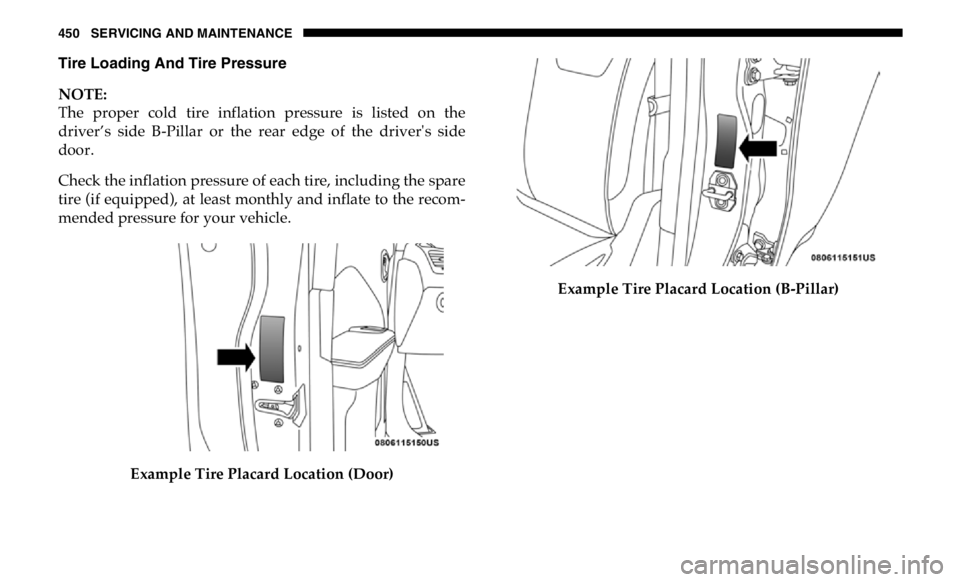
Tire Loading And Tire Pressure
NOTE:
The proper cold tire inflation pressure is listed on the
driver’s side B-Pillar or the rear edge of the driver's side
door.
Check the inflation pressure of each tire, including the spare
tire (if equipped), at least monthly and inflate to the recom -
mended pressure for your vehicle.
Example Tire Placard Location (Door) Example Tire Placard Location (B-Pillar)
Page 453 of 607

SERVICING AND MAINTENANCE 451
Tire And Loading Information Placard
Tire And Loading Information Placard
This placard tells you important information about the:
1. Number of people that can be carried in the vehicle.
2. Total weight your vehicle can carry.
3. Tire size designed for your vehicle.
4. Cold tire inflation pressures for the front, rear, and spare
tires. Loading
The vehicle maximum load on the tire must not exceed the
load carrying capacity of the tire on your vehicle. You will
not exceed the tire's load carrying capacity if you adhere to
the loading conditions, tire size, and cold tire inflation pres -
sures specified on the Tire and Loading Information placard
in “Vehicle Loading” in the “Starting And Operating”
section of this manual.
NOTE:
Under a maximum loaded vehicle condition, gross axle
weight ratings (GAWRs) for the front and rear axles must not
be exceeded.
For further information on GAWRs, vehicle loading, and
trailer towing, refer to “Vehicle Loading” in the “Starting
And Operating” section of this manual.
To determine the maximum loading conditions of your
vehicle, locate the statement “The combined weight of occu -
pants and cargo should never exceed XXX kg or XXX lbs” on
the Tire and Loading Information placard. The combined
weight of occupants, cargo/luggage and trailer tongue
weight (if applicable) should never exceed the weight refer -
enced here. 7
Page 456 of 607

454 SERVICING AND MAINTENANCE
(Continued)Tires — General Information
Tire Pressure
Proper tire inflation pressure is essential to the safe and satis -
factory operation of your vehicle. Four primary areas are
affected by improper tire pressure:
• Safety
• Fuel Economy
• Tread Wear
• Ride Comfort and Vehicle Stability
Safety
Both under-inflation and over-inflation affect the stability of
the vehicle and can produce a feeling of sluggish response or
over responsiveness in the steering.
NOTE:
• Unequal tire pressures from side to side may cause erratic
and unpredictable steering response.
• Unequal tire pressure from side to side may cause the
vehicle to drift left or right.WARNING!
• Improperly inflated tires are dangerous and can cause
collisions.
• Underinflation increases tire flexing and can result in
overheating and tire failure.
• Overinflation reduces a tire's ability to cushion shock.
Objects on the road and chuckholes can cause damage
that result in tire failure. • Overinflated or underinflated tires can affect vehicle
handling and can fail suddenly, resulting in loss of
vehicle control.
• Unequal tire pressures can cause steering problems.
You could lose control of your vehicle.
• Unequal tire pressures from one side of the vehicle to
the other can cause the vehicle to drift to the right or
left.
• Always drive with each tire inflated to the recom -
mended cold tire inflation pressure. WARNING! (Continued)