Page 24 of 324
22
Warning / indicator lamp State Cause Actions / Observations
Black/white warning lamps
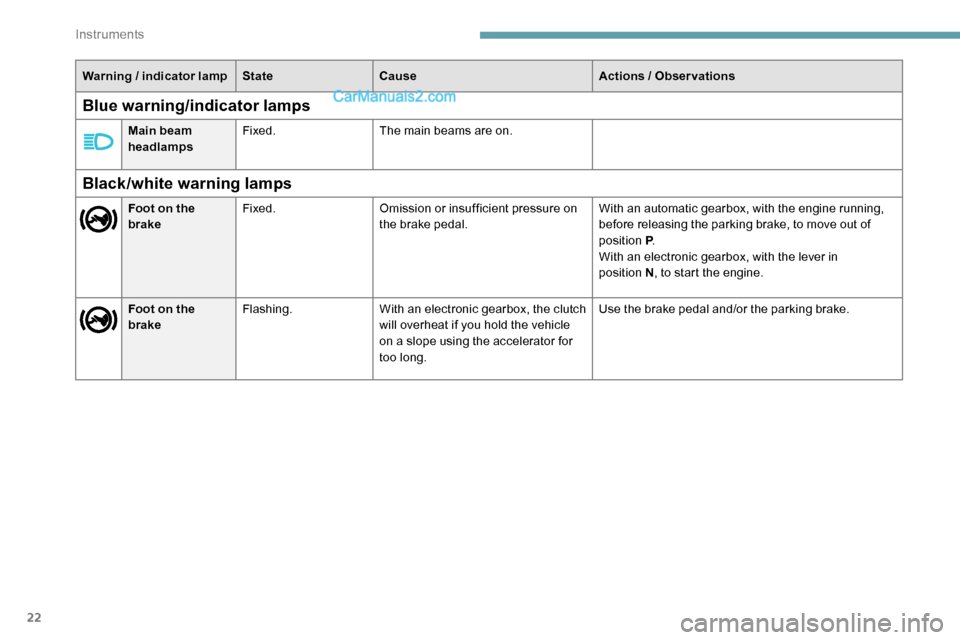
Foot on the
brakeFixed.
Omission or insufficient pressure on
the brake pedal. With an automatic gearbox, with the engine running,
before releasing the parking brake, to move out of
position P
.
With an electronic gearbox, with the lever in
position
N, to start the engine.
Foot on the
brake Flashing.
With an electronic gearbox, the clutch
will overheat if you hold the vehicle
on a slope using the accelerator for
too long. Use the brake pedal and/or the parking brake.
Blue warning/indicator lamps
Main beam
headlamps
Fixed.
The main beams are on.
Instruments
Page 34 of 324
32
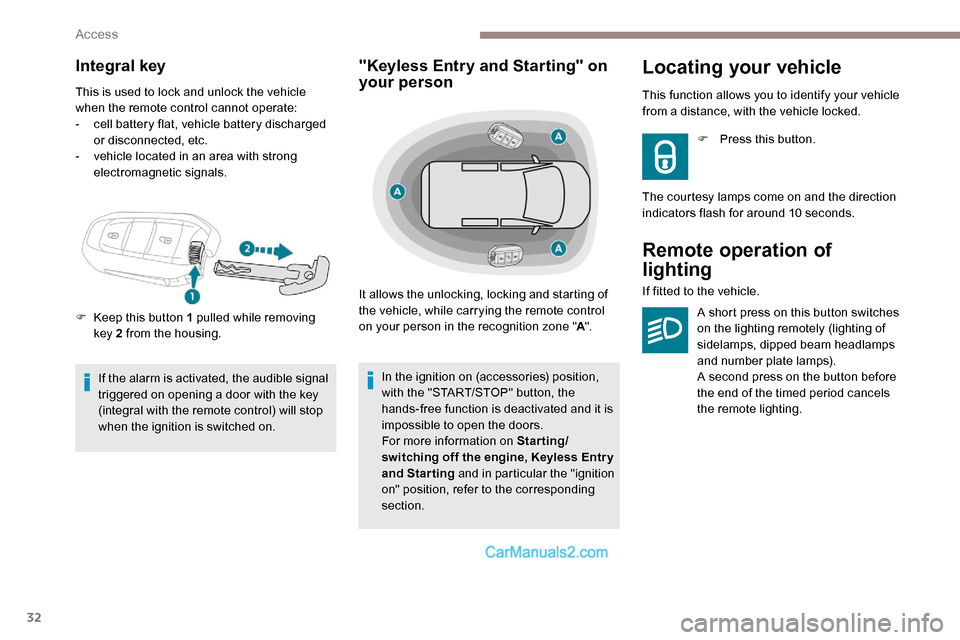
Integral key
This is used to lock and unlock the vehicle
when the remote control cannot operate:
-
c
ell battery flat, vehicle battery discharged
or disconnected, etc.
-
v
ehicle located in an area with strong
electromagnetic signals.
If the alarm is activated, the audible signal
triggered on opening a door with the key
(integral with the remote control) will stop
when the ignition is switched on.
"Keyless Entry and Starting" on
your person
It allows the unlocking, locking and starting of
the vehicle, while carrying the remote control
on your person in the recognition zone " A".
In the ignition on (accessories) position,
with the "START/STOP" button, the
hands-free function is deactivated and it is
impossible to open the doors.
For more information on Starting/
switching off the engine, Keyless Entr y
and Starting and in particular the "ignition
on" position, refer to the corresponding
section.
Locating your vehicle
F Keep this button 1 pulled while removing key 2 from the housing. This function allows you to identify your vehicle
from a distance, with the vehicle locked.
F
P
ress this button.
The courtesy lamps come on and the direction
indicators flash for around 10 seconds.
Remote operation of
lighting
If fitted to the vehicle.
A short press on this button switches
on the lighting remotely (lighting of
sidelamps, dipped beam headlamps
and number plate lamps).
A second press on the button before
the end of the timed period cancels
the remote lighting.
Access
Page 56 of 324
54
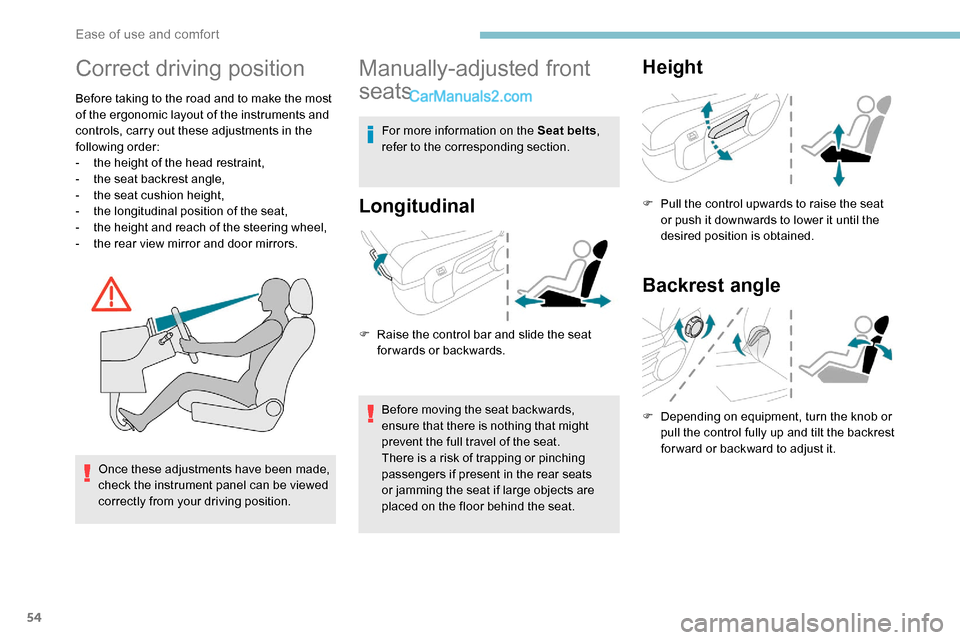
Correct driving position
Before taking to the road and to make the most
of the ergonomic layout of the instruments and
controls, carry out these adjustments in the
following order:
-
t
he height of the head restraint,
-
t
he seat backrest angle,
-
t
he seat cushion height,
-
t
he longitudinal position of the seat,
-
t
he height and reach of the steering wheel,
-
t
he rear view mirror and door mirrors.
Once these adjustments have been made,
check the instrument panel can be viewed
correctly from your driving position.
Manually-adjusted front
seats
For more information on the Seat belts ,
refer to the corresponding section.
Longitudinal
F Raise the control bar and slide the seat forwards or backwards.
Before moving the seat backwards,
ensure that there is nothing that might
prevent the full travel of the seat.
There is a risk of trapping or pinching
passengers if present in the rear seats
or jamming the seat if large objects are
placed on the floor behind the seat.
Height
F Pull the control upwards to raise the seat or push it downwards to lower it until the
desired position is obtained.
Backrest angle
F Depending on equipment, turn the knob or pull the control fully up and tilt the backrest
forward or backward to adjust it.
Ease of use and comfort
Page 57 of 324
55
Lumbar
F Turn the knob manually to obtain the desired level of lumbar support.
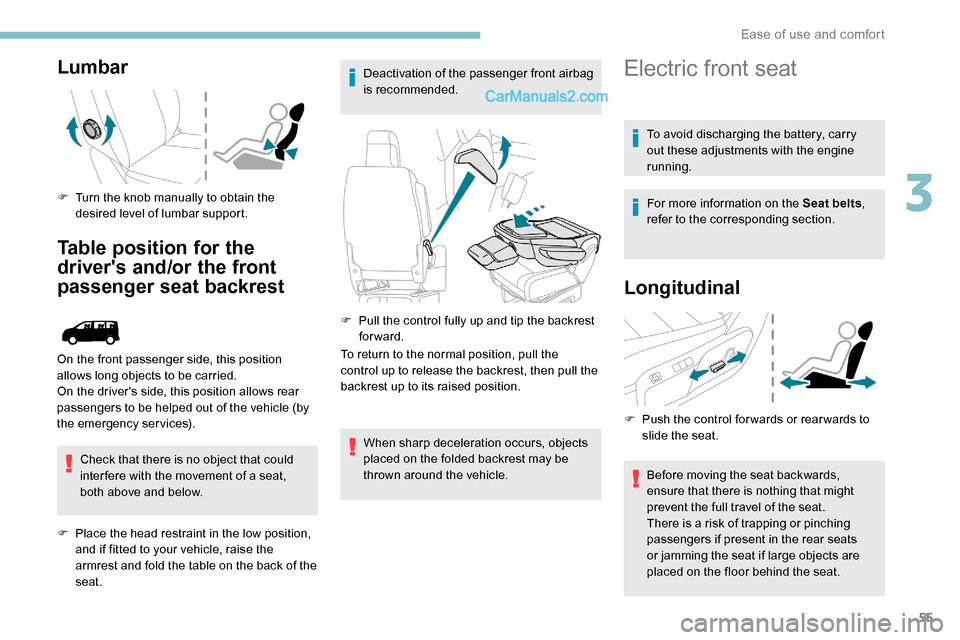
Table position for the
driver's and/or the front
passenger seat backrest
Check that there is no object that could
inter fere with the movement of a seat,
both above and below.
F
P
lace the head restraint in the low position,
and if fitted to your vehicle, raise the
armrest and fold the table on the back of the
seat. Deactivation of the passenger front airbag
is recommended.
F
P
ull the control fully up and tip the backrest
forward.
To return to the normal position, pull the
control up to release the backrest, then pull the
backrest up to its raised position.
On the front passenger side, this position
allows long objects to be carried.
On the driver's side, this position allows rear
passengers to be helped out of the vehicle (by
the emergency services).
When sharp deceleration occurs, objects
placed on the folded backrest may be
thrown around the vehicle.
Electric front seat
To avoid discharging the battery, carry
out these adjustments with the engine
running.
For more information on the Seat belts,
refer to the corresponding section.
Longitudinal
F Push the control for wards or rear wards to slide the seat.
Before moving the seat backwards,
ensure that there is nothing that might
prevent the full travel of the seat.
There is a risk of trapping or pinching
passengers if present in the rear seats
or jamming the seat if large objects are
placed on the floor behind the seat.
3
Ease of use and comfort
Page 58 of 324
56
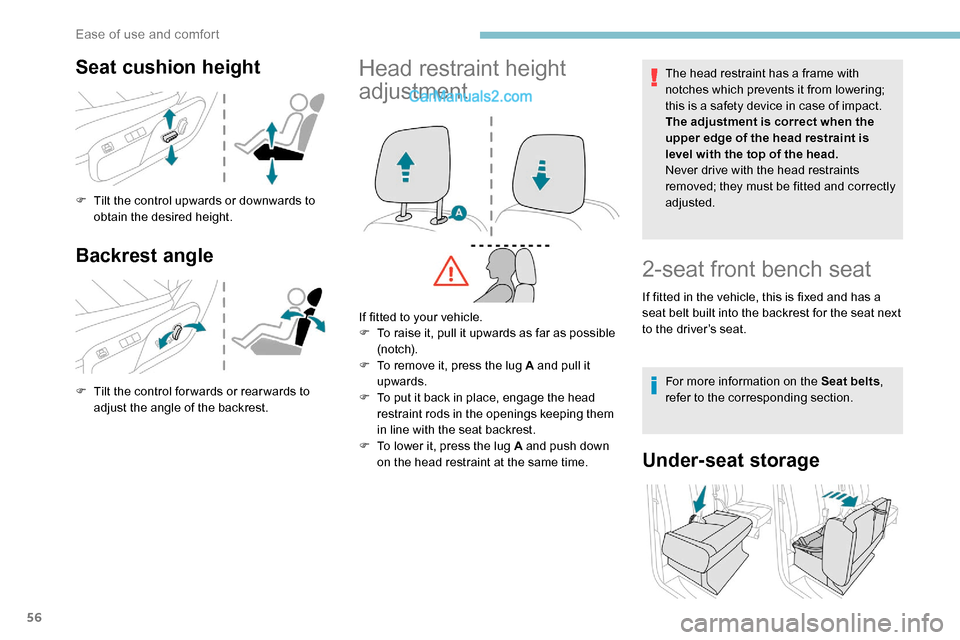
Seat cushion height
F Tilt the control upwards or downwards to obtain the desired height.
Backrest angle
F Tilt the control for wards or rear wards to adjust the angle of the backrest.
Head restraint height
adjustmentThe head restraint has a frame with
notches which prevents it from lowering;
this is a safety device in case of impact.
The adjustment is correct when the
upper edge of the head restraint is
level with the top of the head.
Never drive with the head restraints
removed; they must be fitted and correctly
adjusted.
If fitted to your vehicle.
F
T
o raise it, pull it upwards as far as possible
(n otc h).
F
T
o remove it, press the lug
A and pull it
upwards.
F
T
o put it back in place, engage the head
restraint rods in the openings keeping them
in line with the seat backrest.
F
T
o lower it, press the lug A and push down
on the head restraint at the same time.
2-seat front bench seat
If fitted in the vehicle, this is fixed and has a
seat belt built into the backrest for the seat next
to the driver’s seat.
For more information on the Seat belts ,
refer to the corresponding section.
Under-seat storage
Ease of use and comfort
Page 62 of 324

60
Heated mirrors
F Press this button.For more information on Rear screen
demisting - defrosting , refer to the
corresponding section.
Rear view mirror
Equipped with an anti-dazzle system, which
darkens the mirror glass and reduces the
nuisance to the driver caused by the sun,
headlamps from other vehicles, etc.
Manual model
Adjustment
F A djust the mirror so that the glass is
directed correctly in the "day" position. Day/night position
Automatic "electrochrome"
model
This system automatically and progressively
changes between day and night use by means
of a sensor measuring the light coming from the
rear of the vehicle. In order to ensure optimum visibility during
your manoeuvres, the mirror lightens
automatically when reverse gear is
engaged.
F
P
ull the lever to change to the "night" anti-
dazzle position.
F
P
ush the lever to change to the normal
"day" position.
Moduwork
When the flap is removed, it is possible
to load long objects underneath the outer
seat.
The outer seat cushion of the bench seat can
be folded onto the backrest to create a loading
area inside the cab.
A removable flap on the partition can be
removed to allow long objects to be loaded.
Ease of use and comfort
Page 65 of 324

63
Removing the net
F Release the hooks from the rings 4 and 3.
F R emove the lower fastener 2 then the upper
fastener 1 , turning them by a quarter turn
backwards to unlock them.
Make sure that the size, shape and
volume of the loads carried are compatible
with the highway code and safety
regulations and do not impair the driver’s
field of vision.
All loads must be appropriately secured
to prevent or minimise displacement and
prevent injury.
Install the anti-slip net (supplied with the
vehicle) every time that the seat is raised
and the partition flap removed.
Never use the net for any other purposes.
Regularly check the condition of the
anti-slip net. As soon as signs of wear or
tear appear, contact a PEUGEOT dealer
to have it replaced by an anti-slip net
that meets the specifications required by
PEUGEOT for the vehicle.
Always fit the removable flap back into
place when you are not carrying any long
loads.
"Swivelling writing table"
If the vehicle is so equipped, the central seat
cushion of the bench seat can be tilted to form
a swivelling working table top, thus creating a
mobile desk (with the vehicle stationary).
F
P
ull the handle located at the top of the
backrest cushion.
Central seat cushion
storage
Never use the table while the vehicle is
moving.
Any object on the table will become a
dangerous projectile that could cause
injury in the event of sudden braking or
collision.
Precautions for the seats
and bench seats
Do not remove a head restraint without storing
it and securing it to a support.
Ensure that the passengers can always access
the seat belts and fasten them easily.
A passenger must not take their seat without
adjusting the seat's head restraint correctly and
adjusting and fastening their seat belt.
Ensure that no object or passenger feet
could obstruct the anchorage points
or prevent the correct latching of the
assembly.
3
Ease of use and comfort
Page 67 of 324
65
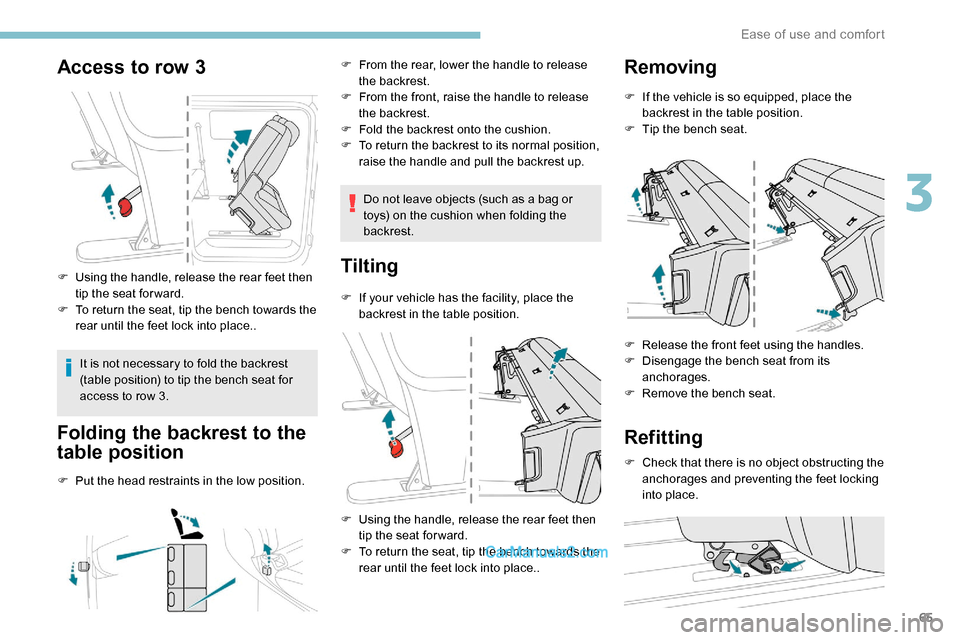
Access to row 3
F Using the handle, release the rear feet then tip the seat for ward.
F
T
o return the seat, tip the bench towards the
rear until the feet lock into place..
It is not necessary to fold the backrest
(table position) to tip the bench seat for
access to row 3.
Folding the backrest to the
table position
F Put the head restraints in the low position. F
F
rom the rear, lower the handle to release
the backrest.
F
F
rom the front, raise the handle to release
the backrest.
F
F
old the backrest onto the cushion.
F
T
o return the backrest to its normal position,
raise the handle and pull the backrest up.
Do not leave objects (such as a bag or
toys) on the cushion when folding the
backrest.
Tilting
F If your vehicle has the facility, place the backrest in the table position.
F
U
sing the handle, release the rear feet then
tip the seat for ward.
F
T
o return the seat, tip the bench towards the
rear until the feet lock into place..
Removing
F If the vehicle is so equipped, place the backrest in the table position.
F
T
ip the bench seat.
F
R
elease the front feet using the handles.
F
D
isengage the bench seat from its
anchorages.
F
R
emove the bench seat.
Refitting
F Check that there is no object obstructing the anchorages and preventing the feet locking
into place.
3
Ease of use and comfort