2019 Peugeot 508 repair
[x] Cancel search: repairPage 5 of 320

3
.
bit.ly/helpPSA
.
Driving recommendations 124
Anti-theft protection 1 25
Starting/Switching off the engine
1
25
Electric parking brake
1
28
Manual gearbox
1
31
Automatic gearbox
1
31
Hill start assist
1
35
Active Suspension Control
1
36
Driving modes
1
36
Gear shift indicator
1
38
Stop & Start
1
38
Tyre under-inflation detection
1
40
Speed Limit recognition and
recommendation
1
42
Speed limiter
1
46
Programmable cruise control
1
48
Memorising speeds
1
51
Drive Assist Plus
1
51
Adaptive cruise control
1
52
Lane Positioning Assist
1
61
Active Safety Brake with Distance Alert
and Intelligent emergency braking
assistance
165
Fatigue detection system
1
69
Active Blind Spot Monitoring System
1
70
Active Lane Keeping Assistance
1
71
Blind Spot Detection
1
74
Parking sensors
1
76
Visiopark 1 – Visiopark 2
1
79
Park Assist
1
84
Full Park Assist
1
88Compatibility of fuels
1 97
Refuelling 1 98
Misfuel prevention (Diesel)
1
99
Towing device
1
99
Towing device with retractable towball
2
00
Load reduction mode
2
01
Energy economy mode
202
S
now chains
2
02
Fitting roof bars
2
03
Bonnet
204
Engine compartment
2
05
Checking levels
20
5
Checks
20
8
Advice on care and maintenance
2
10
AdBlue
® (BlueHDi engines) 2 10
Warning triangle
2
13
Running out of fuel (Diesel)
2
13
Tool kit
2
14
Temporary puncture repair kit
2
16
Spare wheel
2
19
Changing a bulb
2
23
Changing a fuse
2
27
12 V battery
2
33
Towing the vehicle
2
36Engine technical data and towed loads
2
38
Engines and towed loads – Petrol
2
39
Engines and towed loads – Diesel
2
40
Dimensions
2
42
Identification markings
2
43
Driving
Practical information
In the event of a breakdown Technical data
Alphabetical index
Access to additional videos
Audio equipment and telematics
PEUGEOT Connect Radio
PEUGEOT Connect Nav
.
Contents
Page 87 of 320
85
Do not confuse the stowing rings with the
bag hooks or the Top Tether fixings.
To remove or refit one of the movable rings:
F
B
ring it to an oblong slot on the track.
F
T
o obser ve the direction of installation,
make sure the ring is positioned vertically
and towards the outside of the vehicle.
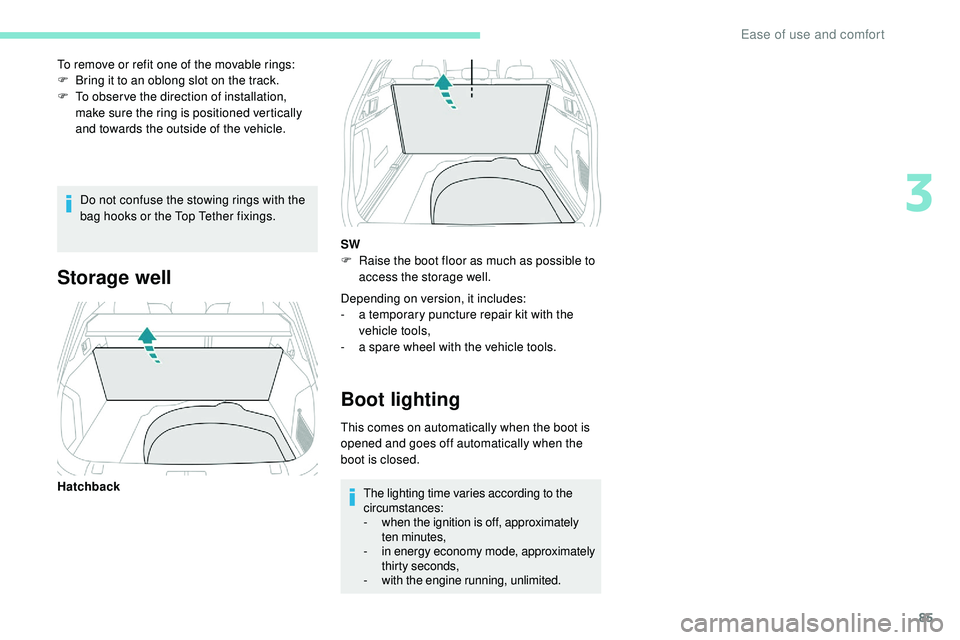
Storage well
Depending on version, it includes:
- a t emporary puncture repair kit with the
vehicle tools,
-
a s
pare wheel with the vehicle tools.
Boot lighting
This comes on automatically when the boot is
opened and goes off automatically when the
boot is closed.The lighting time varies according to the
circumstances:
-
w
hen the ignition is off, approximately
ten minutes,
-
i
n energy economy mode, approximately
thirty seconds,
-
w
ith the engine running, unlimited.
Hatchback SW
F
R
aise the boot floor as much as possible to
access the storage well.
3
Ease of use and comfort
Page 101 of 320

99
Automatic operation of
hazard warning lamps
When braking in an emergency, depending on
the force of deceleration, the hazard warning
lamps come on automatically. They switch off
automatically when you next accelerate.
It is also possible to switch them off by pressing
the button.
Horn
F Press the central part of the multifunction steering wheel.
Emergency or
assistance
call
Peugeot Connect SOS** According to the geographic coverage
of "Peugeot Connect SOS", "Peugeot
Connect Assistance" and the official national
language chosen by the owner of the vehicle.
The list of countries covered and PEUGEOT
CONNECT services is available from dealers
or on the website for your country.
In an emergency, press this
button for more than 2 seconds.
The flashing LED and the voice
message confirm that the call
has been made to the "Peugeot
Connect SOS" ser vice*.
Pressing this button again immediately cancels
the request; the LED goes off.
The LED remains on (without flashing) when
communication is established.
It goes off at the end of the call. *
I
n accordance with the general conditions
of use for the ser vice available from dealers
and subject to technological and technical
limitations.
"Peugeot Connect SOS" immediately locates
your vehicle and contacts you in your own
language**, and – if necessary – requests that
relevant emergency services be dispatched**.
In countries where the ser vice is not available,
or when the locating ser vice has been
expressly declined, the call is sent directly If an impact is detected by the airbag
control unit, an emergency call is made
automatically and independently of the
deployment of any airbags.
Operation of the system
When the ignition is switched on, the indicator
lamp comes on for 3 seconds indicating that the
system is operating correctly.
If the indicator lamp lights up continuously red:
there is a system fault.
If the indicator lamp flashes red: replace the
back-up battery.
In either case, emergency and assistance calls
may not function.
Contact a qualified repairer as soon as possible. to the emergency services (112) without the
vehicle location.
5
Safety
Page 104 of 320
102
Deactivation is done via the Driving/
Vehicle menu of the touch screen.
It is confirmed by the illumination of
this warning lamp in the instrument
panel and the display of a message.
Reactivation
The ASR system is reactivated automatically
every time the ignition is switched back on or
from 31 mph (50 km/h).
Below 31 mph (50
km/h), you can reactivate it
manually:
Activation is done via the Driving/
Vehicle menu of the touch screen.
It is confirmed by this warning lamp
in the instrument panel going out and
the display of a message.
Malfunction
Illumination of this warning lamp,
accompanied by the display of a
message and an audible signal,
indicates a fault with the system. ASR/DSC
These systems offer increased safety
in normal driving, but they should not
encourage the driver to take extra risks or
drive at high speed.
It is in conditions of reduced grip (rain,
snow, ice) that the risk of loss of grip
increases. It is therefore important for your
safety to keep these systems activated in
all conditions, and particularly in difficult
conditions.
The correct operation of these
systems depends on obser vation of
the manufacturer's recommendations
regarding as much the wheels (tyres and
rims), braking and electronic components
as the assembly and repair procedures
used by PEUGEOT dealers.
The use of snow tyres is recommended,
in order to be able to benefit from the
efficiency of these systems in winter
conditions.
In this case, it is essential to equip the
four wheels with tyres approved for your
vehicle.
Contact a PEUGEOT dealer or a qualified
workshop to have the systems checked.
Trailer stability assist (TSA)
When towing, this system reduces the risk of
the vehicle or trailer swaying.
Operation
The system is activated automatically when the
ignition is switched on.
The electronic stability control (ESC) must not
have any faults.
If the system detects oscillations (snaking) in
the movement of the trailer at speeds between
37 and 99 mph (60 and 160 km/h), it acts
on the brakes to stabilise the trailer and, if
necessary, reduces the engine power to slow
down the vehicle. The correction is signalled by the
flashing of this warning lamp in the
instrument panel and illumination of
the brake lamps.
For information on the weights and towed
loads, refer to the "Technical data" section or
the registration certificate for your vehicle.
To ensure complete safety while driving with
a Towing device , refer to the corresponding
section.
Safety
Page 107 of 320
105
Installation
The lower part of the strap must be
positioned as low as possible on the
pelvis.
The upper part must be positioned in the
hollow of the shoulder.
In order to be effective, a seat belt must:
-
b
e tightened as close to the body as
possible,
-
b
e pulled in front of you with a smooth
movement, checking that it does not
twist,
-
b
e used to restrain only one person,
-
n
ot show any signs of cuts or fraying,
-
n
ot be converted or modified to avoid
affecting its performance.
Recommendations for children
Use a suitable child seat if the passenger
is less than 12 years old or shorter than
one and a half metres.
Never use the same seat belt to secure
more than one child.
Never allow a child to travel on your lap.
For more information on Child seats , refer
to the corresponding section. Maintenance
In accordance with current safety
regulations, for all repairs on your
vehicle's seat belts, go to a qualified
workshop with the skills and equipment
needed, which a PEUGEOT dealer is able
to provide.
Have your seat belts checked regularly
by a PEUGEOT dealer or a qualified
workshop, particularly if the straps show
signs of damage.
Clean the seat belt straps with soapy
water or a textile cleaning product, sold
by
PEUGEOT dealers.
In the event of an impact
Depending on the nature and
seriousness of the impact, the pyrotechnic
pretensioner may be deployed before and
independently of the airbags. Deployment of
the pretensioners is accompanied by a slight
discharge of harmless smoke and a noise,
due to the activation of the pyrotechnic
cartridge incorporated in the system.
In all cases, the airbag warning lamp
comes
on.
Following an impact, have the seat belts
system checked and, if necessary, replaced,
by a PEUGEOT dealer or a qualified
workshop.
Airbags
General information
System designed to contribute towards
improving the safety of the occupants of the
front seats and the rear side seats in the event
of serious collisions. The airbags supplement
the action of the seat belts fitted with force
limiters for the front seats and the rear side
seats.
If a collision occurs, the electronic detectors
record and analyse the front and side impacts
sustained in the impact detection zones:
-
i
n the event of violent impact, the airbags
deploy instantly and help better protect
the occupants of the vehicle; immediately
after the impact, the airbags deflate rapidly
in order not to hinder the visibility or the
possible exit of the occupants,
-
i
n the case of a minor or rear impact or
in certain rollover conditions, the airbags
may not be deployed; the seat belt
alone contributes towards ensuring your
protection in these situations.
The airbags do not operate when the
ignition is switched off.
This equipment will only deploy once. If a
second impact occurs (during the same or
a subsequent accident), the airbag will not
be deployed again.
5
Safety
Page 111 of 320

109
Lateral airbags
Use only approved covers on the seats,
compatible with the deployment of the
lateral airbags. For information on the
product range of seat covers suitable for
your vehicle, contact a PEUGEOT dealer.
Do not fix or attach anything to the seat
backrests (clothes, etc.) as this could
cause injuries to the thorax or arm when
the lateral airbag is deployed.
Do not sit with the upper part of the body
any nearer to the door than necessary.
The vehicle's front door panels include
side impact sensors.
A damaged door or any unauthorised or
incorrectly executed work (modification or
repair) on the front doors or their interior
trim could compromise the operation of
these sensors – risk of malfunction of the
lateral airbags!
Such work must only be done by a
PEUGEOT dealer or a qualified workshop.Active bonnet
Deployment of the active bonnet is
accompanied by a slight discharge of
harmless smoke and a noise, due to the
activation of the pyrotechnic cartridge
incorporated in the system. The airbag
warning lamp comes on.
Following deployment of the system, do
not try to open or close the bonnet. Call
a towing company or go to the nearest
PEUGEOT dealer or qualified workshop,
driving below 19 mph (30 km/h).
Make sure that you adjust the height of
the driver's seat – risk of hindrance to
visibility! This equipment will only deploy once. If a
second impact occurs (during the same or
a subsequent accident), the active bonnet
will not be deployed again.
After an accident or if the vehicle has
been stolen, have the system checked.
Do not tamper with the pyrotechnic
systems under the bonnet, close to the
struts – risk of explosion!
All work on this system must be carried
out only by a PEUGEOT dealer or a
qualified workshop.Malfunction
If this warning lamp comes on in the
instrument panel, accompanied by
an audible warning and the display
of a message, you must contact
a PEUGEOT dealer or a qualified
workshop to have the system
checked.
The active bonnet may no longer be
deployed in the event of an impact.
The active bonnet has been designed to
optimise pedestrians’ safety in the event of
collision with the front of the vehicle.
5
Safety
Page 143 of 320

141
The under-inflation detection system does
not replace the need for vigilance on the
part of the driver.
This system does not avoid the need to
check the tyre pressures (including the
spare wheel) every month as well as
before a long journey.
Driving with under-inflated tyres worsens
road-holding, lengthens braking distances,
causes premature wear of the tyres,
particularly in adverse conditions (heavy
loads, high speeds, long journeys).Driving with under-inflated tyres
increases fuel consumption.
The inflation pressures defined for your
vehicle can be found on the tyre pressure
label.
For more information on the
Identification markings , refer to the
corresponding section. Checking tyre pressures
This check should be done when the tyres
are "cold" (vehicle stopped for 1 hour or
after a journey of less than 6 miles (10 km)
at moderate speeds).
Other wise, add 0.3 bar to the pressures
shown on the label.
Snow chains
The system does not have to be
reinitialised after fitting or removing snow
chains.
Under-inflation alert
This is indicated by continuous
illumination of this warning lamp, an
audible signal and, depending on
equipment, the display of a message.
F
R
educe speed immediately, avoid excessive
steering movements and sudden braking.
F
S
top the vehicle as soon as it is safe to do so.
The loss of pressure detected does not
always cause visible bulging of the tyre.
Do not satisfy yourself with just a visual
check. F
I
f you have a compressor, such as the one
in the temporary puncture repair kit, check
the pressures of the four tyres when cold.
F
I
f it is not possible to make this check
immediately, drive carefully at reduced
speed.
or
F
I
n case of a puncture, use the temporary
puncture repair kit or the spare wheel
(depending on equipment).
The alert is kept active until the system is
reinitialised.
Reinitialisation
The system must be reinitialised after any
adjustment to the pressure of one or more
tyres, and after changing one or more wheels.
Before reinitialising the system, ensure
that the pressures of the four tyres
are correct for the conditions of use
of the vehicle and conform to the
recommendations on the tyre pressure
label.
The under-inflation alert can only be relied
on if the reinitialisation of the system has
been done with the pressures in the four
tyres correctly adjusted.
The under-inflation detection system
does not give a warning if a pressure is
incorrect at the time of reinitialisation.
6
Driving
Page 146 of 320

144
To maintain correct operation of the
system: regularly clean the area in front of
the camera.
The internal sur face of the windscreen can
also become misted around the camera.
In humid and cold weather, demist the
windscreen regularly.
Specific speed limits, such as those for
heavy goods vehicles, are not displayed.
The display of the speed limit in the
instrument panel is updated as you pass
a speed limit sign intended for cars (light
vehicles).
Activation/Deactivation
By default, the system is automatically
activated at every engine start.The function is activated and
deactivated in the Driving /Vehicle
menu of the touch screen.
Displays in the instrument
panel
1. Detected speed limit indication.
or
2. Indication of the end of the speed limit.
The system is active but is not detecting speed
limit information. On detection of speed limit information, the
system displays the value.
Operating limits
The legislation on speed limits is specific to
each country.
The system does not take account of reduced
speed limits in the following cases:
-
a
tmospheric pollution,
-
w
hen towing,
-
d
riving with a space-saver type spare wheel
or snow chains fitted,
-
p
uncture repair using the temporary repair kit,
-
y
oung drivers, etc.
The following situations may interfere with
the operation of the system or prevent it from
working:
-
p
oor visibility (inadequate street lighting,
falling snow, rain, fog),
-
w
indscreen area located in front of the
camera: dirty, misted, frost-covered, snow-
covered, damaged or covered by a sticker,
-
f
ault with the camera,
-
o
bsolete or incorrect mapping,
-
h
idden road signs (other vehicles,
vegetation, snow),
-
s
peed limit signs that do not conform to the
standard, are damaged or distorted.
(95
km/h)), the speed flashes for 10 seconds.
For a suggested maximum speed, the first
time that the vehicle’s speed exceeds it by
more than 3 mph (5
km/h) (example: 59 mph
Driving