2019 NISSAN SENTRA lights
[x] Cancel search: lightsPage 85 of 461
Seatback pockets (if so equipped)...........2-50
Storage pouch (if so equipped) ..............2-50
Storagetrays................................ 2-51
Glovebox.................................... 2-52
Console box ................................. 2-52
Slide front armrest (if so equipped) ..........2-52
Overhead sunglasses storage ...............2-53
Cup holders ................................. 2-53
Windows ....................................... 2-55
Power windows ............................. 2-55
Moonroof (if so equipped) ......................2-58
Power moonroof ............................ 2-58
Interior lights ................................... 2-59
Console light (if so equipped) ................2-60Map lights
................................... 2-60
Dome light .................................. 2-61
Trunk light ...................................... 2-62
HomeLink® Universal Transceiver
(if so equipped) ................................. 2-62
Programming HomeLink® ...................2-63
Programming HomeLink® for Canadian
customers and gate openers ................2-64
Operating the HomeLink® Universal
Transceiver .................................. 2-65
Programming trouble-diagnosis ............2-65
Clearing the programmed information ......2-65
Reprogramming a single HomeLink®
button....................................... 2-66
If your vehicle is stolen .......................2-66
Page 86 of 461

1. Headlight/fog light (if soequipped)/turn signal switch
(P. 2-40)
2. Steering wheel switch for trip
computer (if so equipped)/vehicle
information display (if so
equipped) (P. 2-9, P.2-24)
Audio controls (P. 4-2, 4-31)
Bluetooth® Hands-Free Phone
System (P. 4-2, 4-54)
3. Driver’s supplemental air bag
(P. 1-43)
Horn (P. 2-46)
4. Meters and gauges (P. 2-3) Warning and indicators lights
(P. 2-13)
5. Cruise control switches (P. 5-45) Intelligent Cruise Control (ICC)
switches (if so equipped) (P. 5-47)
Bluetooth® Hands-Free Phone
System (P. 4-2, 4-54)
6. Wiper and washer switch (P. 2-38)
7. Vents (P. 4-15)
8. Hazard warning flasher switch
(P. 6-2)
9. Front passenger air bag status
light (P. 1-43)
10. Audio system (P. 4-2, 4-31)
LIC4037
INSTRUMENT PANEL
2-2Instruments and controls
Page 87 of 461
11. Front passenger supplemental airbag (P. 1-43)
12. Glove box (P. 2-49)
13. Shif t lever (P. 5-17)
14. Climate controls (P. 4-20, 4-28)
15. Ignition switch (if so equipped)
(P. 5-9)
Push-button ignition switch
(if so equipped) (P. 5-11)
16. Tilt/Telescopic steering (P. 3-30)
17. Hood release (P. 3-25) Fuel filler door release (P. 3-27)
18. ECO mode switch (if so equipped)
(P. 5-26)
Vehicle Dynamic Control (VDC) OFF
switch (P. 2-47)
SPORT mode switch (if so
equipped) (P. 5-26)
19. Instrument brightness control
(P. 2-40)
Power mirror switch (P. 3-31)
Trunk release (P. 3-26)
Refer to the page number indicated in
parentheses for operating details.
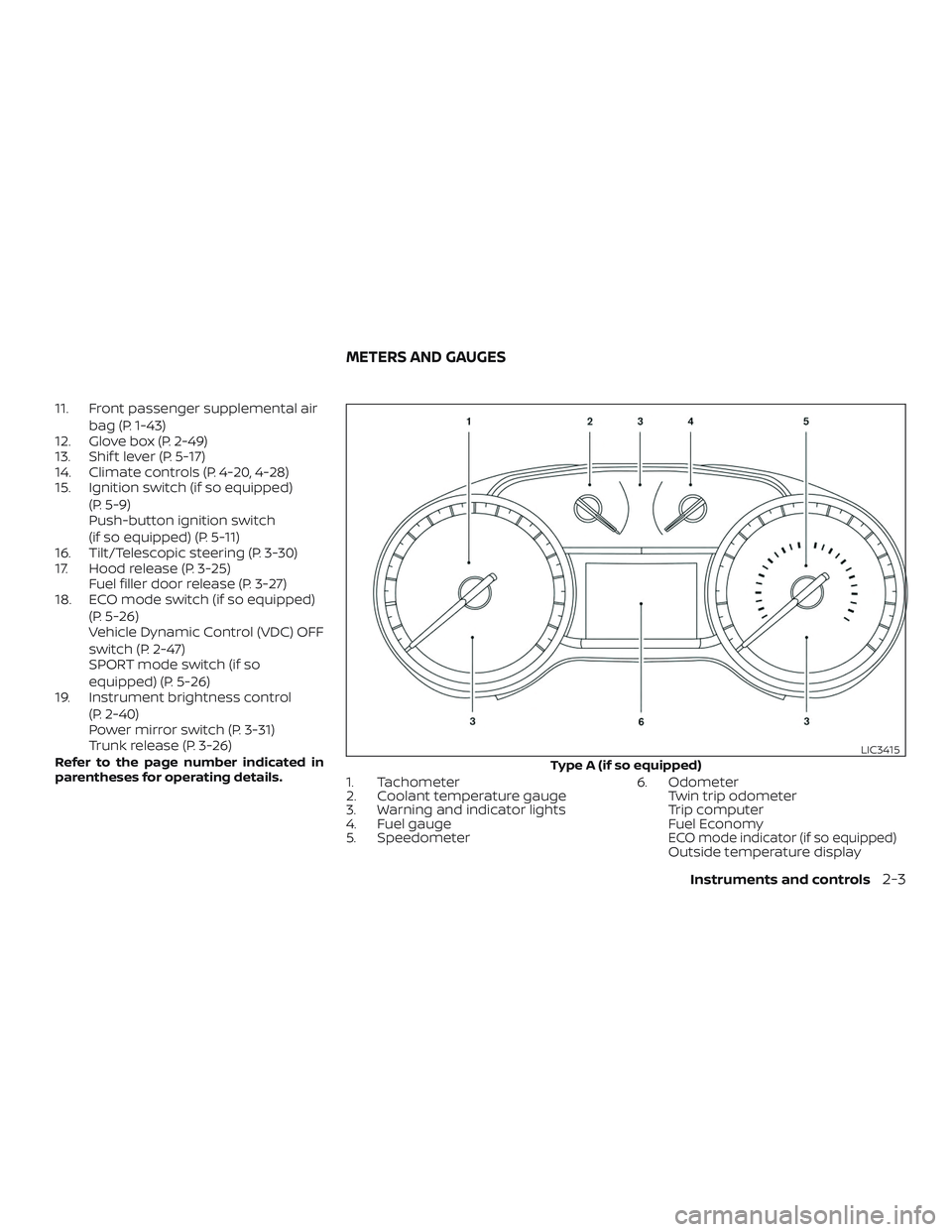
1. Tachometer
2. Coolant temperature gauge
3. Warning and indicator lights
4. Fuel gauge
5. Speedometer 6. Odometer
Twin trip odometer
Trip computer
Fuel Economy
ECO mode indicator (if so equipped)Outside temperature display
Type A (if so equipped)
LIC3415
METERS AND GAUGES
Instruments and controls2-3
Page 88 of 461

1. TachometerWarning and indicator lights
2. Vehicle information display Odometer
Twin trip odometer
Outside temperature display 3. Speedometer
Warning and indicator lights
4. Fuel gauge
5. Engine coolant temperature gauge
SPEEDOMETER AND ODOMETER
This vehicle is equipped with a speedom-
eter and odometer. The speedometer is
located on the right side the meter cluster.
The odometer is located within the vehicle
information display (TypeA—ifso
equipped) or the trip computer (Type B —
if so equipped) to the lef t of the speedom-
eter.
Type B (if so equipped)
LIC3416
2-4Instruments and controls
Page 97 of 461
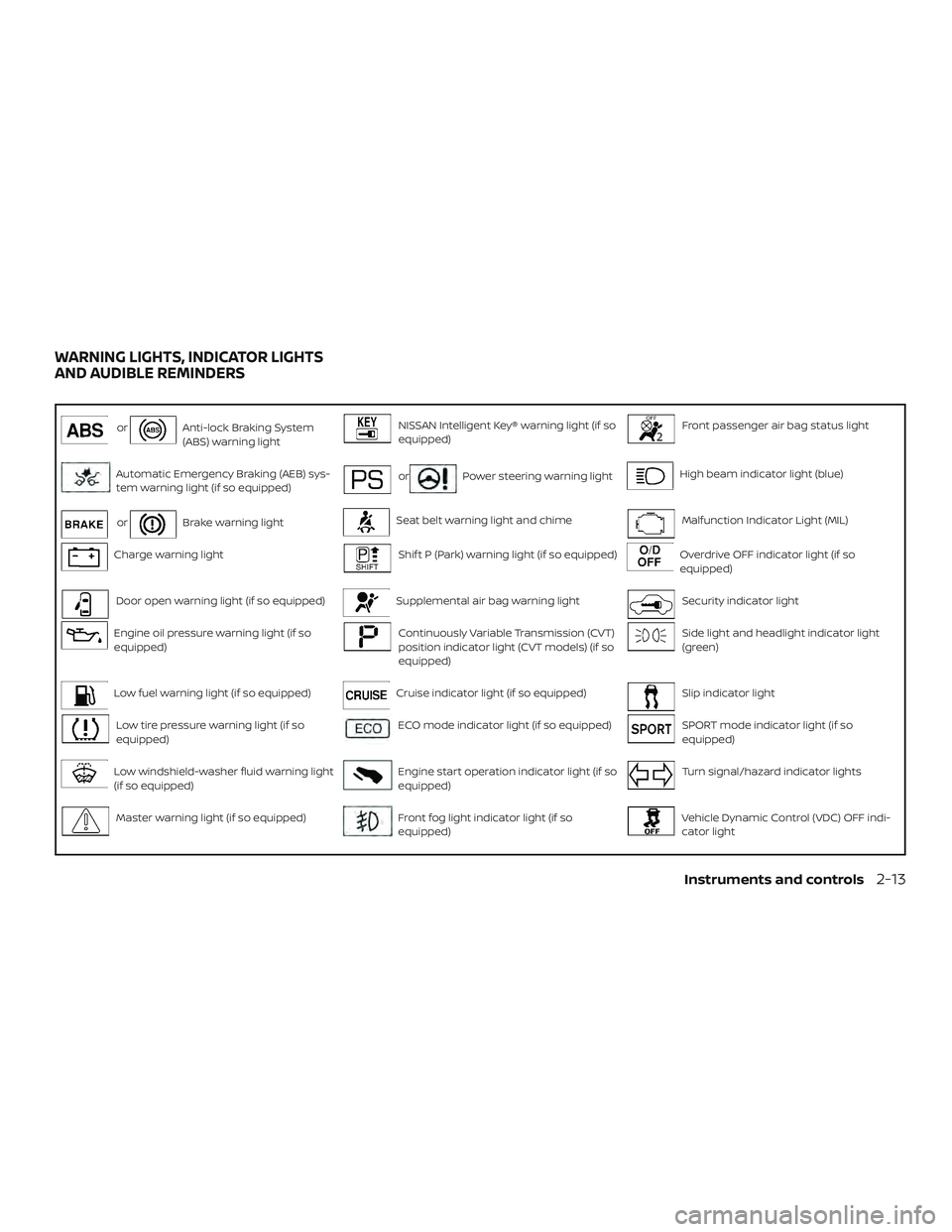
orAnti-lock Braking System
(ABS) warning lightNISSAN Intelligent Key® warning light (if so
equipped)Front passenger air bag status light
Automatic Emergency Braking (AEB) sys-
tem warning light (if so equipped)orPower steering warning lightHigh beam indicator light (blue)
orBrake warning lightSeat belt warning light and chimeMalfunction Indicator Light (MIL)
Charge warning lightShif t P (Park) warning light (if so equipped)Overdrive OFF indicator light (if so
equipped)
Door open warning light (if so equipped)Supplemental air bag warning lightSecurity indicator light
Engine oil pressure warning light (if so
equipped)Continuously Variable Transmission (CVT)
position indicator light (CVT models) (if so
equipped)Side light and headlight indicator light
(green)
Low fuel warning light (if so equipped)Cruise indicator light (if so equipped)Slip indicator light
Low tire pressure warning light (if so
equipped)ECO mode indicator light (if so equipped)SPORT mode indicator light (if so
equipped)
Low windshield-washer fluid warning light
(if so equipped)Engine start operation indicator light (if so
equipped)Turn signal/hazard indicator lights
Master warning light (if so equipped)Front fog light indicator light (if so
equipped)Vehicle Dynamic Control (VDC) OFF indi-
cator light
WARNING LIGHTS, INDICATOR LIGHTS
AND AUDIBLE REMINDERS
Instruments and controls2-13
Page 98 of 461
CHECKING LIGHTS
With all doors closed, apply the parking
brake, fasten the seat belts and place the
ignition switch in the ON position without
starting the engine. The following lights (if
so equipped) will come on:
,or,,or
The following lights (if so equipped) will
come on briefly and then go off:
or,,,,,
SPORT ,
If any light does not come on or operate in
a way other than described, it may indicate
a burned-out bulb and/or a system mal-
function. Have the system checked. It is
recommended that you visit a NISSAN
dealer for this service.
Some indicators and warnings are also dis-
played on the vehicle information display
between the speedometer and tachom-
eter. For additional information, refer to “Ve-
hicle information display” in this section.
WARNING LIGHTS
For additional information on warnings
and indicators, refer to “Vehicle information
display” in this section.
orAnti-lock Braking
System (ABS)
warning light
When the ignition switch is placed in the ON
position, the ABS warning light illuminates
and then turns off. This indicates the ABS is
operational.
If the ABS warning light illuminates while
the engine is running or while driving, it
may indicate the ABS is not functioning
properly. Have the system checked. It is
recommended that you visit a NISSAN
dealer for this service.
If an ABS malfunction occurs, the anti-lock
function is turned off. The brake system
then operates normally but without anti-
lock assistance. For additional information,
refer to “Brake system” in the “Starting and
driving” section of this manual.
Automatic EmergencyBraking (AEB) system
warning light (if so
equipped)
This light comes on when the ignition
switch is placed in the ON position. It turns
off af ter the engine is started.
This light illuminates when the AEB system
is set to OFF on the vehicle information
display.
If the light illuminates when the AEB sys-
tem is on, it may indicate that the system is
unavailable. For additional information, re-
fer to “Automatic Emergency Braking (AEB)”
in the “Starting and driving” section of this
manual.
orBrake warning
light
This light functions for both the parking
brake and the foot brake systems.
Parking brake indicator
When the ignition switch is placed in the ON
position, the light comes on when the park-
ing brake is applied.
2-14Instruments and controls
Page 104 of 461
∙ The supplemental air bag warning lightflashes intermittently.
∙ The supplemental air bag warning light does not come on at all.
It is recommended that you visit a NISSAN
dealer for these services. Unless checked
and repaired, the supplemental restraint
system (air bag system) and/or the preten-
sioners may not function properly. For ad-
ditional information, refer to “Supplemental
restraint system (SRS)” in the “Safety—
Seats, seat belts and supplemental re-
straint system” section of this manual.
WARNING
If the supplemental air bag warning
light is on, it could mean that the front
air bag, side air bag, curtain air bag sys-
tems and/or pretensioner systems will
not operate in an accident. To help
avoid injury to yourself or others, have
your vehicle checked as soon as pos-
sible. It is recommended that you visit a
NISSAN dealer for this service.
INDICATOR LIGHTS
For additional information, refer to “Vehicle
information display” in this section.
Continuously Variable Transmission (CVT)
position indicator light
(CVT models) (if so
equipped)
When the ignition switch is placed in the ON
position, this indicator light shows the shif t
lever position. For additional information,
refer to “Driving the vehicle” in the “Starting
and driving” section of this manual.
Cruise indicator light (if soequipped)
The light comes on when the cruise control
ON/OFF switch is pushed. The light goes
out when the ON/OFF switch is pushed
again. When the cruise indicator light
comes on, the cruise control system is op-
erational. For additional information, refer
to “Cruise control” in the “Starting and driv-
ing” section of this manual.
ECO mode indicator light (if so equipped)
This light comes on when the ECO mode
has been selected. For additional informa-
tion, refer to “ECO mode switch” in the
“Starting and driving” section of this
manual.
Engine start operationindicator light (if so
equipped)
For vehicles equipped with push-button ig-
nition this indicator illuminates when the
ignition switch is in the LOCK, OFF, ACC or
ON position with the shif t lever in the P
(Park) position.
Continuously Variable Transmission
(CVT) models: This indicator means that
the engine will start by pushing the push-
button ignition switch with the brake pedal
depressed.
Manual transmission models: This indi-
cator means that the engine will start by
pushing the ignition switch with the clutch
and the brake pedal depressed
2-20Instruments and controls
Page 105 of 461
Front fog light indicatorlight (if so equipped)
The front fog light indicator light illumi-
nates when the front fog lights are on. For
additional information, refer to “Fog light
switch” in this section.
Front passenger air bagstatus light
The front passenger air bag status light will
be lit and the passenger front air bag will be
off depending on how the front passenger
seat is being used.
For additional information, refer to “Front
passenger air bag and status light” in the
“Safety — Seats, seat belts and supplemen-
tal restraint system” section of this manual.
High beam indicator light(blue)
This blue light comes on when the head-
light high beams are on and goes out when
the low beams are selected.
The high beam indicator light also comes
on when the passing signal is activated.
Malfunction Indicator Light(MIL)
If this indicator light comes on steady or
blinks while the engine is running, it may
indicate a potential emission control mal-
function.
The MIL may also come on steady if the
fuel-filler cap is loose or missing, or if the
vehicle runs out of fuel. Check to make sure
the fuel-filler cap is installed and closed
tightly, and that the vehicle has at least
3 gallons (11.4 liters) of fuel in the fuel tank.
Af ter a few driving trips, the
light
should turn off if no other potential emis-
sion control system malfunction exists.
If this indicator light comes on steady for
20 seconds and then blinks for 10 seconds
when the engine is not running, it indicates
that the vehicle is not ready for an emission
control system inspection/maintenance
test. For additional information, refer to
“Readiness for Inspection/Maintenance
(I/M) test” in the “Technical and consumer
information” section of this manual. Operation
The MIL will come on in one of two ways:
∙ MIL on steady — An emission control system malfunction has been de-
tected. Check the fuel-filler cap if the
Loose Fuel Cap warning appears in the
vehicle information display. If the fuel-
filler cap is loose or missing, tighten or
install the cap and continue to drive the
vehicle. The
light should turn off
af ter a few driving trips. If the
lightdoes not turn off af ter a few driving trips,
have the vehicle inspected. It is recom-
mended that you visit a NISSAN dealer for
this service. You do not need to have your
vehicle towed to the dealer.
∙MIL blinking — An engine misfire has been
detected which may damage the emis-
sion control system. To reduce or avoid
emission control system damage:
– do not drive at speeds above 45 mph (72 km/h).
– avoid hard acceleration or decelera- tion.
– avoid steep uphill grades.
– if possible, reduce the amount of cargo being hauled or towed.
Instruments and controls2-21