2019 NISSAN PATHFINDER SV engine
[x] Cancel search: enginePage 390 of 476
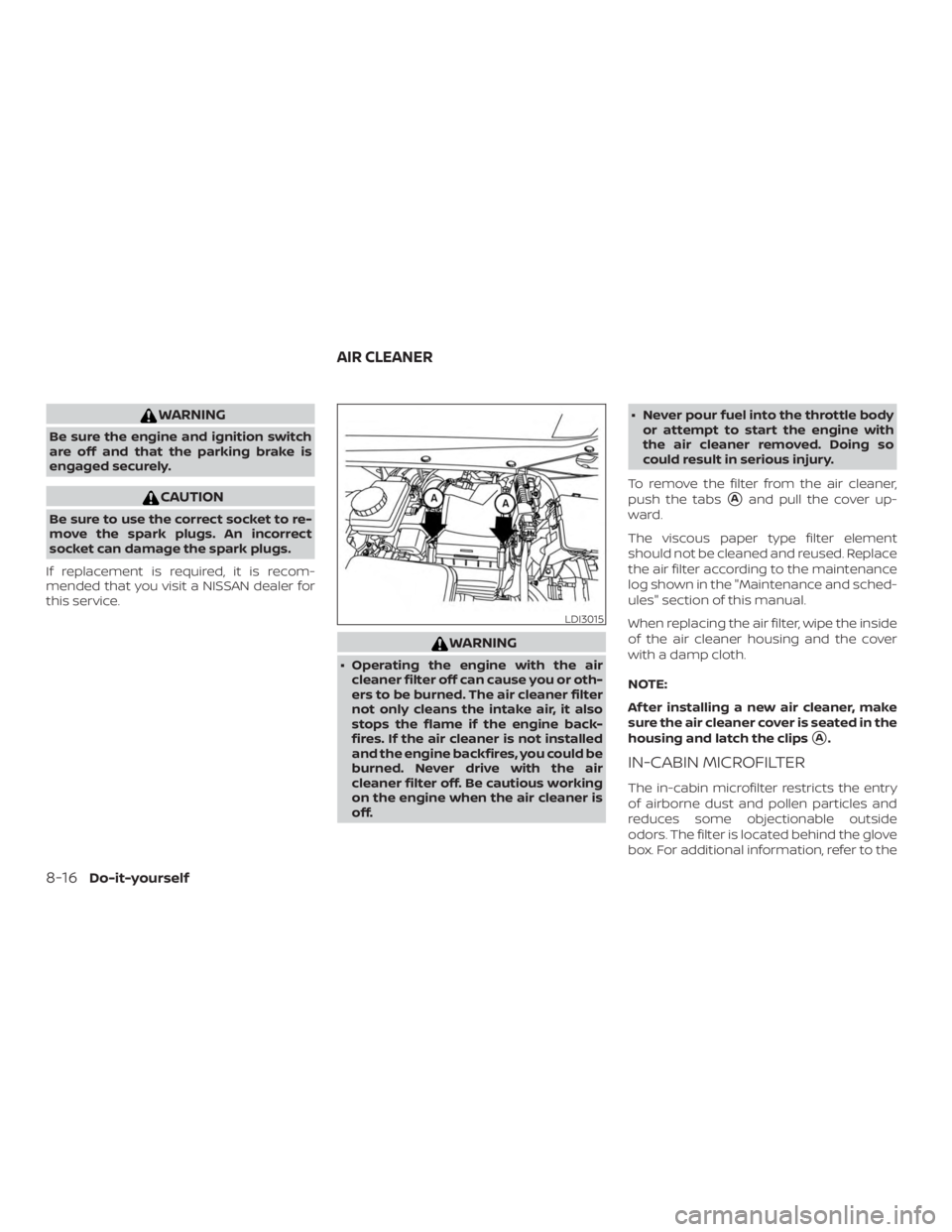
WARNING
Be sure the engine and ignition switch
are off and that the parking brake is
engaged securely.
Page 394 of 476
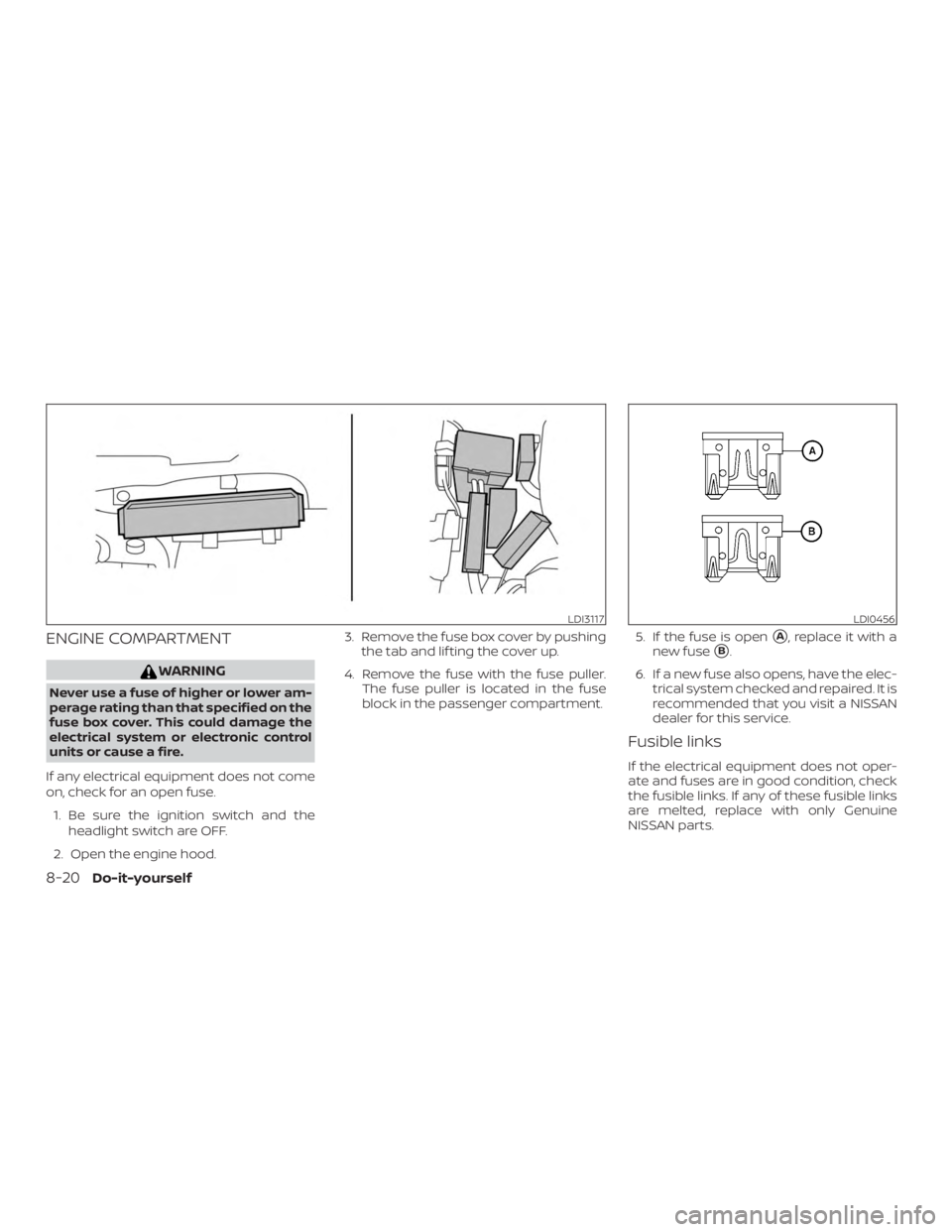
ENGINE COMPARTMENT
Page 438 of 476
Change intervals
The oil and oil filter change intervals for
your engine are based on the use of the
specified quality oils and filters. Using en-
gine oil and filters that are not of the speci-
fied quality, or exceeding recommended oil
and filter change intervals could reduce
engine life. Damage to the engine caused
by improper maintenance or use of incor-
rect oil and filter quality and/or viscosity is
not covered by the NISSAN New Vehicle
Limited Warranty.
Your engine was filled with a high-quality
engine oil when it was built. You do not have
to change the oil before the first recom-
mended change interval. Oil and filter
change intervals depend upon how you
use your vehicle.
Operation under the following conditions
may require more frequent oil and filter
changes:∙ repeated short distance driving at cold outside temperatures
∙ driving in dusty conditions
∙ extensive idling
∙ towing a trailer
∙ stop and go commuting For additional information, refer to the
“Maintenance and schedules” section of
this manual.
AIR CONDITIONER SYSTEM
REFRIGERANT AND OIL
RECOMMENDATIONS
The air conditioner system in your
NISSAN vehicle must be charged with the
refrigerant HFC-134a (R-134a) and the oil,
NISSAN A/C system oil Type DH-PS or the
exact equivalents.
Page 449 of 476
Temperature conditions can also affect
towing. For example, towing a heavy trailer
in high outside temperatures on graded
roads can affect engine performance and
cause overheating. The engine protection
mode, which helps reduce the chance of
engine damage, could activate and auto-
matically decrease engine power. Vehicle
speed may decrease under high load. Plan
your trip carefully to account for trailer and
vehicle load, weather and road conditions.
Page 460 of 476

∙ NISSAN recommends that the cruisecontrol not be used while towing a
trailer.
∙ Some states or provinces have specific regulations and speed limits for ve-
hicles that are towing trailers. Obey the
local speed limits.
∙ Check your hitch, trailer wiring harness connections, and trailer wheel lug nuts
af ter 50 miles (80 km) of travel and at
every break.
∙ When launching a boat, don’t allow the water level to go over the exhaust tail
pipe or rear bumper.
∙ Make sure you disconnect the trailer lights before backing the trailer into the
water or the trailer lights may burn out.
When towing a trailer, final drive gear oil
should be replaced and transmission
oil/fluid should be changed more fre-
quently. For additional information, refer
to the “Do-it-yourself ” section in this
manual.
Tow mode
Using tow mode is recommended when
pulling a heavy trailer or hauling a heavy
load. Press the TOW MODE switch to acti- vate tow mode. The indicator light on the
TOW MODE switch illuminates when tow
mode is selected. Press the TOW MODE
switch again to turn tow mode off. Tow
mode is automatically canceled when the
ignition switch is turned off.
Tow mode includes the following features:
∙ Grade logic — Adjusts transmission shif ts when pulling a trailer or hauling a
load up a grade.
∙ Downhill Speed Control (DSC) — auto- matically downshif ts when driving
down a grade with a trailer or heavy
load to help control vehicle speed.
Driving the vehicle in the tow mode with no
trailer/load or light trailer/light load will not
cause any damage. However, fuel
economy may be reduced and the
transmission/engine driving characteris-
tics may feel unusual.
When towing a trailer, final drive gear oil
should be replaced and transmission
oil/fluid should be changed more fre-
quently. For additional information, refer
to the “Do-it-yourself ” section of this
manual.
FLAT TOWING FOR 4–WHEEL DRIVE
VEHICLE (if so equipped)
Towing your vehicle with all four wheels on
the ground is sometimes called flat towing.
This method is sometimes used when
towing a vehicle behind a recreational ve-
hicle, such as a motor home.
Page 464 of 476

WARNING
A vehicle equipped with Four-Wheel
Drive (4WD) should never be tested us-
ing a two wheel dynamometer (such as
the dynamometers used by some
states for emissions testing), or similar
equipment. Make sure you inform the
test facility personnel that your vehicle
is equipped with 4WD before it is placed
on a dynamometer. Using the wrong
test equipment may result in transmis-
sion damage or unexpected vehicle
movement which could result in serious
vehicle damage or personal injury.
Due to legal requirements in some states
and Canadian Provinces, your vehicle may
be required to be in what is called the
“ready condition” for an
Inspection/Maintenance (I/M) test of the
emission control system.
The vehicle is set to the “ready condition”
when it is driven through certain driving
patterns. Usually, the ready condition can
be obtained by ordinary usage of the ve-
hicle. If a powertrain system component is re-
paired or the battery is disconnected, the
vehicle may be reset to a “not ready” condi-
tion. Before taking the I/M test, check the
vehicle’s inspection/maintenance test
readiness condition. Place the ignition
switch in the ON position without starting
the engine. If the Malfunction Indicator
Light (MIL) comes on steady for 20 seconds
and then blinks for 10 seconds, the I/M test
condition is “not ready”. If the MIL does not
blink af ter 20 seconds, the I/M test condi-
tion is “ready”. It is recommended that you
visit a NISSAN dealer to set the “ready con-
dition” or to prepare the vehicle for testing.
This vehicle is equipped with an Event Data
Recorder (EDR). The main purpose of an
EDR is to record, in certain crash or near
crash-like situations, such as an air bag
deployment or hitting a road obstacle, data
that will assist in understanding how a ve-
hicle’s systems performed. The EDR is de-
signed to record data related to vehicle dy-
namics and safety systems for a short
period of time, typically 30 seconds or less.
The EDR in this vehicle is designed to re-
cord such data as:
∙ How various systems in your vehicle were operating;
∙ Whether or not the driver and passen- ger safety belts were buckled/fastened;
∙ How far (if at all) the driver was depress- ing the accelerator and/or brake pedal;
and,
∙ How fast the vehicle was traveling.
∙ Sounds are not recorded.
READINESS FOR INSPECTION/
MAINTENANCE (I/M) TEST EVENT DATA RECORDERS (EDR)
10-34Technical and consumer information
Page 468 of 476

Compass.....................2-8
Console box ..................2-59
Console light ..................2-72
Continuously Variable Transmission
(CVT) .......................5-16
Continuously Variable Transmission
(CVT) fluid ..................8-10
Driving with Continuously Variable
Transmission (CVT) ............5-16
Controls Heater and air conditioner controls . .4-33
Coolant Capacities and recommended
fuel/lubricants...............10-2
Changing engine coolant .........8-5
Checking engine coolant level ......8-5
Engine coolant temperature gauge . .2-6
Corrosionprotection..............7-7
Cruisecontrol ..............5-41,5-41
Cupholders ..................2-60
D
Daytime Running Light System .......2-41
Defroster switch Rear window and outside mirror
defrosterswitch..............2-38
Dimensions and weights ..........10-10
Dimmer switch for instrument panel . . .2-42
Door locks ....................3-5
Drivebelt ....................8-15
Drive positioner, Automatic ......3-48,3-51
Driving Coldweatherdriving...........5-80 Driving with Continuously Variable
Transmission (CVT)
............5-16
Precautions when starting and
driving.....................5-2
Drivingthevehicle...............5-16
Dual panel moonroof .............2-68
Dual power moonroof ............2-68
E
E-CALL (SOS) SWITCH .............2-53
Economy - fuel .................5-67
Emergency engine shutoff .......5-13,6-2
Emission control information label . . . .10-12
Emission control system warranty . . . .10-32
Engine Before starting the engine ........5-15
Capacities and recommended
fuel/lubricants...............10-2
Changing engine coolant .........8-5
Changing engine oil ............8-6
Changing engine oil filter .........8-6
Checking engine coolant level ......8-5
Checking engine oil level .........8-6
Engine compartment check
locations...................8-3
Engine coolant temperature gauge . .2-6
Engine cooling system ..........8-4
Engine oil ...................8-6
Engine oil and oil filter
recommendation .............10-7
Engine oil viscosity .............10-7
Engine serial number ..........10-12
Engine specifications ...........10-9 Starting the engine
............5-15
Engine Block Heater ..............5-81
Engine coolant temperature gauge ....2-6
EventDatarecorders............10-34
Exhaust gas (Carbon monoxide) .......5-2
Explanation of maintenance items .....9-3
Explanation of scheduled maintenance
items .......................9-5
Extended storage switch ..........2-56
Eyeglasscase.................2-60
F
Flashers
(Seehazardwarningflasherswitch)....6-2
Flattire......................6-3
Floormatpositioningaid...........7-6
Fluid Brakefluid..................8-11
Capacities and recommended
fuel/lubricants...............10-2
Continuously Variable Transmission (CVT)
fluid......................8-10
Engine coolant ...............8-4
Engine oil ...................8-6
Powersteeringfluid............8-10
Windshield-washer fluid .........8-11
F.M.V.S.S. certification label .........10-12
F
oglightswitch................2-43
Front air bag system
(See supplemental restraint system) . . .1-60
Front-door pocket ...............2-57
Front power seat adjustment ........1-5
Frontseats....................1-2
11-2
Page 469 of 476

FuelCapacities and recommended
fuel/lubricants...............10-2
Fuel economy ...............5-67
Fuel-filler door and cap ..........3-39
Fuel gauge ..................2-7
Fueloctanerating.............10-6
Fuel recommendation ..........10-4
Loose fuel cap warning .........2-30
Fuelefficientdrivingtips...........5-66
Fuel-filler door .................3-39
Fuel gauge ....................2-7
Fuses .......................8-19
Fusiblelinks...................8-20
G
Garage door opener, HomeLink® Universal
Transceiver .........2-73,2-74,2-76,2-77
Gascap.....................3-39
Gauge Engine coolant temperature gauge . .2-6
Fuel gauge ..................2-7
Odometer ..................2-5
Speedometer ..............2-4,2-5
Tachometer .................2-6
Trip odometer .............2-4,2-5
General maintenance .............9-3
Glovebox....................2-59
Gloveboxlock.................2-59
H
Hazard warning flasher switch ........6-2Headlight and turn signal switch
......2-39
Headlightcontrolswitch...........2-39
Headlights ...................8-24
Headrestraints.................1-12
Heated 2nd row seat switches .......2-46
Heatedseats..................2-44
Heated seat switches ............2-45
Heated steering wheel switch ....2-47,2-48
Heater Heater and air conditioner controls . .4-33
Heater operation .............4-34
Hill descent control switch .........2-49
Hill descent control system .........5-78
Hill start assist system ............5-78
HomeLink® Universal
Transceiver .........2 -73, 2-74, 2-76, 2-77
Hood .......................3-32
Hook Luggage hook ...............2-63
Horn.......................2-43
I
Ignition switch Push-button ignition switch .......5-11
Immobilizer system ...........2-34,5-14
Important vehicle information label . . .10-12
In-cabinmicrofilter..............8-16
Increasing fuel economy ...........5-67
Indicator lights and audible reminders
(See warning/indicator lights and audible
reminders) .................2 -11, 2-16
Inside automatic anti-glare mirror .....3-46
Instrument brightness control .......2-42
Instrument panel .............0-6,2-2 Instrument panel dimmer switch
.....2-42
Intelligent 4x4 (I-4x4) .............5-67
Intelligent Around View Monitor .......4-11
Intelligent Cruise Control (ICC) .......5-43
Intelligent Key system Key operating range .........3-9,3-22
Key operation ................3-11
Mechanical key ...............3-3
Remote keyless entry
operation ...............
3-14,3-22
Troubleshooting guide .......3-18,3-27
Warning signals ...........3-18,3-27
Interiorlight...................2-71
ISOFIX child restraints .............1-32
J
Jumpstarting..............6-10, 8-14
K
Key........................ .3-2
Key fob battery replacement ........8-22
Keyless entry With Intelligent Key system
(See Intelligent Key system) ....3-14,3-22
Keys NISSAN Intelligent Key® .......3-2,3-21
NISSAN Vehicle Immobilizer System
keys......................3-4
11-3