2019 NISSAN PATHFINDER park assist
[x] Cancel search: park assistPage 347 of 476
The hill start assist system automatically
keeps the brakes applied to help prevent
the vehicle from rolling backward in the
time it takes the driver to release the brake
pedal and apply the accelerator when the
vehicle is stopped on a hill.
Hill start assist will operate automatically
under the following conditions:∙ The shif t lever is moved to a forward or reverse gear.
∙ The vehicle is stopped completely on a hill by applying the brake.
The maximum holding time is 2 seconds.
Af ter 2 seconds the vehicle will begin to roll
back and hill start assist will stop operating
completely.
Hill start assist will not operate when the
shif t lever is moved to N (Neutral) or P (Park)
or on a flat and level road.
WARNING
∙ Always turn and look back before backing up. The RSS is not a substi-
tute for proper backing procedures.
∙ Read and understand the limitations of the RSS as contained in this section.
Inclement weather may affect the
function of the RSS; this may include
reduced performance or a false
activation.
∙ This system is not designed to pre- vent contact with small or moving
objects. ∙ The system is designed as an aid to
the driver in detecting large station-
ary objects to help avoid damaging
the vehicle. The system will not detect
small objects below the bumper, and
may not detect objects close to the
bumper or on the ground.
∙ If your vehicle sustains damage to the rear bumper fascia, leaving it mis-
aligned or bent, the sensing zone may
be altered causing inaccurate mea-
surement of obstacles or false alarms.
The RSS sounds a tone to warn the driver of
obstacles near the rear bumper when the
shif t lever is in R (Reverse). The system may
not detect objects at speeds above 3 mph
(5 km/h) and may not detect certain angu-
lar or moving objects.
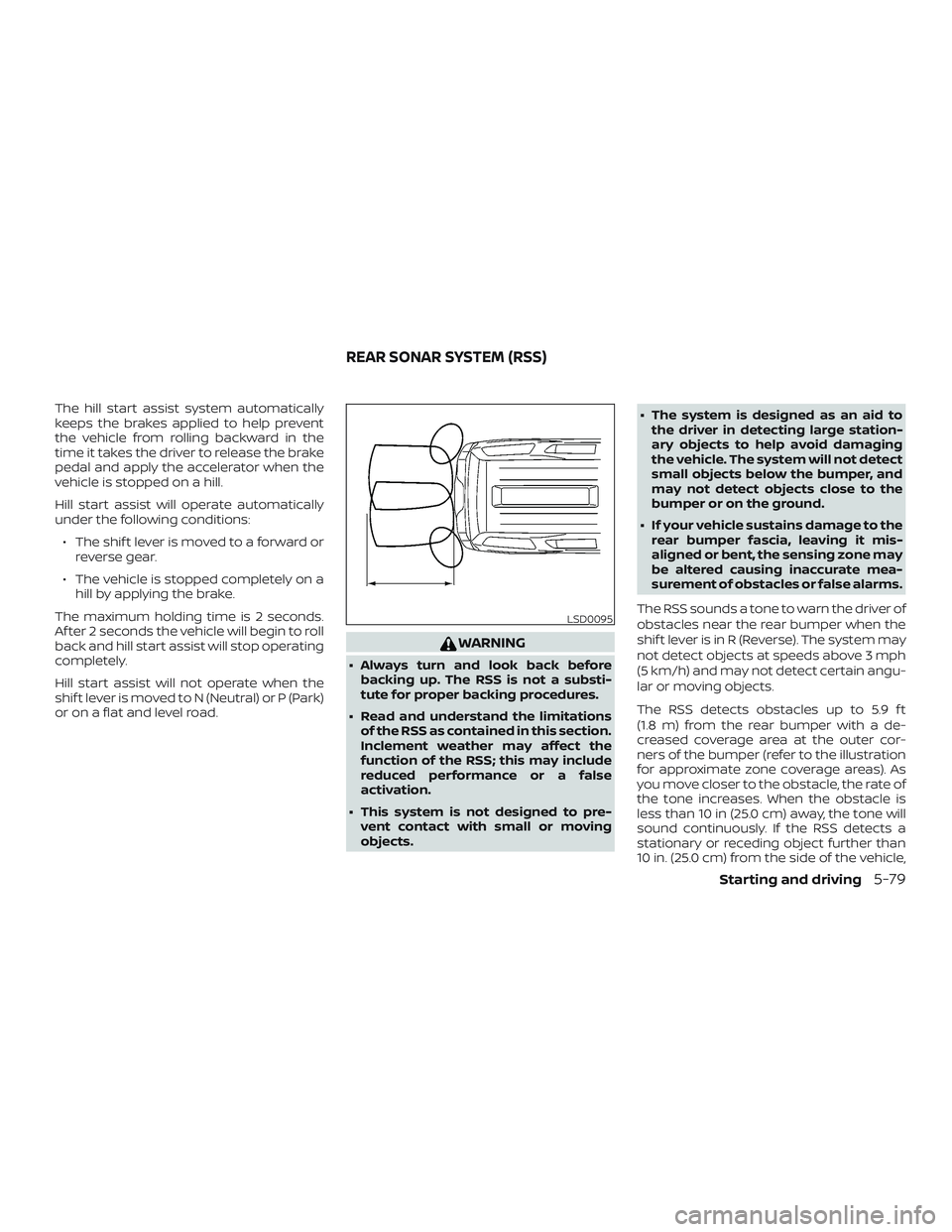
The RSS detects obstacles up to 5.9 f t
(1.8 m) from the rear bumper with a de-
creased coverage area at the outer cor-
ners of the bumper (refer to the illustration
for approximate zone coverage areas). As
you move closer to the obstacle, the rate of
the tone increases. When the obstacle is
less than 10 in (25.0 cm) away, the tone will
sound continuously. If the RSS detects a
stationary or receding object further than
10 in. (25.0 cm) from the side of the vehicle,
LSD0095
REAR SONAR SYSTEM (RSS)
Starting and driving5-79
Page 354 of 476
CHANGING A FLAT TIRE
If you have a flat tire, follow the instructions
below:
Stopping the vehicle
1. Safely move the vehicle off the road andaway from traffic.
2. Turn on the hazard warning flashers.
3. Park on a level surface and apply the parking brake. Move the shif t lever to P
(Park).
4. Turn off the engine.
5. Raise the hood to warn other traffic and to signal professional road assis-
tance personnel that you need assis-
tance.
6. Have all passengers get out of the ve- hicle and stand in a safe place, away
from traffic and clear of the vehicle.
WARNING
∙ Make sure the parking brake is se-curely applied and the Continuously
Variable Transmission (CVT) is shif ted
into P (Park).
∙ Never change tires when the vehicle is on a slope, ice or slippery areas. This is
hazardous.
∙ Never change tires if oncoming traffic is close to your vehicle. Wait for pro-
fessional road assistance.
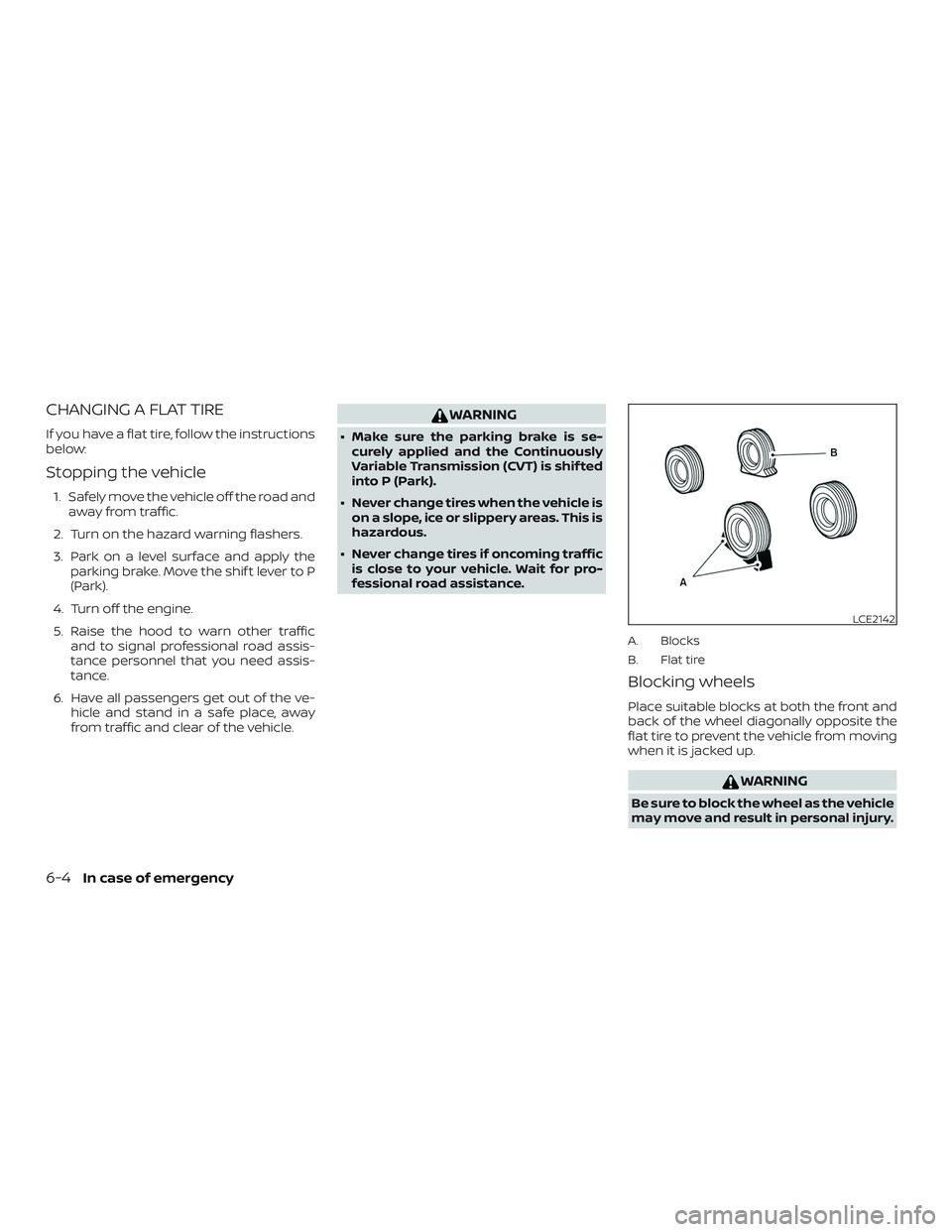
A. Blocks
B. Flat tire
Blocking wheels
Place suitable blocks at both the front and
back of the wheel diagonally opposite the
flat tire to prevent the vehicle from moving
when it is jacked up.
WARNING
Be sure to block the wheel as the vehicle
may move and result in personal injury.
LCE2142
6-4In case of emergency
Page 368 of 476
In order to maintain the appearance of
your vehicle, it is important to take proper
care of it.
To protect the paint surfaces, wash your
vehicle as soon as you can:∙ Af ter a rainfall to prevent possible dam- age from acid rain.
∙ Af ter driving on coastal roads.
∙ When contaminants such as soot, bird droppings, tree sap, metal particles or
bugs get on the paint surface.
∙ When dust or mud builds up on the sur- face.
Whenever possible, store or park your ve-
hicle inside a garage or in a covered area.
When it is necessary to park outside, park in
a shady area or protect the vehicle with a
body cover.
Be careful not to scratch the paint sur-
face when putting on or removing the
body cover.WASHING
Wash dirt off with a wet sponge and plenty
of water. Clean the vehicle thoroughly us-
ing a mild soap, a special vehicle soap or
general purpose dishwashing liquid mixed
with clean, lukewarm (never hot) water.
CAUTION
∙ Do not use car washes that use acid in the detergent. Some car washes, es-
pecially brushless ones, use some
acid for cleaning. The acid may react
with some plastic vehicle compo-
nents, causing them to crack. This
could affect their appearance, and
also could cause them not to function
properly. Always check with your car
wash to confirm that acid is not used.
∙ Do not wash the vehicle with strong household soap, strong chemical de-
tergents, gasoline or solvents.
∙ Do not wash the vehicle in direct sun- light or while the vehicle body is hot,
as the surface may become
water-spotted. ∙ Avoid using tight-napped or rough
cloths, such as washing mitts. Care
must be taken when removing
caked-on dirt or other foreign sub-
stances so the paint surface is not
scratched or damaged.
Rinse the vehicle thoroughly with plenty of
clean water.
Inside edges, seams and folds on the
doors, hatches and hood are particularly
vulnerable to the effects of road salt. There-
fore, these areas must be cleaned regularly.
Take care that the drain holes in the lower
edge of the door are open. Spray water
under the body and in the wheel wells to
loosen the dirt and wash away road salt.
A damp chamois can be used to dry the
vehicle to avoid water spots.
WAXING
Regular waxing protects the paint surface
and helps retain new vehicle appearance.
Polishing is recommended to remove
built-up wax residue and to avoid a weath-
ered appearance before re-applying wax.
A NISSAN dealer can assist you in choosing
the proper product.
CLEANING EXTERIOR
7-2Appearance and care
Page 467 of 476

11 Index
2nd row bench seat adjustment......1-9
A
Air bag (See supplemental restraint
system) .................... .1-53
Air bag system Front (See supplemental front impact air
bagsystem)............... .1-60
Air bag warning labels ............1-71
Airbagwarninglight..........1-72, 2-16
Air bag warning light,
supplemental ..............1-72, 2-16
Air cleaner ...................8-16
Air cleaner housing filter ..........8-16
Air conditioner Air conditioner operation ........4-33
Air conditioner specification label . .10-13
Air conditioner system refrigerant and oil
recommendations ............10-8
Heater and air conditioner
controls...................4-33
Servicing air conditioner ........4-40
Alarm system
(See vehicle security system) .......2-33
Anchor point locations ...........1-35
Antenna ....................4-41
Antifreeze ...................5-80
Anti-lock brake warning light ........2-12
Anti-lock Braking System (ABS) ......5-73
Armrests................... .1-10
Audible reminders ..............2-19 Autolightswitch ...............2-40
Automatic
Automatic drive positioner ....3-48,3-51
Automatic power window switch . . .2-66
Automatic anti-glare inside mirror ....3-46
Automatic door locks .............3-7
Automatic drive positioner ......3-48, 3-51
Automatic Emergency Braking
(AEB) ...................2-12,5-58
B
Battery..................5-80,8-13 Charge warning light ...........2-13
Battery replacement ............8-22
Keyfob...................8-22
NISSAN Intelligent Key® .........8-22
Before starting the engine .........5-15
Belt(Seedrivebelt)..............8-15
Blind Spot Warning (BSW) ..........5-22
Booster seats .................1-49
Brake Anti-lock Braking System (ABS) ....5-73
Brakefluid .................8-11
Brakelight(Seestoplight).......8-25
Brakesystem...............5-73
Brakewarninglight............2-12
Brakewearindicators.......2-19,8-19
Parking brake operation .........5-21
Self-adjustingbrakes ..........8-19
Brake Assist ..................5-74
Brakefluid ...................8-11 Brakes......................8-19
Brakesystem................
.5-73
Break-in schedule ..............5-65
Brightness control Instrument panel .............2-42
Bulb check/instrument panel .......2-11
Bulb replacement ..............8-25
C
Capacities and recommended fuel/
lubricants....................10-2
Cargoareastoragebin...........2-62
C
argolight...................2-73
Cargo
(See vehicle loading information) . . . .10-14
Car phone or CB radio ............4-41
Check tire pressure .............2-30
Childrestraints.......1-27, 1-28, 1-30, 1-32 LATCH (Lower Anchors and Tethers for
CHildren)System.............1-32
Precautions on child
restraints.........1-30, 1-37, 1-43, 1-49
Top tether strap anchor point
locations................. .1-35
Child restraint with top tether strap . . .1-34
Child safety rear door lock ..........3-7
Chimes, audible reminders .........2-19
Cleaningexteriorandinterior .....7-2,7-4
Climate-controlled seat switches .....2-44
C.M.V.S.S. certification label .........10-12
Coldweatherdriving ............5-80